본문으로 바로가기
Ess-neofab

A line- and system-level record of ESS and secondary-battery manufacturing processes

  • 한국어
  • English
  • Home
  • Process
  • System
  • Interface
  • Traceability
  • News & Trends
  • About
  • Contact
  • 한국어
  • English
  • Home
  • Process
  • System
  • Interface
  • Traceability
  • News & Trends
  • About
  • Contact

카테고리

  • Interface (28)
  • News & Trends (20)
  • Process (32)
  • System (31)
  • Traceability (22)

최근 글

  • Five million ACC cells equal 2.7 to 3.6 months of nameplate outputOctober 15, 2026
  • A 160 MW battery’s six-week commissioning has two baselinesOctober 8, 2026
  • Two Cycles a Day Take 106.8 % of a Day, and the Retention Tier Shifts Cell Volume by 1.47 GWhOctober 1, 2026
  • Battwoo’s Second-Life EV Batteries — When an 80 % Acceptance Threshold Overlaps the Retirement Distribution, Incoming Screening Becomes the BottleneckSeptember 30, 2026
  • US storage set an energy record in Q2 as installed power fell 7%September 29, 2026
  • CATL Starts Trial Production in Debrecen — The Digits of the Defect-Rate Target, Not the Equipment, Set the Length of a Trial RunSeptember 29, 2026
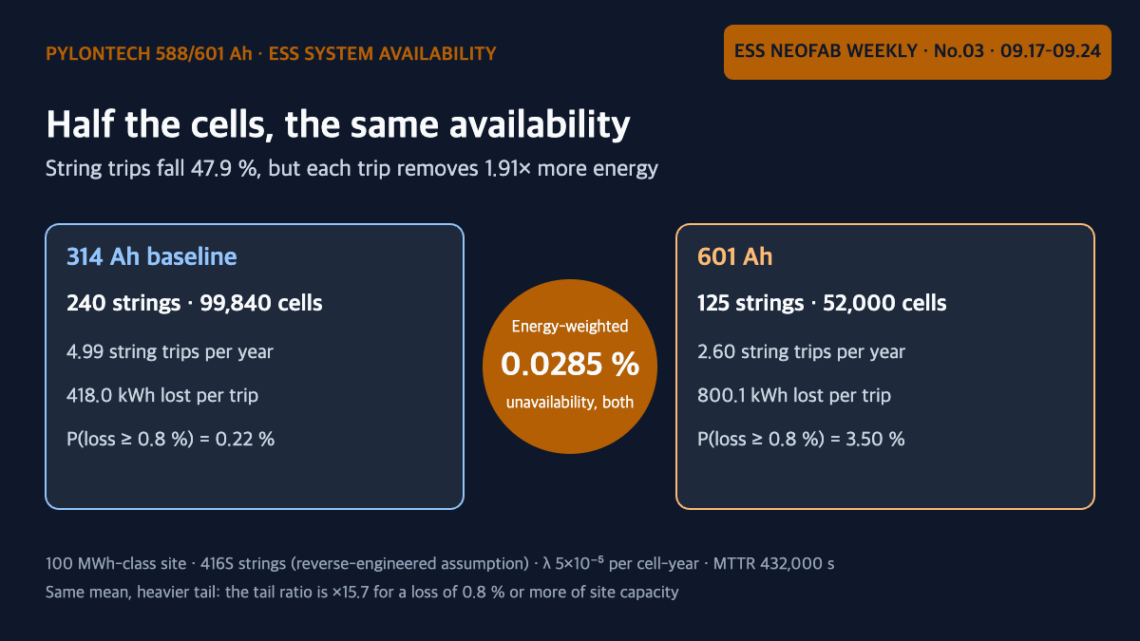
  • 대형 LFP 셀 314 Ah와 601 Ah의 100 MWh급 ESS 스트링 정지 건수와 에너지 가중 비가용률 비교 도식
    Interface,  System

    Pylontech’s 588 Ah and 601 Ah LFP Cells Enter Mass Production — Why Energy-Weighted Availability Stays the Same When the Cell Count Halves

    September 28, 2026 /

    On September 21, 2026, Pylontech began mass production of 588 Ah and 601 Ah prismatic LFP ESS cells at its Hefei base and named "fewer cells and interconnections" as a benefit of the larger format¹. Under a reverse-engineered assumption of 416S strings, a 100 MWh-class site drops from 99,840 cells to 52,000 cells (−47.9 %), and string trips caused by cell-count-proportional faults fall at the same rate. Each trip, however, now removes 800.1 kWh instead of 418.0 kWh (1.91×), so the energy-weighted unavailability stays at 0.0285 % regardless of cell capacity. The mean is unchanged and only the tail gets heavier: the probability of losing 0.8 % or more of…
    read more
    ESS-neofab 0 Comments

    You May Also Like

    Hero graphic showing five million cells equal 2.7 to 3.6 months of a 12-month nameplate year bar

    Five million ACC cells equal 2.7 to 3.6 months of nameplate output

    October 15, 2026
    Isometric concept of a line with products moving between stations at equal intervals, labeled takt time, cycle time and lead time

    Don’t Subtract Breakdowns When Calculating Takt Time — Takt Time vs. Cycle Time vs. Lead Time

    September 25, 2026
    ESS 조립라인 침지냉각 병목과 병렬화 후 처리간격을 비교한 인포그래픽

    ESS Assembly Line: Why Immersion Cooling Becomes a Bottleneck

    August 20, 2026
© 2026 Ess-neofab · A line- and system-level record of ESS and secondary-battery manufacturing processes
  • About
  • Contact
  • Privacy Policy
  • Disclaimer
Ashe Theme by WP Royal.