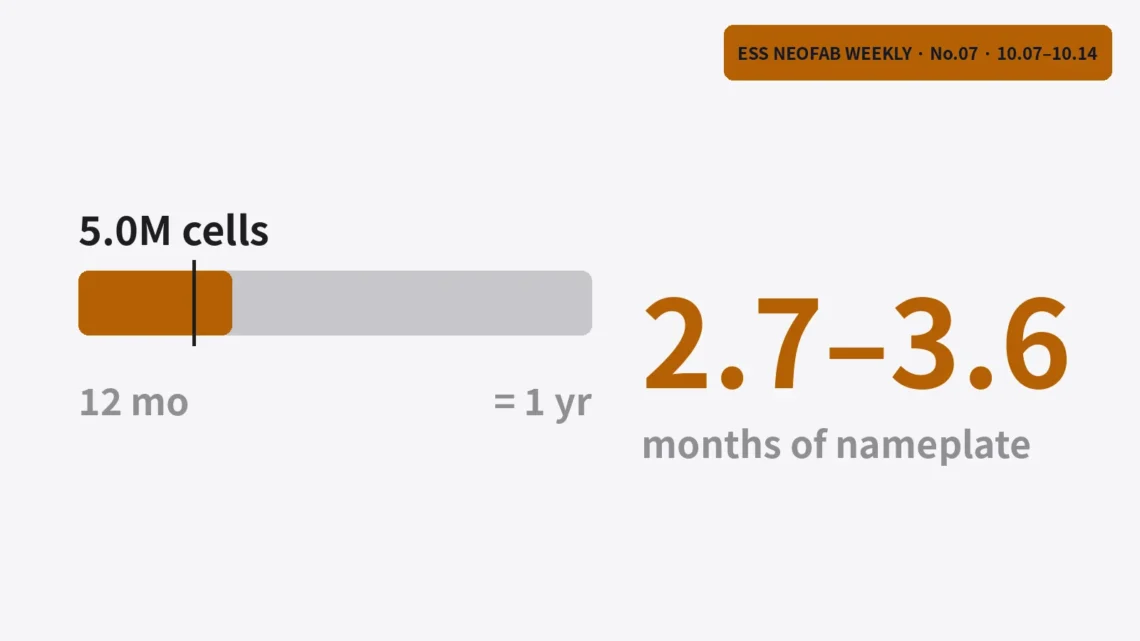
Five million ACC cells equal 2.7 to 3.6 months of nameplate output
ESS NEOFAB WEEKLY · No.07 · Process
Five million cells equal three to four months of nameplate output, and the reports never say how long it took.
Summary
ACC’s Douvrin plant in France announced a running total of five million cells on 12 October 2026. Two figures in the coverage imply about 125 cells per vehicle, and assuming the first block runs at 13 GWh a year, five million cells equal 22.5 to 29.9 % of one nameplate year, or 2.7 to 3.6 months. Reports do not say how many years the total took, so average utilization can only be given as a range: 11.2 to 14.9 % over two years, 5.6 to 7.5 % over four. Applying the 15 to 20 % scrap rate reported in November 2025 would put 0.88 to 1.25 million scrapped cells behind the five million good ones, but nothing shows that the rate still holds.
Putting five million cells next to the nameplate
ACC’s plant in Douvrin, northern France, announced five million cells at the Paris Motor Show on 12 October 2026[1]. Douvrin is a gigafactory1 still in ramp-up2. Coverage described the total as enough for nearly 40,000 vehicles. Dividing one number by the other gives about 125 cells per vehicle.
Five million sounds large. A running total, though, says nothing about speed. Piled up over one year or over four, the same five million cells look very different. I decided to set the number beside the plant’s nameplate capacity3 and count how many months it represents.
Here is the answer first. If the first block4 runs at 13 GWh5 a year, five million cells are 22.5 to 29.9 % of a nameplate year, or 2.7 to 3.6 months. The range exists because coverage never states the energy in a single cell, so the calculation uses two values. With no elapsed time on record, average utilization has no single value either.
Coverage of this plant mixes numbers from several dates. Read together, do they show a plant finding its speed, or one still far from it?
The numbers I could read, and what the reports leave blank
I read three articles from the electric-vehicle outlet electrive[1][2][3]. I could not open ACC’s press release or the original Bloomberg and Milano Finanza reports that the articles cite. Every figure in the next table has passed through electrive’s retelling.
| Item | Figure | Reported | Left unstated |
|---|---|---|---|
| Cumulative cells | 5 million | 2026-10-12 | Good cells only? Elapsed time |
| Vehicle equivalent | Nearly 40,000 | 2026-10-12 | Split by pack size |
| Second block | 12.9 GWh, 2027 start | 2026-10-12 | First block capacity |
| Site total | Just under 26 GWh after block two | 2026-10-12 | Whether it is annual |
| Scrap rate | 15 to 20 % | 2025-11 (relayed 2026-02) | Whole plant or one step |
| Cars fitted per month | About 1,000 (long-range pack) | 2026-02 (Bloomberg) | ACC’s own confirmation |
Each report switches units. In November 2025, a report gave 15,000 to 20,000 battery packs for the last four months of that year. A February 2026 report gave about 1,000 cars a month. The latest one gives five million cells in total[3]. Converting packs, cars, and cells into one another needs the number of cells per pack, and no report supplies it. Those 1,000 cars carry only long-range packs, so they do not match the pack figure either.
ACC also brought in a team of experts from China to raise output and cut defects, according to the reports[3]. Defect rates have since fallen, the coverage says, without giving a figure. Nothing in the reports lets me size the improvement.
Stellantis has pauses planned for October. Sochaux stops from the 23rd to the 30th and Rennes from the 22nd to the 30th, and the reports tie both partly to battery supply[2]. Mulhouse stops from the 15th to the 30th for reasons reported as unrelated to batteries. Counting both end days, the three pauses last 8, 9, and 16 days.
I think only the 17 days at Sochaux and Rennes can be linked to batteries, and even that is an upper bound. Adding Mulhouse’s 16 days gives 33, which nearly doubles the apparent size of the shortage. And “partly” in the reports keeps the 17 from being a clean number.
A Stellantis spokesperson said the company is still not receiving enough batteries despite big progress in ACC’s production[2]. Production rising and supply falling short share one sentence. For both to hold, demand must have grown faster than output, or output must have landed well under its target. No target appears in the reports. Without one, I chose the nameplate capacity as my baseline.
Without the elapsed time, utilization is only a range
The first block’s capacity never appears in the coverage. Block two is 12.9 GWh, and the site total after it falls just under 26 GWh, so working backward gives roughly 13 GWh for the first. That figure stands in for annual capacity. Dividing pack capacity by 125 gives one cell’s energy: a 97 kWh pack gives 0.776 kWh and a 73 kWh pack gives 0.584 kWh.
A smaller cell needs more units to fill the same capacity, so its share is smaller. With 97 kWh packs, five million cells make up 29.9 % of a nameplate year, or 3.58 months. With 73 kWh packs, they make up 22.5 %, or 2.70 months. Nameplate output for a year is 16.75 million cells in the first case and 22.26 million in the second.
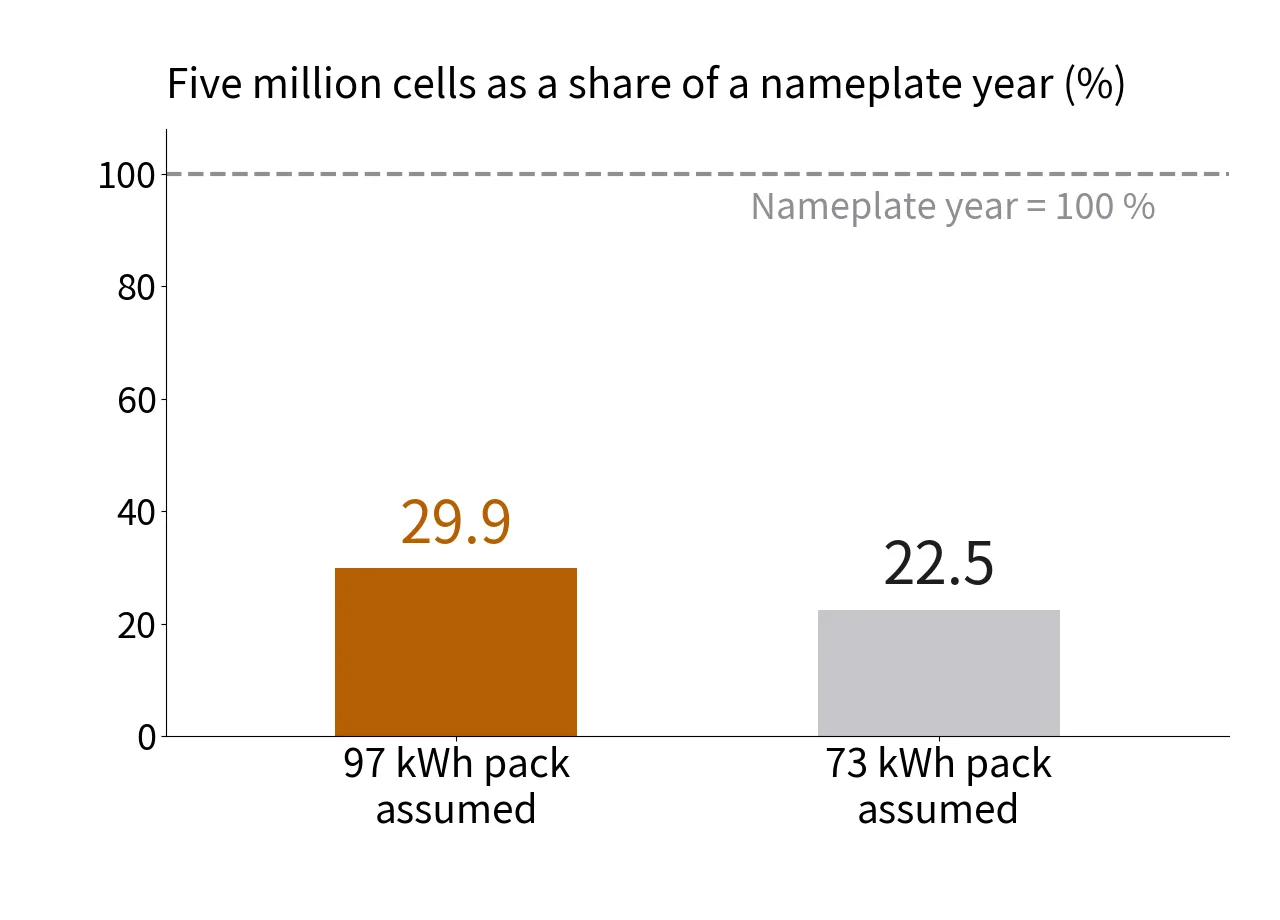
Two bars show the same five million cells set against each assumption. Neither reaches a third of a nameplate year. That small share, with no known period attached, is the point of the whole calculation.
Neofab’s calculation note
Energy per cell = pack capacity ÷ 125 = 97 ÷ 125 = 0.776 kWh (0.584 kWh for 73)
Cells per nameplate year = 13,000,000 kWh ÷ 0.776 kWh = 16,752,577 (22,260,274 for 73 kWh)
Share of five million = 5,000,000 ÷ 16,752,577 = 29.9 % (22.5 %), × 12 = 3.58 months (2.70)
Average utilization = 5,000,000 ÷ (cells per year × years elapsed)
2 years 14.9 % (11.2 %), 3 years 9.9 % (7.5 %), 4 years 7.5 % (5.6 %)
Pace in February 2026 = 1,000 cars × 125 cells = 125,000 cells/month, 40,000 cars ÷ 1,000 cars/month = 40 months
Long-range-only floor = 1,000 cars × 97 kWh × 12 = 1.164 GWh/year = 9.0 % of 13 GWh
Assumptions: the first block’s 13 GWh is annual capacity, backed out from the second block’s 12.9 GWh and the site total just under 26 GWh. “Nearly 40,000” counts as 40,000, which sets 125 cells per vehicle. Pack sizes of 97 kWh and 73 kWh are the two options named in the coverage. None of these values is printed in the reports.
Together, the two assumptions bracket the result. Where the real cell energy falls between them depends on how many of each pack size sold, and the coverage gives no split. Either way, five million cells stay below one nameplate year.
Pick an elapsed time and average utilization follows. Two years gives 11.2 to 14.9 %, three years 7.5 to 9.9 %, and four years 5.6 to 7.5 %. Five million cells span 5.6 % to 14.9 %, a spread of almost 2.7 times, just by changing the period.
Coverage offers one timing clue, the February 2026 pace of about 1,000 cars a month. At 125 cells each, that is 125,000 cells a month, and 40,000 cars at that pace take 40 months. No history of pace changes appears in it. Those 40 months stay here as a reference and does not feed any estimate of the period.
Converting the same 1,000 cars at 97 kWh gives 1.164 GWh a year, which is 9.0 % of 13 GWh. Cars with 73 kWh packs are missing from that figure, so it works only as a floor. I think a running-total report should be read by asking for the elapsed time and the good-cell basis first. Depending on the period, five million cells land anywhere from 5.6 to 14.9 % average utilization.
A 15 to 20 % scrap rate forces more cells into the start
Scrap6 means cells thrown away in production. Milano Finanza put ACC’s scrap rate at 15 to 20 % in November 2025[3]. Latest coverage says only that defect rates are nearing target, with no figure[1]. Nothing in the coverage shows that 15 to 20 % still applies.
If the scrap rate is s, the good fraction is 1 − s. Overall equipment effectiveness7 is OEE = availability × performance × quality, and the quality term is exactly this good fraction. Reports do not say whether 15 to 20 % covers the whole plant or one step. I assumed the whole plant.
A vehicle needs 125 good cells. At 15 % scrap that means starting 147.1 cells, and at 20 % it means 156.3. Between 22 and 31 cells are thrown away for each car. Applied to the five million cells, the same rates imply a start of 5.88 to 6.25 million cells and 0.88 to 1.25 million scrapped. If the five million already counts scrapped cells, that figure needs recalculation, and the coverage does not say which basis applies.
The gap carries over into takt time8. Takt time is defined as available operating time / customer demand quantity, and meeting 1,000 cars a month means a demand of 125,000 cells. Treating the whole site as one flow with 30 days (2,592,000 s) available, the takt time on a good-cell basis is 20.7 s. In terms of starting cells it becomes one cell every 17.6 s at 15 % scrap and every 16.6 s at 20 %. That is 3.1 to 4.1 s shorter than the good-cell takt time.
This takt time uses calendar days, so holidays and maintenance are not subtracted. Removing them from the available time would shorten every takt time further.
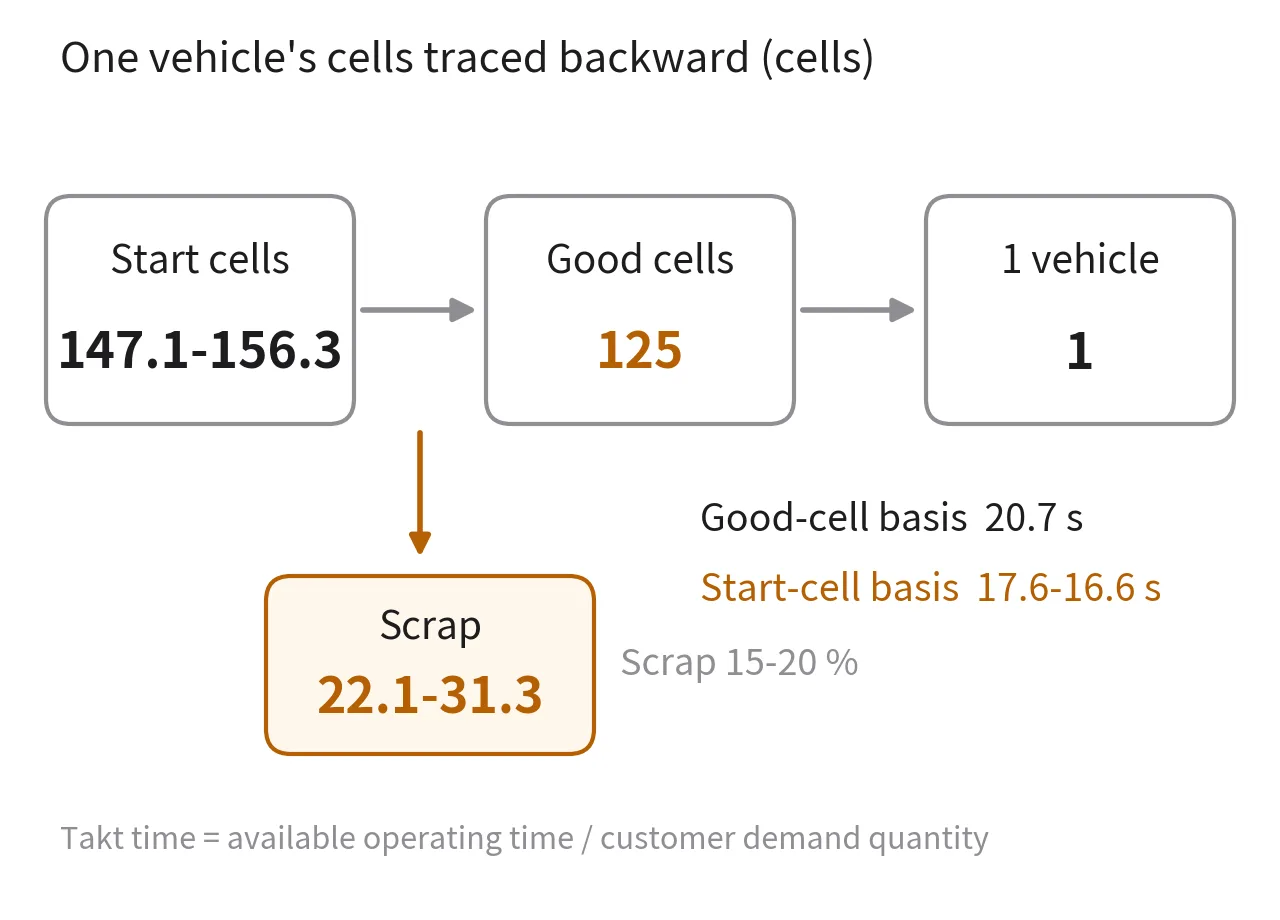
One vehicle’s worth of cells runs backward through the diagram. To end with 125 cells on the right, 147 to 156 must enter on the left, and 22 to 31 drop out between. Takt time shrinks by the same ratio, so the intake side runs on a tighter interval.
This simplification treats the site as a single line, and real plants run different takt times line by line. Still, the direction holds. Scrap in a cell plant turns into a shortfall of cells at the vehicle plant, and the point where they meet is the interface9. Stellantis also said it stops to avoid building vehicle inventory that does not match customer demand[2]. Days lost to missing cells and days lost to weak demand sit in one sentence in the coverage.
How many months I can answer, and how many years I cannot
A single total cannot show whether the plant has found its speed. A running total adds speed up over time and is not speed itself. Five million cells are 22.5 to 29.9 % of a nameplate year, or 2.7 to 3.6 months. If that took three years, the average was 7.5 to 9.9 %, and over four years it was 5.6 to 7.5 %.
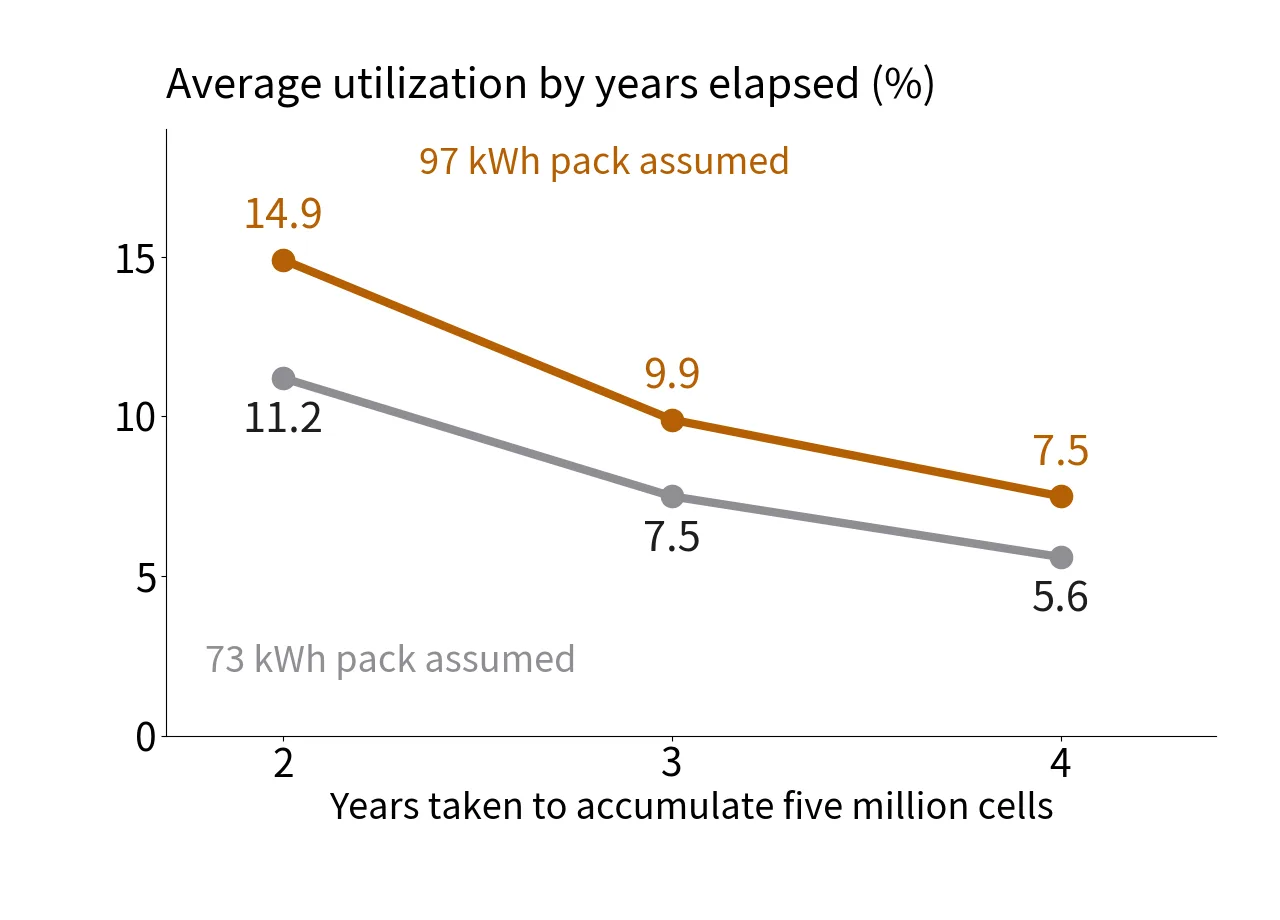
Lines trace average utilization against years elapsed. Both curves fall the same way because years sit in the denominator. Upper line: 97 kWh packs. Lower line: 73 kWh packs.
So the announcement shows that the total still fits inside one nameplate year. It does not show the current monthly output. February’s figure of about 1,000 cars comes from Bloomberg’s unnamed sources, and ACC did not confirm it directly. Figures for later months are not in the coverage I could access.
Some limits are worth stating. The 13 GWh comes from subtracting two reported numbers, and if it is not an annual figure, every share changes. And 125 cells per vehicle uses “nearly 40,000” as 40,000, so the real count is a little higher. The scrap rate dates from November 2025. If ACC’s own press release lists monthly output or the good-cell basis, two blanks in Table 1 close at once.
When monthly output is published, I will line it up against the February figure of 1,000 cars, or 125,000 cells, in the same unit. If block two at 12.9 GWh starts in 2027, output before and after can then be compared on one basis.
Frequently asked questions
If five million cells are three months of nameplate, did the plant run for three months only?
No. Nameplate conversion is only a ruler for sizing five million cells. Put in the real elapsed time and you get average utilization: 11.2 to 14.9 % for two years, 5.6 to 7.5 % for four. With no period in the coverage, three months is a comparison value.
Does a 15 to 20 % scrap rate mean 80 to 85 % of cells are good?
For a single step, yes. For the whole plant, the overall good fraction is 80 to 85 %. Coverage does not say which. The calculation above assumed the whole plant. If the rate came from multiplying several steps, each step’s scrap would have been smaller.
Are all the Stellantis stoppages caused by a cell shortage?
Coverage does not support that. Sochaux and Rennes are partly tied to batteries, while Mulhouse is attributed to reasons unrelated to them. Stellantis also cited its wish to avoid building inventory that fails to match demand.
What each reader can do
One running total reads differently from each seat, so the table lists what each reader can take from it.
| Reader | What to take away | What to try now |
|---|---|---|
| Job seeker | Getting 125 good cells at 15 to 20 % scrap means starting 147 to 156, and the takt time drops from 20.7 s to 16.6 to 17.6 s | Find the scrap rate and monthly output in a cell-plant report you follow and work out the starting cell count with the same formula |
| General reader | A running total like “five million cells” says nothing about speed without a period, and the average swings from 5.6 to 14.9 % with it | When you meet a total, look for the time it took first, and if none is given, do not read it as speed |
| Reader following investments | Stellantis’s October stoppages have different stated reasons, and the days tied to batteries are 17 or fewer | Write the monthly output and the stoppage wording from ACC and Stellantis filings or coverage side by side for the same month |
This article is for information only and is not investment advice. See our Disclaimer.
Glossary
- Gigafactory — A large plant that makes batteries at a scale of GWh per year. Here it means ACC’s Douvrin plant. ↩
- Ramp-up — The period in which a new plant raises output from trial production to its planned volume. Scrap runs high and output swings during it. ↩
- Nameplate capacity — The maximum output an installation is rated to deliver when it runs as designed. This article treats it as annual capacity. ↩
- Production block — A unit of a plant that is built and brought online as one group. ACC adds blocks one at a time, and the text separates the first block from the second. ↩
- GWh and kWh (gigawatt-hour and kilowatt-hour) — Units for the amount of energy. One GWh equals 1,000,000 kWh. For a battery plant, the figure is the energy of all cells it can make in a year. ↩
- Scrap and scrap rate — Cells discarded as defective, as a share of the cells started. If the scrap rate is s, the good fraction is 1 − s. ↩
- Overall equipment effectiveness (OEE) — The share of an installation’s capacity that produced good product. OEE = availability × performance × quality. More: How to calculate OEE ↩
- Takt time — How often one unit must come out to meet customer demand. Takt time = available operating time / customer demand quantity. More: How to calculate takt time ↩
- Interface — The handoff point where an upstream step or supplier passes material or signals to a downstream step or user. Here it means the supply of cells from the cell plant to the vehicle plant. ↩
Sources and notes
- electrive, “ACC announces five million battery cells ‘Made in France’”, 2026-10-12. Used for the five million cells, nearly 40,000 vehicles, second block at 12.9 GWh, a site total just under 26 GWh, and the defect-rate wording. https://www.electrive.com/2026/10/12/acc-announces-five-million-battery-cells-made-in-france/
- electrive, “Battery shortage: Stellantis pauses EV production in France”, 2026-09-30. Used for the Sochaux, Rennes, and Mulhouse stoppage dates and reasons and the Stellantis spokesperson’s remarks. https://www.electrive.com/2026/09/30/battery-shortage-stellantis-pauses-ev-production-in-france/
- electrive, “Battery shortage at ACC likely to impact Stellantis production”, 2026-02-05. Relays Bloomberg (2026-02-04) on about 1,000 cars a month and Milano Finanza (2025-11) on 15,000 to 20,000 packs and a 15 to 20 % scrap rate. Neither original was opened. https://www.electrive.com/2026/02/05/battery-shortage-at-acc-likely-to-impact-stellantis-production/
- Assumed values: first block 13 GWh as annual capacity (backed out from the second block’s 12.9 GWh and a site total just under 26 GWh), 125 cells per vehicle (five million ÷ 40,000), pack capacity 97 kWh and 73 kWh (both named in the coverage), and 30 days (2,592,000 s) of available time with the site treated as one flow. Energy per cell and first block capacity are not printed in the reports.
- Method: share = 5,000,000 ÷ cells per nameplate year, average utilization = share ÷ years elapsed, starting cells = 125 ÷ (1 − scrap rate), and takt time = 2,592,000 s ÷ cells needed per month. Scrap rates of 15 to 20 % date from November 2025 and are not current values. Starting and scrapped cell counts assume the five million cells are good cells only.

You May Also Like
Sebang Lithium Battery’s Simultaneous HEV Pack and ESS Module Orders — Analyzing the Cell-Inbound Interface and Cell-ID Traceability Load
Formation Channel Sizing Read from a Cell Assembly Equipment FAT — How 1 Second of Takt Time Moves 3,350 Channels