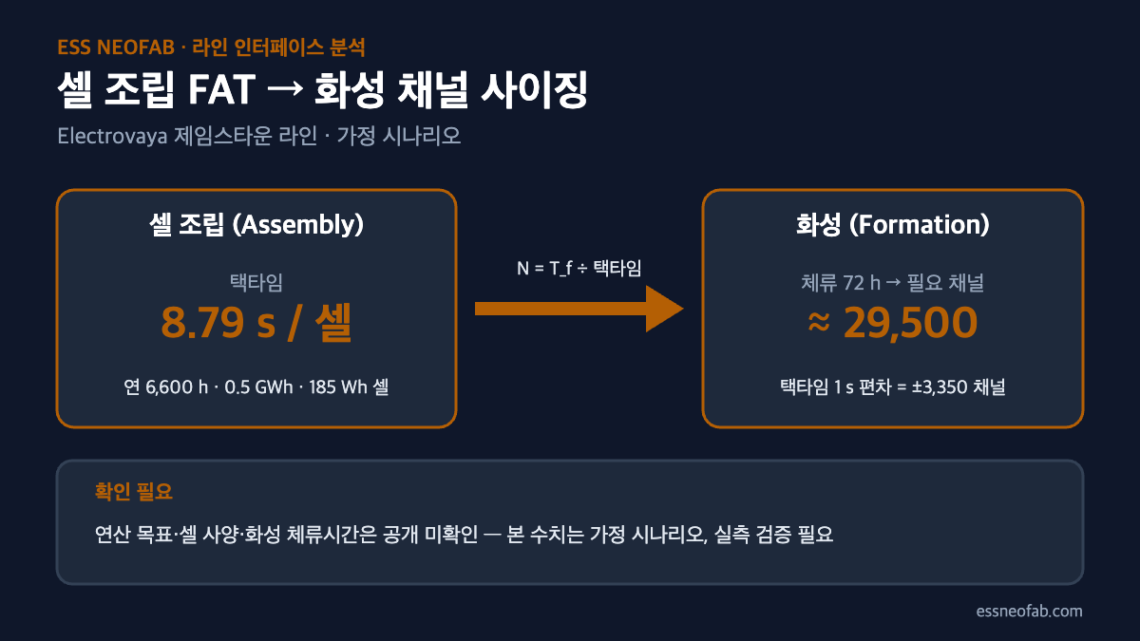
Formation Channel Sizing Read from a Cell Assembly Equipment FAT — How 1 Second of Takt Time Moves 3,350 Channels
Abstract
Electrovaya announced that on August 24, 2026, it began a Factory Acceptance Test (FAT) of automated cell-assembly and Formation equipment for its Jamestown, New York cell plant, to be followed after completion in early October by shipping and a Site Acceptance Test (SAT). This article reinterprets that FAT not as “equipment inspection” but as a sizing verification that absorbs, through the number of Formation channels, the takt-time mismatch between cell assembly — which moves at a second-by-second cadence — and Formation — which holds cells for hours at a time.
Under an assumed scenario (0.5 GWh annual output, 185 Wh cells, 6,600 h/yr of operation, 72 h Formation dwell time), the assembly takt time is approximately 8.79 s/cell, the required number of Formation channels is approximately 29,500, and every 1-second reduction in assembly takt time requires roughly 3,350 additional channels. The decision to run the FAT with production-grade material is interpreted as an act of locking in the denominator of this ratio (takt-time reproducibility) before the SAT.
1. Conclusion: The Number of Formation Channels Is a Function of Assembly Takt Time, and the FAT Is the Stage That Fixes Its Denominator
Situation (S): Electrovaya is building a proprietary ceramic-separator-based cell line at its Jamestown plant (a roughly 52-acre site with a building of approximately 12,540 ㎡), and on August 24 began the FAT of its cell-assembly and Formation equipment at the equipment manufacturer’s site. About ten of Electrovaya’s future Jamestown operating personnel are directly participating in the FAT, verifying function, process performance, and reproducibility using production-grade material.
Complication (C): The cell-assembly process cycles on the order of seconds, but the Formation/aging process holds each cell for tens of hours. To tie the two processes together under a single line takt time, the Formation side must have parallel channels equal to the ratio of “takt time × dwell time,” and this channel count depends directly on the reproducibility of the assembly takt time confirmed at the FAT.
Question (Q): What quantitative effect does the assembly-takt-time deviation confirmed at the FAT stage have on Formation channel sizing and on ramp-up after the SAT?
Answer (A): Under the assumed scenario, a 1-second deviation in assembly takt time translates into a surplus or shortfall of roughly 3,350 Formation channels. Verifying reproducibility with production-grade material at the FAT is therefore a preemptive measure that avoids the most costly design change of all — adding Formation channels after the SAT.
2. Mechanism: The Interface Between Second-Scale Assembly and Hour-Scale Formation
Takt Time is Available Operating Time divided by Customer Required Quantity[1]. If the cell-assembly line’s takt time is 8.79s, then one cell must move into the Formation process every 8.79s, and Formation must hold that cell for the dwell time Tf. The number of cells simultaneously in Formation — that is, the required channel count N — is then:
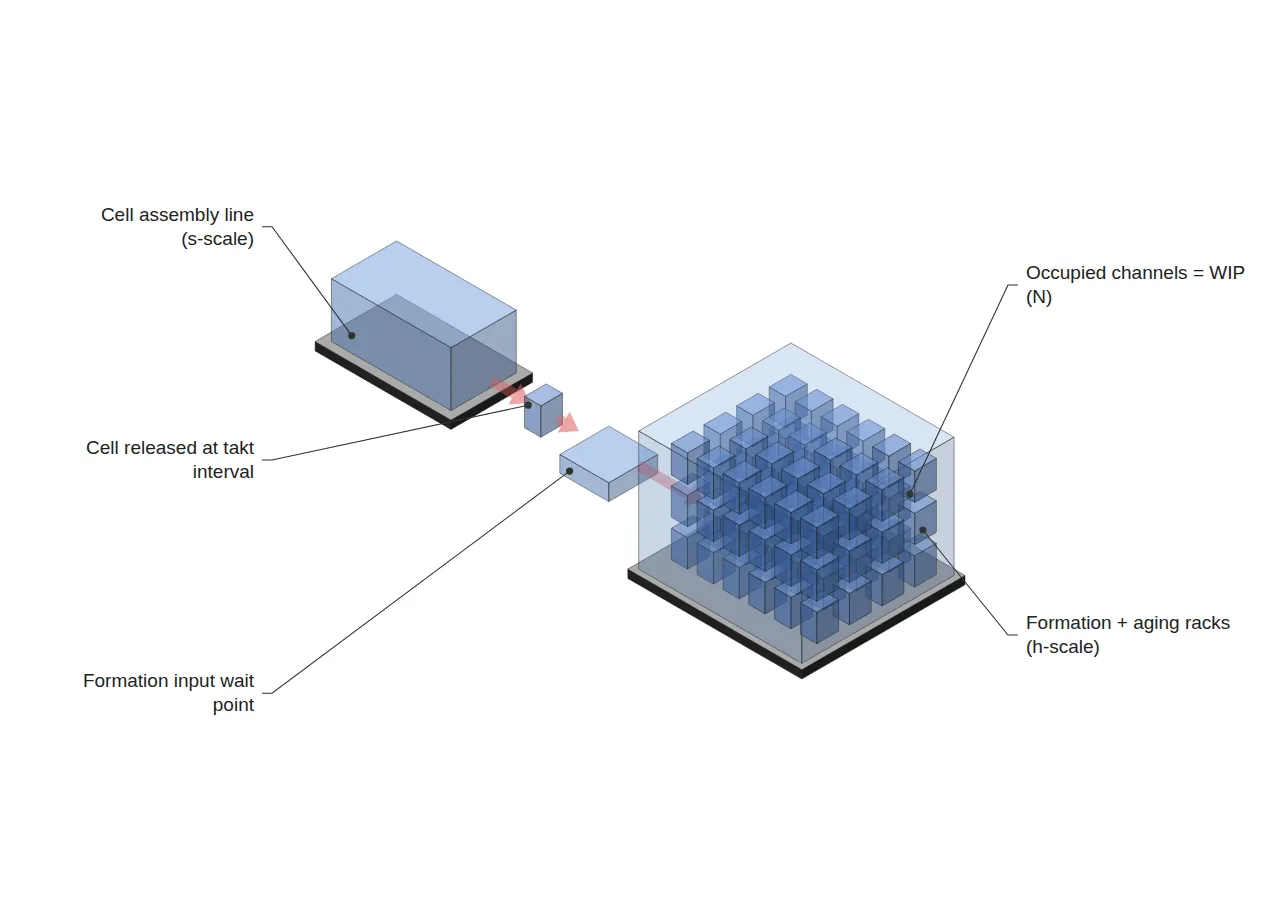
N = Tf / Takt Time (Tf: Formation + aging dwell time [s], Takt Time [s/cell])
This formula shows that Formation channels are, in effect, a WIP (Work-In-Process) buffer within the line. If the channel count is below N, the assembly line stops while waiting to feed Formation, and the Availability component of OEE (Overall Equipment Effectiveness) is degraded[2]. Conversely, if assembly-side availability drops, Formation channels sit empty and channel utilization falls. Ultimately, the Formation channel count can only be fixed on the premise of the “reproducibility” of the assembly takt time.
It matters here that Electrovaya explicitly stated it uses production-grade material (including its proprietary ceramic separator) for the FAT. Separator thickness, stiffness, and friction characteristics directly affect stacking and winding cycles, so a takt time achieved with a substitute material carries the risk of not being reproduced at the SAT. In other words, the choice of FAT material is the decision that fixes the denominator of the formula above before the SAT.
3. Assumed Scenario: Back-Calculating Takt Time and Sizing Formation Channels
The Jamestown plant’s cell specifications and annual production target are not confirmed in public materials, so all values below are assumed. Recalculation is required once actual specifications are obtained.
| Item | Assumed Value | Note |
|---|---|---|
| Annual production target | 0.5 GWh/yr | Confirmation needed |
| Cell spec | 50 Ah × 3.7 V = 185 Wh | Confirmation needed |
| Annual cell count | approx. 2,702,700 units | 0.5 GWh ÷ 185 Wh |
| Available operating time | 300 days/yr × 2 shifts × 22h = 6,600h = 23,760,000s | Assumes planned downtime excluded |
| Assembly takt time | approx. 8.79 s/cell | 23,760,000s ÷ 2,702,700 |
| Formation + aging dwell | 72h = 259,200s | Confirmation needed |
| Required Formation channels N | approx. 29,500 channels | 259,200 ÷ 8.79 |
| With 10% margin applied | approx. 32,400 channels | Absorbs availability loss |
The sensitivity to dwell time and takt-time deviation is as follows. The partial derivative with respect to takt time, ∂N/∂Takt Time = −Tf/Takt Time² ≈ −3,350 channels/s, means that if the assembly side runs 1s faster than the FAT target, roughly 3,350 channels become short, and if it runs 1s slower, an equivalent number of channels sit idle.
| Scenario | Dwell Time | Takt Time | Required Channels N |
|---|---|---|---|
| Baseline | 72h | 8.79s | approx. 29,500 |
| Shortened Formation | 48h | 8.79s | approx. 19,700 |
| Extended Formation | 96h | 8.79s | approx. 39,300 |
| Faster Assembly | 72h | 7.79s | approx. 33,300 |
* Calculation conditions: based on the assumed values in the table above, temperature/humidity conditions not reflected, Formation channel failure rate assumed to be 0. No sample size (formula-derived result). As these are not pilot- or lab-scale figures, they are not asserted as mass-production line performance.
4. Trend Snapshot
LG Energy Solution’s Michigan Lansing plant startup (August 19): A plant with capacity exceeding 35 GWh/yr, producing ESS-bound LFP and EV-bound NCM together, began operation, and reports followed that second-half ESS production is expected to roughly double relative to the first half. In a mixed-model line, because Formation protocols differ by chemistry and channel pools cannot be shared, N from Section 2 must be sized separately by chemistry — a point that connects directly to this article’s mechanism.
Distribution-grid ESS Phase 1 PCS allocation: It was reported that of 32 distribution feeders, HD Hyundai Electric will supply PCS (Power Conversion System) units for 19 sites (approx. 60%), with Hyosung Heavy Industries handling the remainder. Battery supply share was covered in an earlier article (배전망 ESS 128MW 물량배분, 배터리팩 조립라인은 택타임을 감당할 수 있는가); the effect of this dual PCS sourcing on BMS (Battery Management System)–PCS interface standardization requires separate examination.
5. Implications: Demand a Takt-Time Distribution in the FAT Report
Typically, an FAT report records only the average value of Cycle Time. But Formation channel sizing is sensitive to the reproducibility — that is, the variance — of takt time. Cycle Time is the operating time of one unit of equipment, while Takt Time is the interval a line must hold to meet demand; conflating the two throws off the calculation of N[3]. Obtaining the cycle-time distribution (mean, standard deviation, maximum) from continuous operation with production-grade material at the FAT stage, and setting the channel-count range from the resulting upper and lower takt-time bounds, is the only path that avoids expansion after the SAT.
This differs in layer from an earlier article (그리드포밍 PCS 의무화, FAT 택타임과 BMS-PCS-EMS 인터페이스를 다시 설계하다) that dealt with the shipping FAT takt time of grid-forming PCS. That article addressed a structure in which product-inspection time determines shipping takt time, while this article addresses a structure in which the FAT of the production line itself determines the channel sizing of the downstream process. It is also distinguished from an article on upstream–downstream buffer inventory in a solid-state-electrolyte pilot (고체전해질 연속공정과 조립라인 사이, 버퍼 인터페이스는 어떻게 설계하는가) in that the variable here is not “inventory quantity” but the “dwell-time/takt-time ratio.” Read together, these three pieces connect FAT–buffer–takt time into a single system of line-design variables.
FAQ
Q1. Isn’t the number of Formation channels simply something the equipment vendor decides on its own?
A1. The equipment vendor proposes a channel count based on the target takt time and dwell time in the order specification. The problem arises when that target takt time is not reproduced at the FAT, and this deviation often originates from the ordering company’s own material and process conditions. Electrovaya running the FAT with its own material is interpreted as an act of closing this responsibility boundary at the point of the FAT.
Q2. Doesn’t shortening the Formation dwell time resolve the channel-count problem?
A2. It is correct that shortening from 72h to 48h in the Section 3 table reduces the channel count by roughly 9,800. However, shortening the Formation protocol can affect cell lifespan (see US20230029405A1), so it cannot be decided by line-design variables alone, and it falls outside this blog’s scope (cell-internal chemistry), requiring separate examination.
Q3. What does the fact that 10 people participate in the FAT have to do with line performance?
A3. If the FAT participants are the same as the SAT/mass-production operators, the causes of cycle-time deviation identified at the FAT (material-loading method, alignment correction, etc.) are transferred through people rather than documentation. This is a variable that reduces availability loss during the SAT ramp-up period, but its quantitative effect cannot be asserted without empirical measurement.
Field Application Notes
| Category | Monday-Morning Action Item | Verification Metric |
|---|---|---|
| Order specification | Specify in the FAT spec sheet “use of production-grade material” and “submission of continuous-operation cycle-time distribution (mean·σ·max)” | Whether the clause exists in the spec sheet |
| Sizing | Calculate the Formation channel baseline value as N = Tf ÷ Takt Time, and note the upper/lower N bounds for a ±1s takt-time range | N range table |
| Sensitivity | Calculate ∂N/∂Takt Time = −Tf/Takt Time² and record the channel change per second in the design-review material | Channels/s value |
| Mixed-model response | If Formation protocols differ by chemistry (LFP/NCM, etc.), size channel pools separately | N by chemistry |
| Personnel handover | Cross-check the FAT participant list against the SAT/mass-production assignment sheet; define handover items for unmatched personnel | Match rate |
Items requiring confirmation: the Jamestown plant’s annual production target (GWh), cell specifications (Ah·V), actual Formation/aging dwell time, the equipment manufacturer’s name, and the actual ordered quantity of Formation channels. As these items are not confirmed in public materials, all figures in the body text are an assumed scenario.
Reference Patents (General Prior Art)
US20230029405A1 (Early-Life Diagnostics for Fast Battery Formation Protocols) · KR20000042002A (Formation and aging method for secondary lithium batteries) · CN104810565B (Lithium-ion battery charge-discharge method; equipment channel efficiency) · US9214659B2 (Application of a ceramic separator to lithium-ion batteries). No patent directly matching Electrovaya’s Jamestown line was found.
Footnotes
[1] Takt Time = Available Operating Time ÷ Customer Required Quantity. In this article, the annual production target is substituted for customer required quantity.
[2] OEE (Overall Equipment Effectiveness) = Availability × Performance × Quality. A stoppage while waiting to feed Formation is classified as an availability loss.
[3] Cycle Time is the time for one unit of equipment to process one unit; Takt Time is the interval a line must hold to meet demand. Neither should be conflated with FPY (First Pass Yield).


You May Also Like
Even a tenfold faster model moves the whole by 1.29x — what “5 to 10 times faster commissioning” actually requires
45 Days from Pohang to Georgia — Safety Stock at an Intercontinental Cathode Interface Is Driven by Lead-Time Variability, Not Demand
3 Comments
Pingback:
Pingback:
Pingback: