-
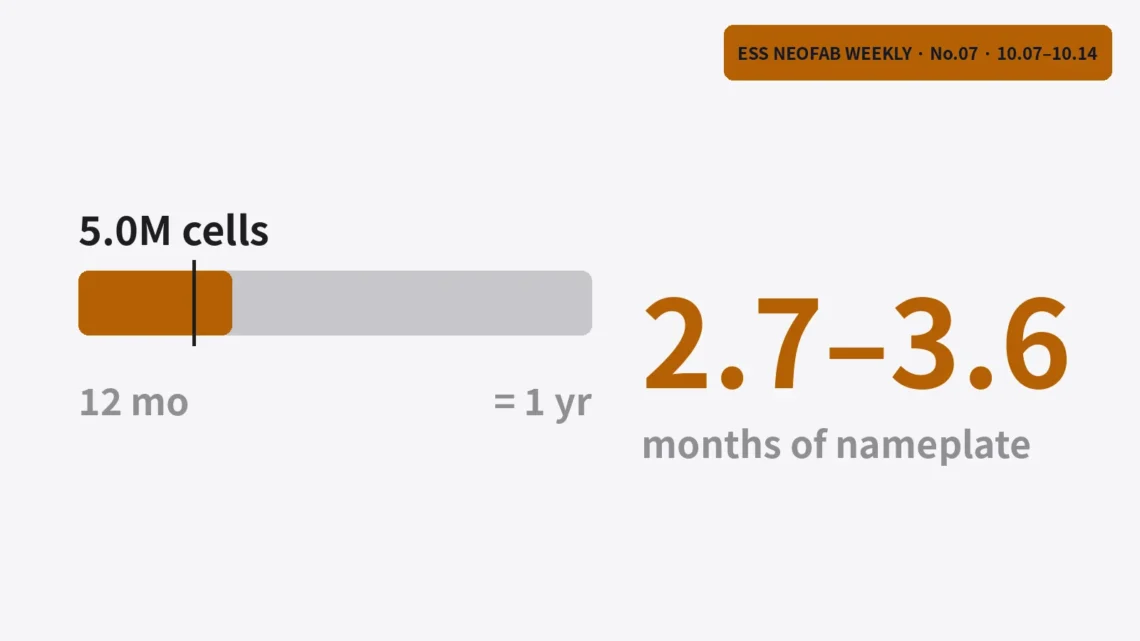
Five million ACC cells equal 2.7 to 3.6 months of nameplate output
ACC's Douvrin plant in France announced a running total of five million cells on 12 October 2026. Two figures in the coverage imply about 125 cells per vehicle, and assuming the first block runs at 13 GWh a year, five million cells equal 22.5 to 29.9 % of one nameplate year, or 2.7 to 3.6 months. Reports do not say how many years the total took, so average utilization can only be given as a range: 11.2 to 14.9 % over two years, 5.6 to 7.5 % over four. Applying the 15 to 20 % scrap rate reported in November 2025 would put 0.88 to 1.25 million scrapped cells behind…
You May Also Like
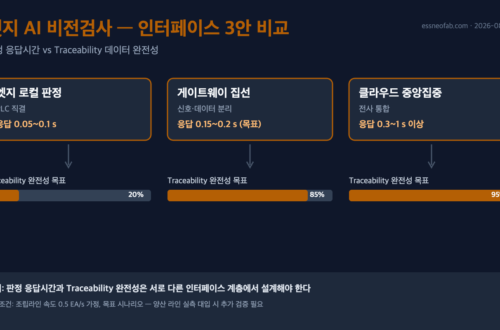
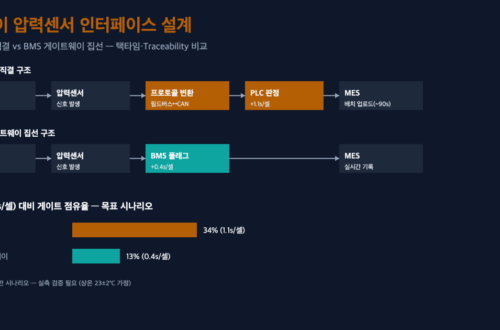
Edge AI Vision Inspection and Battery-Pack Leak Testing: How Gateway Aggregation Affects Traceability Completeness
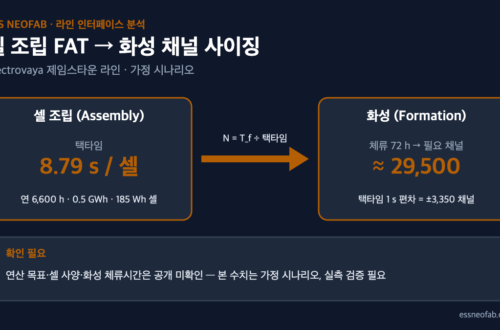
Formation Channel Sizing Read from a Cell Assembly Equipment FAT — How 1 Second of Takt Time Moves 3,350 Channels
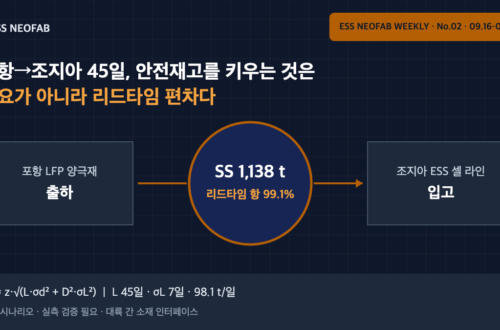
45 Days from Pohang to Georgia — Safety Stock at an Intercontinental Cathode Interface Is Driven by Lead-Time Variability, Not Demand
-
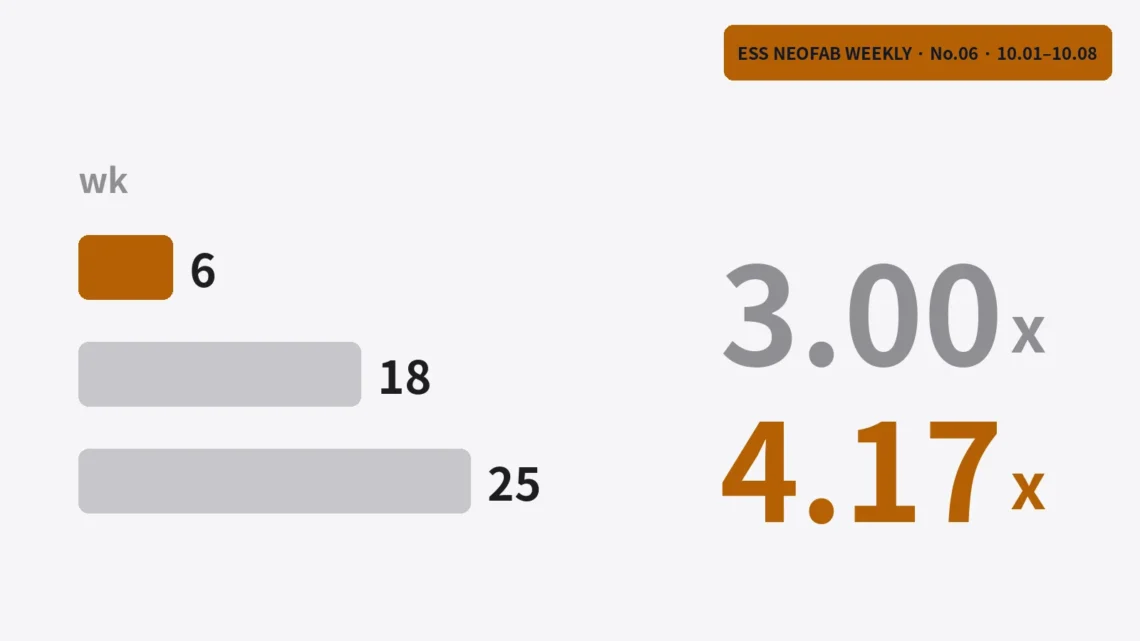
A 160 MW battery’s six-week commissioning has two baselines
Two different baselines hang on the six-week commissioning of a 160 MW/320 MWh battery in Texas. One report says deployment time fell threefold against the original plan, and another compares the six weeks with a typical 25 weeks or more, so the baselines sit 7 weeks apart (18 and 25) and the multiples split into 3.00 and 4.17. Of roughly 16 months from groundbreaking to start-up (69.6 weeks), the six weeks make up 8.6 %, and the site announced operation 10.1 weeks after the last day of its target quarter. However the planned commissioning length is assumed, the delay that built up before commissioning stays at 4.1 weeks or more,…
-
Two Cycles a Day Take 106.8 % of a Day, and the Retention Tier Shifts Cell Volume by 1.47 GWh
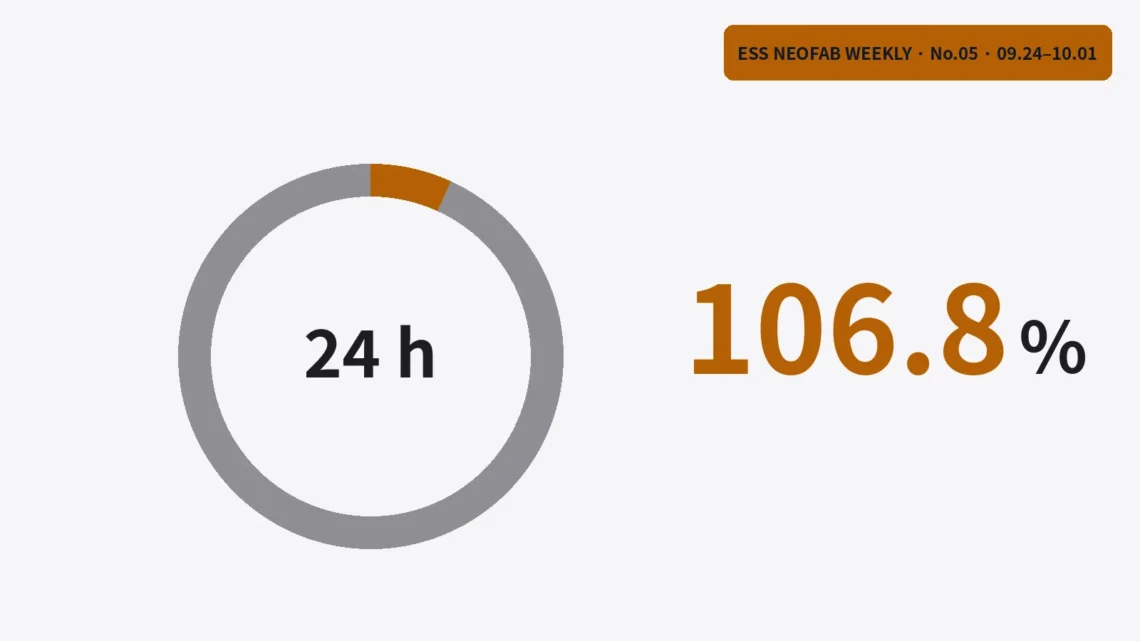
Korea's 25-year Jeju contract asks for at least 730 charge and discharge cycles a year from an 80 MW, 480 MWh system that runs for 21,600 s (6 hours) at full power. If each cycle is a full one and round-trip efficiency is assumed at 0.88, two cycles a day take 92,291 s, which is 106.8 % of the 86,400 s in a day. The warranty-life score pays 7 points for 90 % or more capacity at contract end and 1.75 points for 75 to 80 %. With no cells allowed to be added mid-term, the mainland's 6.6 GWh needs between 7.33 and 8.80 GWh of installed cells, a gap…
You May Also Like
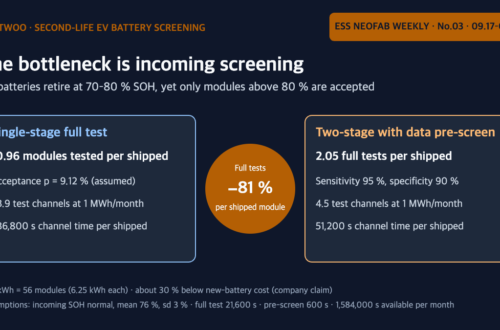
Battwoo’s Second-Life EV Batteries — When an 80 % Acceptance Threshold Overlaps the Retirement Distribution, Incoming Screening Becomes the Bottleneck
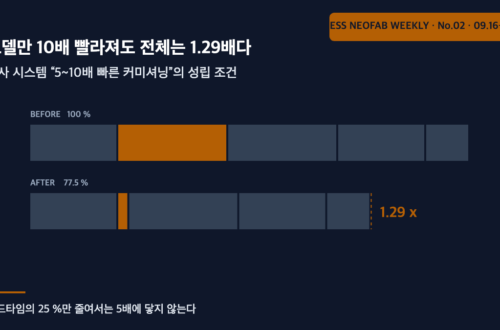
Even a tenfold faster model moves the whole by 1.29x — what “5 to 10 times faster commissioning” actually requires
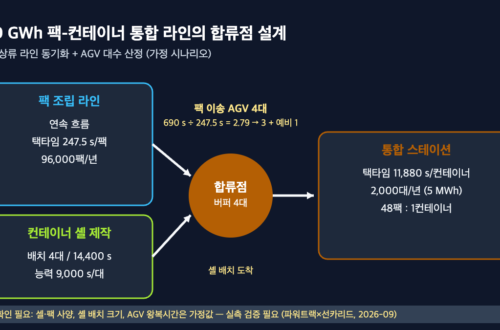
Designing the Merge Point in a 10 GWh Pack-Container Integration Line: Synchronizing Two Upstream Lines and Sizing AGV Fleet from the Powertrac × Sunka Lead Order
-
Battwoo’s Second-Life EV Batteries — When an 80 % Acceptance Threshold Overlaps the Retirement Distribution, Incoming Screening Becomes the Bottleneck
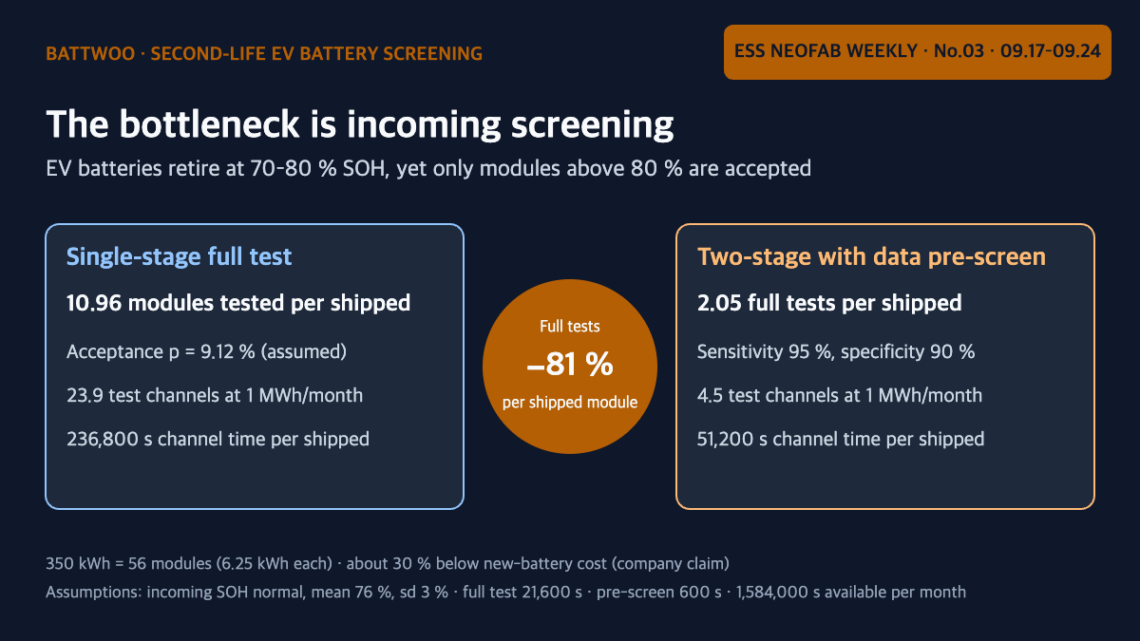
French startup Battwoo refurbishes into stationary ESS only those retired EV batteries that retain more than 80 % of their capacity, while EV batteries typically retire at 70–80 %, and it says a 500 kWh system costs about 30 % less than one built with new batteries¹. When the retirement distribution and the acceptance threshold overlap like this, the acceptance rate is low: assuming incoming SOH with a mean of 76 % and a standard deviation of 3 %, the acceptance rate is 9.1 %, so 11.0 modules must be tested for every module shipped. At an assumed 1 MWh per month of shipments, 23.9 full-capacity test channels are needed,…
You May Also Like
Market Trends from a Battery Process/Equipment Perspective — 46-Phi Ramp-Up, Dry Process, Equipment In-Housing
Even a tenfold faster model moves the whole by 1.29x — what “5 to 10 times faster commissioning” actually requires
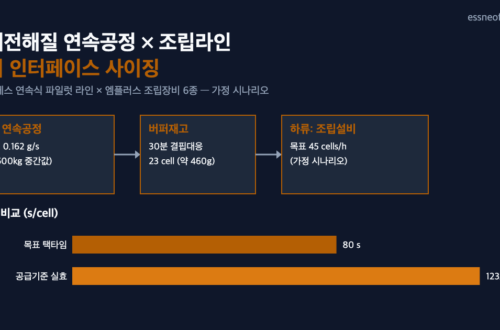
Between the Continuous Solid-Electrolyte Process and the Assembly Line: How Should the Buffer Interface Be Designed?
-
US storage set an energy record in Q2 as installed power fell 7%
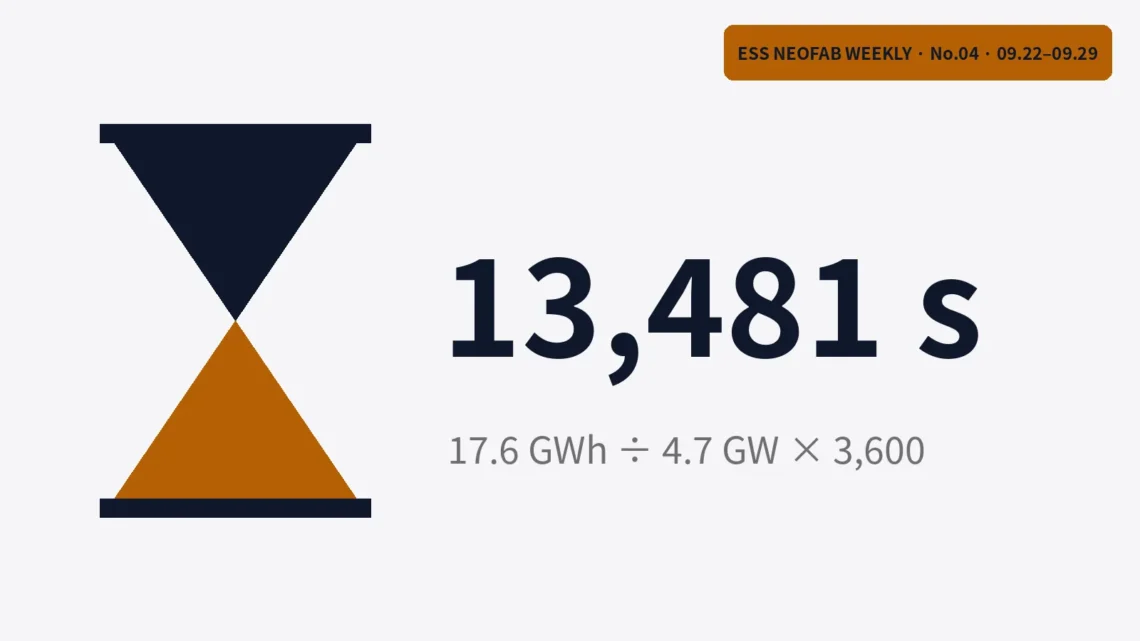
The US installed a record 18.9 GWh of energy storage in the second quarter of 2026, yet installed power fell 7% from a year earlier. Duration, the energy divided by the power, got longer, and for utility-scale projects it reached 13,481 s (about 3.74 hours). If duration stretches to the 14,788 s average in the 2026–2031 outlook, a 10% rise in energy calls for only 0.3% more PCS capacity. Battery lines follow GWh and PCS-transformer lines follow GW, and each conversion unit carries a larger share as duration grows.
-
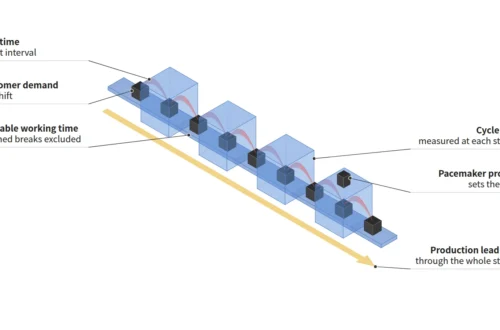
Don’t Subtract Breakdowns When Calculating Takt Time — Takt Time vs. Cycle Time vs. Lead Time
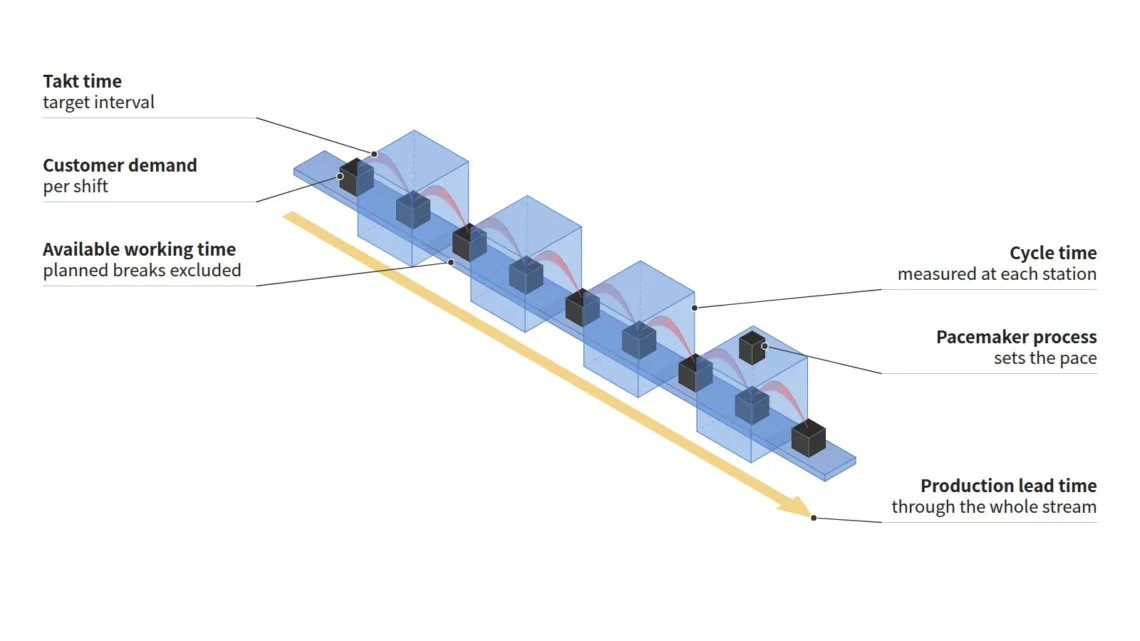
Takt time is the target production interval obtained by dividing available working time by customer demand, whereas cycle time is the measured time a process actually takes to make one unit. The calculation rule in the workbook published by the Lean Enterprise Institute (LEI) subtracts from shift time planned operator breaks, meetings, cleanups, etc., but not time for unplanned machine downtime, changeovers or other internal problems. Dividing the 27,600 s of available working time per shift obtained under this rule by the demand per shift of 690 units gives a takt time of 40 s. To cover stopped time as well, the measured cycle time must be shorter than takt…
You May Also Like
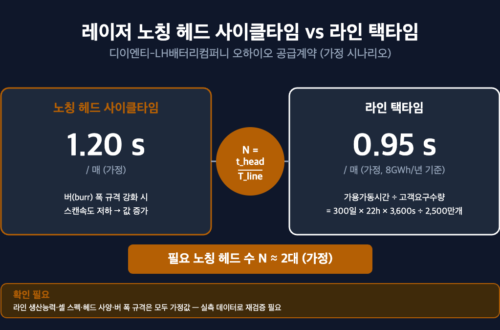
The Interface Between Laser Notching Cycle Time and Line Takt Time — The Head-Count Sizing Problem Revealed by DI ENT’s Ohio Supply Contract
Even a tenfold faster model moves the whole by 1.29x — what “5 to 10 times faster commissioning” actually requires
45 Days from Pohang to Georgia — Safety Stock at an Intercontinental Cathode Interface Is Driven by Lead-Time Variability, Not Demand
-
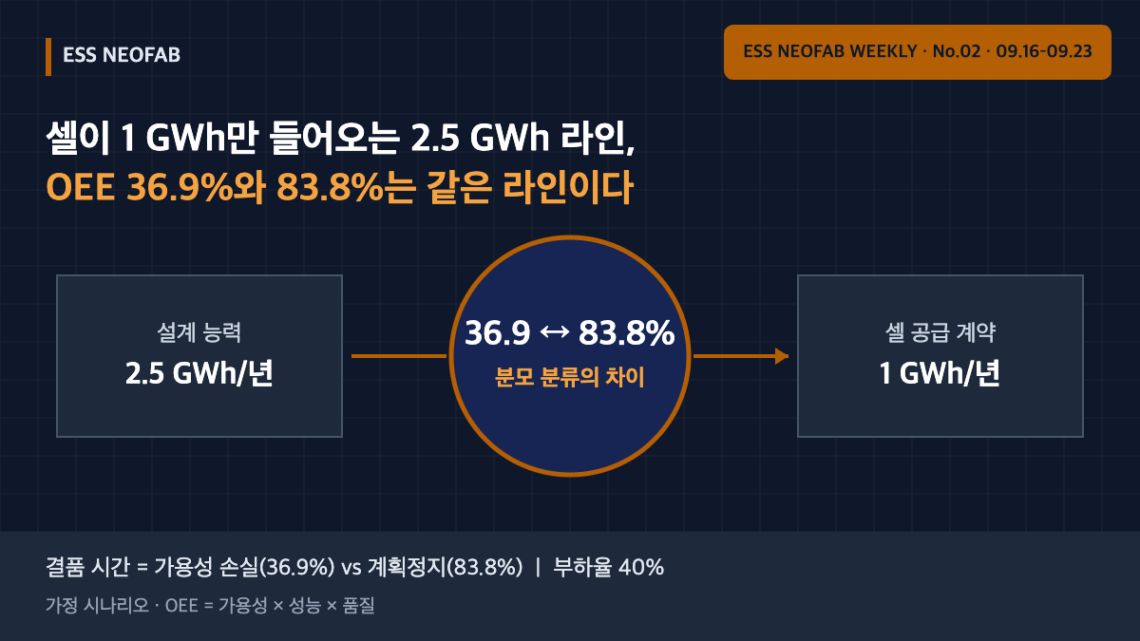
A 2.5 GWh Line Fed Only 1 GWh of Cells — OEE of 36.9% and 83.8% Describe the Same Line
Advait Group’s supply agreement with Hithium for 314 Ah LFP cells (up to 1 GWh over the next year, 18 September 2026) feeds a 2.5 GWh/yr assembly plant with only 40% of its design capacity. Under an assumed scenario, the same line with the same output reports an OEE of 36.9% if cell-shortage time is counted as availability loss, and 83.8% if it is separated as planned downtime and available operating time is matched to supply. The 46.9-point gap comes from the OEE denominator rule, not the equipment; on supply-constrained lines, the loading ratio should be reported alongside OEE.
You May Also Like
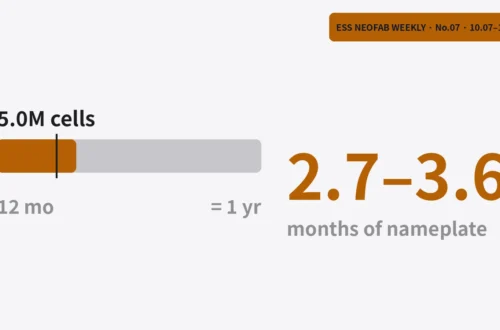
Five million ACC cells equal 2.7 to 3.6 months of nameplate output
45 Days from Pohang to Georgia — Safety Stock at an Intercontinental Cathode Interface Is Driven by Lead-Time Variability, Not Demand
Between the Continuous Solid-Electrolyte Process and the Assembly Line: How Should the Buffer Interface Be Designed?
-
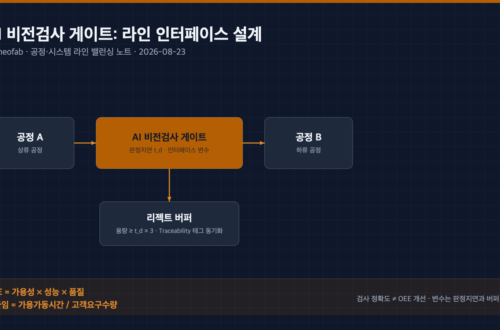
Designing the Merge Point in a 10 GWh Pack-Container Integration Line: Synchronizing Two Upstream Lines and Sizing AGV Fleet from the Powertrac × Sunka Lead Order
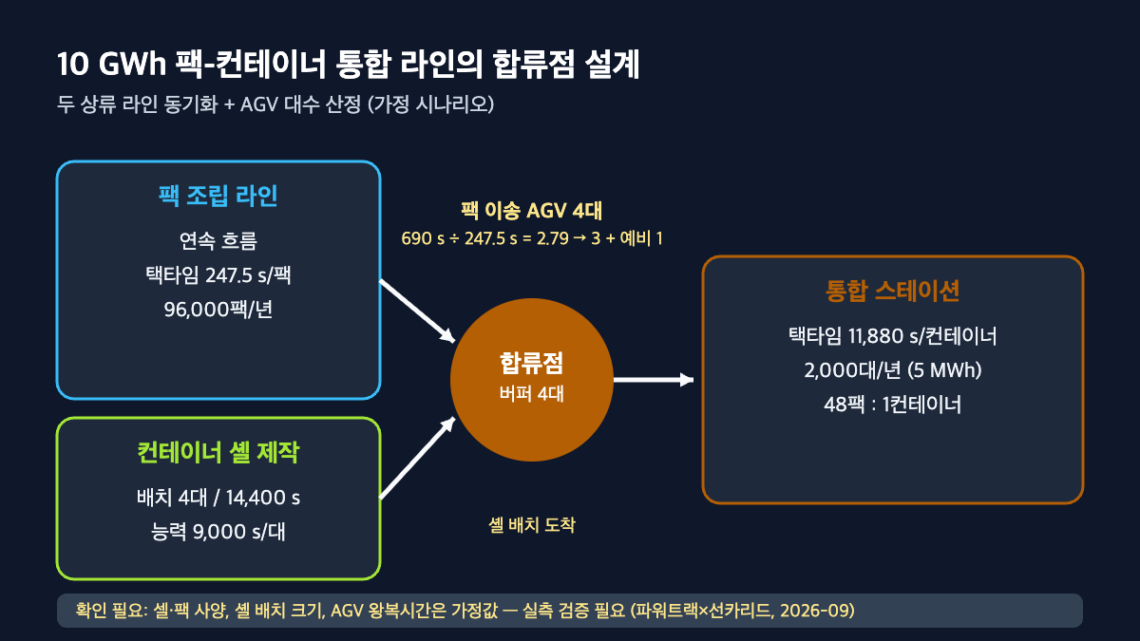
India's Powertrac has ordered a 10 GWh line from China's Sunka Lead in which a pack assembly line and an in-house container shell fabrication line — two upstream flows — merge at a single integrated station. In a two-input line of this kind, the first bottleneck appears not at the pack assembly takt time but at the merge point's synchronization buffer and the AGV transfer capacity linking the two flows. This article, under an assumed scenario (10 GWh/year, 5 MWh container baseline), back-calculates a container takt time of 11,880 s and a pack takt time of 247.5 s, and derives a design value of a minimum 4-unit merge-point buffer (assuming…
You May Also Like
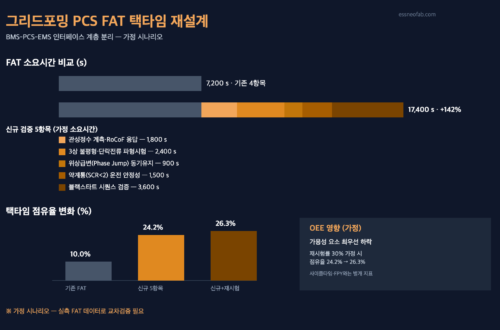
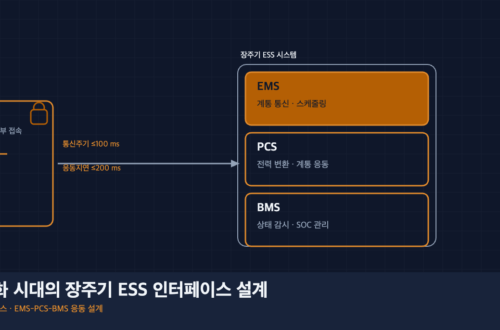
Grid-Forming PCS Mandate Redesigns FAT Takt Time and the BMS-PCS-EMS Interface
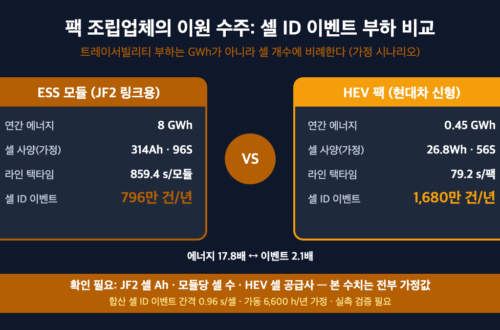
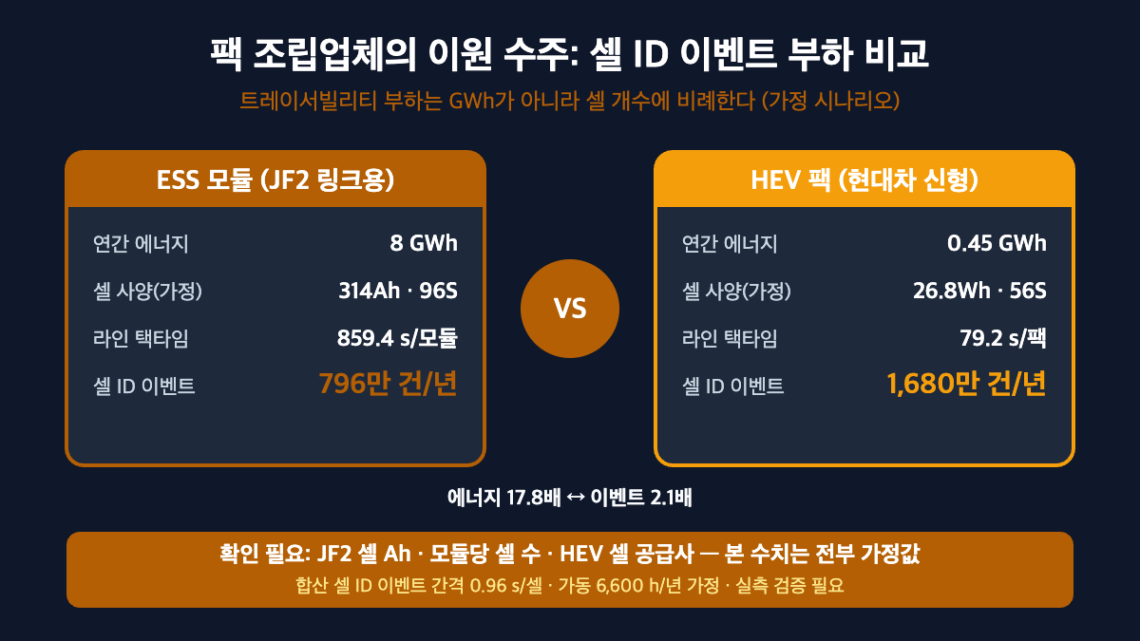
Sebang Lithium Battery’s Simultaneous HEV Pack and ESS Module Orders — Analyzing the Cell-Inbound Interface and Cell-ID Traceability Load
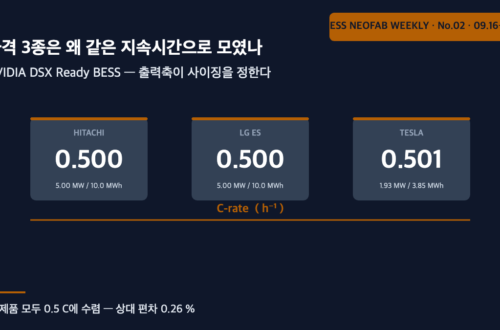
Why three qualified products landed on the same duration — in DSX Ready BESS, sizing is set by the output axis
-
StarPlus Energy’s Indiana Plant — The Blended-OEE Illusion Created by Sequential NCA/LFP Commissioning
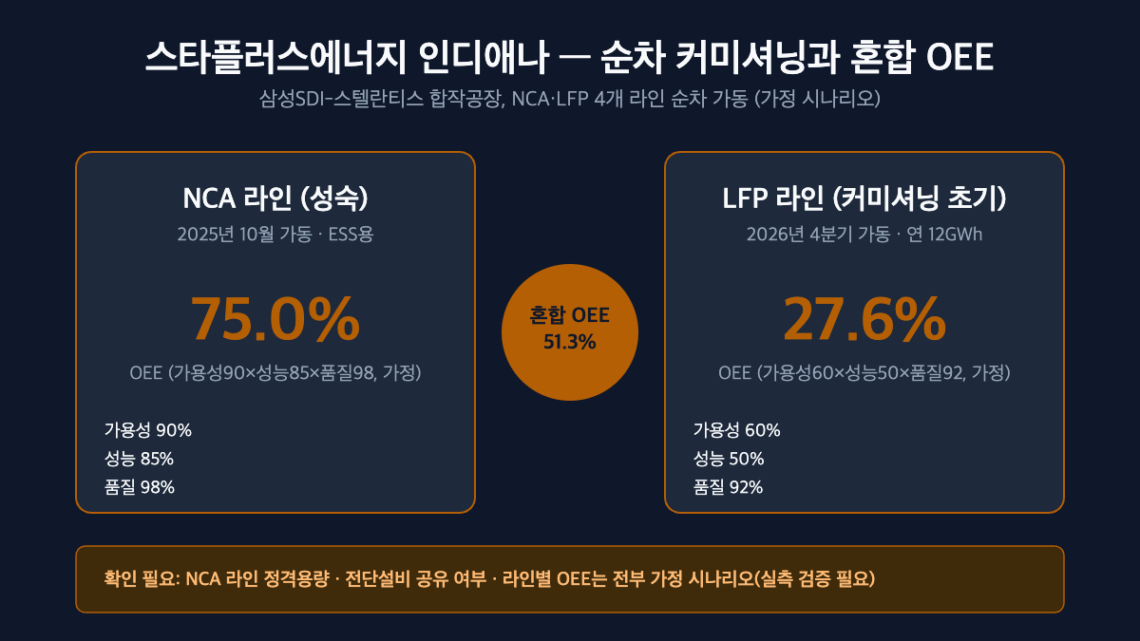
The Samsung SDI–Stellantis joint venture StarPlus Energy's Indiana (Kokomo) plant is bringing four lines online in sequence over 18 months: an NCA line starting October 2025, an LFP line (12 GWh/year) in Q4 2026, and additional NCA and LFP lines in Q1 2027. When lines of different chemistries (NCA, LFP) and end uses (EV, ESS) are commissioned at different times within a single site, a “Blended OEE” that sums the entire site into one number creates an illusion that obscures the actual performance of mature lines. This article back-calculates Takt Time from the publicly disclosed line-startup schedule and compares site-level blended metrics against line-level OEE under an assumed scenario. The…
-
Sebang Lithium Battery’s Simultaneous HEV Pack and ESS Module Orders — Analyzing the Cell-Inbound Interface and Cell-ID Traceability Load
Sebang Lithium Battery simultaneously won orders for Hyundai Motor's new hybrid (HEV) battery packs and LG Energy Solution's new ESS (JF2) battery packs, together worth more than KRW 3 trillion (reported 2026-09-07). This article quantifies, under an assumed scenario, how the Cell Inbound Interface and Cell-ID Traceability load differ when a pack systems company that sources cells externally receives two heterogeneous product lines — automotive and grid-scale power — within a single organization. The conclusion is that the traceability system's load scales with cell count, not GWh. In the assumed scenario, the HEV pack, at 0.45 GWh/year, is only 1/17.8 the scale of the ESS module (8 GWh/year), yet its…