Edge AI Vision Inspection and Battery-Pack Leak Testing: How Gateway Aggregation Affects Traceability Completeness
Abstract
Edge AI vision inspection has already solved the problem of judgment speed itself on battery-pack assembly lines. Combining gas imaging with edge computing, as in GM’s disclosed leak-inspection system “BVSeal,” makes per-cell judgment within 3 seconds possible. However, depending on where the judgment result is stored — the edge device locally, a gateway, or the cloud — the completeness of Traceability data remains an entirely different problem. This article compares the data architecture of edge AI vision inspection from an interface-design perspective and presents, as a target scenario, a gateway-aggregation approach that secures Traceability completeness without takt-time loss.
1. Judgment Has Gotten Faster, But the Record Still Breaks
To state the conclusion first, the discussion on adopting edge AI vision inspection should shift from “how fast can it judge” to “where, and how completely, is the judgment result retained.” The inspection’s own latency has been largely resolved over the past 2–3 years through advances in edge hardware and lightweight models. The problem lies in the next stage.
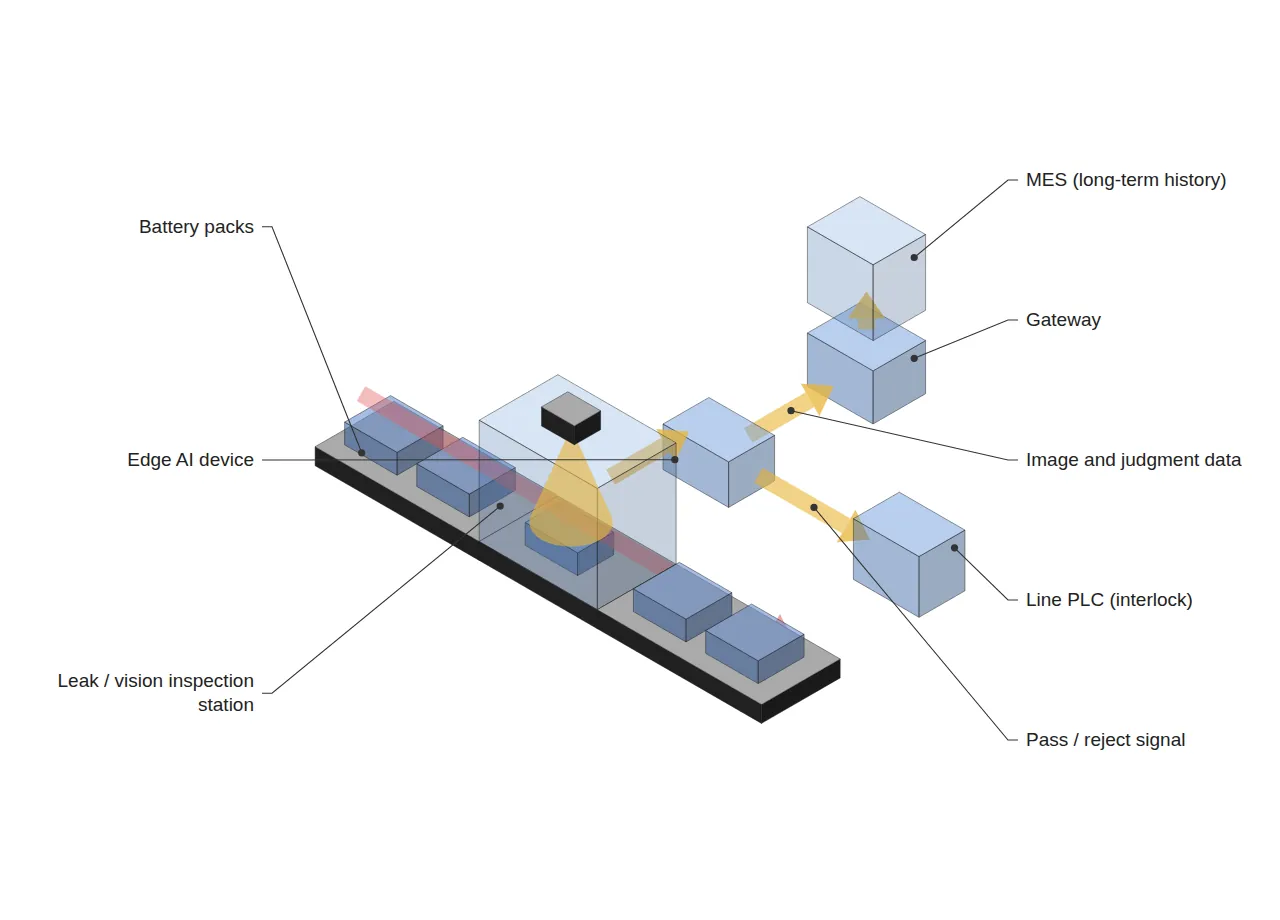
As of 2026, battery cell manufacturing accounts for 45% of global machine-vision inspection demand, making it a process highly dependent on vision inspection. BVSeal, disclosed by GM in August 2026, is a system that combines CO2 gas imaging, a cobot, edge computing, and AI software to detect micro-cracks and leaks in battery trays/packs in real time. What makes this case interesting is not judgment accuracy, but the fact that it shows the system-design stage must decide, from the outset, whether judgment data connects first to the line interlock or to the history-management system.
This raises a question: between a structure where the edge device makes the local judgment and sends only a pass/reject signal to the line PLC, and a structure where the entire judgment dataset is aggregated to a gateway and only signals are sent down to the line — these two structures appear to show little difference in instantaneous response time, but yield entirely different results weeks later when a specific pack’s history must be traced. This site redefines this difference as an interface-design variable and addresses it quantitatively.
2. How Far Has Edge AI Vision Inspection Come — Case Studies and Market Snapshot
As of 2026, the edge AI vision inspection market is estimated at approximately USD 32 billion, with an average annual growth rate of 23% projected (source: aggregated industry market research, sample and estimation method undisclosed — separate verification needed). Beyond GM’s BVSeal, Atlas Copco’s “VisionTools” is expanding AI vision applications in EV battery assembly processes, and in the industrial camera sector, LUCID Vision Labs has released a new camera equipped with a 5.0MP backside-illuminated CMOS sensor, among other hardware-layer updates.
Verifiable actual patents related to edge AI vision inspection include US11916199B2 and US12191456B2, covering battery cell leak-inspection apparatus/methods; US10615460B2, covering localized leak detection based on chemical indicators; and US11378527B2, covering inspection apparatus/methods for full inspection automation. On the Traceability side, CN109559132A, which proposes a blockchain-based power-battery history-management structure, is worth reference. These patents commonly separate “inspection” and “recording” into distinct claims, which in practice also demonstrates that the two functions need not physically reside in the same location.
3. Comparing Three Interface Options: Edge-Local vs. Gateway Aggregation vs. Cloud Centralization
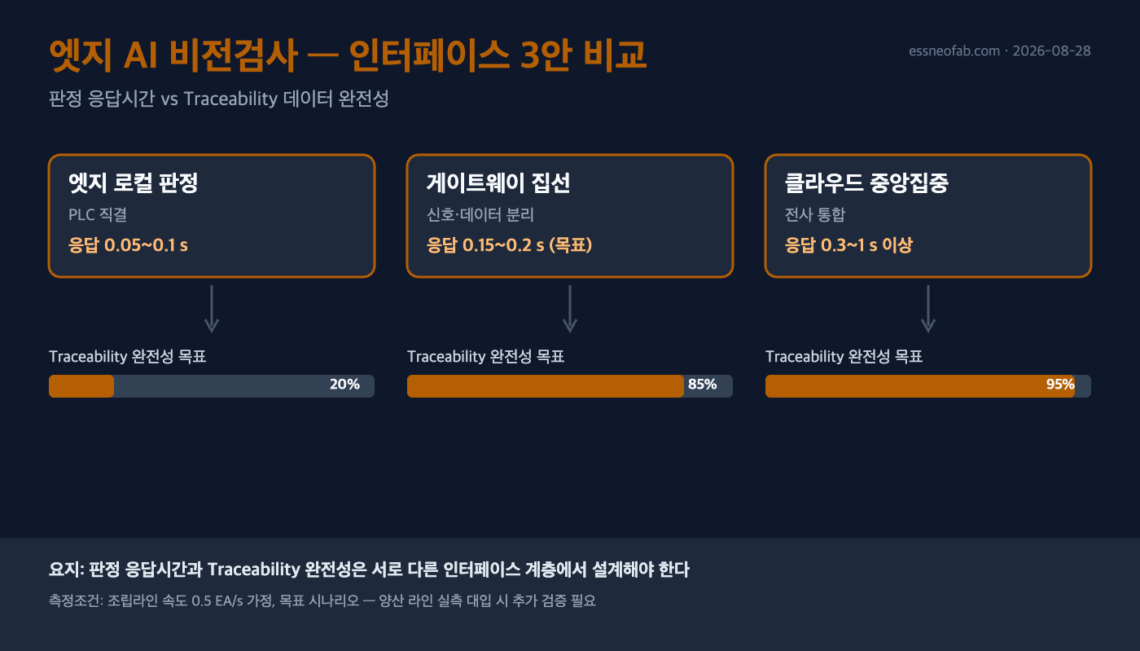
Depending on where edge AI vision inspection data is stored and aggregated, the line interface broadly divides into three structures. The table below compares the response time, data completeness, and PLC load of each structure. The figures are a target scenario combining published benchmarks with essneofab’s own calculations, and actual line conditions may cause deviation (measurement conditions: assembly-line speed assumed at 0.5 EA/s, room temperature 20–25°C, wired Ethernet basis — further verification needed).
| Structure | Judgment Response Time | Traceability Data Completeness | Line PLC Load | Long-Term History Retention |
|---|---|---|---|---|
| Edge-local judgment + direct PLC connection | approx. 0.05–0.1 s | Low (risk of loss from cyclic deletion) | Low (pass/reject signal only) | Typically days to weeks, limited by device storage capacity |
| Gateway aggregation | approx. 0.15–0.2 s (target) | High (target: 100% collection of per-cell images/judgment values) | Low (signal to PLC, data to gateway — separated) | Long-term retention possible via gateway–MES integration |
| Cloud centralization | approx. 0.3–1 s or more (network-dependent) | Very high (enterprise-wide integration) | None (parallel local judgment required) | Favorable for long-term retention, but risky if the line interlock depends on it alone |
The comparison baseline is “edge-local judgment + direct PLC connection.” This structure has the shortest response time, but because it retains the raw image/sensor data underlying the judgment only within the device’s own storage-capacity limit, cyclic deletion occurs. The immediate implication is clear — response-time advantage does not by itself guarantee Traceability completeness, and the two requirements must be designed separately at different interface layers.
4. Calculation Scenario: The Impact of Gateway Aggregation on Takt Time and Traceability
The target scenario is verified with concrete figures. Assuming an assembly-line speed of 0.5 EA/s (30 EA/min) and setting the edge-inference target cycle time for the leak-inspection station at within 3.0 s/cell (basis: the industry-benchmark criterion of “within 3 seconds per cell” — separate verification needed), and setting the gateway-aggregation structure’s judgment-response-time target at 0.2 s under this condition, the inspection station’s share of the overall takt time — from the formula Takt Time = Available Operating Time / Customer Required Quantity — is approximately 10% or less, with the response-time increase versus edge-local direct connection limited to about 0.1–0.15 s.
Whether this increase is acceptable depends on how much margin the Performance factor has within the line’s overall OEE (= Availability × Performance × Quality). Because the Quality factor is often the bottleneck in the early stage of a new line’s mass-production ramp-up (see this site’s prior analysis), the Traceability data secured through gateway aggregation during this period is likely to shorten root-cause traceback time and thereby contribute to improving the Quality factor. However, this is a target scenario under pilot conditions, and a 1:1 substitution with measured mass-production-line values is withheld — further verification is needed.
As a snapshot of trends over the same period, CATL and BYD are competing toward a 2027 target for solid-state battery pilot production, and BYD newly filed a dual-electrolyte cathode structure patent (2026-08-06). Cell chemistry itself falls outside this site’s scope, so detailed mechanisms are not addressed, but it is noted from an interface perspective that whenever a new cell format is introduced, the inspection station’s judgment criteria and the Traceability schema must also be revised together. Separately, in Korea, grid-connection delays for data-center power supply continue as a primary cause of the ultra-high-voltage transformer supply bottleneck, with easing projected after 2028 — this is in the same context as the ESS system-layer connection-interface issue this site has addressed separately.
5. Conclusion and Implications
The next stage for edge AI vision inspection is not an inference-speed race but data-architecture design. Attempting to process judgment and recording at the same layer inevitably sacrifices one or the other. The gateway-aggregation structure is worth examining as a compromise that keeps the response-time increase manageable within the takt-time budget while structurally securing Traceability completeness.
FAQ
Q. Since real-time judgment is already possible at the edge, is there really a need to route through a gateway?
A. Judgment and history management are different requirements. Judgment requires millisecond-level response, but history management requires long-term retention and searchability. Edge devices typically have limited storage capacity, so judgment data is often cyclically deleted. A gateway delivers the judgment signal to the PLC immediately as-is, while aggregating the judgment-basis data through a separate path, satisfying the two requirements separately.
Field Application Notes
Items that can be checked immediately during Monday-morning line inspection are organized below.
| Check Item | Measurement Method | Target Standard |
|---|---|---|
| Edge device data retention period | Check the cyclic-deletion interval in the vision-inspection device settings | At least 7 days; immediate improvement needed if not linked to a gateway |
| Separation of judgment-signal and raw-data paths | Confirm whether the PLC interlock signal and the MES-loaded data originate from the same device only | Secure at least two physically separated output paths |
| Inspection-station cycle time | Sample the per-cell judgment time from measured logs (minimum 30 samples) | Within 3.0 s/cell (target; requires re-calculation per line) |
| Traceability traceback time | Measure the data-retrieval time assuming a specific-lot recall scenario | Recommend establishing a separate improvement target after measurement |
Related Reading
- Embedding an AI Vision Inspection Gate in the Line: Redefining OEE and Takt-Time Design Variables
- 46-Phi Cylindrical Cell Line Conversion: The Pressure-Sensor–BMS Interface Determines Takt Time
- Cell Traceability: Where Does It Break Down at the Line Level?


2 Comments
Pingback:
Pingback: