-
Battwoo’s Second-Life EV Batteries — When an 80 % Acceptance Threshold Overlaps the Retirement Distribution, Incoming Screening Becomes the Bottleneck
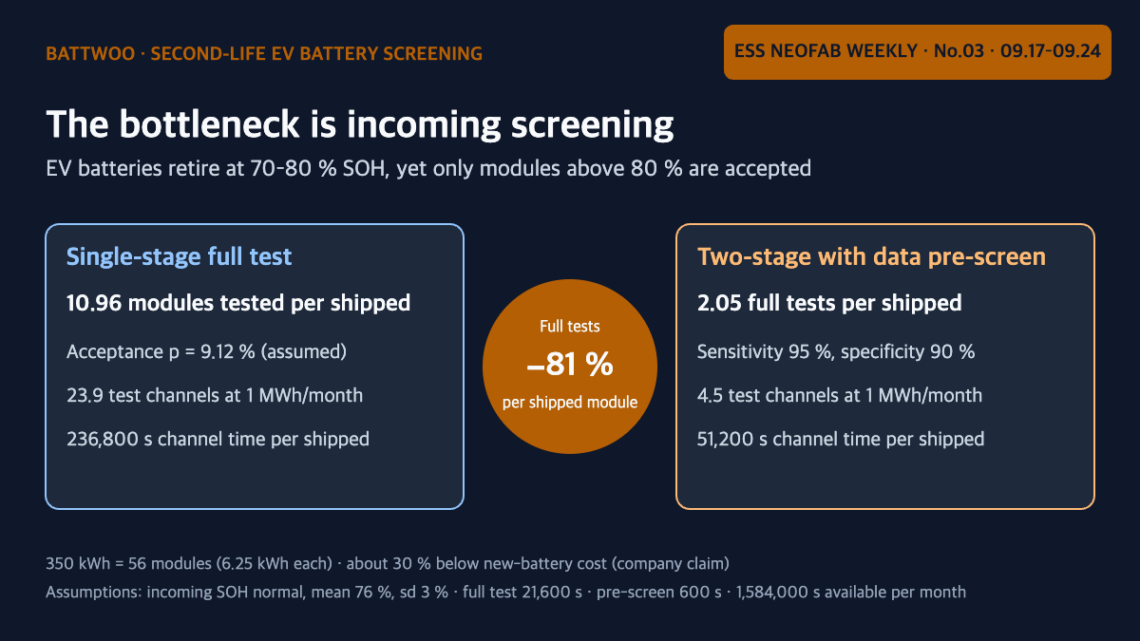
French startup Battwoo refurbishes into stationary ESS only those retired EV batteries that retain more than 80 % of their capacity, while EV batteries typically retire at 70–80 %, and it says a 500 kWh system costs about 30 % less than one built with new batteries¹. When the retirement distribution and the acceptance threshold overlap like this, the acceptance rate is low: assuming incoming SOH with a mean of 76 % and a standard deviation of 3 %, the acceptance rate is 9.1 %, so 11.0 modules must be tested for every module shipped. At an assumed 1 MWh per month of shipments, 23.9 full-capacity test channels are needed,…
-
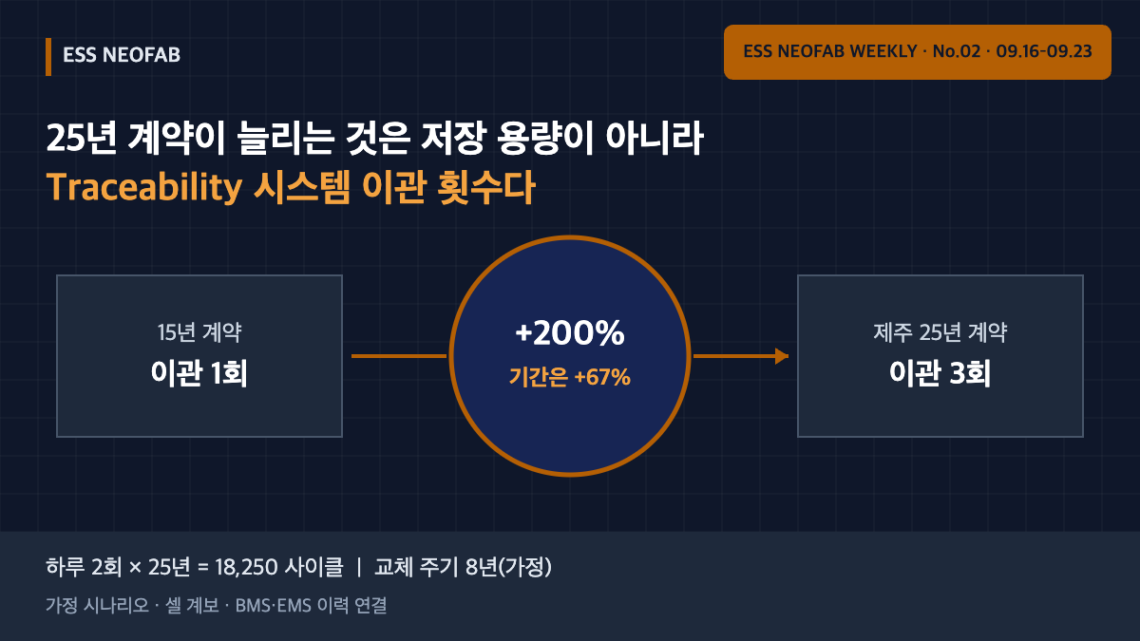
A 25-Year Contract Increases Migrations, Not Storage — Traceability Design for Jeju Long-Term ESS Contracts
Korea’s 2026 ESS central contract market (1,180 MW, opened 22 September 2026) introduced, for the first time, a 25-year contract on Jeju for facilities capable of two charge/discharge cycles per day for 25 years. A longer contract lengthens the retention period for cell-level Traceability records. Under an assumed scenario (8-year system replacement cycle), the contract term grows by 67% but Traceability system migrations triple from one to three, while one generation of cell records is only about 15.9 GB. The design constraint of a 25-year contract is not storage but genealogy breaks at each migration.
-
Introducing Robotic Automation Equipment — Where Does the Interface with Line Takt Time Break Down
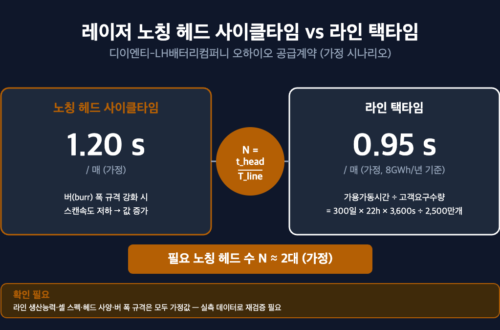
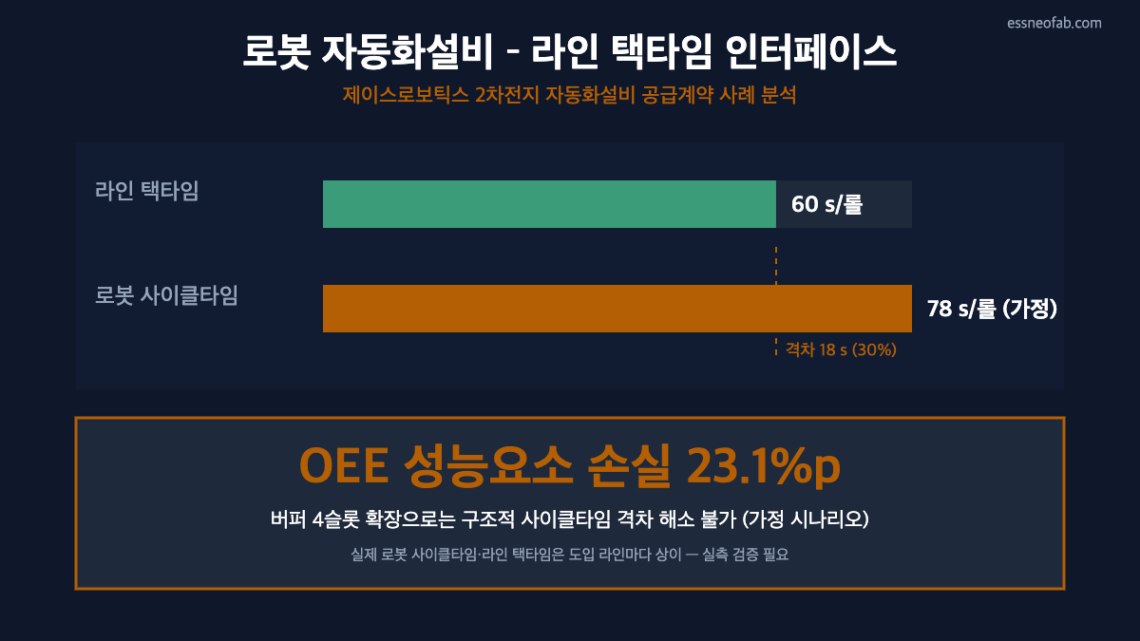
The supply contract disclosed by JS Robotics on September 2, 2026, worth roughly KRW 33.26 billion, for battery-manufacturing robotic automation equipment brings renewed attention to the Cycle Time-Takt Time gap that arises the moment new robotic equipment is connected to an existing R2R (Roll-to-Roll) line. This article calculates an assumed scenario in which one cycle of robotic automation equipment exceeds the line takt time, distinguishing the range of variation that buffer accumulation design can absorb from the structural gap it cannot. The analysis concludes that buffers absorb only micro-stop-level variation, and that a structural gap where the robot's own cycle time exceeds takt time translates directly into OEE performance-factor loss,…
-
Doubling the Renewable-Energy Budget and Underground-Parking EV Fire-Detection AI — Two Signals the 2027 Budget Sends to the ESS Line
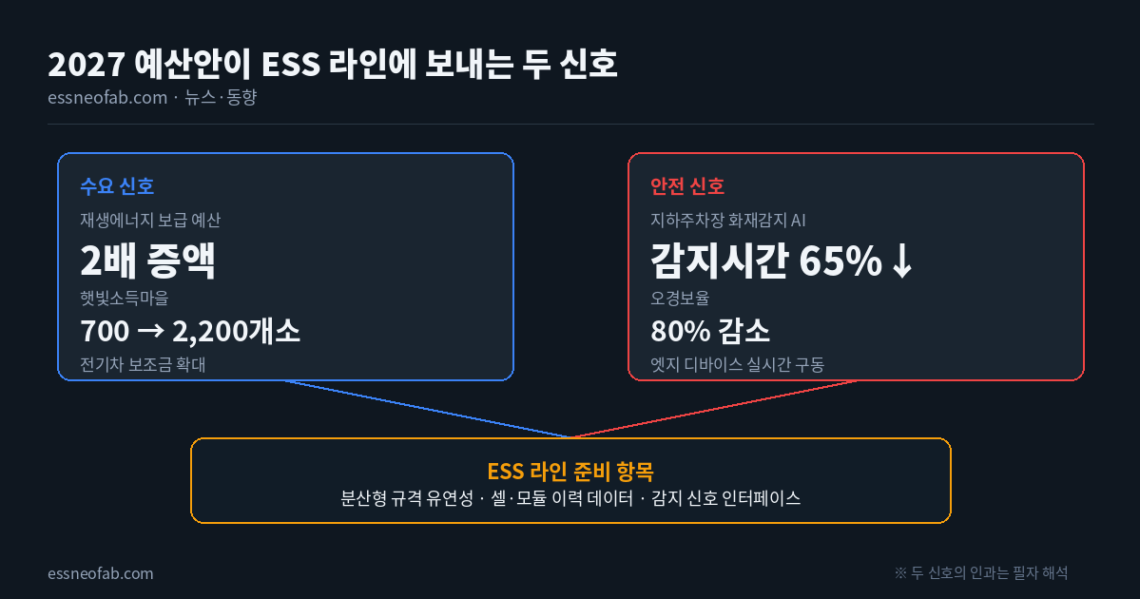
The 2027 government budget doubles the renewable-energy deployment budget, expands "Sunlight Income Villages" from 700 to 2,200 sites, and expands EV subsidies (Source 1). During the same period, an AI model for early detection of EV fires in underground parking garages has been developed domestically to the point of running in real time on edge devices (Source 2). This article reads the two items from an ESS¹ line/system perspective — as a demand signal and a safety signal, respectively — and sets out what the line side should prepare. The conclusion is that "as distributed generation increases, ESS demand increases, but expanded installation is accompanied by tightening fire-safety standards"; this…
You May Also Like

From EV to ESS Use: What Ultium Cells and Cosmos Lab Show About Converting a Line’s Purpose
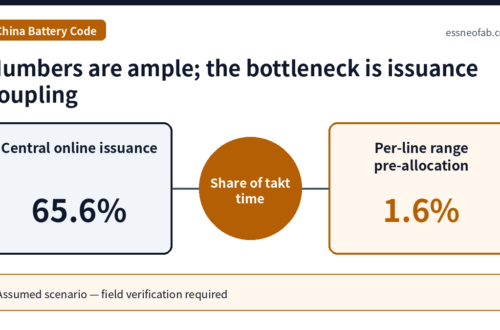
China’s GB/T 34014 24-Character Battery Code: How Code Structure Fixes Issuance Timing and Authority on the Line
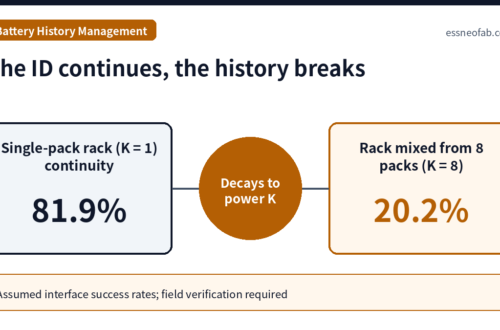
After Korea’s Battery History Management System: IDs Continue, Operating History Breaks — History Continuity of ESS Reuse Racks
-
Line Changeover Design in the Era of Low-Price ESS Round-3 Bidding — Flexible Assembly Viewed Through Takt Time and OEE
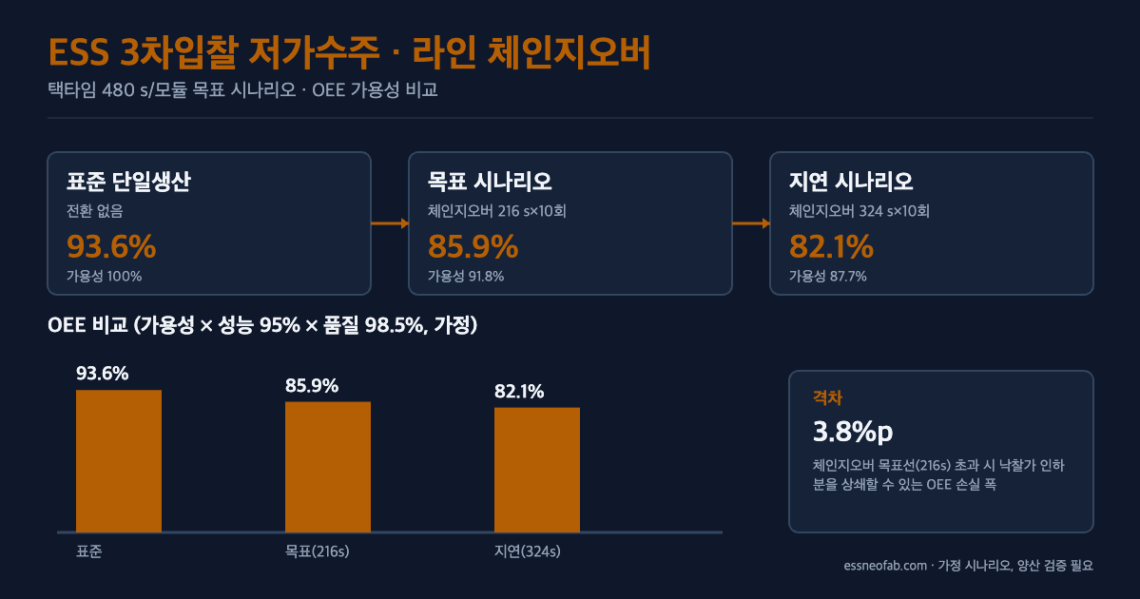
Korea's ESS centralized-contract market Round-3 bid (approximately KRW 1 trillion), scheduled for announcement in September 2026, has already shown a decline in bid prices compared to Rounds 1 and 2, intensifying low-price order competition among the three battery makers. This article focuses on the possibility that this low-price order volume will require cell-format mixed-model flow on an existing single-model production line, and quantifies, as a target scenario, the impact of changeover time on takt time and the OEE Availability factor. The verification shows that controlling changeover time within the 216 s target versus exceeding it by 50% produces an OEE gap of approximately 3.8 pp. However, these figures are an…
You May Also Like
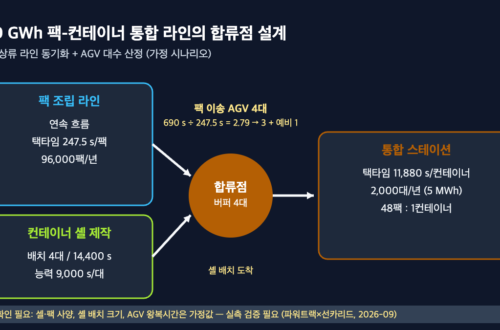
Designing the Merge Point in a 10 GWh Pack-Container Integration Line: Synchronizing Two Upstream Lines and Sizing AGV Fleet from the Powertrac × Sunka Lead Order
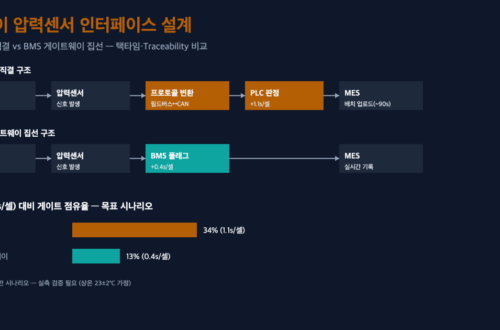
46-Phi Cylindrical Cell Line Conversion: The Pressure-Sensor–BMS Interface Determines Takt Time
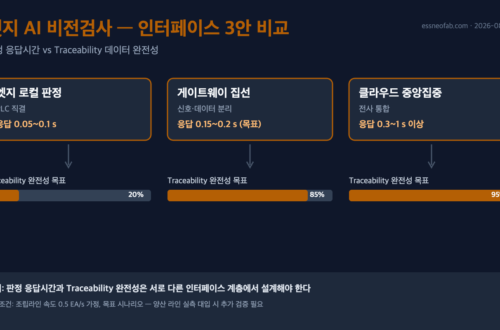
Edge AI Vision Inspection and Battery-Pack Leak Testing: How Gateway Aggregation Affects Traceability Completeness
-
Edge AI Vision Inspection and Battery-Pack Leak Testing: How Gateway Aggregation Affects Traceability Completeness
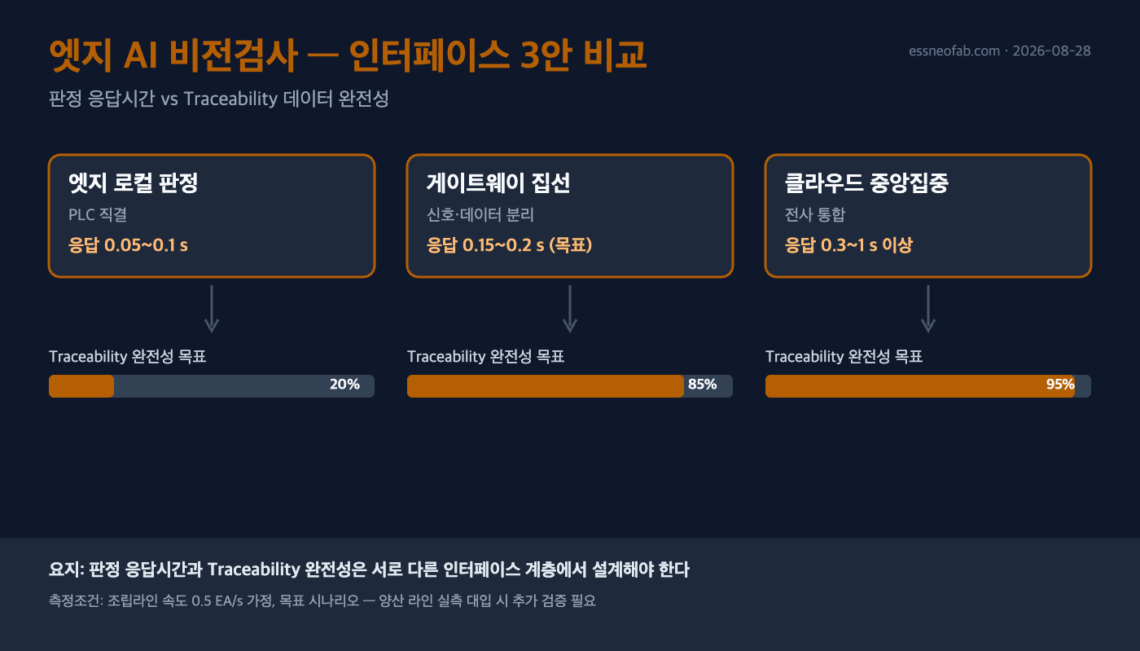
Edge AI vision inspection has already solved the problem of judgment speed itself on battery-pack assembly lines. Combining gas imaging with edge computing, as in GM's disclosed leak-inspection system “BVSeal,” makes per-cell judgment within 3 seconds possible. However, depending on where the judgment result is stored — the edge device locally, a gateway, or the cloud — the completeness of Traceability data remains an entirely different problem. This article compares the data architecture of edge AI vision inspection from an interface-design perspective and presents, as a target scenario, a gateway-aggregation approach that secures Traceability completeness without takt-time loss. 1. Judgment Has Gotten Faster, But the Record Still Breaks To state…
You May Also Like
Designing the Merge Point in a 10 GWh Pack-Container Integration Line: Synchronizing Two Upstream Lines and Sizing AGV Fleet from the Powertrac × Sunka Lead Order
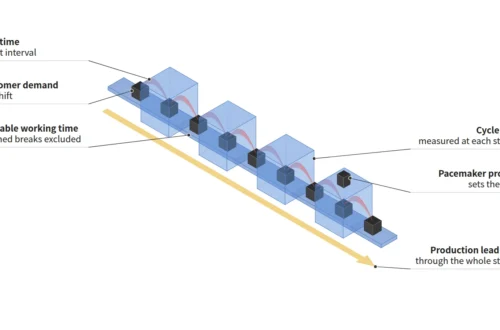
Don’t Subtract Breakdowns When Calculating Takt Time — Takt Time vs. Cycle Time vs. Lead Time
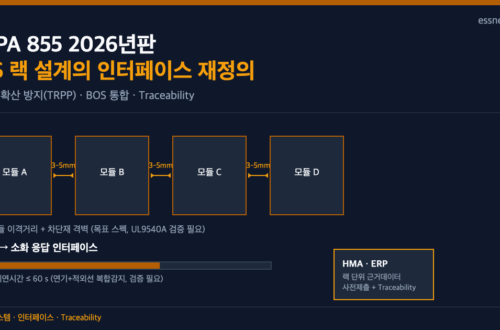
The 2026 Edition of NFPA 855 Changes ESS Rack Design and Traceability Documentation at the Same Time
-
46-Phi Cylindrical Cell Line Conversion: The Pressure-Sensor–BMS Interface Determines Takt Time
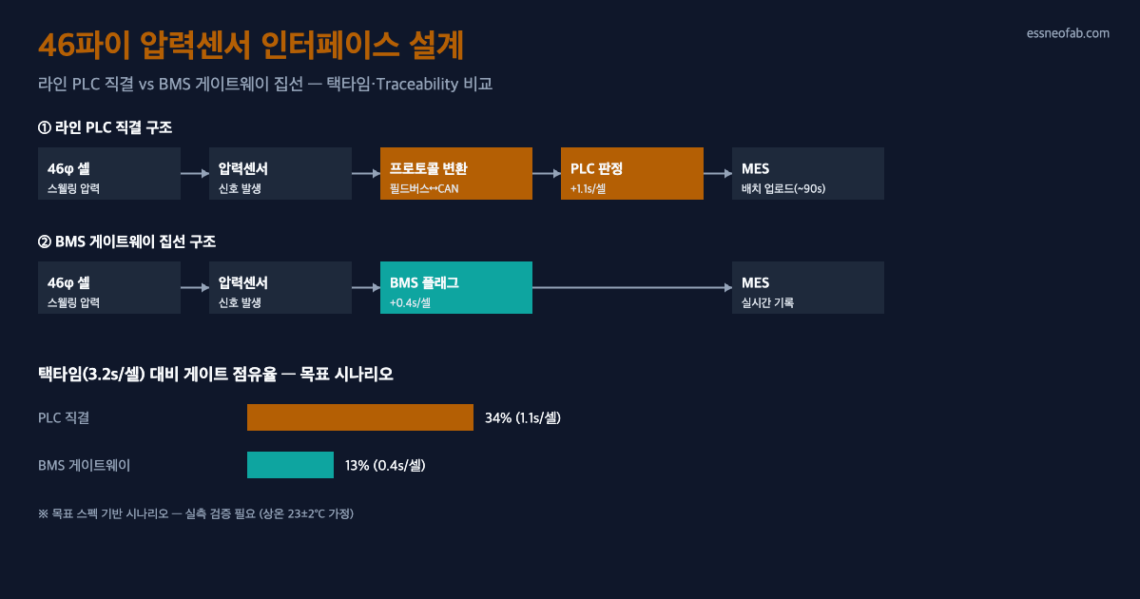
As the transition to 46-series (46-phi) cylindrical cell mass production approaches, how much more finely the swelling-pressure behavior specific to the 46 mm-diameter cell must be measured compared to the 21700 has emerged as a practical line-design variable. As Korea's ESS Round-3 centralized-contract market bid size is under review for expansion to over 1 GW and new ESS orders for AI data centers surge, pressure to expand or convert 46-phi lines is expected to grow further. This article presents the proposition that an interface structure in which pressure-sensor data is first aggregated at the BMS gateway layer — rather than at the line PLC — absorbs per-gate judgment delay within…
You May Also Like
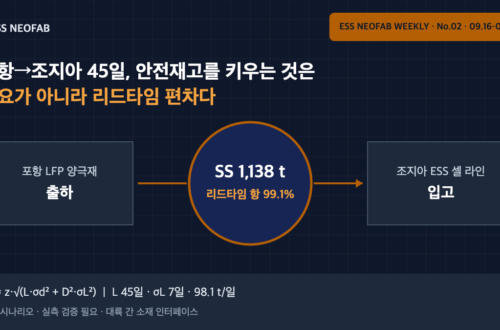
45 Days from Pohang to Georgia — Safety Stock at an Intercontinental Cathode Interface Is Driven by Lead-Time Variability, Not Demand
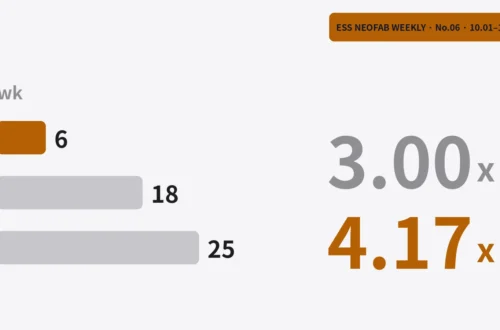
A 160 MW battery’s six-week commissioning has two baselines
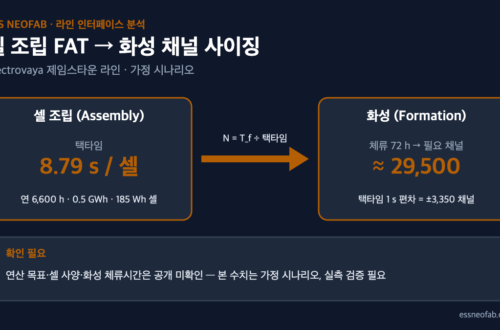
Formation Channel Sizing Read from a Cell Assembly Equipment FAT — How 1 Second of Takt Time Moves 3,350 Channels
-
The 2026 Edition of NFPA 855 Changes ESS Rack Design and Traceability Documentation at the Same Time
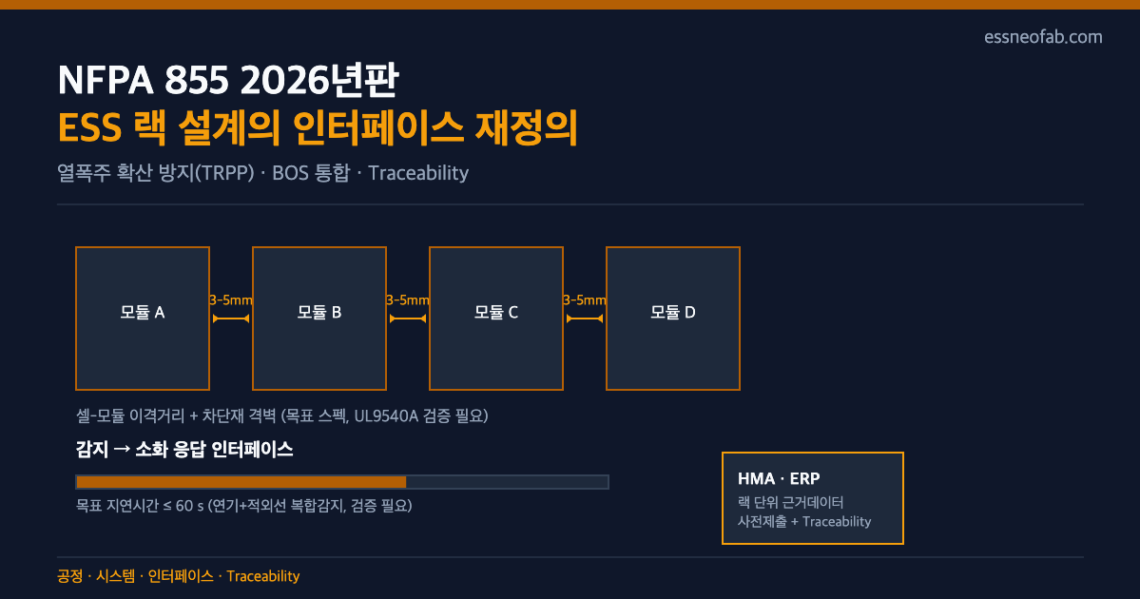
The 2026 edition of NFPA 855 shifts the center of gravity of ESS (Energy Storage System) safety standards from preventing ignition at the cell level to Thermal Runaway Propagation Prevention (TRPP) at the rack/container level. This revision is a line/system-engineering matter, not a problem of the battery's own material properties, in that it brings the entire BOS (Balance of System) — including cell-to-cell spacing, detection interfaces, and cooling wiring — into the scope of design. At the same time, mandatory pre-submission of the HMA (Hazard Mitigation Analysis) and ERP (Emergency Response Plan) to fire authorities has made a Traceability system that tracks and retains design-basis data at the rack level…
You May Also Like
Formation Channel Sizing Read from a Cell Assembly Equipment FAT — How 1 Second of Takt Time Moves 3,350 Channels
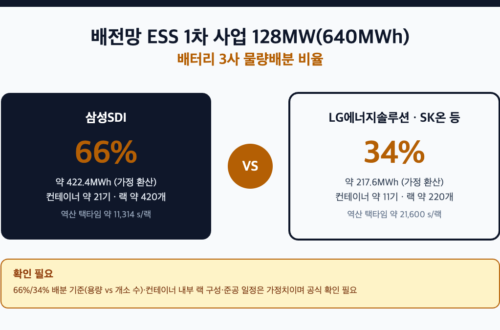
128 MW of Distribution-Grid ESS Volume Allocated — Can the Battery Pack Assembly Line Absorb the Takt Time?
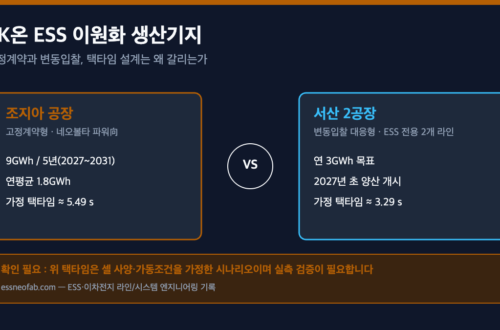
SK On’s Dual-Site ESS Production Bases — Where Fixed Contracts and Variable Bidding Split Takt Time Design
-
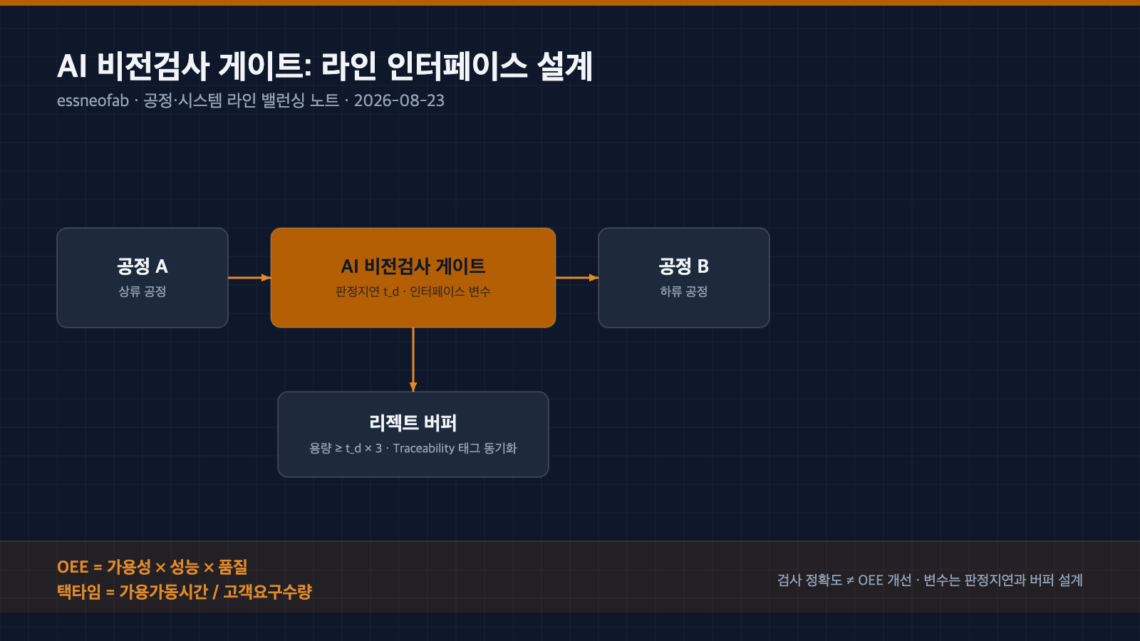
Embedding an AI Vision Inspection Gate in the Line: Redefining OEE and Takt-Time Design Variables
Across battery-line procurement specifications from 2024 to 2026, a trend is confirmed in which the Cognex, Keyence, ISRA, and MVTec deep-learning vision-inspection platforms have effectively become standard fixtures. However, only inspection-accuracy specs are typically stated, while the effect an AI vision-inspection gate has on the line's overall OEE performance rate and takt-time variance is often not treated as a separate design item. This article redefines the AI vision-inspection gate as two interface variables — judgment delay and reject-merge point — and addresses the procedure for incorporating them into line-balancing calculations. To state the conclusion first, it is not the accuracy of the AI vision inspection itself, but the buffer-capacity design…
-
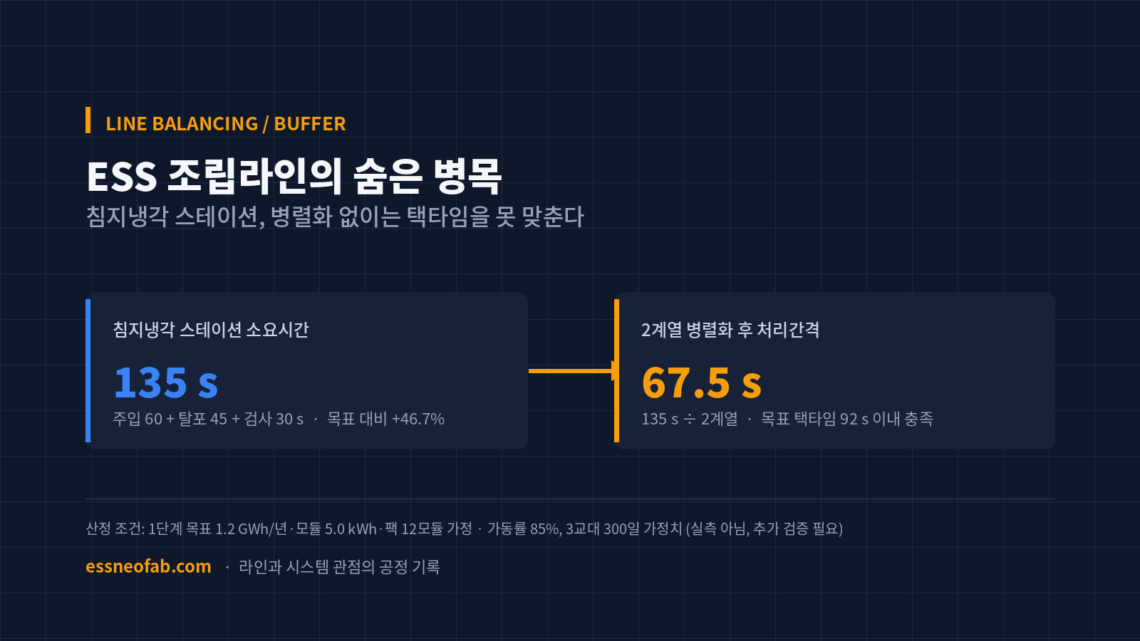
ESS Assembly Line: Why Immersion Cooling Becomes a Bottleneck
This article addresses the line-balancing problem that arises when immersion cooling and AI cell monitoring are simultaneously integrated in-line into an ESS module-pack assembly line. Under the estimation scenario, the immersion-cooling station's process time is 135 s, exceeding the target module takt time of 92 s by 46.7%, making a bottleneck unavoidable with a single-station configuration. Parallelizing into 2 lines lowers the effective processing interval to 67.5 s, satisfying the takt-time condition, but this in turn raises the FIFO buffer size at the point where the two lines merge, and the module-serial tagging of AI monitoring data, as new interface risks. This estimation is a scenario based on assumed values…