A 25-Year Contract Increases Migrations, Not Storage — Traceability Design for Jeju Long-Term ESS Contracts
Abstract
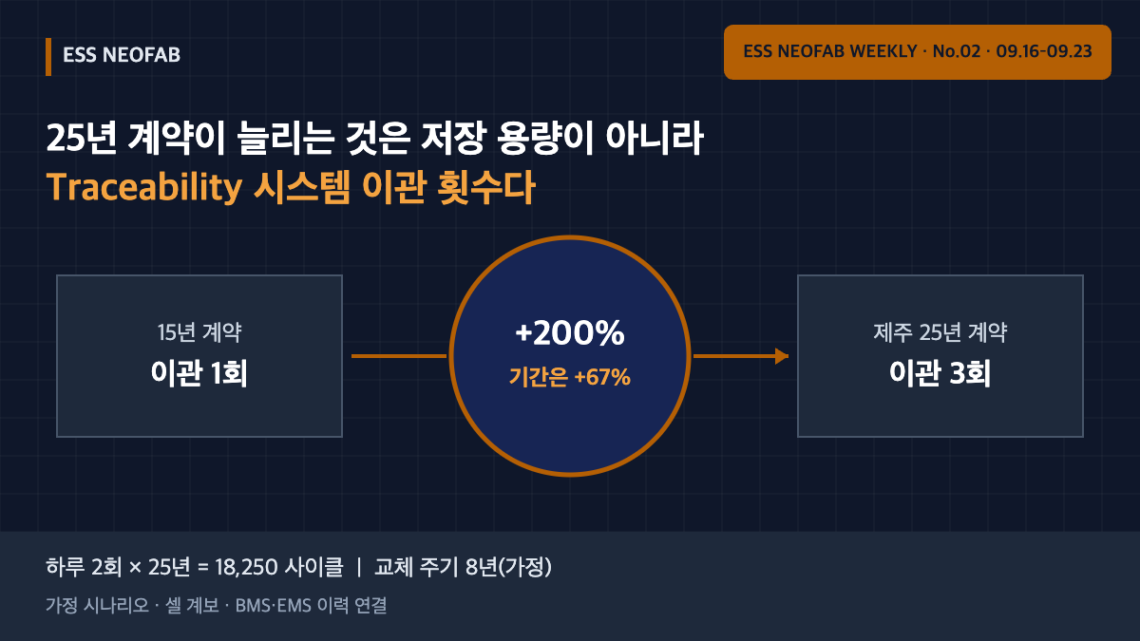
On 22 September 2026, Korea’s Ministry of Climate, Energy and Environment opened an ESS central contract market totalling 1,180 MW (1,100 MW on the mainland, 80 MW on Jeju), and for Jeju introduced, for the first time, a 25-year contract — longer than the existing 15 years — for facilities capable of two charge/discharge cycles per day for 25 years. A longer contract also lengthens the period over which cell-level Traceability¹ records must be preserved. Under an assumed scenario, the contract term grows by 67%, but the number of migrations of the systems that hold Traceability data triples, from one to three. In a 25-year contract, the constraint on Traceability design is not storage capacity but the genealogy links that break at each migration.
1. Conclusion First — A 25-Year Contract Increases Migrations, Not Storage
Under the assumed conditions (system replacement cycle of 8 years), a 15-year contract period involves one Traceability system migration, while a 25-year contract period involves three. Meanwhile, the record volume for one generation of cells is about 15.9 GB and is not a storage constraint.
Situation (S): An ESS cell’s manufacturing history (raw-material lot, process conditions, inspection results) is bound to its cell ID and linked to BMS² data in the operating phase. Complication (C): The Jeju 25-year contract requires the facility to cycle twice a day for 25 years, which greatly increases cumulative cycles and raises the likelihood of cell replacement or augmentation during operation. Question (Q): Where does the Traceability scheme hit its limit first in such a long contract? Answer (A): Not in data volume, but in how many times the systems holding the data change within the contract term.
The assumption this article challenges is that “a longer contract just needs more data storage.” Capacity grows linearly, but system migrations grow in steps each time the contract term crosses a replacement cycle.
2. Announced Facts and Assumed Conditions
The disclosed facts are as follows. This market selects 1,100 MW on the mainland and 80 MW on Jeju, and selected operators must build their ESS by February 2029. Bidding runs until 11 November, and winners will be selected in November. On Jeju, operators may choose a 25-year contract only for facilities capable of two charge/discharge cycles per day for 25 years. Among the existing evaluation items, ‘curtailment level’ and ‘contribution to grid stabilisation’ are merged into ‘contribution to grid stabilisation’.
The storage capacity (MWh) of the Jeju 80 MW, the applicable cell specification, cell cycle life and operators’ data-system replacement cycles have not been disclosed. All figures below are assumptions that require measured verification.
| Item | 15-year contract (baseline) | 25-year contract | Basis |
|---|---|---|---|
| Charge/discharge cycles per day | 2 (same condition assumed) | 2 | Announcement (25-year contract condition) |
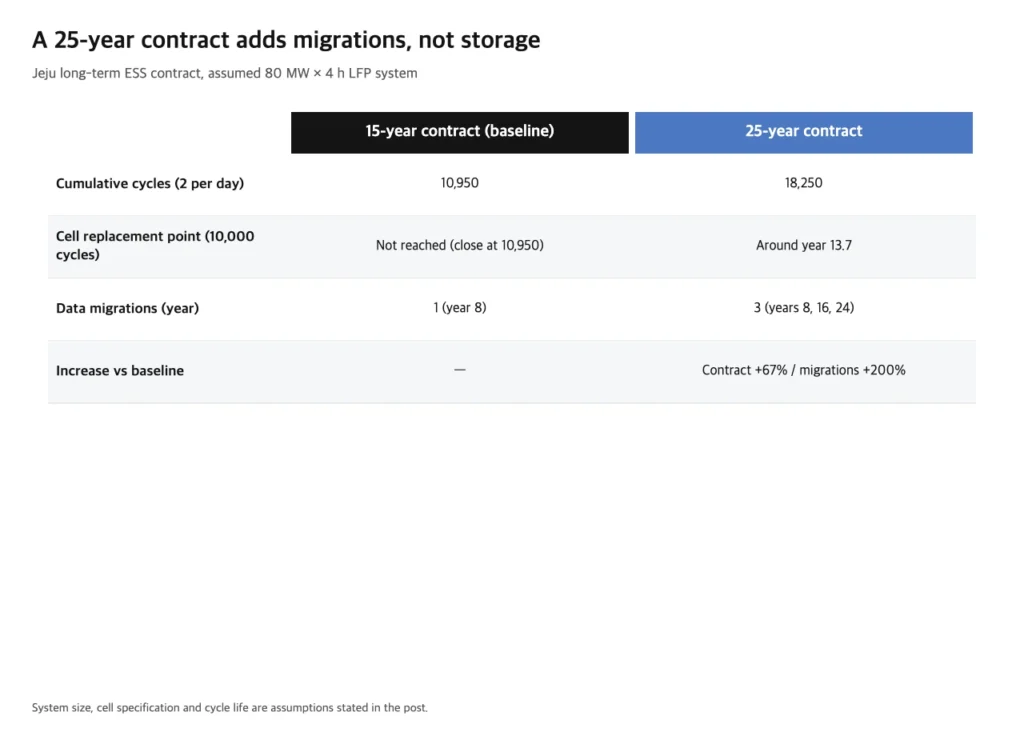
| Cumulative cycles over the term | 10,950 | 18,250 | 2 × 365 × years |
| System size | 80 MW × 4 h = 320 MWh | Assumption (4 h duration) | |
| Cell specification | LFP 314 Ah × 3.2 V = 1.0048 kWh | Assumption | |
| Number of cells (1st generation) | about 318,471 | 320 MWh ÷ 1.0048 kWh | |
| Rated cell cycle life | 10,000 cycles (replacement threshold) | Assumption | |
| Time to replacement threshold | Not reached within term (close at 10,950) | about year 13.7 | 10,000 ÷ 730 |
Under the assumed conditions, the 25-year contract reaches the cell-replacement threshold once during the term. That means two generations of cells manufactured at different times coexist in one system or enter it in sequence. About 636,943 cell IDs are tied into a single facility genealogy.
3. Mechanism — Capacity Is Linear, Migrations Are Stepwise
The storage volume of Traceability data is the number of cells × record size per cell. Assuming 50 KB of manufacturing record per cell, one generation is about 15.9 GB, and both generations together about 31.8 GB. By today’s storage standards this is not a constraint.
The MES, databases and data formats that hold the data, however, are replaced periodically. Assuming an 8-year replacement cycle, the number of migrations grows stepwise as follows.
| Contract term | Migration points (year) | Number of migrations | Increase in term | Increase in migrations |
|---|---|---|---|---|
| 15 years (baseline) | 8 | 1 | — | — |
| 25 years | 8, 16, 24 | 3 | +67% | +200% |
Each migration is a point at which the mapping of cell ID schemes, timestamp formats and inspection-item codes must be re-verified. A single mapping error can break the link between the manufacturing history and operating data of hundreds of thousands of cells. The risk of genealogy breaks is proportional to the number of migrations, not to data volume — this is the core observation of this article.
If the replacement-cycle assumption changes, so do the numbers. With a 10-year cycle, the 15-year contract has one migration and the 25-year contract two. With a 6-year cycle, they have two and four respectively. In every case, the direction holds: the 25-year contract has at least twice as many migrations as the 15-year contract.
4. Implications by System Layer — How BMS and EMS Read the Genealogy
When cells are replaced, original and replacement cells may be mixed within the same rack or string. When the BMS interprets SoH (state of health), the same voltage and temperature signals mean different things if cells differ in manufacturing date and cumulative history. Prior art that uses historical data to determine cell SoH (US9395420B2) also presupposes that each cell’s past records remain continuous.
- Cell layer: Cell IDs and manufacturing lots must be retained regardless of replacement. Replacement cells need a ‘generation field’.
- Rack/string layer: A position–time mapping of which cell in which position was replaced when is required. Without it, BMS history and manufacturing history cannot be re-linked.
- EMS³ layer: The history of the twice-daily charge/discharge schedule is the basis for judging replacement timing and must be preserved for the entire contract term.
The consolidation and emphasis of ‘contribution to grid stabilisation’ among the evaluation items can also be read as meaning that continuity of operating data is directly tied to operator performance. Whether this is specified as a Traceability requirement, however, needs confirmation against the original tender notice.
5. Limitations and Scope
This calculation treats cell cycle life, duration and system replacement cycle as assumptions. Actual cycle life varies widely with depth of discharge, temperature and C-rate, and operators may choose augmentation instead of replacement. The announcement also does not confirm whether ‘two charge/discharge cycles per day’ means full cycles.
The direction of the conclusion — migration risk rises stepwise each time the contract term exceeds a multiple of the data-system replacement cycle — holds independently of these assumptions. This conclusion is a calculation scenario and requires further verification before being applied to an actual project.
FAQ
Q. Doesn’t storing everything in the cloud eliminate the migration problem?
It reduces the storage-media lifetime problem. But the essence of migration risk is not the medium; it is the mapping of ID schemes, data formats and inspection codes. Schema changes and service transitions still occur within cloud services, so the perspective of counting migrations remains necessary.
Q. If cells are replaced under a 15-year contract, isn’t it the same problem?
It is the same kind of problem. Under the assumed conditions, however, the 15-year contract reaches 10,950 cumulative cycles — just about at the replacement threshold (10,000) — with only one migration. In the 25-year contract, replacement definitely falls in mid-term and migrations rise to three, so both risks overlap within the same period.
Field Application Notes
| Check | How to execute | Remarks |
|---|---|---|
| ☐ Estimate migrations relative to contract term | Confirm the replacement cycle of the current MES/DB and mark migration points within the contract term by year | Use the format of Table 2 |
| ☐ Secure a cell generation field | Check whether cell master data has a ‘generation/replacement’ field; request one if not | Prevents genealogy breaks for replacement cells |
| ☐ Design a position–time mapping table | Record cell ID and installation/replacement date for each rack, string and slot position | Prerequisite for re-linking BMS history |
| ☐ Document a migration verification procedure | Write in advance a procedure that checks manufacturing-to-operating history links for a random sample of cells at each migration | Agree sample size and acceptance criteria beforehand |
| ☐ Check bid proposal requirements | Check data-retention and grid-contribution requirements in the original tender notice | Item not confirmed in the original (confirmation required) |
Footnotes
¹ Traceability: The ability to link manufacturing and operating history from raw-material lot through cell, module and rack into a single ID genealogy and trace it backward.
² BMS (Battery Management System): The battery management system that monitors cell voltage, temperature and current and estimates SoC and SoH.
³ EMS (Energy Management System): The energy management system that manages charge/discharge schedules and grid-connected operation.
Sources: Aju Business Daily, “ESS central contract market opens 1,180 MW tender… 25-year long-term contract introduced for Jeju for the first time” (2026-09-22). Financial News (Korea), “Government opens 3rd ESS central contract market, to select 1,180 MW of operators” (2026-09-22). Prior-art reference patent (no new patents were found in the most recent 7 days, so the search was extended to 30 days; no newly published items were confirmed in that window either, so the patent is cited as general prior art only): US9395420B2 (Historical analysis of battery cells for determining state of health, published 2016-07-19).
Measurement and calculation conditions: Duration 4 h, cell 314 Ah/3.2 V, cell cycle life 10,000 cycles, 50 KB record per cell and 8-year system replacement cycle are all assumptions. The comparison baseline is a 15-year contract with the same cycling (twice a day). Temperature, humidity, sample size and similar measurement conditions are not applicable (calculation scenario). Not to be cited for finalising a project plan without measured verification.
Other Articles in This Issue
ESS NEOFAB WEEKLY No.02 · Research window 2026-09-16 to 2026-09-23
- 45 Days from Pohang to Georgia — Safety Stock at an Intercontinental Cathode Interface Is Driven by Lead-Time Variability, Not Demand (published 2026-09-23)
- A 2.5 GWh Line Fed Only 1 GWh of Cells — OEE of 36.9% and 83.8% Describe the Same Line (2026-09-25)


2 Comments
Pingback:
Pingback: