-
A 25-Year Contract Increases Migrations, Not Storage — Traceability Design for Jeju Long-Term ESS Contracts
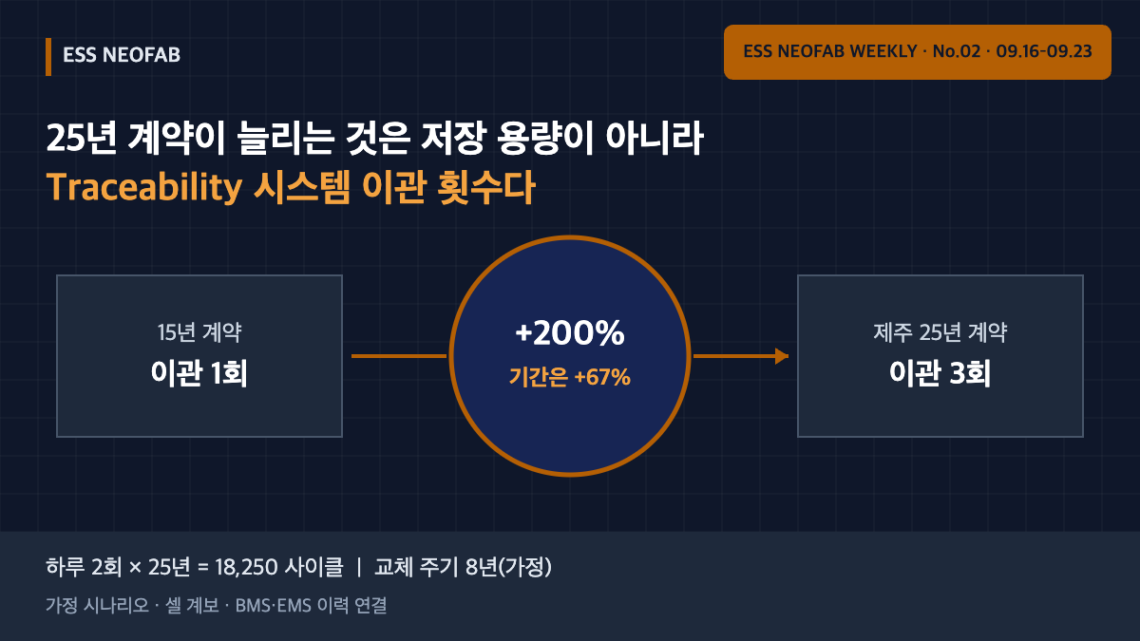
Korea’s 2026 ESS central contract market (1,180 MW, opened 22 September 2026) introduced, for the first time, a 25-year contract on Jeju for facilities capable of two charge/discharge cycles per day for 25 years. A longer contract lengthens the retention period for cell-level Traceability records. Under an assumed scenario (8-year system replacement cycle), the contract term grows by 67% but Traceability system migrations triple from one to three, while one generation of cell records is only about 15.9 GB. The design constraint of a 25-year contract is not storage but genealogy breaks at each migration.
You May Also Like
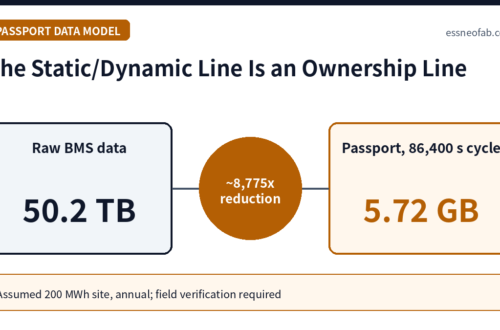
Battery Passport Static vs Dynamic Data: Ownership and Update Interfaces Across ESS Layers
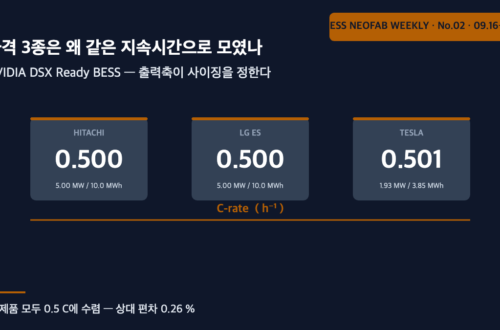
Why three qualified products landed on the same duration — in DSX Ready BESS, sizing is set by the output axis
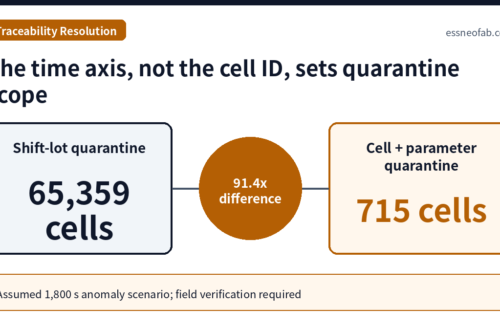
Recall and Quarantine Scope vs Traceability Resolution: Lot Tracking Compared with Cell-Plus-Parameter Tracking
-
Linking BMS Operating History to the Battery Passport: Why Sampling and Retention Must Be Separated
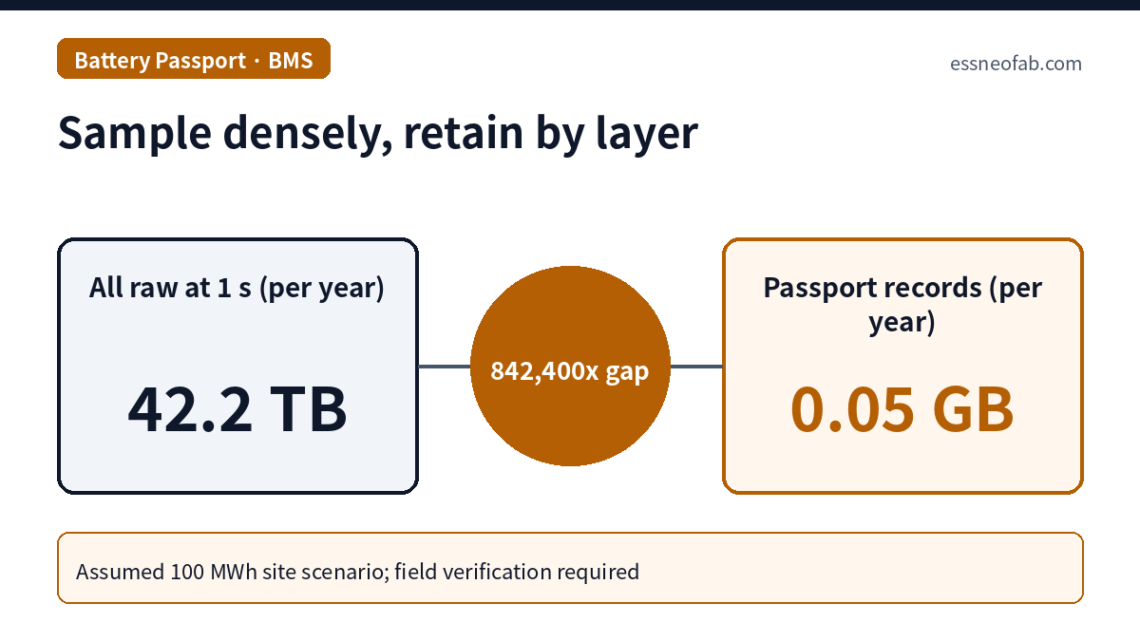
When the dynamic BMS data required by Article 14 and Annex VII of the EU Battery Regulation (Regulation (EU) 2023/1542) is linked to the battery passport[1], the variable that determines data volume is not the sampling period but which layer retains what. At a site of roughly 100 MWh (111,488 cells, assumed), retaining all raw cell data at 1 s accumulates 42.2 TB per year and 421.9 TB over 10 years, whereas aggregating the Annex VII parameters into daily rack-level records yields about 0.05 GB per year, roughly 1/840,000 of that. Conversely, sampling a 20 s abnormal event at a 60 s period drops the detection probability to 33.3%. A…