Linking BMS Operating History to the Battery Passport: Why Sampling and Retention Must Be Separated
Abstract
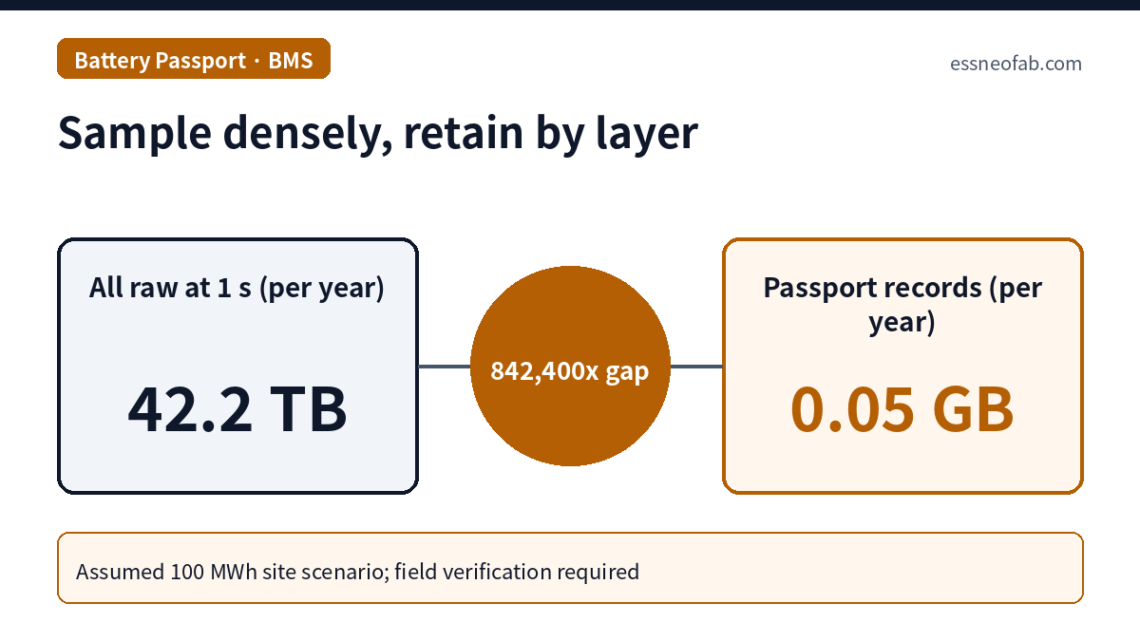
When the dynamic BMS data required by Article 14 and Annex VII of the EU Battery Regulation (Regulation (EU) 2023/1542) is linked to the battery passport[1], the variable that determines data volume is not the sampling period but which layer retains what. At a site of roughly 100 MWh (111,488 cells, assumed), retaining all raw cell data at 1 s accumulates 42.2 TB per year and 421.9 TB over 10 years, whereas aggregating the Annex VII parameters into daily rack-level records yields about 0.05 GB per year, roughly 1/840,000 of that. Conversely, sampling a 20 s abnormal event at a 60 s period drops the detection probability to 33.3%. A three-layer design is therefore rational: let the shortest event to be detected set the sampling period, and let the passport resolution set transmission and retention, keeping the two variables separate.
1. Conclusion First — Passport Data Is Small; the Problem Is the Sampling That Produces It
The dynamic data layer of the battery passport is an accuracy problem, not a capacity problem. The values sent to the passport amount to a few hundred bytes per day, but their accuracy is bound to the period, in s, at which the raw signal was observed at the site edge.
Situation (S): Article 14 of the EU Battery Regulation requires stationary BESS[2], LMT and EV batteries with a BMS to hold up-to-date data on the parameters for determining SoH[3] and expected lifetime laid down in Annex VII, applicable since 18 August 2024. Complication (C): The Article 77 battery passport becomes mandatory from 18 February 2027 for, among others, industrial batteries above 2 kWh, yet the Article 77(9) implementing act defining passport access rights missed its 18 August 2026 deadline and has slipped to Q4 2026 (reported 2026-09-08).
Question (Q): In this window, where the application date stands but the detailed rules are empty, at what period in s should site BMS history be sampled and how much should be retained? Answer (A): Separating raw signals, continuous aggregates and passport records into three layers reduces 10-year retention from 421.9 TB to about 10.5 TB while keeping event-detection accuracy at the 1 s level.
The assumption this article refutes is that “passport compliance requires uploading and storing BMS data densely.” Once the form of the parameters required by the regulation is examined, what must be dense is the sampling, not the transmission and retention.
2. Mechanism — Annex VII Parameters Are Integrals and Counters
Annex VII is split into two parts. Part A contains the parameters for determining SoH; Part B contains the parameters for determining expected lifetime. Table 1 summarizes the data form of each parameter and the resolution at which the raw signal must be observed to produce it.
| Part | Parameter (Annex VII) | Data form | Sensitivity to raw-signal resolution |
|---|---|---|---|
| Part A(1) | Remaining capacity | Estimate (periodic update) | Low — integration over charge/discharge intervals |
| Part A(2)·(3) | Remaining power capability, remaining round trip efficiency (where possible) | Estimate (periodic update) | Medium — pulse and interval energy calculation |
| Part A(4)·(5) | Evolution of self-discharge rates, ohmic resistance (resistance where possible) | Trend value | Medium — voltage behavior during rest intervals |
| Part B(2)·(3) | Energy throughput[4], capacity throughput | Cumulative counter (kWh, Ah) | Low — current integration |
| Part B(4) | Deep discharge events, cumulative time in extreme temperatures, cumulative time charging during extreme temperatures | Event counter / cumulative time (s) | High — risk of missing short events |
| Part B(5) | Number of full charge-discharge cycles | Cumulative counter | Low |
The point of Table 1 is that every value passed to the passport is an integral, trend or counter. Because these are not raw time series, transmission volume is independent of the sampling period. The Part B(4) event counters, however, miss short events if the raw signal is observed at a long period, and a missed event cannot be reconstructed afterward.
The regulation body sets no numerical update period. Recital 46 recommends updating at least daily, and the mandatory update interval remains subject to follow-up work under standardization request M/579 (EUROMOT FAQ 2025-05, DIN DKE SPEC 99100). At present it is therefore a variable the site designer must set.
3. Calculation — Annual Data Volume of a 100 MWh Site
The assumed scenario is as follows: cells of 280 Ah and 3.2 V (0.896 kWh per cell), racks of 1P416S (372.7 kWh), 268 racks, 111,488 cells and 99.9 MWh in total. Measurement points are one voltage point per cell plus one temperature point per two cells, i.e., 1.5 points per cell and 167,232 points in total. One record of one point is 8 bytes (4-byte value plus a 4-byte share of timestamp and tag), with no compression. Annual operation is 31,536,000 s.
| Recording method | Period | Annual volume | 10-year retention | Edge-to-upstream rate | Detection probability of a 20 s event |
|---|---|---|---|---|---|
| All raw cell data | 1 s | 42.2 TB | 421.9 TB | 1.34 MB/s | 100% |
| All raw cell data | 10 s | 4.22 TB | 42.2 TB | 0.13 MB/s | 100% |
| All raw cell data | 60 s | 0.70 TB | 7.03 TB | 0.022 MB/s | 33.3% |
| All raw cell data | 900 s | 0.047 TB | 0.47 TB | 0.0015 MB/s | 2.2% |
| Passport record (per rack, Annex VII aggregate) | 86,400 s | about 0.05 GB | about 0.5 GB | — | Depends on edge sampling period |
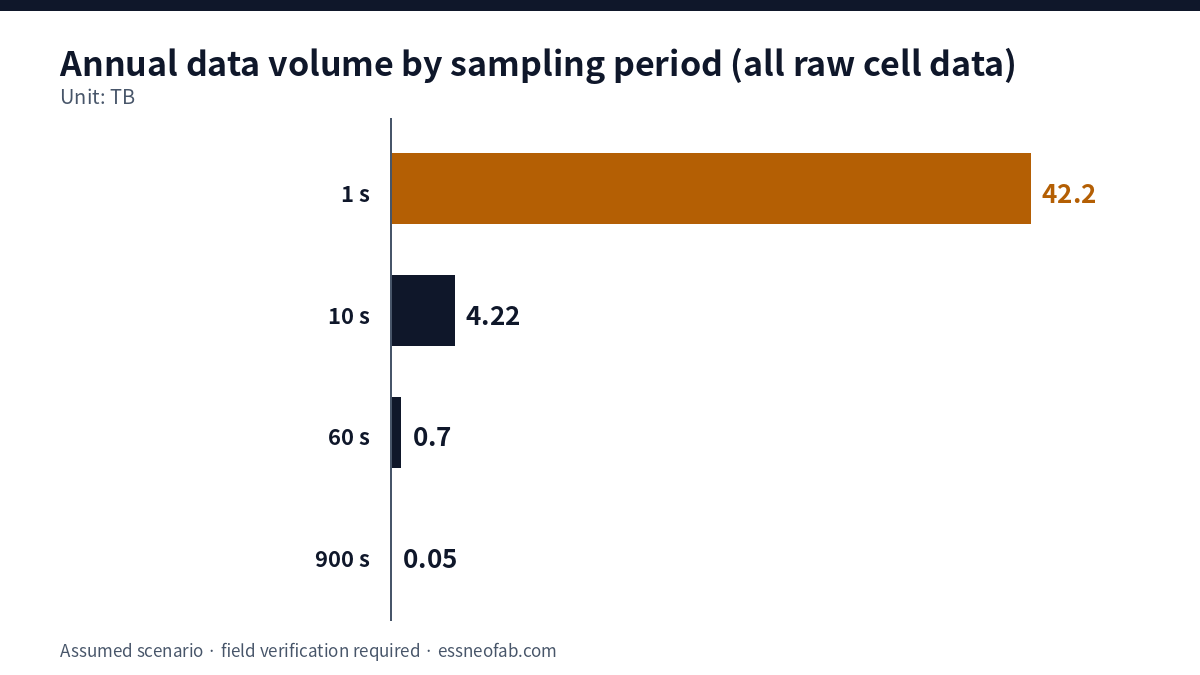
Taking 1 s all-raw recording (42.2 TB per year) as the baseline, stretching the period to 60 s cuts data volume by 98.3% but drops the detection probability of a 20 s event from 100% to 33.3%. The key is that these two figures do not move in the same direction. The moment the sampling period is lengthened to save data, the Part B(4) deep-discharge and extreme-temperature counters become systematically under-counted.
By contrast, passport records are about 1/840,000 of 1 s all-raw data (a factor of 842,400). Passport transmission and retention barely change whether the sampling period is 1 s or 900 s. In short, “at what period to sample” and “how much to upload and retain” are different variables, and tying them to a single setting is a common design error.
4. Design — A Three-Layer Structure Separating Sampling from Retention
The structure derived from this analysis has three layers. Layer 1, at the site edge (the gateway above the BMS), receives 1 s raw signals, continuously updates the Annex VII counters and keeps raw data in a ring buffer[5] for only 30 days (2,592,000 s). Layer 2 retains 60 s statistics (mean, maximum, minimum) in the site history database for 10 years. Layer 3 sends daily rack-level passport records to the passport backend.
The 10-year retention of this structure is about 10.5 TB: 3.47 TB of ring buffer, 7.03 TB of 60 s history and 0.5 GB of passport records. That is a 97.5% reduction against 10-year retention of all 1 s data (421.9 TB), with no loss of detection accuracy because the event counters are computed from 1 s raw signals. If the 60 s statistics keep only means, however, extreme-temperature intervals are smoothed out, so maxima and minima must also be kept, and the actual Layer 2 capacity may then exceed the assumption (field verification required).
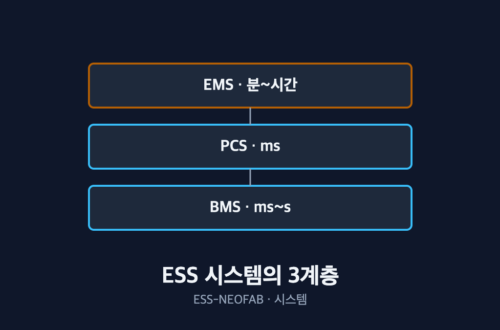
The layer addressed here is data retention and delivery. The article on speed differences across the BMS, PCS and EMS layers analyzed response-speed mismatch in control loops, which is a different concern. The speed required for control and the resolution required for history start from the same BMS signals but carry different requirements. Also, unlike the article on cell ID event rates, which found traceability load proportional to cell count, passport load in the operating phase scales with the number of passport units (racks or systems), not cells.
The limits of application are clear. Whether one passport in a stationary BESS corresponds to a rack, a container or the whole system depends on the manufacturer’s unit of placing on the market, and neither passport access rights (Article 77(9) implementing act) nor the mandatory update interval has been finalized. The record count and period of Layer 3 therefore need readjustment once the rules are settled.
5. Conclusion and Implications
When Annex VII parameters are linked to the battery passport, data volume is not a design issue. The issue is the accuracy of passport values, which is determined by the edge sampling period. In this assumed scenario, the difference between 1 s and 60 s sampling is effectively zero in passport transmission volume but 66.7 percentage points in the detection probability of a 20 s event.
The design sequence should therefore be not “retention budget → sampling period” but “shortest event to be detected → sampling period → retention period per layer.” The shortest event duration depends on cell specifications and operating strategy, so the 20 s value is an assumption of this article and requires further verification against each site’s measured event distribution.
FAQ
Q. If the 60 s statistics keep maxima and minima anyway, won’t a 20 s event still be captured?
A. Yes, if the raw signal enters the edge at 1 s and the maximum and minimum of each 60 s window are computed there. That is equivalent to the three-layer structure described above. The problem arises when the upstream BMS communication itself is polled at 60 s, in which case the extremes inside the window are never observed. This is why sampling period and retention resolution must be distinguished.
Q. If the regulation does not set an update period, isn’t uploading more often than daily safer?
A. As long as records take the form of counters, shortening the transmission period adds almost no information and only increases communication and backend load and access-rights management cost. From a controlled-variable standpoint it is preferable to align the passport record period with the recommendation (at least daily) and the finalized implementing act, and to secure accuracy at the edge layer.
Field Application Notes
The following items can be executed first thing Monday morning.
| Check | How to execute | Remarks |
|---|---|---|
| ☐ Confirm the current upstream BMS polling period | Extract the acquisition period (s) of cell voltage and temperature, item by item, from gateway and SCADA settings | Always distinguish polling period from storage period |
| ☐ Derive the distribution of shortest event durations | Pull durations (s) of deep-discharge and over-temperature alarms from the past year’s alarm log and check the lowest 10% value | This value is the upper bound for the sampling period |
| ☐ Assign where Annex VII counters are computed | Specify that energy and capacity throughput, cumulative extreme-temperature time and deep-discharge count are computed at the edge from 1 s signals | Recomputation on an upstream server cannot recover missed samples |
| ☐ Document retention periods per layer | Prepare a one-page table of period, retention and capacity (TB) for raw (ring buffer), statistics and passport records | Recalculate Table 2 with your own point count |
| ☐ Confirm the passport unit (rack/system) | Obtain written confirmation from the manufacturer of the unit placed on the market and the unit covered by one passport | Basis for record count and access-rights design |
Footnotes
[1] Battery Passport: An electronic record linked to a unique identifier for each individual battery under Article 77 of the EU Battery Regulation, divided into public, legitimate-interest and authority access tiers.
[2] BESS (Battery Energy Storage System): Power storage equipment that integrates batteries, PCS, BMS, thermal management and control into a single unit.
[3] SoH (State of Health): A measure of the extent to which a battery can deliver its specified performance compared with its initial condition. For stationary BESS it is determined by a combination of the parameters in Annex VII Part A.
[4] Energy throughput: The cumulative energy (kWh) charged or discharged by a battery over its operating period.
[5] Ring buffer: A storage structure that reuses a fixed capacity cyclically, overwriting the oldest records first. Used for short-term retention of raw data for incident analysis.
Sources: Regulation (EU) 2023/1542 concerning batteries and waste batteries, EUR-Lex, 2023-07-12, https://eur-lex.europa.eu/eli/reg/2023/1542/oj/eng / DIN DKE SPEC 99100:2025-02, Requirements for data attributes of the battery passport, Battery Pass consortium, DIN, DKE, 2025-02, https://thebatterypass.eu/assets/images/content-guidance/pdf/DIN_DKE_SPEC_99100.PDF / Batteries Regulation Briefing, Energy Storage Europe, 2023-08-25, https://energystorageeurope.eu/wp-content/uploads/2023/08/Batteries-Regulation-Briefing-25.08.2023_for-distribution.pdf / FAQ on EU Battery Regulation, EUROMOT, 2025-05-02, https://www.euromot.eu/wp-content/uploads/2025/05/2025-05-02-EUROMOT-FAQ-Batteries-Regulation.pdf / VDE information paper on the Battery Regulation (EU) 2023/1542, VDE, https://www.vde.com/resource/blob/2308300/0609b56a29220934a4276b673c76c176/download-infopapier-zur-batterieverordnung-data.pdf / Battery passport access rights: the Article 77(9) implementing act missed its 18 August 2026 deadline, eudigitalproductpassport.org, 2026-09-08, https://eudigitalproductpassport.org/updates/battery-passport-access-rights-implementing-act-delay
Measurement & Calculation Conditions: Cells of 280 Ah and 3.2 V, racks of 1P416S, 268 racks (99.9 MWh), 1.5 measurement points per cell, 8 bytes per point record, no compression, 31,536,000 s per year, 20 s event duration, one 512-byte passport record per rack per day, and a 2,592,000 s ring buffer are all assumed values. The Annex VII clause mapping follows DIN DKE SPEC 99100 and requires cross-checking against the regulation text. Actual point counts, compression ratios and event distributions differ by site, so field verification is required.


You May Also Like
BMS, PCS, EMS: Why Do the Three ESS System Layers Move at Different Speeds?
Recall and Quarantine Scope vs Traceability Resolution: Lot Tracking Compared with Cell-Plus-Parameter Tracking