본문으로 바로가기
Ess-neofab

A line- and system-level record of ESS and secondary-battery manufacturing processes

  • 한국어
  • English
  • Home
  • Process
  • System
  • Interface
  • Traceability
  • News & Trends
  • About
  • Contact
  • 한국어
  • English
  • Home
  • Process
  • System
  • Interface
  • Traceability
  • News & Trends
  • About
  • Contact

카테고리

  • Interface (28)
  • News & Trends (20)
  • Process (32)
  • System (31)
  • Traceability (22)

최근 글

  • Five million ACC cells equal 2.7 to 3.6 months of nameplate outputOctober 15, 2026
  • A 160 MW battery’s six-week commissioning has two baselinesOctober 8, 2026
  • Two Cycles a Day Take 106.8 % of a Day, and the Retention Tier Shifts Cell Volume by 1.47 GWhOctober 1, 2026
  • Battwoo’s Second-Life EV Batteries — When an 80 % Acceptance Threshold Overlaps the Retirement Distribution, Incoming Screening Becomes the BottleneckSeptember 30, 2026
  • US storage set an energy record in Q2 as installed power fell 7%September 29, 2026
  • CATL Starts Trial Production in Debrecen — The Digits of the Defect-Rate Target, Not the Equipment, Set the Length of a Trial RunSeptember 29, 2026
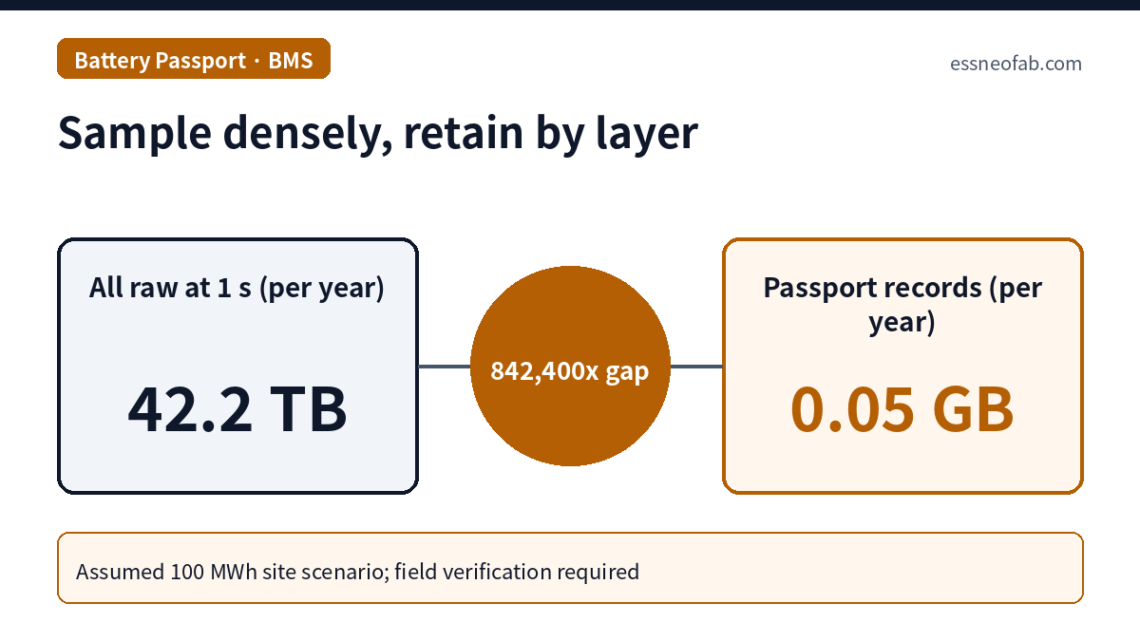
  • Sample densely, retain by layer
    System,  Traceability

    Linking BMS Operating History to the Battery Passport: Why Sampling and Retention Must Be Separated

    July 9, 2026 /

    When the dynamic BMS data required by Article 14 and Annex VII of the EU Battery Regulation (Regulation (EU) 2023/1542) is linked to the battery passport[1], the variable that determines data volume is not the sampling period but which layer retains what. At a site of roughly 100 MWh (111,488 cells, assumed), retaining all raw cell data at 1 s accumulates 42.2 TB per year and 421.9 TB over 10 years, whereas aggregating the Annex VII parameters into daily rack-level records yields about 0.05 GB per year, roughly 1/840,000 of that. Conversely, sampling a 20 s abnormal event at a 60 s period drops the detection probability to 33.3%. A…

    read more
    ESS-neofab Comments Off on Linking BMS Operating History to the Battery Passport: Why Sampling and Retention Must Be Separated

    You May Also Like

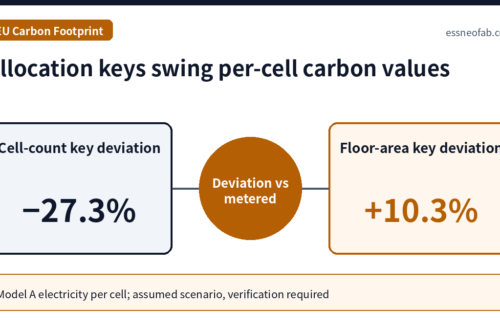
    Allocation keys swing per-cell carbon values

    EU Battery Carbon Footprint Methodology Still Pending: How Line Energy Metering Resolution and Allocation Choice Shift Per-Cell Values
    July 8, 2026
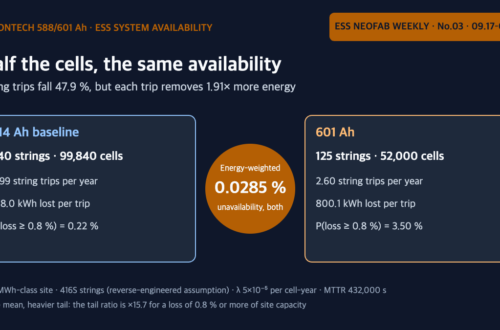
    대형 LFP 셀 314 Ah와 601 Ah의 100 MWh급 ESS 스트링 정지 건수와 에너지 가중 비가용률 비교 도식

    Pylontech’s 588 Ah and 601 Ah LFP Cells Enter Mass Production — Why Energy-Weighted Availability Stays the Same When the Cell Count Halves
    September 28, 2026
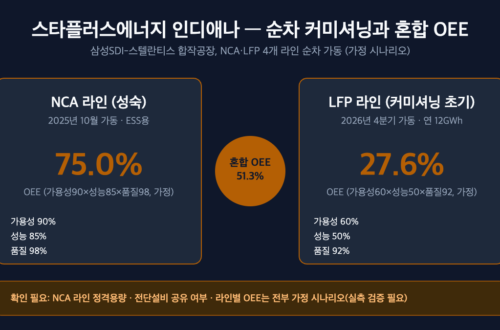
    삼성SDI 스타플러스에너지 인디애나 공장의 NCA·LFP 라인 순차 커미셔닝 일정과 혼합 OEE 개념도

    StarPlus Energy’s Indiana Plant — The Blended-OEE Illusion Created by Sequential NCA/LFP Commissioning
    September 9, 2026
© 2026 Ess-neofab · A line- and system-level record of ESS and secondary-battery manufacturing processes
  • About
  • Contact
  • Privacy Policy
  • Disclaimer
Ashe Theme by WP Royal.