Pylontech’s 588 Ah and 601 Ah LFP Cells Enter Mass Production — Why Energy-Weighted Availability Stays the Same When the Cell Count Halves
Abstract
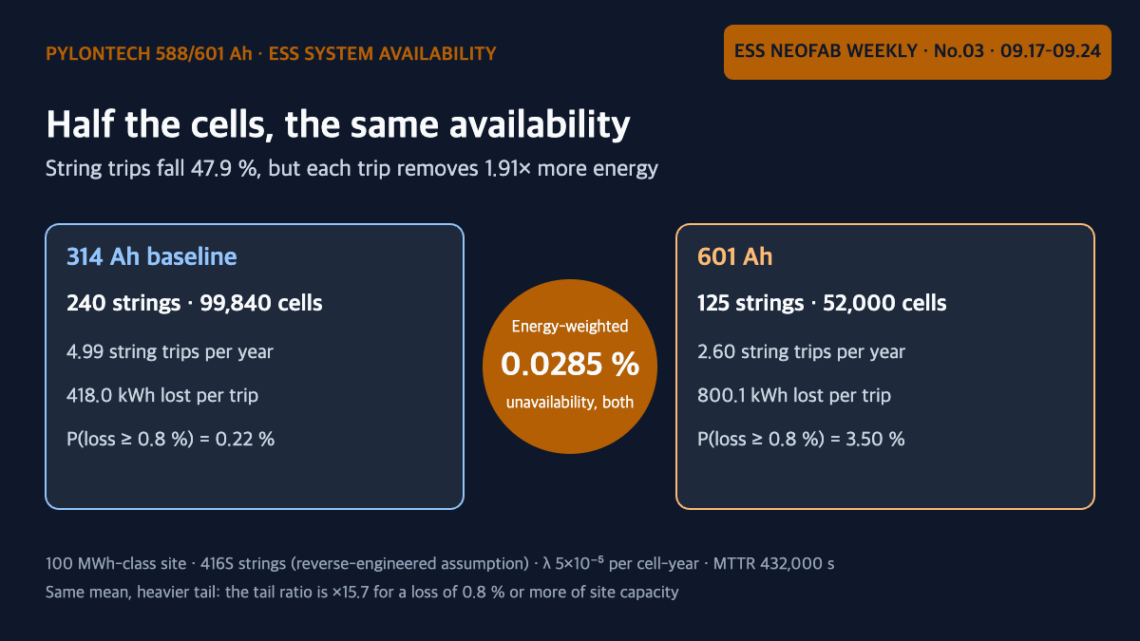
On September 21, 2026, Pylontech began mass production of 588 Ah and 601 Ah prismatic LFP ESS cells at its Hefei base and named “fewer cells and interconnections” as a benefit of the larger format¹. Under a reverse-engineered assumption of 416S strings, a 100 MWh-class site drops from 99,840 cells to 52,000 cells (−47.9 %), and string trips caused by cell-count-proportional faults fall at the same rate. Each trip, however, now removes 800.1 kWh instead of 418.0 kWh (1.91×), so the energy-weighted unavailability stays at 0.0285 % regardless of cell capacity. The mean is unchanged and only the tail gets heavier: the probability of losing 0.8 % or more of site capacity at the same moment rises from 0.22 % to 3.50 %, a factor of 15.7.
1. Conclusion First — Larger Cells Mean Fewer Faults, Not Higher Availability
The conclusion fits in three lines. Upsizing cells reduces the number of maintenance dispatches, but it does not change the mean energy-weighted availability; it only increases the amount of capacity lost at once. The variables that raise availability are the mean time to repair (MTTR) and the isolation unit, not the cell size.
The situation (S) is clear. ESS cells are moving from the 314 Ah class to 500 Ah and above, and Pylontech reports having already produced more than 100 MWh of its 588 Ah and 601 Ah cells¹. The complication (C) is that the effect of upsizing is usually compressed into one sentence: fewer cells and interconnections improve integration efficiency and lifecycle economics. The question (Q) is simple: if the cell count halves, does site availability improve? The answer (A), as the calculation below shows, is “event counts improve, the mean stays the same, and the tail gets worse.”
| Item | Published value | Use in this article |
|---|---|---|
| Start of mass production | 2026-09-21, Hefei manufacturing base | Reference event |
| Cell capacity | 588 Ah and 601 Ah (prismatic LFP) | String energy back-calculation |
| Cumulative output | More than 100 MWh of the new cells | Confirms production scale |
| 601 Ah performance | 425.8 Wh/L, more than 12,000 cycles, 96.5 % efficiency | Reference (not used in calculation) |
| Target systems | PyOcean 6.25 MWh and 8 MWh | String configuration back-calculation |
| Production set-up | More than 120 robots, 180 sets of intelligent equipment, 100 % cell-level MES traceability | Data source for estimating λ (Section 4) |
2. Mechanism — String Voltage Fixes the Series Count, and Cell Capacity Cancels Out
A string is a set of series-connected cells and the smallest operating unit that the BMS (Battery Management System)² disconnects at once through a DC contactor. Because the string voltage is set by the PCS input range, the series count n is fixed regardless of cell capacity. This article takes n = 416 (3.2 V × 416 ≈ 1,331 V) as a reverse-engineered assumption. With 588 Ah × 3.2 V × 416 = 782.7 kWh, eight strings give 6.262 MWh; with 601 Ah, 800.1 kWh × 10 = 8.0005 MWh, matching the nominal 6.25 MWh and 8 MWh (not a published specification; to be confirmed).
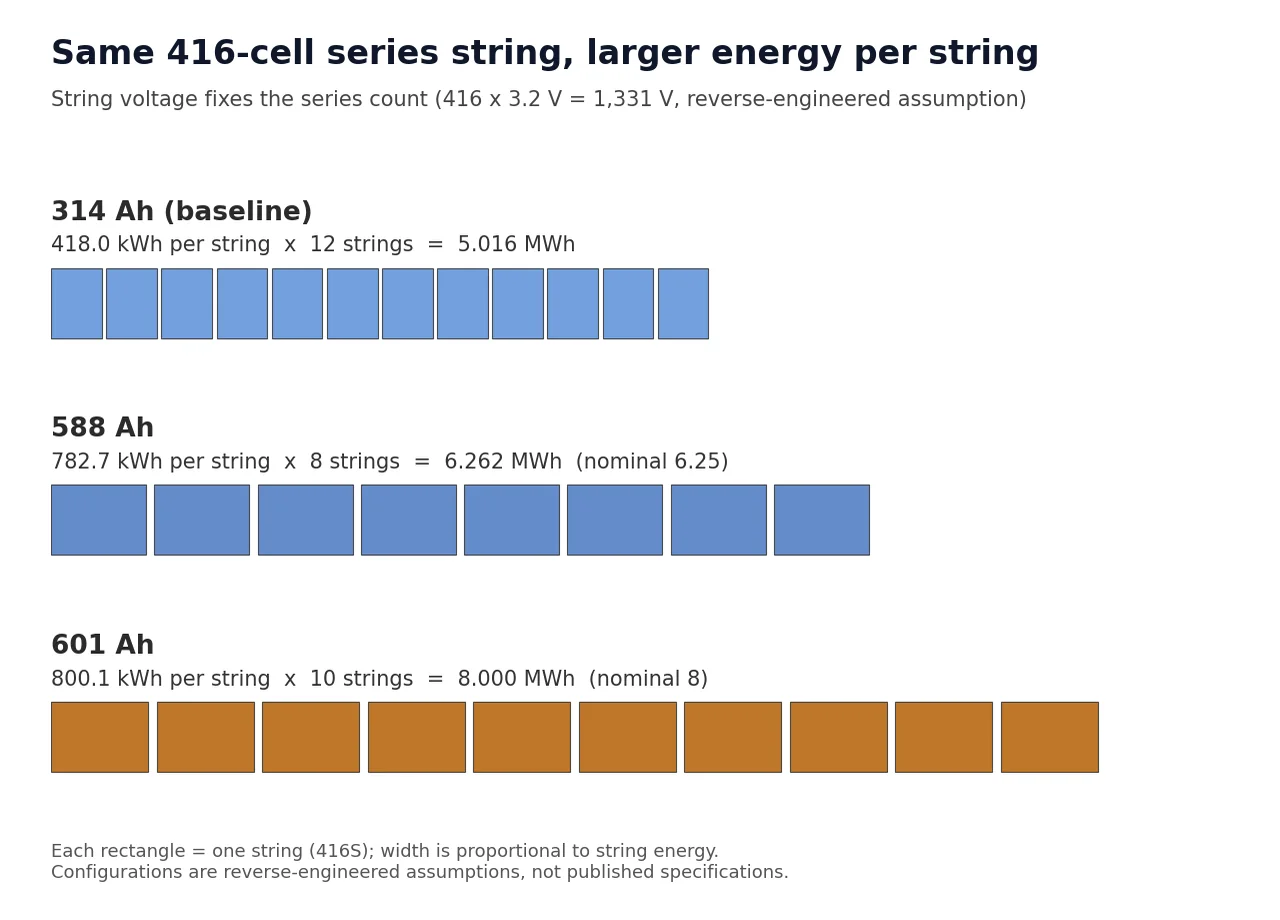
The baseline is twelve 314 Ah × 416S strings of 418.0 kWh (5.016 MWh), the same 100 MWh assumed site (99,840 cells, 240 racks) used in an earlier analysis on this site (#524). With site energy E, string count N, annual string-trip failure rate per cell λ and MTTR, the annual number of trips is N·n·λ and the energy removed per trip is E/N. Multiplying the two cancels N, leaving an energy-weighted unavailability of U = n·λ·MTTR/T (T = one year = 31,536,000 s).
Energy-weighted availability is the time-averaged operable energy divided by rated energy, and it is a different metric from the availability term of the line KPI OEE (= availability × performance × quality), which compares actual run time with planned run time. Mixing the two produces misreadings such as “availability went up because the cell count went down.” The key observation of this article is that cell capacity does not appear in the equation.
3. Calculation — Same Mean, a 15.7× Heavier Tail at a 100 MWh-Class Site
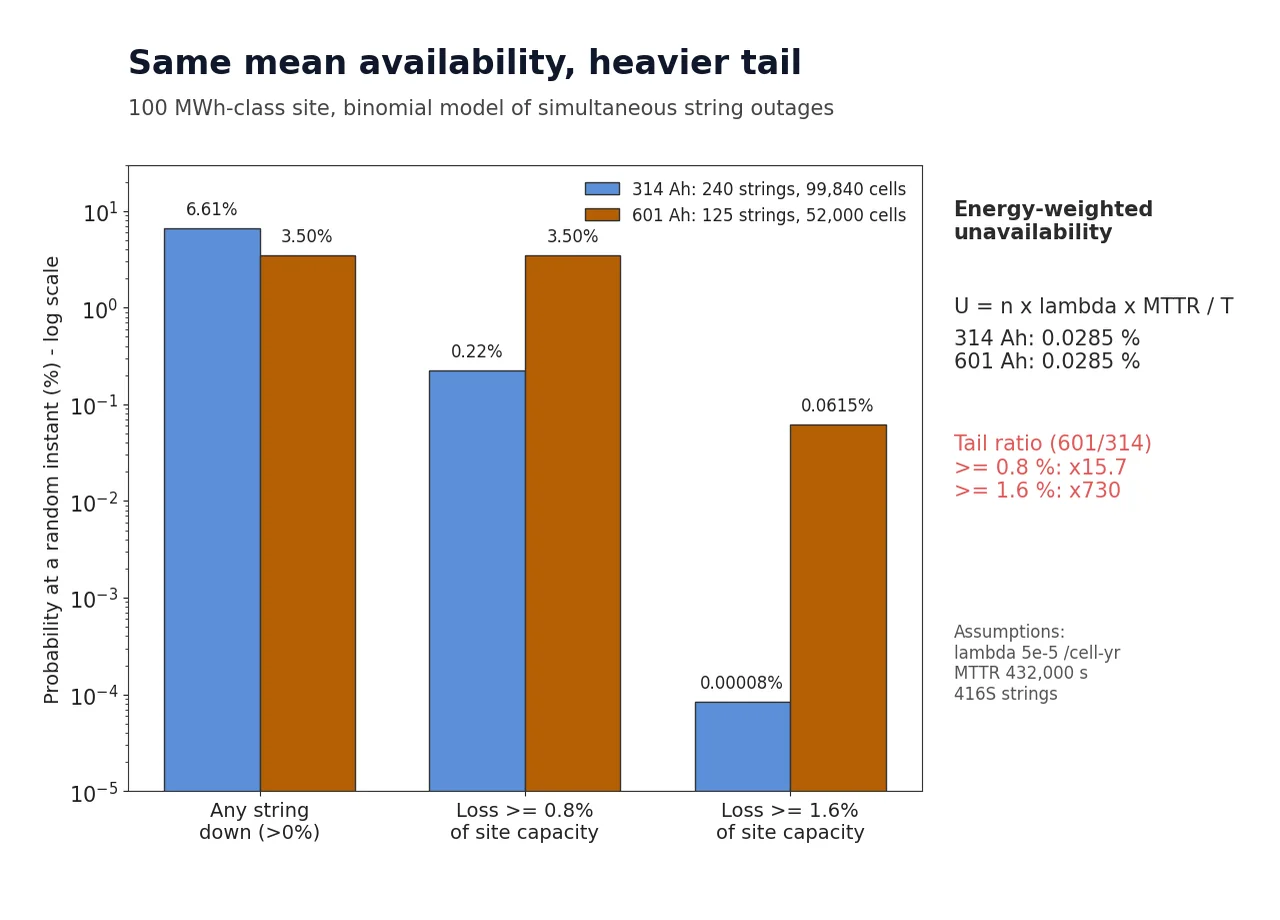
Assuming λ = 5×10⁻⁵ per cell-year and MTTR = 432,000 s, the unavailability of a single string is q = 416 × 5×10⁻⁵ × 432,000 / 31,536,000 = 2.849×10⁻⁴. The site size was matched as 240 strings at 314 Ah (100,319 kWh) and 125 strings at 601 Ah (100,006 kWh), and the number of simultaneously stopped strings was computed with a binomial distribution. The baseline is the 314 Ah site, and every difference comes from the failure granularity, i.e., the unit of energy that one failure removes.
| Metric | 314 Ah baseline | 601 Ah | Change |
|---|---|---|---|
| Strings / cells | 240 / 99,840 | 125 / 52,000 | Cells −47.9 % |
| String trips per year | 4.99 | 2.60 | −47.9 % |
| Energy removed per trip | 418.0 kWh | 800.1 kWh | ×1.91 |
| Energy-weighted unavailability | 0.0285 % | 0.0285 % | Same |
| Time-averaged energy offline | 28.6 kWh | 28.5 kWh | Same (0.3 % size difference) |
| Probability that one or more strings are down | 6.61 % | 3.50 % | More time at full capacity |
| Probability of losing 0.8 % or more at once | 0.223 % | 3.50 % | ×15.7 |
| Probability of losing 1.6 % or more at once | 0.00008 % | 0.0615 % | ×730 |
※ Calculation conditions: 416S strings (reverse-engineered assumption), λ 5×10⁻⁵ per cell-year (assumption; string-trip causes summed over cells, terminal joints and voltage/temperature sensing channels), MTTR 432,000 s (assumption; including parts procurement, replacement and re-commissioning), independent failures between strings, a stopped string is fully offline (no partial operation), temperature, humidity and degradation effects not included. Implication: under contracts that look only at mean metrics there is no difference, but where a threshold such as “instantaneous available capacity ≥ contracted value” applies, the large-cell site breaches it more often.
The direction of sensitivity is also clear. If λ comes from defects proportional to cell capacity (electrode area) rather than cell count, λ for the 601 Ah cell rises 1.91-fold and so does unavailability. If count-proportional and capacity-proportional causes are split half and half, the factor is 1.46. In other words, within this model there is no case in which the large cell wins on mean availability; it wins only when MTTR goes down.
4. Line and System Implications — The Availability Levers Are MTTR and the Isolation Unit
The benefits of fewer cells are real in the factory and in the field. When the number of cells per MWh falls from 995.2 to 520.0, cell loading, welding and BMS voltage channels on the pack line fall at the same rate, and field maintenance dispatches drop from 4.99 to 2.60 per year. The name of that benefit, however, is cost and labor, not availability.
Three levers actually move availability. First, a field spare-parts strategy that shortens MTTR: the larger the string energy, the more spare-cell and module inventory should be sized by energy removed rather than by event count. Second, the isolation unit: module-level disconnection or bypass inside a string reduces the failure granularity, but it is constrained by voltage range and protection design and must be confirmed product by product.
Third, the BMS fault domain. If one sensing channel’s false reading escalates to a whole-string trip, a large share of λ comes from the measurement layer rather than from the cells. Splitting measurement circuitry into fault-isolated domains (US8598840B2)³ and three-tier BMU–cluster–array management (CN103227494A)⁴ are known as general prior art. Pylontech’s stated 100 % cell-level MES traceability¹ connects directly to this discussion as a data source for measuring λ lot by lot.
This article sits on a different layer from #291 (station-block scale-up and the unit- versus energy-proportional split of commissioning labor). Where #291 dealt with installation labor, this article deals with the distribution of availability during operation. Where #524 dealt with the points where board replacement breaks genealogy, this article isolates only the effect of cell size on operating availability under the same site assumption.
5. Conclusion and Limitations
Large cells halve the cell count, but as long as the string series count is fixed by voltage, the mean energy-weighted availability is set by n·λ·MTTR alone. What changes is the shape of the distribution: more time at full capacity and larger losses at once. A large-cell adoption review is therefore more accurate when it states “fewer maintenance events, heavier tail risk” rather than “improved availability.”
The limitations are equally clear. λ and MTTR are assumptions, and whether heavier cells lengthen replacement MTTR or whether partial string operation is possible differs by product. Until measured cell-level failure data separate the count-proportional and capacity-proportional shares of λ, this conclusion remains a model result and requires further verification.
FAQ
Q1. If interconnections are halved, shouldn’t reliability improve?
The number of interconnections across the site halves, but the number of series cells and joints inside one string stays at 416. Site trips therefore halve while the energy removed per trip doubles, and the mean offline energy cancels out. Measured by “event count,” reliability improves; measured by “energy,” it does not change.
Q2. Is it reasonable to assume that the cell failure rate does not depend on cell size?
It is reasonable for causes counted per cell, such as terminal joints and sensing channels. If defects proportional to electrode area (foreign particles, micro-shorts) dominate, λ increases and the large cell becomes worse (up to 1.91×). This article does not estimate which cause dominates; it must be confirmed by lot-level measurement.
Q3. Does this mean there is no reason to use large cells?
No. A roughly 48 % reduction in cell loading, welding, BMS channels and maintenance dispatches is a clear cost benefit. Writing that benefit into availability guarantees, however, would be an over-promise, so it should be handled separately from the contract’s availability formula.
Field Application Notes
| Check | How to execute | Decision criterion | Remarks |
|---|---|---|---|
| ☐ Confirm the contractual availability formula | Tabulate whether the LTSA or capacity contract defines availability as time-weighted or energy-weighted, and whether instantaneous threshold clauses exist | If a threshold clause exists, calculate the tail probability separately | Mandatory before adopting large cells |
| ☐ Measure string MTTR | Aggregate string stop-to-return times (s) over the last 12 months by cause | Deviation from the assumed 432,000 s | Report median and 90th percentile |
| ☐ Re-size spare-parts criteria | Recalculate spare-cell and module inventory by energy removed rather than by trip count | Target 0 s of waiting caused by stock-outs | Assumed target |
| ☐ Review BMS fault domains | List paths where a single sensor or AFE fault leads to a whole-string trip | Share of measurement-induced trips | To be confirmed |
| ☐ Record the simultaneous-stop distribution | Build a monthly histogram of simultaneously stopped strings | Cumulative time with 0.8 % or more lost | Tracks tail risk |
Sources and Notes
¹ Pylontech, “Pylontech Starts Mass Production of 588Ah and 601Ah LFP Cells for ESS,” PR Newswire, 2026-09-22 (mass production started 09-21). Cell capacities, cumulative output, 601 Ah performance, PyOcean 6.25/8 MWh, 120 robots, 180 equipment sets and cell-level MES traceability are cited.
² BMS (Battery Management System): the lowest control layer of the ESS system hierarchy, responsible for cell voltage and temperature measurement, protective disconnection and balancing.
³ US8598840B2, “Fault-tolerant battery management system, circuits and methods,” LaunchPoint Energy and Power LLC, published 2013-12-03 (patents.google.com). Cited as general prior art.
⁴ CN103227494A, “Energy storage battery management system,” GUODIAN New Energy Technology Institute et al., published 2013-07-31 (patents.google.com). Cited as general prior art.
※ Patent search: no new patents were found in the most recent 7 days by publication date, so the search was widened to 30 days, still with no new relevant patents. The patents above do not correspond one-to-one to this case.
※ The 416S string configuration, λ and MTTR are all assumed scenarios and require verification against measured data.
Other Articles in This Issue
- CATL Starts Trial Production in Debrecen — The Digits of the Defect-Rate Target, Not the Equipment, Set the Length of a Trial Run
- Battwoo’s Second-Life EV Batteries — When an 80 % Acceptance Threshold Overlaps the Retirement Distribution, Incoming Screening Becomes the Bottleneck


You May Also Like
ESS Assembly Line: Why Immersion Cooling Becomes a Bottleneck
Between the Continuous Solid-Electrolyte Process and the Assembly Line: How Should the Buffer Interface Be Designed?