-
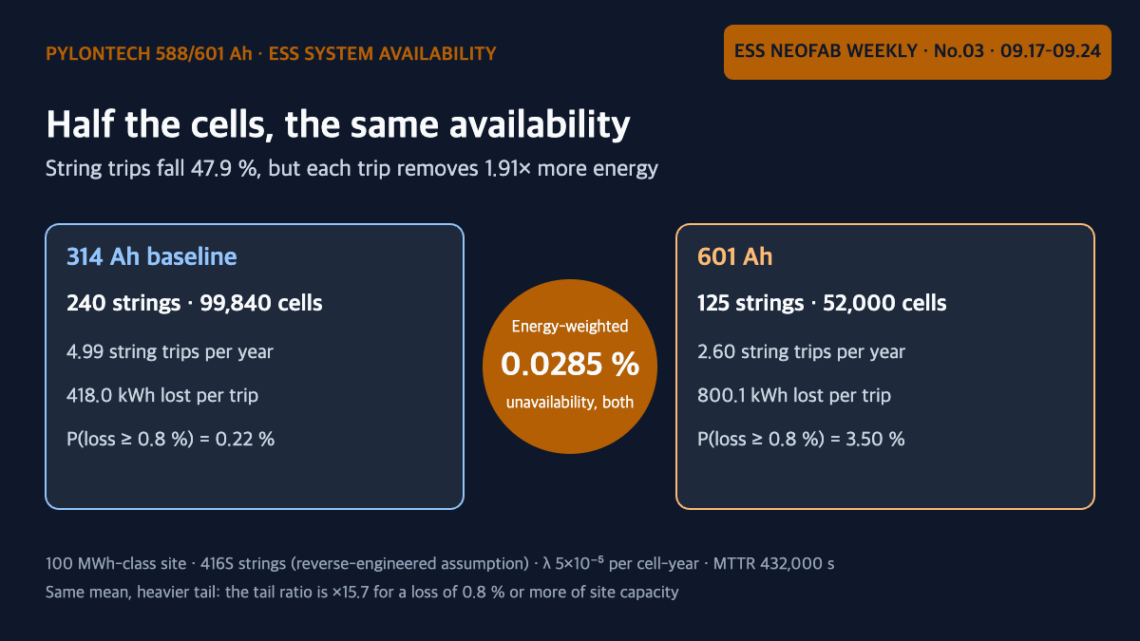
Pylontech’s 588 Ah and 601 Ah LFP Cells Enter Mass Production — Why Energy-Weighted Availability Stays the Same When the Cell Count Halves
On September 21, 2026, Pylontech began mass production of 588 Ah and 601 Ah prismatic LFP ESS cells at its Hefei base and named "fewer cells and interconnections" as a benefit of the larger format¹. Under a reverse-engineered assumption of 416S strings, a 100 MWh-class site drops from 99,840 cells to 52,000 cells (−47.9 %), and string trips caused by cell-count-proportional faults fall at the same rate. Each trip, however, now removes 800.1 kWh instead of 418.0 kWh (1.91×), so the energy-weighted unavailability stays at 0.0285 % regardless of cell capacity. The mean is unchanged and only the tail gets heavier: the probability of losing 0.8 % or more of…
-
Is a Changeover Planned Downtime or an Availability Loss? — How the Definition Changes OEE
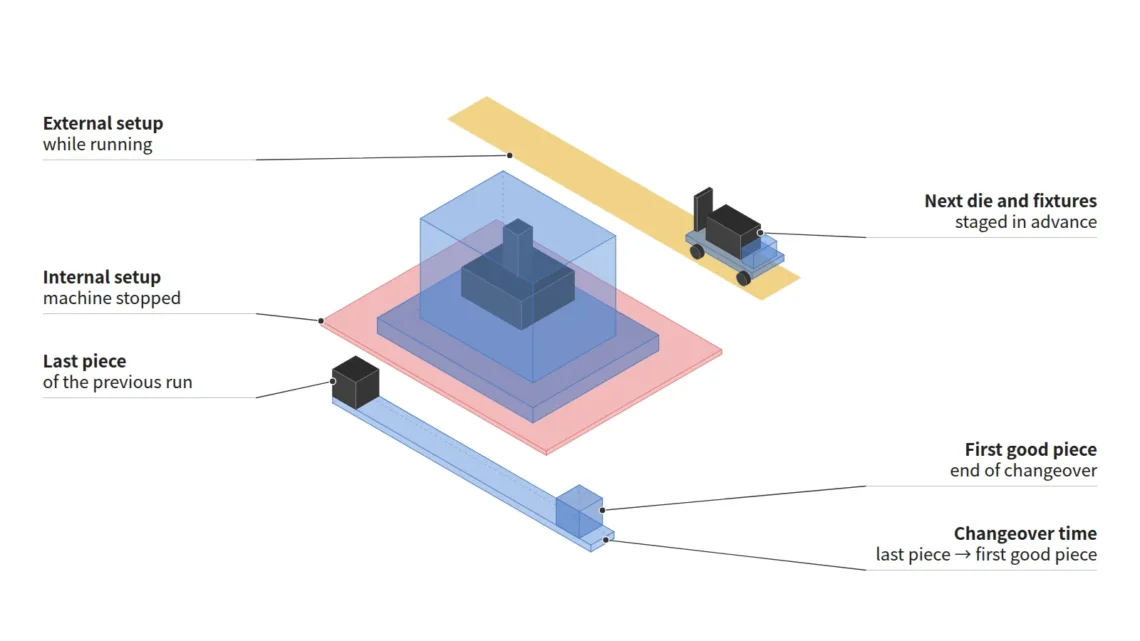
Whether a changeover (also called a setup) counts as planned downtime or as an availability loss differs from source to source, and because that choice alone changes availability and OEE substantially, changeover time must be tracked as a metric separate from OEE. The "Downtime" entry in the Lean Enterprise Institute (LEI) lexicon classifies changeovers to produce other products as planned downtime, while the Japan Institute of Plant Maintenance (JIPM) classifies setup and adjustment as a stop loss in availability. In an assumed shift (loading time 27,600 s, changeovers 3,000 s, breakdowns 600 s), availability is 87.0 % under the JIPM approach and 97.6 % under a planned-downtime approach that subtracts…
-
If Availability, Performance and Quality Are All 80 %, OEE Is 51.2 % — How to Calculate OEE
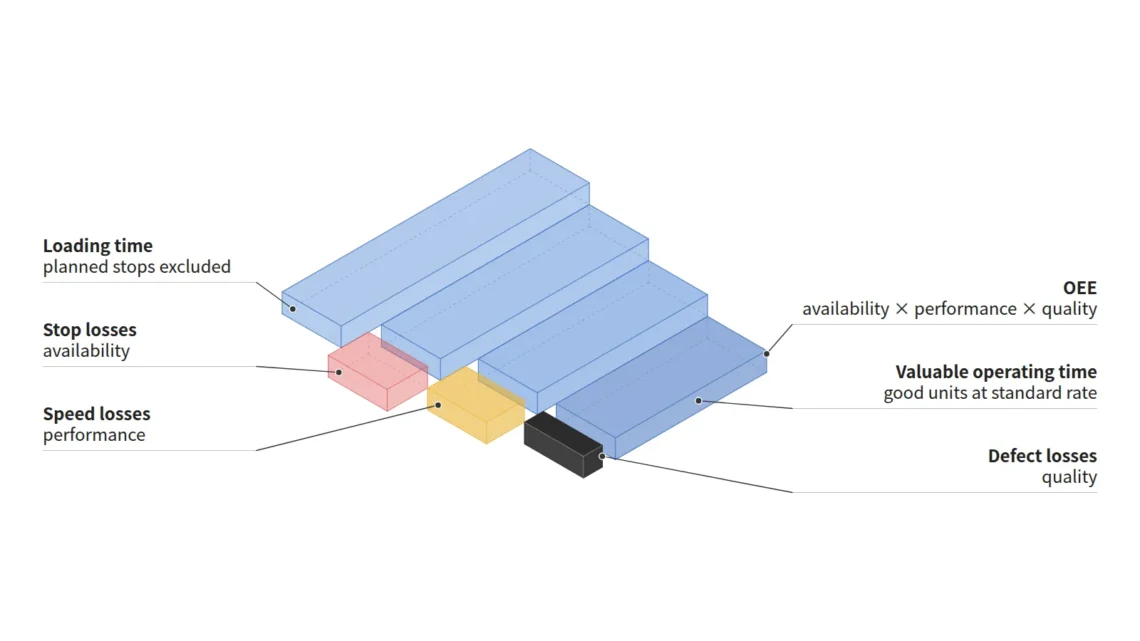
OEE (overall equipment effectiveness) is calculated as availability × performance × quality, and the Japan Institute of Plant Maintenance (JIPM) gives the example that when all three factors are 80 %, OEE is 51.2 %. When the three factors are multiplied as JIPM defines them, OEE is organized as "standard (planned) cycle time × number of good units ÷ loading time," that is, the share of loading time spent making good units at the standard speed. In an assumed shift (loading time 27,600 s, standard cycle time 32 s, 690 good units), availability is 90.0 %, performance 90.4 % and quality 98.3 %, giving an OEE of 80.0 %. If…
You May Also Like
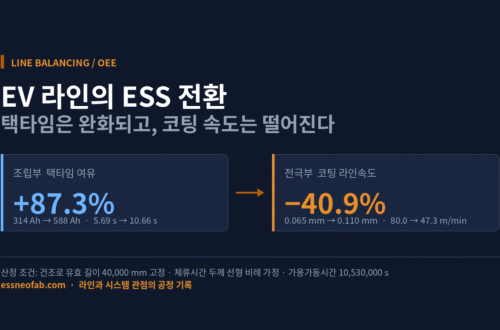
Converting EV Lines to ESS: Where Does OEE Break Down?
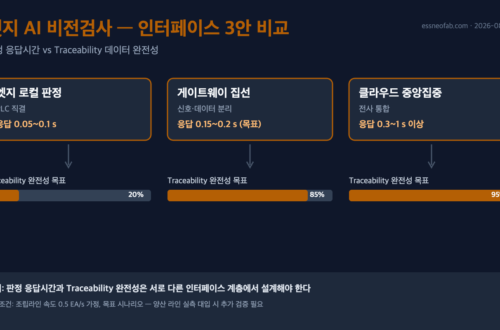
Edge AI Vision Inspection and Battery-Pack Leak Testing: How Gateway Aggregation Affects Traceability Completeness
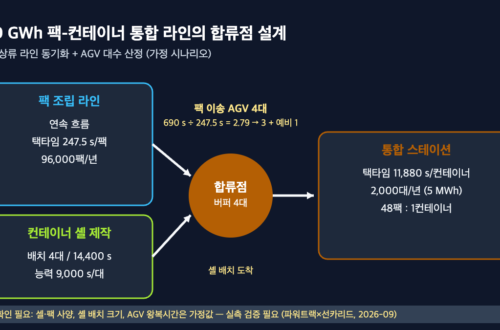
Designing the Merge Point in a 10 GWh Pack-Container Integration Line: Synchronizing Two Upstream Lines and Sizing AGV Fleet from the Powertrac × Sunka Lead Order
-
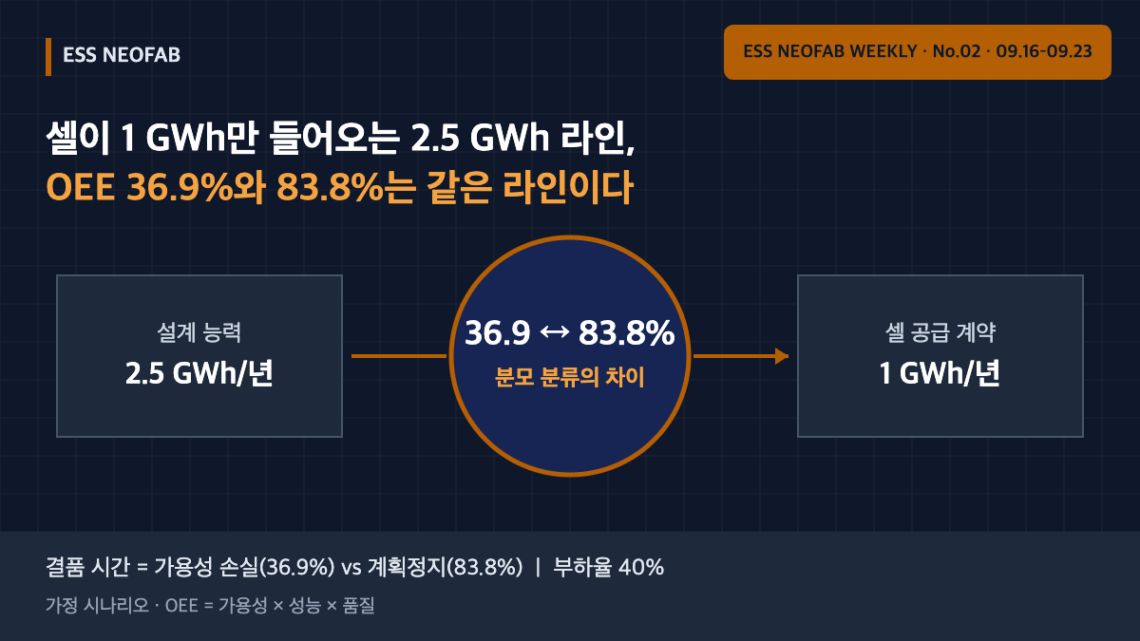
A 2.5 GWh Line Fed Only 1 GWh of Cells — OEE of 36.9% and 83.8% Describe the Same Line
Advait Group’s supply agreement with Hithium for 314 Ah LFP cells (up to 1 GWh over the next year, 18 September 2026) feeds a 2.5 GWh/yr assembly plant with only 40% of its design capacity. Under an assumed scenario, the same line with the same output reports an OEE of 36.9% if cell-shortage time is counted as availability loss, and 83.8% if it is separated as planned downtime and available operating time is matched to supply. The 46.9-point gap comes from the OEE denominator rule, not the equipment; on supply-constrained lines, the loading ratio should be reported alongside OEE.
You May Also Like
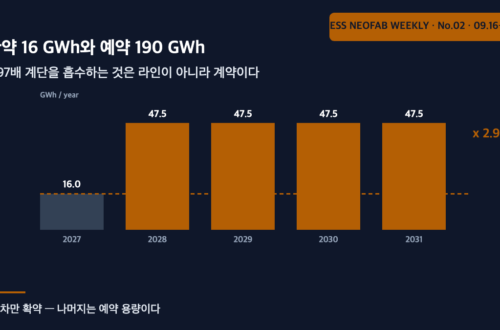
16 GWh committed and 190 GWh reserved — what absorbs the 2.97x step is the contract, not the line
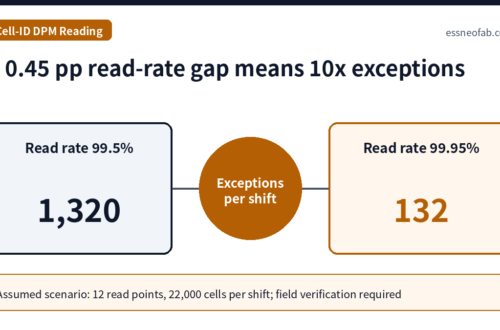
Cell-ID Laser DPM Read Rate 99.5% vs 99.95%: How No-Reads Drive Exceptions per Shift and OEE
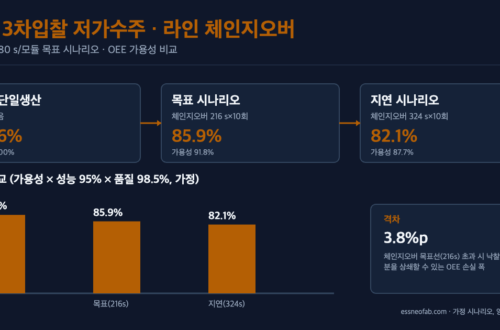
Line Changeover Design in the Era of Low-Price ESS Round-3 Bidding — Flexible Assembly Viewed Through Takt Time and OEE
-
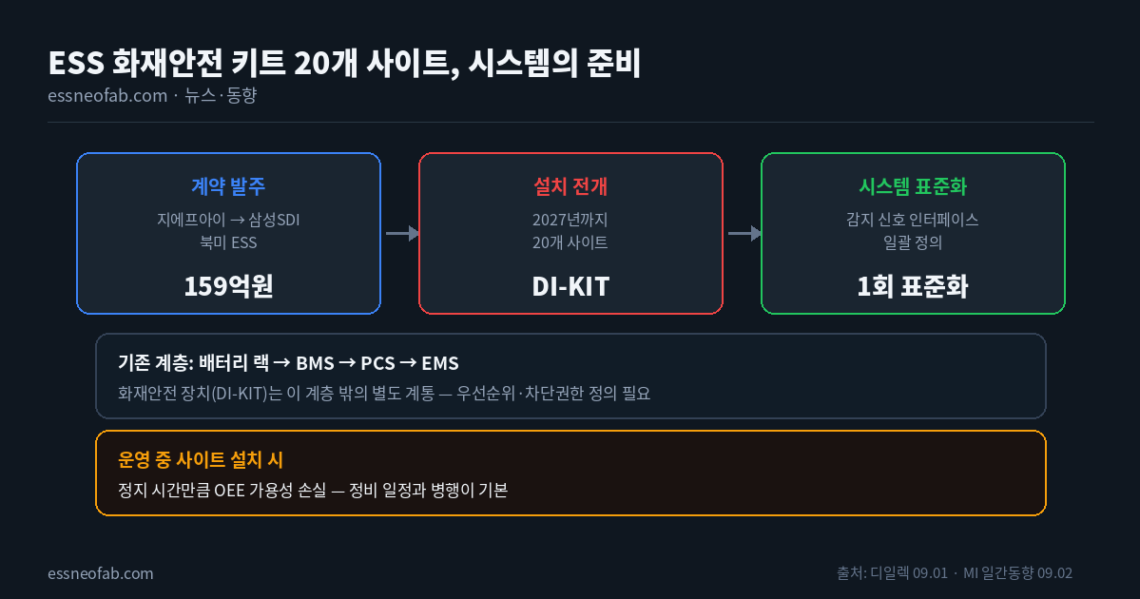
ESS Fire-Safety Kits Across 20 Sites — What the System Must Prepare
GFI has won a KRW 15.9 billion contract for Samsung SDI's North American ESS fire-safety solution. It will install DI-KIT at 20 sites by 2027. This contract shows that fire-safety devices are being ordered not as a cell-level option but as a site-level system line item. On the operations side, what is needed first is defining the installation sequence across the 20 sites and the interface with existing systems. 1. What Happened To state the conclusion first: ESS fire-safety solutions have moved into a phase of being applied in bulk across multiple sites. Until now, the general approach for North American ESS was to address site-specific safety requirements individually. Bundling…
You May Also Like
Today’s ESS/Battery Process Trends — Expanded Support for Materials/Parts/Equipment Lines, Solid-State/LFP Pilot Lines Launch (2026.08.07)
LS Electric Ships First Units of Next-Gen ESS PCS “G2” — Is Liquid Cooling the Answer?
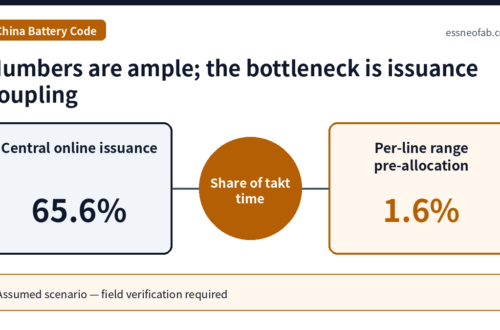
China’s GB/T 34014 24-Character Battery Code: How Code Structure Fixes Issuance Timing and Authority on the Line