Is a Changeover Planned Downtime or an Availability Loss? — How the Definition Changes OEE
Abstract
Whether a changeover (also called a setup)¹ counts as planned downtime or as an availability loss differs from source to source, and because that choice alone changes availability and OEE substantially, changeover time must be tracked as a metric separate from OEE. The “Downtime” entry in the Lean Enterprise Institute (LEI) lexicon classifies changeovers to produce other products as planned downtime, while the Japan Institute of Plant Maintenance (JIPM) classifies setup and adjustment as a stop loss in availability²·³.
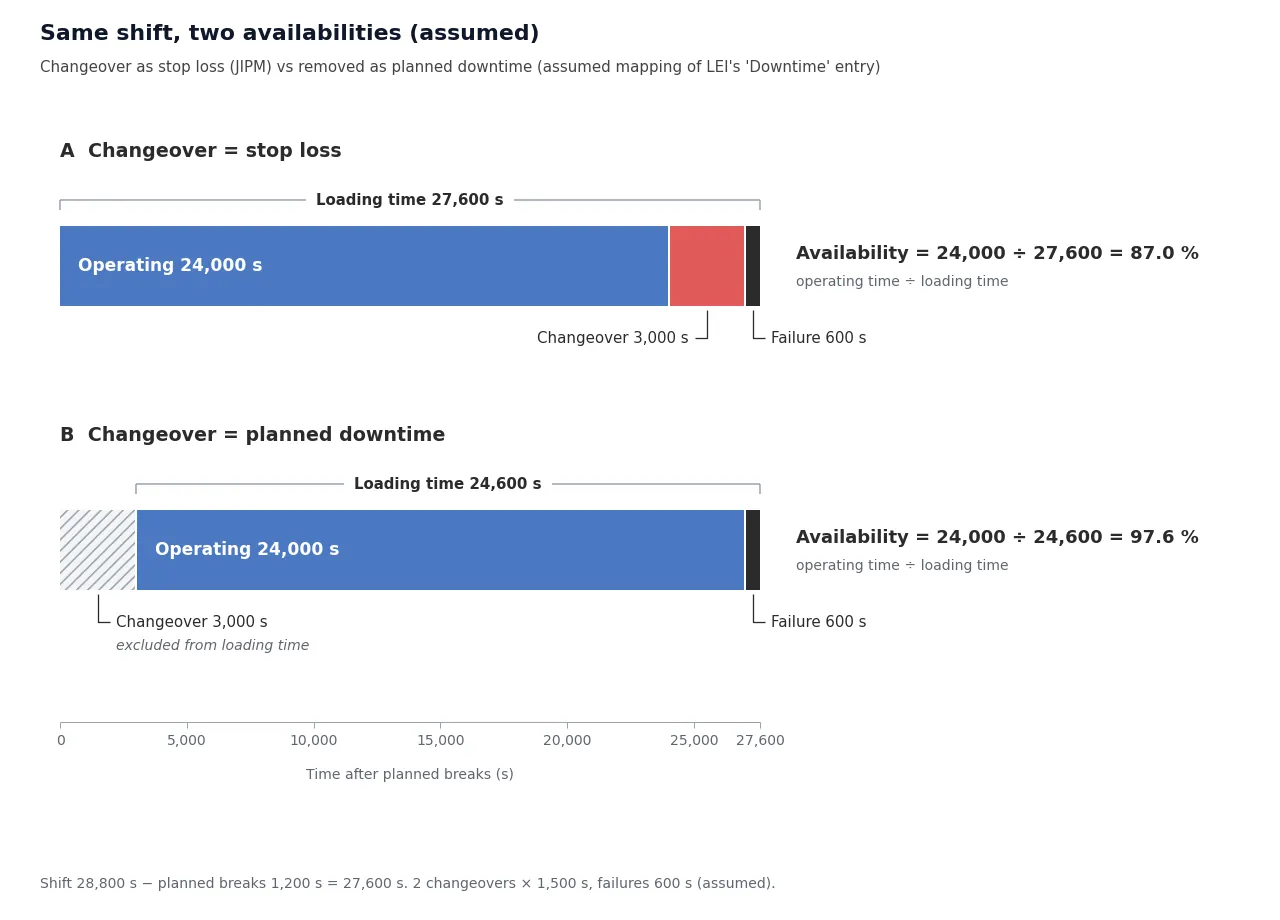
In an assumed shift (loading time 27,600 s, changeovers 3,000 s, breakdowns 600 s), availability is 87.0 % under the JIPM approach and 97.6 % under a planned-downtime approach that subtracts changeovers from loading time (assumed), a gap of 10.6 percentage points. Under the planned-downtime approach, cutting stop time by 1,200 s through SMED raises availability by only 0.1 percentage points, so the improvement must be verified with changeover time measured from the last piece of the run just completed to the first good piece¹.
1. Conclusion First — Depending on the Definition, the Same Changeover Is Either a Loss or Planned Downtime
The conclusion has two parts. Where a changeover belongs in OEE differs from source to source, and that choice alone can shift availability by 10 percentage points or more (assumed example in Section 3). Whichever option is chosen, changeover time itself must be tracked as a metric separate from OEE for the effect of any reduction to become visible.
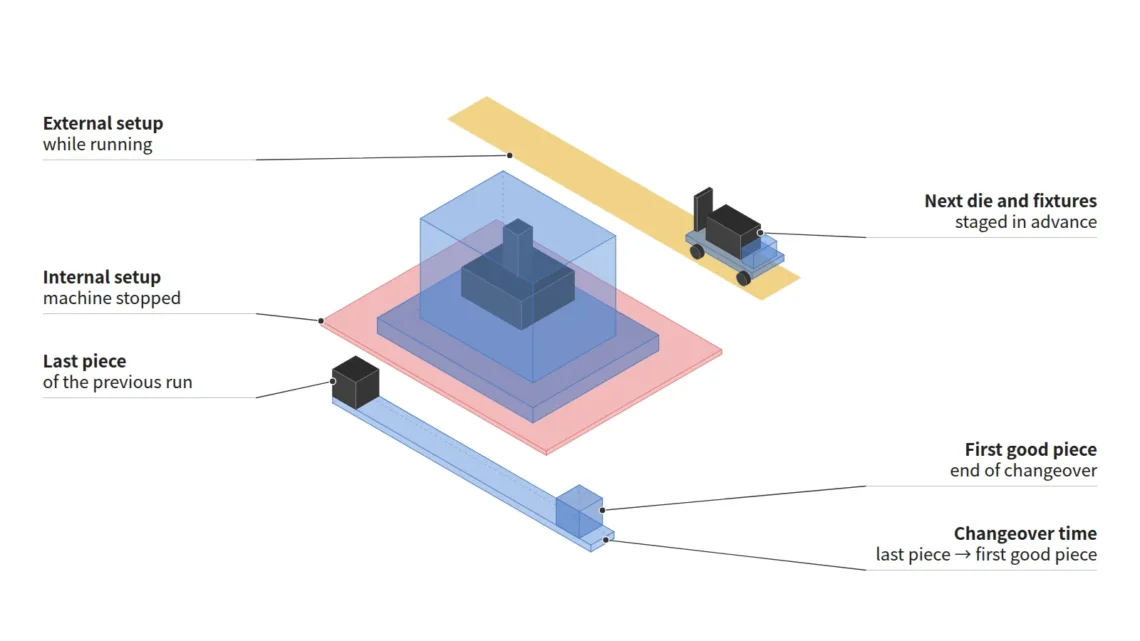
Situation (S): A changeover, also called a setup, is the process of switching from the production of one product or part number to another in a machine or a series of linked machines by changing parts, dies, molds, fixtures and the like¹. Complication (C): Even within the same LEI lexicon, the treatment differs by entry. The “Downtime” entry places “changeovers to produce other products” in planned downtime², the “TPM” entry lists changeover time as one of the six major losses of equipment, and the “OEE” entry states only that availability “measures downtime losses from equipment failures and adjustments,” without mentioning changeovers separately⁴.
Question (Q): Is a changeover an availability loss or planned downtime? Answer (A): It is a matter of choosing a definition, and Section 3 calculates how much that choice changes the numbers. The position assigned by each source is summarized below.
| Source | Position of changeover (setup) | Supporting wording (summary) |
|---|---|---|
| LEI “Downtime” entry | Planned downtime | Planned downtime includes “changeovers to produce other products”² |
| LEI “Total Productive Maintenance” entry | One of the six major losses of equipment | Six major losses: downtime, changeover time, minor stops, speed losses, scrap and rework⁴ |
| LEI “Overall Equipment Effectiveness” entry | Not stated (possibly an availability loss by interpretation) | The availability rate “measures downtime losses from equipment failures and adjustments as a percentage of scheduled time”⁴. In the entry’s list of six major losses, “adjustments” sits where the TPM entry has “changeover time” (interpretation). The “Downtime” entry separately classifies “machine adjustments” as unplanned downtime² |
| JIPM TPM Excellence Award examination guidelines (受審要領) | Stop loss in availability (時間稼動率) | Availability evaluates the magnitude of “stop losses due to breakdowns, setup and adjustment, etc.”³ |
| ISO 22400-2 (preview) | Setup time separated from actual production time | Actual production time includes only value-adding functions; actual unit setup time (AUST) is defined separately⁵ |
※ Except for the “Not stated” cell, which is an interpretation, the classifications in the table restate the wording of each source; no statement was found in which one source compares its classification with another’s or judges which is superior.
2. Where Changeover Time Begins and Ends
The LEI definition states the measurement interval most clearly. Changeover time “is measured as the time elapsed between the last piece in the run just completed and the first good piece from the process after the changeover”¹. Because the end point is the “first good piece” rather than the “first piece,” the adjustment time until quality stabilizes after the switch is also included in the changeover.
JIPM also defines setup-related time as separate indicators. The TPM Excellence Award examination guidelines (受審要領) define “setup adjustment time (段取り調整時間)” as the monthly total of time during which a line or machine is stopped for setup adjustment, and “lot changeover time (ロット替時間)” as the monthly total of time during which a line or machine is stopped for lot changeover³. In other words, indicators that track setup time itself, separately from OEE, are included in the list of effect indicators for the TPM Excellence Award examination.
A changeover can also be converted into time per unit. LEI defines effective machine cycle time as “machine cycle time plus load and unload time, plus the result of dividing changeover time by the number of pieces between changeovers”⁶. In an assumed example with a machine cycle time of 32 s (assumed to equal the standard cycle time in Section 3), a changeover of 1,500 s, 345 units between changeovers (the shift demand of 690 units produced in two runs) and 0 s of load and unload time, the effective machine cycle time is 32 + 1,500 ÷ 345 = 36.3 s. This value must be less than the 40 s takt time from Part 1 of this series (a necessary condition).
3. How the Classification Changes the Numbers — One Shift, Two Availability Values
Applying the two classifications to the same shift makes the difference immediately visible. Assume a shift with a loading time of 27,600 s (shift 28,800 s − planned breaks 1,200 s), 2 changeovers (1,500 s each) and 600 s of breakdowns, leaving an actual operating time of 24,000 s. The JIPM approach keeps changeovers inside loading time as a stop loss³·⁷, whereas the planned-downtime approach maps the classification of the LEI “Downtime” entry² onto JIPM’s time structure and subtracts changeovers from loading time in the same way as beginning-of-the-shift production meetings and scheduled maintenance (assumed; the LEI entry does not directly address the OEE denominator).
| Item | JIPM approach (stop loss) | Planned-downtime approach |
|---|---|---|
| Denominator (loading time) | 27,600 s | 24,600 s |
| Stop time | 3,600 s (changeover 3,000 + breakdown 600) | 600 s (breakdown) |
| Operating time | 24,000 s | 24,000 s |
| Availability | 87.0 % | 97.6 % |
| Minimum required OEE to meet demand of 690 units (standard cycle time 32 s) | 80.0 % | 89.8 % |
| Good units when the target OEE of 85 % (assumed) is achieved | 733 units (demand met) | 653 units (demand not met) |
※ Calculation conditions: 1 shift; all times and quantities are assumed values. The minimum required OEE and the good-unit counts were obtained by applying the formula from Part 2 of this series (OEE = standard cycle time × good units ÷ loading time) to each denominator. Implication: even with the same operating time and output, availability differs by 10.6 percentage points, and the same “target OEE of 85 %” meets demand under one definition but not under the other.
The two approaches also differ in their consistency with takt time. The LEI workbook rule covered in Part 1 of this series does not subtract changeovers from the available working time used for takt time⁶. Under the JIPM approach, the OEE denominator is 27,600 s, the same as the takt time numerator, so the two metrics connect in a single equation; under the planned-downtime approach, the denominator shrinks to 24,600 s and the time bases of the two metrics diverge by 3,000 s. This divergence is what raises the minimum required OEE to meet demand from 80.0 % to 89.8 %, and this time-base mismatch is the core of this article.
4. SMED — The Target Is “Work That Can Be Done Only While Stopped”
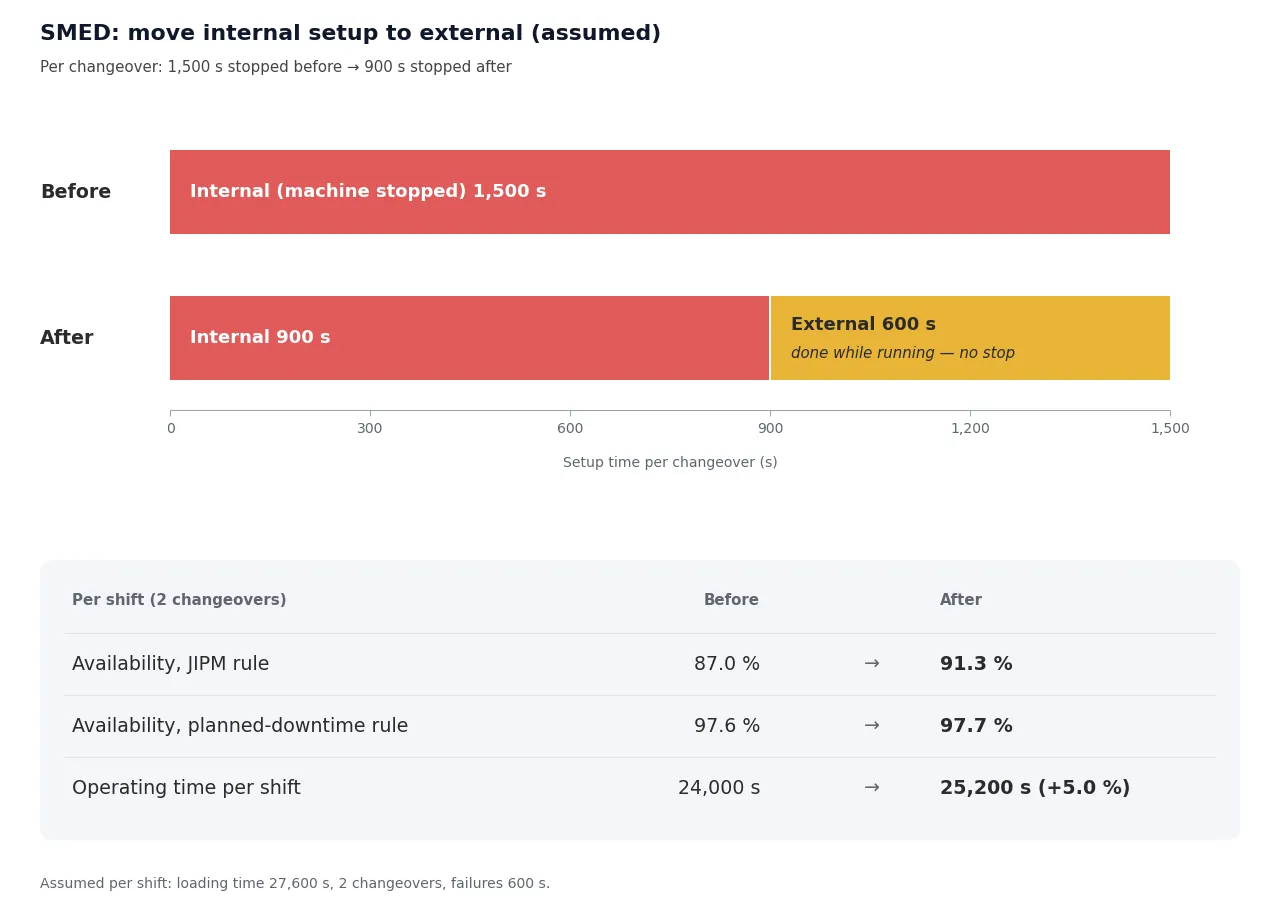
In connection with changeover reduction, the LEI lexicon provides a separate entry for SMED (Single Minute Exchange of Die)⁸. LEI defines SMED as “a process for changing over production equipment from one part number to another in as little time as possible” and states that the term “refers to the target of reducing changeover times to a single digit,” that is, under 600 s (a single digit of minutes in the original, converted to seconds)⁸. The key is to separate internal setup (operations that can be done only when the machine is stopped, such as inserting a new die) from external setup (operations that can be performed while the machine is running, such as transporting the new die to the machine), and then to convert internal setup to external setup⁸.
These key insights about setup reduction were developed by Shigeo Shingo in the 1950s and 1960s⁸. LEI records that he taught industrial engineering methods aimed at plant supervisors and engineers at Toyota from roughly 1955 to 1980, coined the phrase single minute exchange of die (SMED), and developed steps to analyze setup work, especially the distinction between internal and external work⁹. The book “A Revolution in Manufacturing: The SMED System” (Shigeo Shingo and Andrew P. Dillon) was published in 1985⁹.
| Step | Six steps of LEI setup reduction¹⁰ |
|---|---|
| 1 | Measure the total setup time in the current state |
| 2 | Identify the internal and external elements, calculating the individual times |
| 3 | Convert as many of the internal elements to external as possible |
| 4 | Reduce the time for the remaining internal elements |
| 5 | Reduce the time for the external elements |
| 6 | Standardize the new procedure |
Applying Step 3 to the assumed shift from Section 3 shows its effect. Assuming that 600 s of each 1,500 s changeover is work that can be moved to external setup, stop time falls to 900 s per changeover and 1,800 s per shift, and operating time rises from 24,000 s to 25,200 s, an increase of 1,200 s (5.0 %). At the standard cycle time of 32 s, this is enough time to produce about 37 more units per shift.
| Item | Before improvement | After improvement | Change |
|---|---|---|---|
| Changeover stop time per shift | 3,000 s | 1,800 s | −1,200 s |
| Operating time | 24,000 s | 25,200 s | +5.0 % |
| Availability (JIPM approach) | 87.0 % | 91.3 % | +4.3 percentage points |
| Availability (planned-downtime approach) | 97.6 % | 97.7 % | +0.1 percentage points |
| Effective machine cycle time (345 units between changeovers) | 36.3 s | 34.6 s | −1.7 s |
※ Calculation conditions: the time convertible to external setup (600 s per changeover), breakdowns of 600 s and 2 changeovers per shift are all assumed values. Implication: the same improvement raises availability by 4.3 percentage points under the JIPM approach, but under the planned-downtime approach the denominator grows as well, so the gain is only 0.1 percentage points. Lines that use the planned-downtime approach should report SMED results in terms of changeover time and operating time, not OEE.
The same principle can also be applied to roll-to-roll (R2R) equipment (interpretation). For example, if the materials and fixtures for the next product can be prepared and transported while the machine is running, that work becomes a candidate for external setup (illustrative mapping). Which work can actually be moved to external setup, however, depends on the equipment structure and safety conditions; it cannot be determined within the scope of the primary sources consulted for this article and is to be confirmed for each machine.
5. Conclusion and Limitations
In the LEI “Downtime” entry a changeover is planned downtime, in the LEI “TPM” entry it is one of the six major losses of equipment, and in JIPM it is a stop loss in availability. In the assumed shift, this choice alone split availability into 87.0 % and 97.6 %, and the minimum required OEE to meet demand also diverged into 80.0 % and 89.8 %. To use the same time base as takt time, treating changeovers as a stop loss is the consistent choice; in either case, changeover time must be tracked as a separate metric for the effect of SMED to be visible.
This article addresses a different point from other articles on this site. Line Changeover Design in the Era of Low-Price ESS Round-3 Bidding dealt with changeover targets under mixed-model order conditions, and A 2.5 GWh Line Fed Only 1 GWh of Cells — OEE of 36.9% and 83.8% Describe the Same Line dealt with how to classify shortage time. This article isolates only the effect that the definition and classification of changeover as a loss have on OEE and takt time.
There are also limitations. The availability formula in ISO 22400-2 is in the paid body text (Clause 6), so whether setup time is placed in planned downtime could not be checked directly (to be confirmed), and no primary source dealing with changeovers on R2R equipment was found. Changeover time, time convertible to external setup and breakdown time are all assumed values, and further verification with line-by-line measurements is needed.
FAQ
Q1. If even planned changeovers are counted as losses, won’t the shop floor be evaluated unfavorably?
The classification is a choice of evaluation rule, and it differs by source (Section 1). However, because the takt time calculation does not subtract changeovers, using the same time base is the consistent choice if OEE is to be linked directly to meeting demand (Section 3). Fairness in evaluation can be secured by reporting changeover time alongside OEE as a separate metric.
Q2. Does the SMED target of “under 600 s” apply to every machine?
LEI only defines SMED as a term referring to the single-digit target⁸, and information on whether that target can be achieved on a specific machine could not be found in the primary sources consulted. The target value should be set machine by machine, starting from Step 1 of setup reduction, which measures the total setup time in the current state¹⁰.
Q3. Why not simply change over less often and run larger batches?
In the effective machine cycle time formula, the changeover share per unit shrinks in inverse proportion to the number of units produced between changeovers⁶. The effects of larger batches on inventory and lead time, however, could not be supported with quantitative evidence within the scope of the primary sources consulted for this article, so separate review is required.
Field Application Notes
| Check | How to execute | Decision criterion | Remarks |
|---|---|---|---|
| ☐ State the classification rule | Write one line in the OEE definition document stating whether changeovers are treated as a stop loss or as planned downtime | Is the same rule used across lines? | Source differences in Section 1 |
| ☐ Reconcile the time bases | Calculate the difference (s) between the available working time used for takt time and the OEE loading time | If the difference equals changeover time, the time bases are inconsistent | Section 3 |
| ☐ Record changeover time | Record the elapsed time (s) from last piece → first good piece for each changeover and calculate the monthly total | Trend of the average per changeover and the monthly total | LEI definition¹, JIPM indicators³ |
| ☐ Separate internal and external setup | Divide changeover work elements into those possible only while stopped and those possible while running, and measure the time of each element | A list of candidates for conversion to external setup is prepared | Setup reduction Steps 1–2¹⁰ |
| ☐ Check effective machine cycle time | Machine cycle time + load/unload + changeover ÷ units between changeovers | Is it below takt time? | LEI definition⁶ |
Sources and Notes
¹ Lean Enterprise Institute (LEI), Lean Lexicon, “Changeover” entry, lean.org. Definition (also called a setup) and the measurement interval of changeover time.
² LEI, Lean Lexicon, “Downtime” entry, paragraphs 1–2, lean.org. Distinction between planned and unplanned downtime.
³ 公益社団法人日本プラントメンテナンス協会 (JIPM), 「2021年度 TPM®優秀賞 ②受審要領(国内事業場 最終版)」, “1. 活動の効果指標,” pp. 20–21, jipm.or.jp PDF. Formula and explanation of 時間稼動率 (availability), 段取り調整時間 (setup adjustment time) and ロット替時間 (lot changeover time).
⁴ LEI, Lean Lexicon, “Overall Equipment Effectiveness” entry, paragraph 2 (availability) and final paragraph (six major losses), and “Total Productive Maintenance” entry, paragraph 2.
⁵ ISO 22400-2:2014 preview, 5.1.2.3 PUST, 5.1.2.4 PBT, 5.1.3.6 APT, 5.1.3.10 AUST, 5.1.3.12 AUPT. Clause 6, which contains the availability formula, has not been checked.
⁶ LEI, Lean Lexicon, “Cycle Time” entry, definition of Effective Machine Cycle Time, lean.org; Rick Harris and Mike Rother, “Creating Continuous Flow,” LEI public excerpt, pp. 12–14 (rule on available working time for takt time).
⁷ JIPM, pe-digital.jp series 「指標でモノづくりを評価しよう!」, part 2 時間稼働率, 2025-05-12. Definitions of loading time and operating time (publicly available portion).
⁸ LEI, Lean Lexicon, “Single Minute Exchange of Die” entry, paragraphs 1–2 (including the citation Shingo 1985, pp. 21–25), lean.org.
⁹ LEI, Lean Lexicon, “Shingo, Shigeo (1909 – 1990)” entry; Routledge, “A Revolution in Manufacturing: The SMED System” book information (Productivity Press, 1985).
¹⁰ LEI, Lean Lexicon, “Setup Reduction” entry (six steps), lean.org.
※ Assumed values: shift 28,800 s, planned breaks 1,200 s, changeover 1,500 s per occurrence × 2, breakdowns 600 s, time convertible to external setup 600 s per changeover, standard cycle time 32 s and target OEE 85 % are illustrative assumptions and require verification against measurements on each line.
Line Metrics Glossary — Other Articles in This Series
- Part 1. Don’t Subtract Breakdowns When Calculating Takt Time — Takt Time vs. Cycle Time vs. Lead Time
- Part 2. If Availability, Performance and Quality Are All 80 %, OEE Is 51.2 % — How to Calculate OEE
- Part 3. FAT and SAT Differ in More Than Location — How IEC 62381:2024 Defines the Tests


You May Also Like

Grid-Forming PCS Mandate Redesigns FAT Takt Time and the BMS-PCS-EMS Interface
Five million ACC cells equal 2.7 to 3.6 months of nameplate output