FAT and SAT Differ in More Than Location — How IEC 62381:2024 Defines the Tests
Abstract
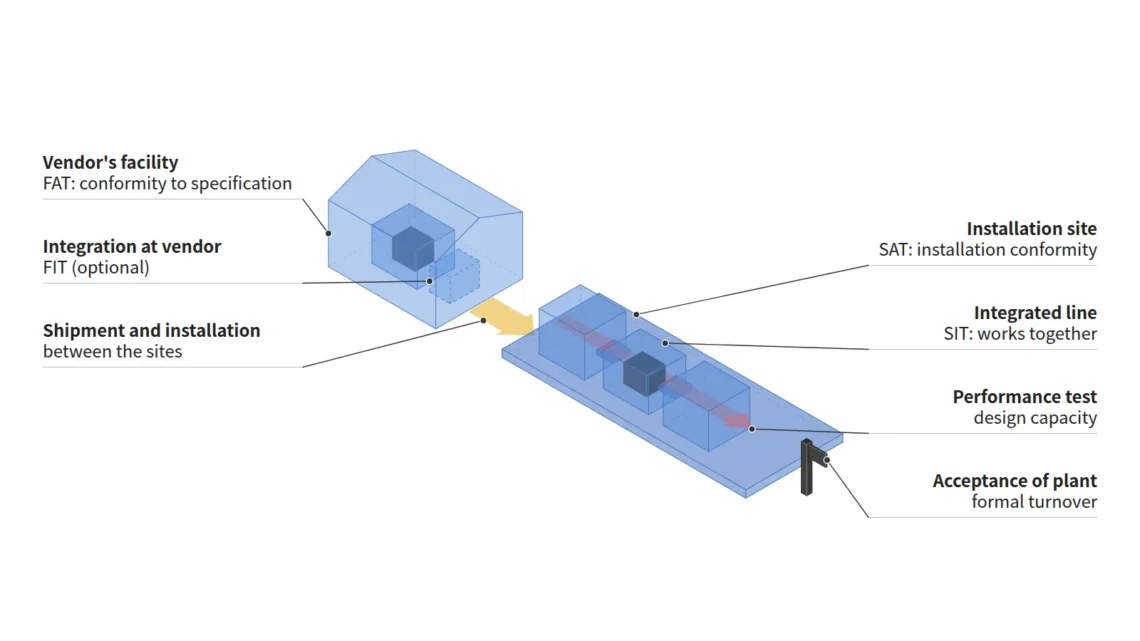
IEC 62381:2024 defines the factory acceptance test (FAT) as an activity to demonstrate that the automation system is in accordance with the specification, typically conducted at the vendor’s facility, and the site acceptance test (SAT) as an activity to demonstrate, at the site of the installation, that the installation is in accordance with the applicable standards, codes, specifications, and installation instructions¹·². The two tests differ not only in location but also in what they demonstrate, and the 2024 edition adds the optional factory integration test (FIT) and defines requirements and checklists for the FAT, FIT, SAT, and site integration test (SIT)¹.
Loop checks and commissioning lie outside the scope of this standard, while IEC 62337, the commissioning standard for the process industry, addresses design capacity at the performance test milestone and the formal turnover at the subsequent acceptance of plant²·³. This article’s interpretation is therefore that defining line capacity conditions as performance test conditions, separate from the FAT and SAT acceptance criteria, is consistent with the structure of the two standards.
1. Conclusion First — FAT Proves ‘Specification,’ SAT Proves ‘Installation’
The conclusion has two parts. FAT and SAT are not the same test repeated at a different location; they demonstrate different propositions, namely conformity to the specification and conformity of the installation, respectively. Moreover, both tests are defined separately from the performance test, which IEC 62337 defines as the milestone at which the production plant runs to its design capacity, and from acceptance of plant, the formal turnover.
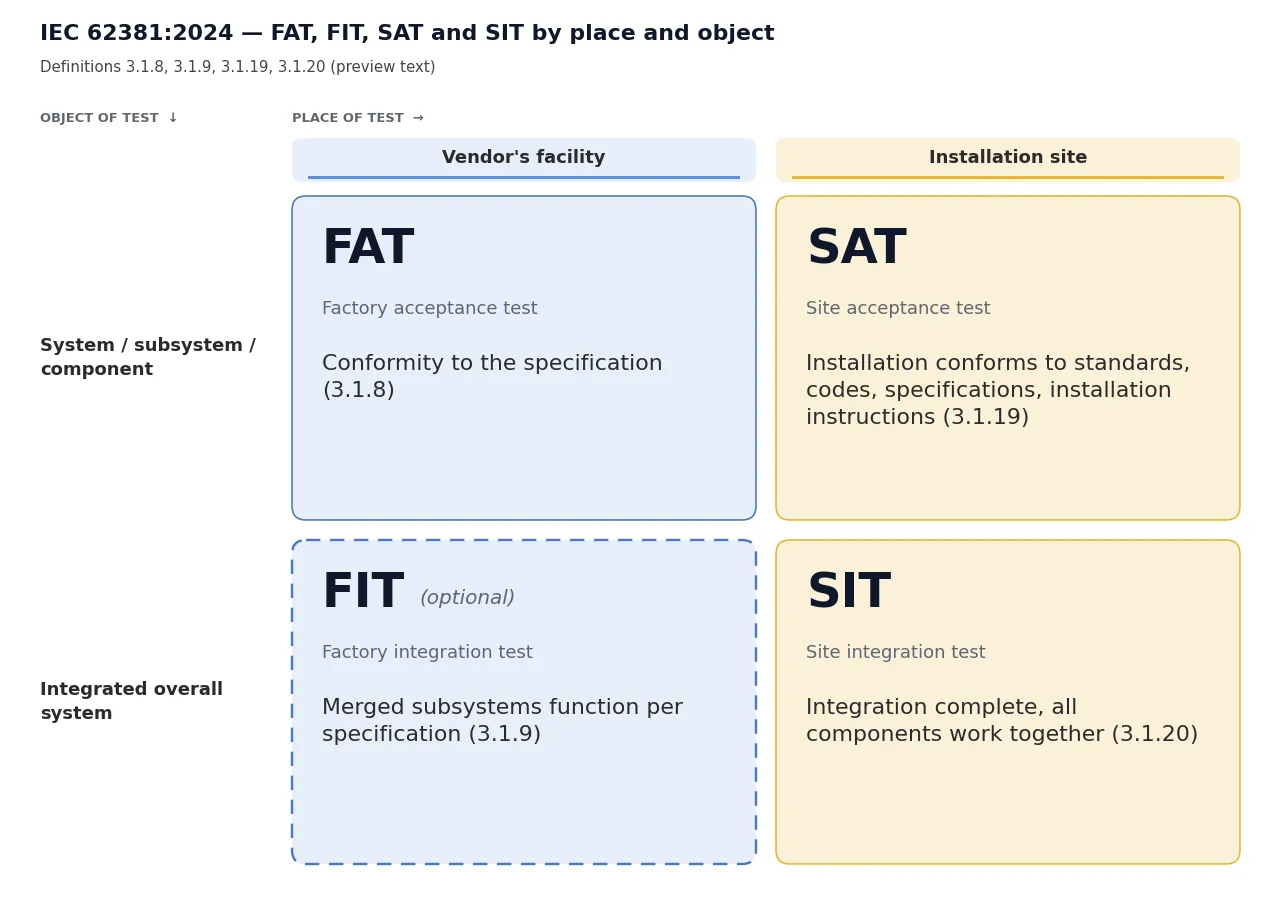
Situation (S): IEC 62381 states that it provides a means for the owner, the buyer, and the vendor to clearly establish and agree on the scope and responsibilities of these tests in order to achieve timely delivery and acceptance of the automation system¹. Complication (C): if the tests to be agreed on are divided only into “tests done at the factory” and “tests done on site,” what each test has demonstrated can become blurred in the contract. Question (Q): what does each of the four tests demonstrate, and where does acceptance end? The answer (A) lies in the table below and in the milestones of Section 3.
| Test | Location | What is demonstrated (summary of IEC 62381:2024 definition) | Clause | Korean KS term |
|---|---|---|---|---|
| FAT | Typically the vendor’s facility | The automation system, subsystem, or component is in accordance with the specification | 3.1.8 | 공장인수시험 |
| FIT (optional) | Vendor’s facility | The merging of various subsystems and components into one system functions in accordance with the specification | 3.1.9 | — |
| SAT | Site of the installation | The installation of the system, subsystem, or component is in accordance with the applicable standards, codes, specifications, and installation instructions | 3.1.19 | 현장인수시험 |
| SIT | Site of the installation | The merging is completed and all components work together in accordance with the specification | 3.1.20 | 현장통합시험 |
※ The phrase “activity, including inspection and testing” opens all four definitions². The Korean KS terms follow the title of KS C IEC 62381, which was abolished in 2013, and FIT has no KS term because it was added in a later edition⁴.
2. What the 2024 Edition of IEC 62381 Changed — The New FIT and Checklists
The latest edition of IEC 62381 is the third edition (Edition 3.0, 83 pages), published on 2024-07-30¹. The third edition is a technical revision that cancels and replaces the 2012 second edition, which was withdrawn on the same date²·⁵. In the United States, ANSI/ISA-62381-2026 adopted the 2024 edition as an identical (IDT) standard⁶.
The IEC lists five changes. They are a general reorganization of the standard, incorporation of current technology, addition of the optional factory integration test (FIT), replacement of the forms in the annexes with detailed checklists that can be used to develop project-specific test plans, and additional references to other applicable standards¹. The table of contents includes checklist annexes for FAT, SAT, and SIT (A–C), together with entries for the FAT certificate (A.5), the SAT certificate (B.4), and the SIT certificate (C.4)².
| Test | 2012 edition (Ed. 2), definition summary | 2024 edition (Ed. 3), definition summary |
|---|---|---|
| FAT | Activity to demonstrate that the vendor system and additionally supplied systems are in accordance with the specification (3.1.3) | Activity, including inspection and testing, to demonstrate that the automation system, subsystem, or component is in accordance with the specification; typically conducted at the vendor’s facility (3.1.8) |
| SAT | Demonstrates that the installation of the various vendor systems is in accordance with the applicable specifications and installation instructions (3.1.4) | At the site of the installation, demonstrates that the installation is in accordance with the applicable standards, codes, specifications, and installation instructions (3.1.19) |
| SIT | Demonstrates that the merging of the various systems into one overall system is completed and that all components work together as specified (3.1.5) | At the site of the installation, demonstrates that the merging is completed and that all components work together in accordance with the specification (3.1.20) |
| FIT | None | At the vendor’s facility, demonstrates that the merged system functions in accordance with the specification (3.1.9, optional) |
※ The definitions of both editions are based on the preview pages; the body text of Clauses 4–8 and the annexes are paid content and could not be checked²·⁵. Implication: the 2024 edition writes the test location into the definitions and adds “standards and codes” to what the SAT installation must conform to, defining the difference between the two tests more clearly in terms of both location and object.
The punch list is also defined. The 2024 edition defines it as a “list of all problems found, the corrective action to be taken, party responsible and date completed,” and a note to entry adds that other information categories can be added as required². In Korea, KS C IEC 62381 was established on 2008-11-28 and abolished on 2013-11-25 “because of low market demand, as a standard designated for conversion to an association standard,” and the association standard SPS-KEA065-IEC 62381-6445 is recorded as its replacement⁴.
3. After the Tests — IEC 62337 Commissioning Phases and Milestones
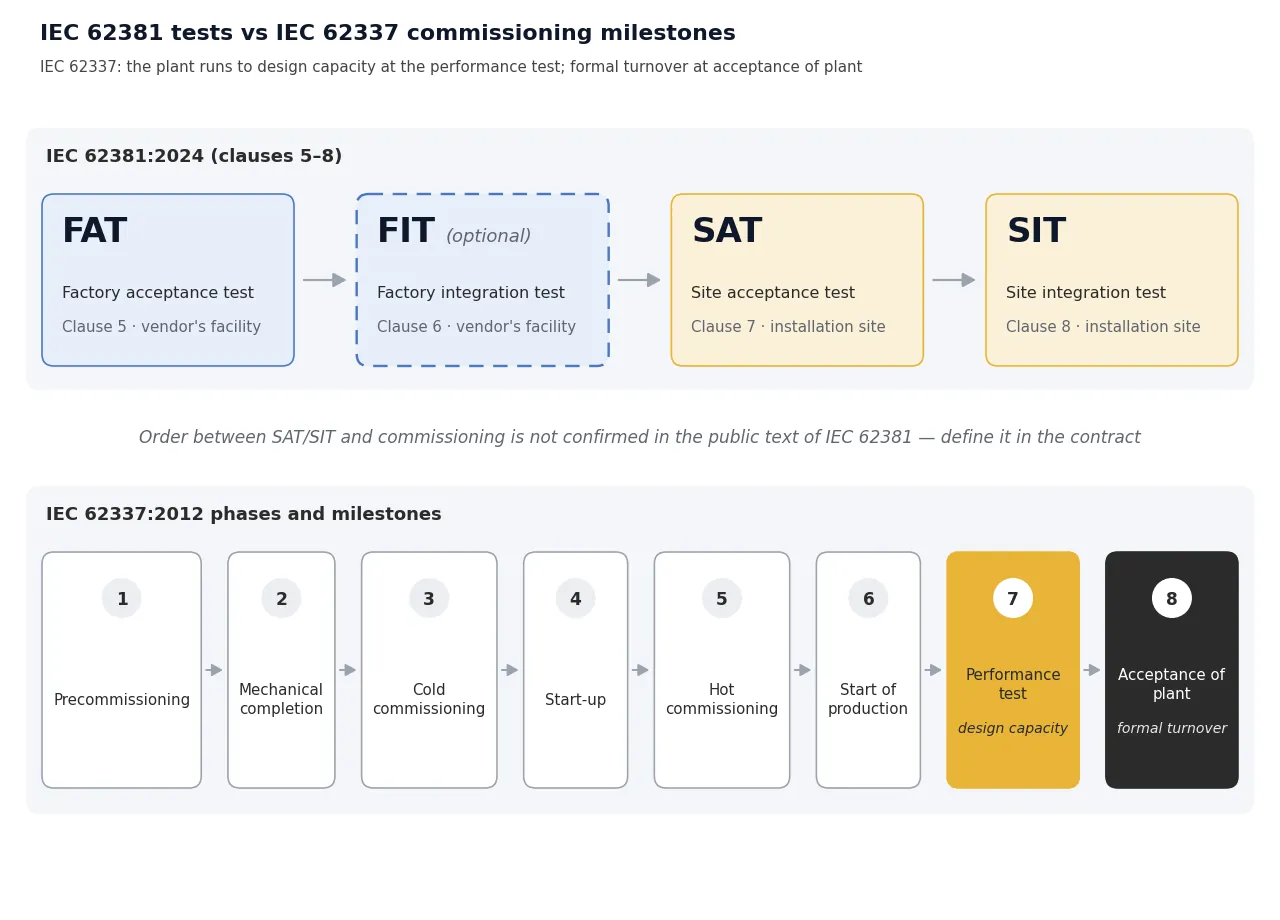
In its scope, IEC 62381 states that engineering and manufacturing activities prior to or after the FAT, FIT, SAT, and SIT, such as loop checks and commissioning, are not covered². Loop checks are covered by IEC 62382, which IEC 62381 cites as a normative reference², and the commissioning phases and milestones are defined by IEC 62337 (second edition, 2012, stability date 2026; the linkage between the two standards is this article’s own arrangement)³. In Korea, KS C IEC 62337 (established 2014-10-02, reaffirmed 2024-07-31) is also in force as a current standard⁷, and by way of example, this standard defines the activities that follow the “completion of erection” milestone and precede the owner’s “acceptance of plant” phase³.
| Order | Phase / milestone | Definition summary | Clause |
|---|---|---|---|
| 1 | Precommissioning | Phase of non-operating adjustments, cold alignment checks, cleaning, and testing of machinery | IEC 62337 3.1 |
| 2 | Mechanical completion | Milestone achieved when the plant has been erected and tested in accordance with drawings, specifications, instructions, and applicable codes and regulations, permitting cold commissioning. End of precommissioning | IEC 62337 3.2 |
| 3 | Cold commissioning | Phase of testing and operating equipment or facilities with test media such as water or inert substances, prior to introducing any chemical | IEC 62337 3.3 |
| 4 | Start-up | End of cold commissioning | IEC 62337 3.4 |
| 5 | Hot commissioning | Phase of testing and operating equipment or facilities with the actual process chemical, prior to making an actual production run | IEC 62337 3.5 |
| 6 | Start of production | End of hot commissioning | IEC 62337 3.6 |
| 7 | Performance test | Milestone at which the production plant runs to its design capacity. Demonstrates the contractual process performance and consumption guarantees | IEC 62337 3.7 |
| 8 | Acceptance of plant | Formal turnover of the plant from the contractor to the owner. The owner resumes responsibility for running and maintaining the plant | IEC 62337 3.8 |
※ The order follows Figure 1 of IEC 62337 (definition of phases and milestones) and the definition of each milestone (“end of …”). Figure 1 shows the milestones in the order completion of erection → mechanical completion → start-up → start of production → performance test, while the position of acceptance of plant after the performance test is assumed in the NOTE to the scope of IEC 62337 (Clause 1)³. Implication (interpretation): by the definitions of IEC 62337, the milestone at which the plant runs to its design capacity is not the FAT or SAT but the performance test (No. 7).
Who carries out the performance test also deserves attention. IEC 62337 describes it as a test carried out by the owner’s personnel with the help and supervision of the contractor, serving to demonstrate the contractor’s process performance and consumption guarantees as specified in the contract³. This means that, unlike the FAT, which is typically conducted at the vendor’s facility (3.1.8), the capacity guarantee is verified on site under operation by the owner’s personnel.
4. Mapping the Definitions onto Battery and ESS Equipment — What to Assign to Which Test
IEC 62381 and IEC 62337 are standards for automation and electrical, instrumentation, and control (E&I) systems in the process industry, and IEC 62381:2024 defines the process industry as an industry with a continuous or batch flow that uses chemical reactions, separations, or mixing techniques (chemical, petrochemical, water and wastewater treatment, paper, cement, etc.), adding a note to entry that it does not include such industries as equipment/machine manufacturing or other similar industries (3.1.15)². Whether a battery manufacturing line falls within this definition calls for process-by-process interpretation, and no evidence was found within the scope of this review that the standards apply as-is.
IEC 62381 does, however, state that the activities it specifies can be used to develop test plans adapted to the specific requirements of the process, plant, or equipment, which presupposes adjustment in application¹. The table below gives examples of assignment by definition, and each assignment is to be confirmed for the specific contract and equipment.
| What is to be verified (examples) | Assignment by definition | Basis clause |
|---|---|---|
| Do the control functions and interlocks of the individual equipment work in accordance with the specification? | FAT | IEC 62381 3.1.8 |
| Combined operation of the subsystems within the scope of supply | FIT (optional) | IEC 62381 3.1.9 |
| Does the condition after delivery and installation conform to the installation instructions, standards, and codes? | SAT | IEC 62381 3.1.19 |
| Line operation combined with upstream and downstream equipment | SIT | IEC 62381 3.1.20 |
| Design capacity of the line (takt time and quantity conditions) | Performance test | IEC 62337 3.7 |
| Transfer of responsibility for operation and maintenance | Acceptance of plant | IEC 62337 3.8 |
※ This table is an interpretation that maps the IEC definitions onto battery equipment cases. Implication: writing line takt time or quantity conditions into the FAT acceptance criteria can create a contradiction, in which a condition that by definition can be confirmed only after integration is judged at the individual-equipment stage.
The same terms appear in ESS documents. The table of contents of IEC TS 62933-3-1:2018, which covers the planning and performance assessment of electrical energy storage (EES) systems, lists 6.1 FAT, 6.2 installation and commissioning (installation phase, commissioning phase), 6.3 SAT, and 6.4 performance monitoring phase in that order⁸. This document was replaced by IEC 62933-3-1:2025 on 2025-11-20, and the abstract of the revised document does not contain the expressions FAT or SAT, so whether those clauses have been retained is to be confirmed⁸. Because IEC 62381 mentions commissioning in its public scope (1.2.1) as an out-of-scope activity before or after the tests, and Figure 1 (Project phases and E&I testing), which would show the relationship between the phases, is in the paid body text and could not be checked², the sequence of SAT and commissioning must be stated separately in the contract.
This article sits on a different layer from other articles on this site. Grid-Forming PCS Mandate Redesigns FAT Takt Time and the BMS-PCS-EMS Interface addressed the time taken by the FAT itself in terms of takt time, and Formation Channel Sizing Read from a Cell Assembly Equipment FAT dealt with the signals that the FAT sends to downstream process design. Field commissioning labor was covered in When the Station Block Grows to 62 MWh, What Actually Shrinks Is Commissioning Labor, Not Cell Count, while this article sets out the definitions and boundaries of the test phases themselves, which all three articles presuppose.
5. Conclusion and Limitations
FAT demonstrates conformity to the specification and SAT demonstrates conformity of the installation, and the 2024 edition of IEC 62381 adds the optional FIT and the site integration stage, SIT, to define four tests. Because IEC 62337 designates the performance test as the milestone at which the plant runs to its design capacity, and the subsequent acceptance of plant as the formal turnover³, assigning the demonstration of design capacity to the performance test rather than to the four tests is consistent with the structure of the two standards (interpretation). The purchase specification should therefore state the performance test conditions separately, together with the location, object of demonstration, and acceptance criteria of each test.
There are three limitations. First, the body text of Clauses 4–8 of IEC 62381 and the annex checklists are paid content, so this article relies on the definitions clause (Clause 3) and the abstract. Second, both IEC standards address automation and E&I systems in the process industry, so their application to battery equipment is an interpretation, and further verification is needed. Third, KS C IEC 62381 has been abolished, and the content of the replacement association standard could not be reviewed (to be confirmed).
FAQ
Q1. Isn’t it redundant to check again in the SAT a function that already passed the FAT?
The propositions they demonstrate are different. FAT demonstrates that the system is in accordance with the specification, whereas SAT demonstrates, at the site of the installation, that the installation is in accordance with the standards, codes, specifications, and installation instructions². By definition, the test that demonstrates the conformity of the installation itself at the site of the installation is the SAT, while integrated operation is confirmed in the SIT.
Q2. Once the SAT and SIT are passed, is acceptance complete?
IEC 62337 treats acceptance of plant as a separate milestone, the formal turnover of the plant from the contractor to the owner, which is assumed to come after the performance test³. With the turnover, the owner resumes full responsibility for running and maintaining the plant³. The SAT and SIT certificates (IEC 62381 B.4 and C.4) and the acceptance of plant certificate (IEC 62337 Annex E) are different documents²·³.
Q3. If the KS has been abolished, what should the contract state?
KS C IEC 62381 was abolished in 2013, and a replacement association standard is recorded⁴. The latest edition of the international standard is IEC 62381:2024 (third edition)¹. Which edition applies is a matter for the parties to agree on, so the starting point is to state the standard number together with its year.
Field Application Notes
| Check | How to execute | Decision criterion | Remarks |
|---|---|---|---|
| ☐ Build a test-phase table | Summarize location, object of demonstration, acceptance criteria, and certificate for each of FAT, (FIT), SAT, SIT, the performance test, and acceptance of plant in one table | Phases with missing acceptance criteria: 0 | IEC 62381 3.1, IEC 62337 3.7 and 3.8 |
| ☐ State the applicable edition | Record the number and year in the form “IEC 62381:2024” | References without an edition: 0 | 2012 edition withdrawn 2024-07-30 |
| ☐ Punch list template | Set up four columns: problem, corrective action, responsible party, and date completed | Missing columns: 0 | IEC 62381 3.1.16 |
| ☐ Separate capacity conditions | Move takt time and quantity conditions into the performance test items | Are the FAT and SAT acceptance criteria free of capacity conditions? | Section 4 interpretation (to be confirmed per contract) |
| ☐ State the order of SAT and commissioning | Record in the contract which comes first, the SAT or the commissioning phases | Contracts without a stated order: 0 | Sequence not confirmed in the public scope of IEC 62381 (1.2.1); Figure 1 body text not checked |
Sources and Notes
¹ IEC, IEC 62381:2024 Ed. 3.0 Webstore page (published 2024-07-30, 83 pages, TC 65/SC 65E), abstract sentences 1–5 and changes a)–e), webstore.iec.ch.
² IEC 62381:2024 preview (IEC-issued sample hosted by a distributor), Foreword, 1.2.1, Clause 2 (normative reference IEC 62382), 3.1.4, 3.1.8, 3.1.9, 3.1.13, 3.1.15, 3.1.16, 3.1.19, 3.1.20, table of contents, preview PDF.
³ IEC 62337:2012 Ed. 2.0 Webstore abstract and preview, Clause 1 NOTE, 3.1–3.8, Figure 1 (definition of phases and milestones), table of contents (Annex E, acceptance of plant certificate), webstore.iec.ch, preview PDF.
⁴ Korean Agency for Technology and Standards (KATS), e-나라표준인증 portal, KS C IEC 62381 standard record (established 2008-11-28, abolished 2013-11-25, reason for abolition, replacement standard, scope), standard.go.kr.
⁵ IEC 62381:2012 Ed. 2.0 Webstore page (withdrawn 2024-07-30) and preview, 3.1.3–3.1.5, webstore.iec.ch.
⁶ ISA, ANSI/ISA-62381-2026 / IEC 62381:2024 (IDT) product page, isa.org.
⁷ Korean Agency for Technology and Standards (KATS), e-나라표준인증 portal, KS C IEC 62337 standard record (established 2014-10-02, reaffirmed 2019-12-30 and 2024-07-31, scope), standard.go.kr.
⁸ IEC TS 62933-3-1:2018 preview table of contents (6.1–6.4) and Webstore status (replaced by IEC 62933-3-1:2025 on 2025-11-20), IEC 62933-3-1:2025 Webstore abstract, webstore.iec.ch.
※ The assignment table in Section 4 is an interpretation that maps the IEC definitions onto battery equipment and is to be confirmed for each contract and piece of equipment. The content of the replacement association standard (SPS-KEA065-IEC 62381-6445) is an item to be confirmed.
Line Metrics Glossary — Other Articles in This Series
- Part 1. Don’t Subtract Breakdowns When Calculating Takt Time — Takt Time vs. Cycle Time vs. Lead Time
- Part 2. If Availability, Performance and Quality Are All 80 %, OEE Is 51.2 % — How to Calculate OEE
- Part 4. Is a Changeover Planned Downtime or an Availability Loss? — How the Definition Changes OEE


You May Also Like
Between the Battery Rack and the PCS: Two Points Where the Interface Diverges
LFP High-Compaction-Density Conversion and the Calendering Interface: How Nip Pressure and Line Speed Affect Takt Time
One Comment
Pingback: