News & Trends
This category tracks market, policy, and international standards and safety regulation trends in the ESS, secondary battery, and clean energy industries from a line- and system-level perspective.
-
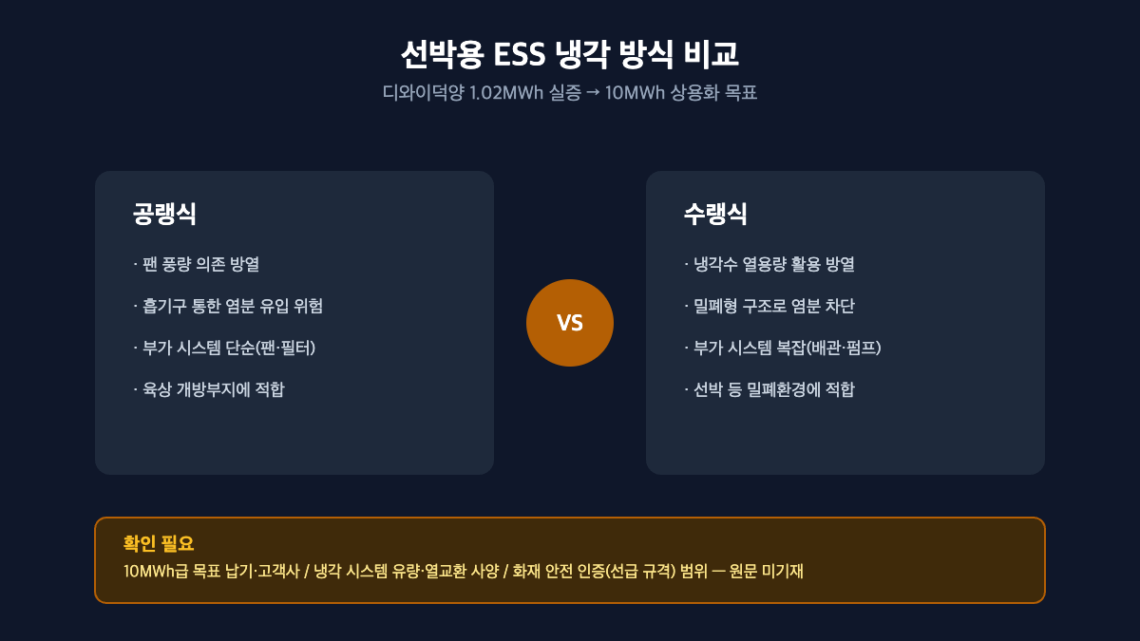
DY Duckyang’s 10 MWh-Class Marine ESS — What the Water-Cooled Demonstration Means for System Design
DY Duckyang has moved forward with a 10 MWh-class marine ESS business. The company has completed demonstration and certification of a 1.02 MWh-class water-cooled ESS and, building on this, is targeting supply of marine ESS at roughly 10 times that scale, at the 10 MWh class. While the battery system itself is similar between land-based and marine ESS, differing environmental constraints — installation space, vibration, and salt exposure — fundamentally diverge the cooling method and certification process design. This article organizes what completing the demonstration stage means from a system-design standpoint, and the nonlinear difficulty-escalation factors typically seen across a 10x scale-up. 1. Why marine applications require water cooling The…
-
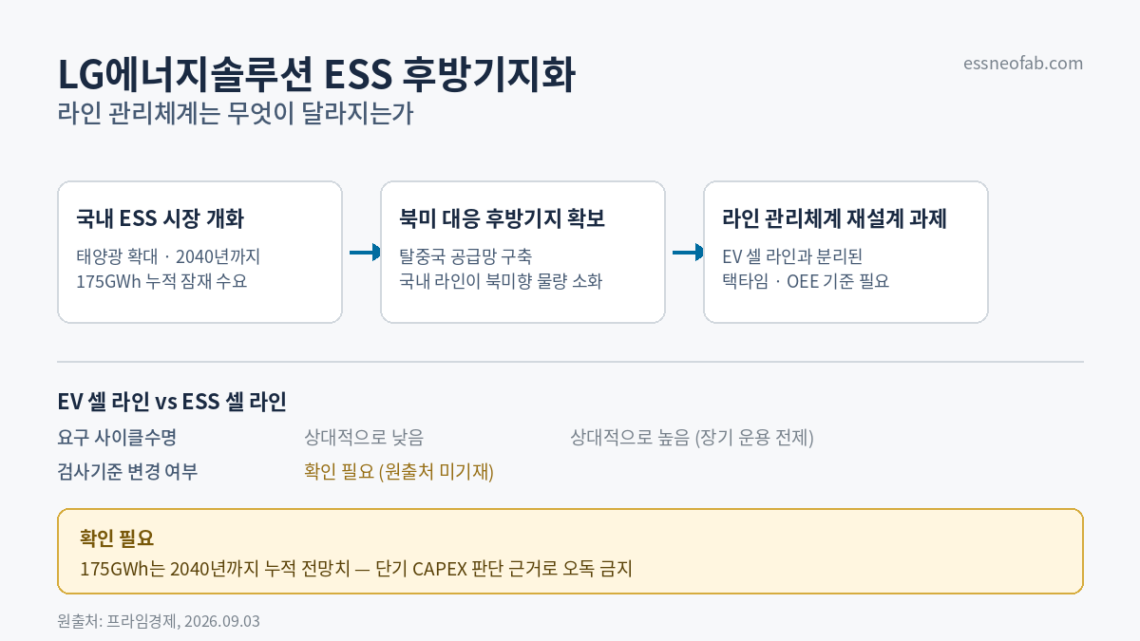
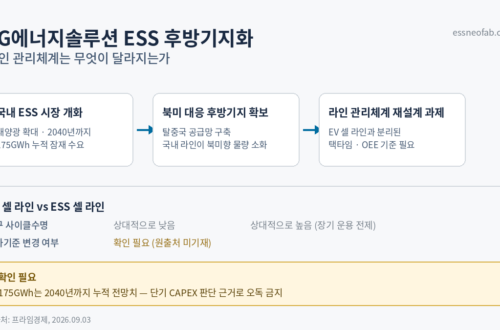
LG Energy Solution’s ESS Rear-Base Positioning — What Changes in Line Management
As Korea's domestic ESS market opens up, a trend is forming in which LG Energy Solution secures a role as a rear base responding to North American demand. Driven by solar power expansion, potential cumulative ESS battery demand of 175 GWh is projected through 2040, alongside attention to the effect of building a China-independent supply chain. However, absorbing this volume in domestic lines requires a takt time (Takt Time)¹ and OEE (Overall Equipment Effectiveness)² management system separate from existing EV cell lines, and the relevant detailed criteria are not given in the original source and require separate verification. 1. Situation and Challenge The opening of Korea's domestic ESS market is…
You May Also Like
From EV to ESS Use: What Ultium Cells and Cosmos Lab Show About Converting a Line’s Purpose
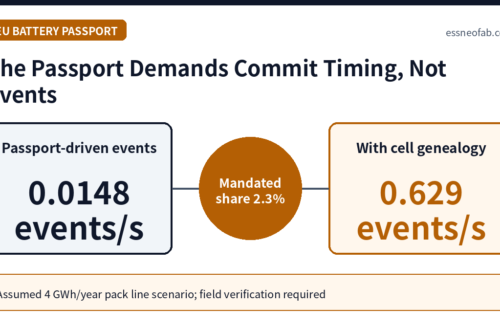
EU Battery Passport 2027: Which Station on an ESS Pack Line Commits What
Today’s ESS/Battery System Trends — U.S. LFP Mass Production Imminent, Megapack 3 Launched, Used-Battery Platform Integration (2026.08.11)
-
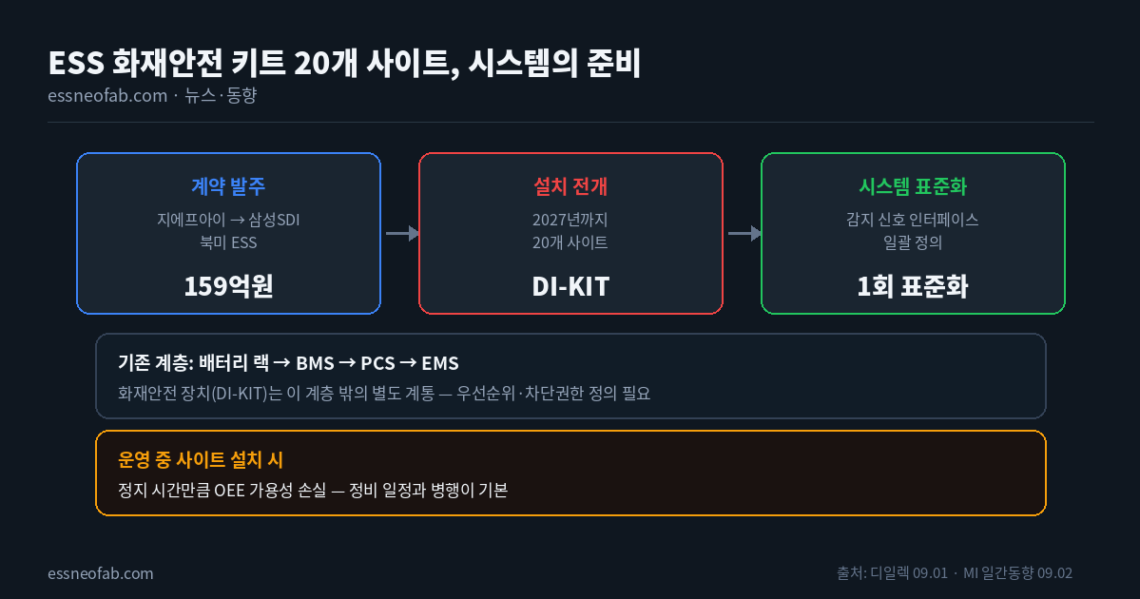
ESS Fire-Safety Kits Across 20 Sites — What the System Must Prepare
GFI has won a KRW 15.9 billion contract for Samsung SDI's North American ESS fire-safety solution. It will install DI-KIT at 20 sites by 2027. This contract shows that fire-safety devices are being ordered not as a cell-level option but as a site-level system line item. On the operations side, what is needed first is defining the installation sequence across the 20 sites and the interface with existing systems. 1. What Happened To state the conclusion first: ESS fire-safety solutions have moved into a phase of being applied in bulk across multiple sites. Until now, the general approach for North American ESS was to address site-specific safety requirements individually. Bundling…
You May Also Like
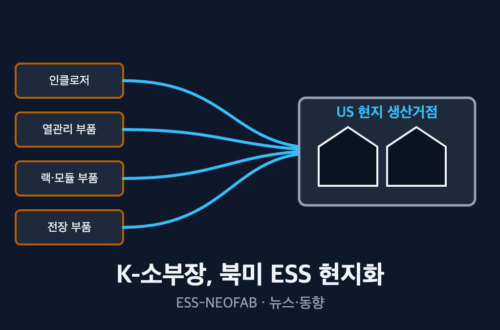
“Capturing the U.S. ESS Market” — K-Battery Supply Chain’s Wave of Localization: What’s Going Where
LS Electric Ships First Units of Next-Gen ESS PCS “G2” — Is Liquid Cooling the Answer?
Today’s ESS/Battery Process Trends — Expanded Support for Materials/Parts/Equipment Lines, Solid-State/LFP Pilot Lines Launch (2026.08.07)
-
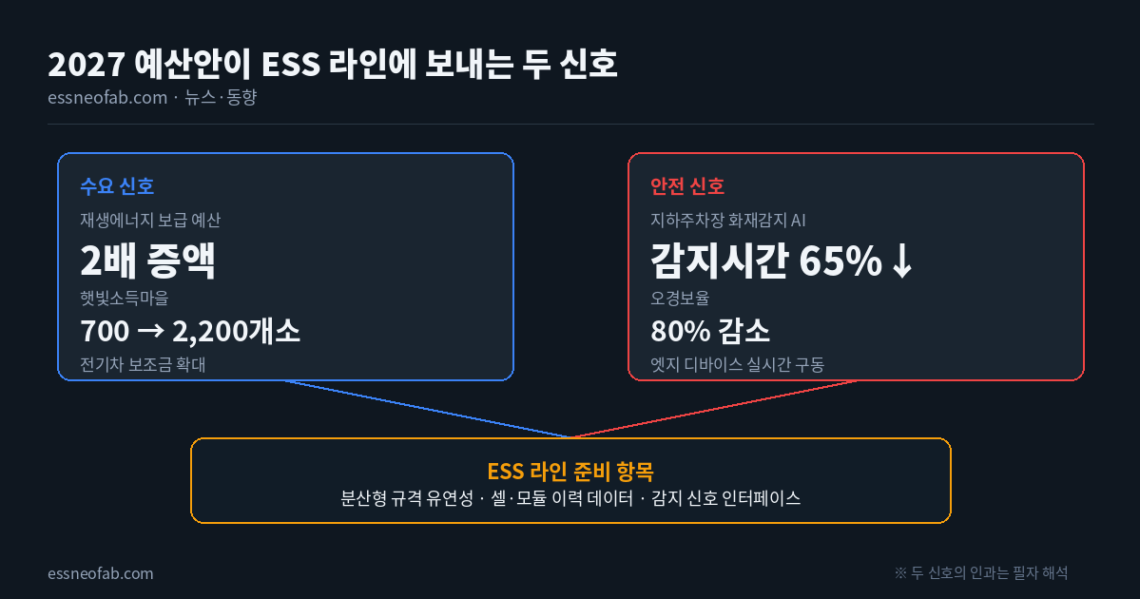
Doubling the Renewable-Energy Budget and Underground-Parking EV Fire-Detection AI — Two Signals the 2027 Budget Sends to the ESS Line
The 2027 government budget doubles the renewable-energy deployment budget, expands "Sunlight Income Villages" from 700 to 2,200 sites, and expands EV subsidies (Source 1). During the same period, an AI model for early detection of EV fires in underground parking garages has been developed domestically to the point of running in real time on edge devices (Source 2). This article reads the two items from an ESS¹ line/system perspective — as a demand signal and a safety signal, respectively — and sets out what the line side should prepare. The conclusion is that "as distributed generation increases, ESS demand increases, but expanded installation is accompanied by tightening fire-safety standards"; this…
-
Converting EV Lines to ESS: What the H1 Utilization Gap Reveals About Line-Conversion Speed
In H1 2026, utilization rates at the three major domestic battery makers' plants diverged based on how quickly each converted its lines to ESS use amid weak EV demand. LG Energy Solution and Samsung SDI sharply raised utilization through faster conversion and by securing new demand outlets (ESS, BBU), while SK On's utilization actually declined due to delayed conversion. This is not a matter of individual equipment performance, but of the speed of line-level decision-making. This article compares the three companies' utilization changes from a line-reconfiguration perspective. 1. What Happened U.S. EV demand is weak. The three battery makers all faced the same market environment. So why did their utilization…
You May Also Like
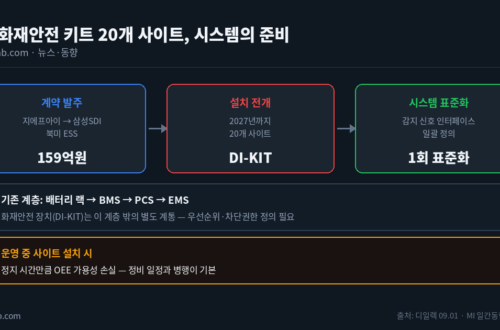
ESS Fire-Safety Kits Across 20 Sites — What the System Must Prepare
Today’s ESS/Battery System Trends — U.S. LFP Mass Production Imminent, Megapack 3 Launched, Used-Battery Platform Integration (2026.08.11)
From EV to ESS Use: What Ultium Cells and Cosmos Lab Show About Converting a Line’s Purpose
-
Dry Electrode: Where Does the Line Bottleneck Move?
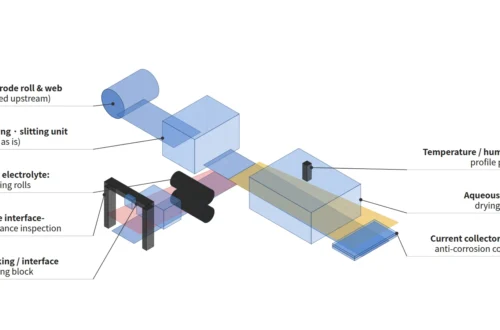
Converting to a dry electrode process eliminates the drying-oven section of a wet-coating line, but the claim that this improvement, by itself, shortens line takt time does not hold. When both the physical length and the time buffer that the drying oven provided disappear at once, the bottleneck shifts to the electrode-formation/lamination section and the quality-inspection section, and the degrees of freedom available for buffer design actually shrink. Separately, an industrial-park zoning deregulation announced in August 2026 adds battery-recycling businesses to the eligible occupants of the Gumi and Pohang national industrial complexes, changing the logistics-interface conditions outside the line. This article examines both changes together at the line/system level, and…
You May Also Like
“Capturing the U.S. ESS Market” — K-Battery Supply Chain’s Wave of Localization: What’s Going Where
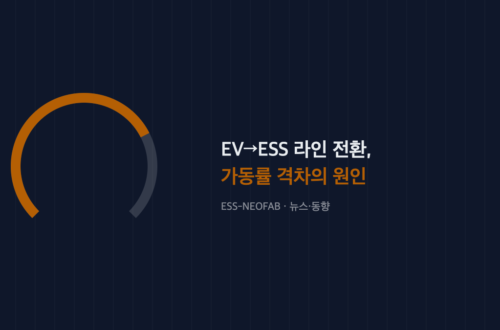
Converting EV Lines to ESS: What the H1 Utilization Gap Reveals About Line-Conversion Speed
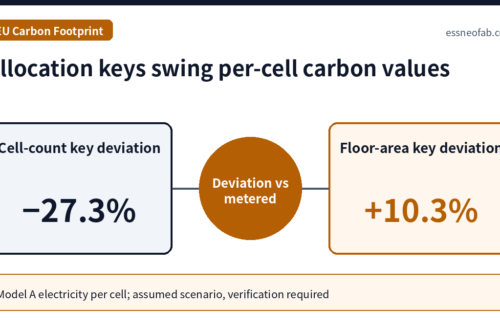
EU Battery Carbon Footprint Methodology Still Pending: How Line Energy Metering Resolution and Allocation Choice Shift Per-Cell Values
-
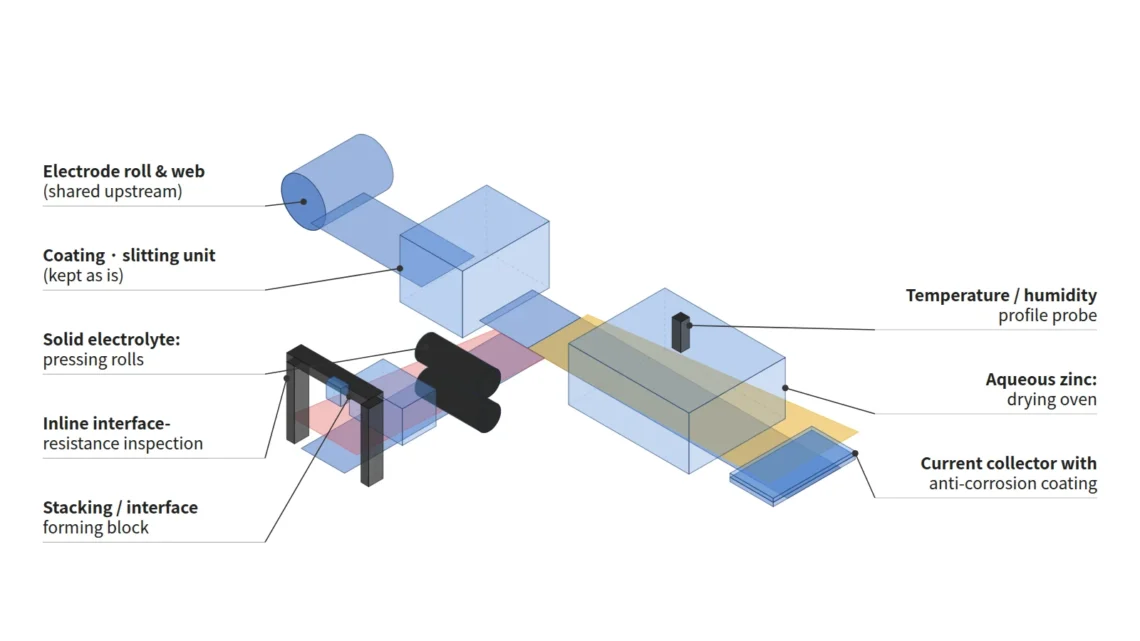
Solid Electrolyte and Aqueous Zinc Batteries: Investment Is Up — Is the Line Ready?
In August 2026, two domestic battery-material startups raised large investment rounds in quick succession. A solid-electrolyte specialist secured KRW 23.0 billion in a Series C round, and an aqueous zinc-ion battery company secured KRW 22.0 billion in a Series A round. Both companies handle materials whose process conditions differ from the conventional lithium-ion system, so from a shop-floor standpoint, the more important question is not the investment news itself but "what changes once this material actually reaches a mass-production line." Key Points at a Glance CategorySolid ElectrolyteAqueous Zinc-Ion Battery Funding roundSeries CSeries A Funding amountKRW 23.0 billionKRW 22.0 billion Difference from conventional lithium-ionThe liquid-electrolyte impregnation process itself disappears or shrinksUses…
-
K-BATTERY SHOW 2026 Fire Safety Seminar: What to Look for in a Line-Level Fire Response System
K-BATTERY SHOW 2026 was held from September 9 to 11, 2026, in Hall 7 of KINTEX Exhibition Center 2, with 185 exhibiting companies and 15,311 visitors over three days. The exhibition featured a special EV fire-response pavilion gathering fire prevention, detection, and suppression technologies, and the SFPE Korea Chapter’s “2026 International Lithium Battery and EV Fire Safety Seminar” shared thermal-runaway prediction and suppression technologies. This article treats line-level fire response as a closed loop of three serially connected segments (detection, isolation, and suppression) and shows that, in an assumed scenario, suppression-discharge delay accounts for 54 % of the loop’s total response time of 18.5 s. In other words, the performance…
-
From EV to ESS Use: What Ultium Cells and Cosmos Lab Show About Converting a Line’s Purpose
In summer 2026, cases of cell lines being converted to a different purpose followed one another in North America and Korea. Ultium Cells, the GM–LG Energy Solution joint venture, retooled one EV line at its Spring Hill (Tennessee) plant into an LFP cell line for ESS at a cost of USD 70 million and began production on July 8, 2026, while its Warren (Ohio) plant resumed production of NCMA cells for EVs after a shutdown of about seven months, with about 1,400 workers returning. In the same period, Cosmos Lab raised a KRW 22 billion Series A and is preparing mass production of aqueous zinc-halogen batteries. This article distinguishes “purpose…
You May Also Like
Today’s ESS/Battery System Trends — U.S. LFP Mass Production Imminent, Megapack 3 Launched, Used-Battery Platform Integration (2026.08.11)
Converting EV Lines to ESS: What the H1 Utilization Gap Reveals About Line-Conversion Speed
Dry Electrode: Where Does the Line Bottleneck Move?
-
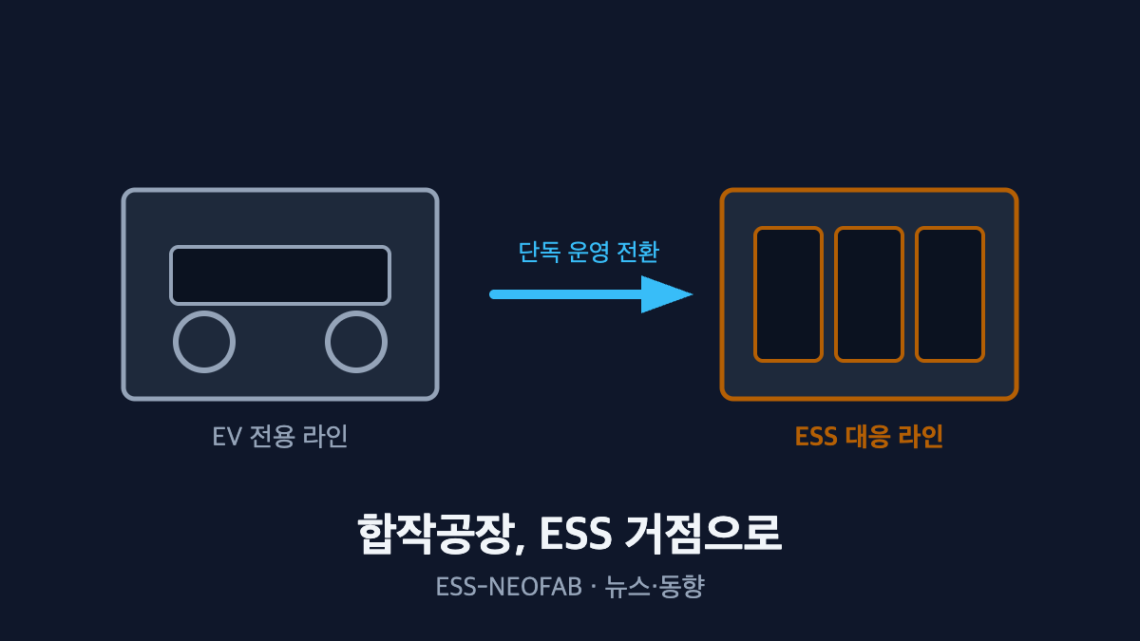
Samsung SDI Turns Its GM Joint-Venture Plant Into an ESS Hub
On August 11, 2026, Samsung SDI announced that it would acquire GM’s 49.99 % stake in SDI-GM Synergy Cells, its U.S. battery joint venture with GM, converting it into a wholly owned entity. The subject is the 27 GWh per year plant in New Carlisle (Indiana) (with an expansion plan of up to 36 GWh), and Samsung SDI intends to raise its U.S. ESS battery production capacity to about 30 GWh by the end of 2026. This article uses an assumed scenario to calculate how plant load is redistributed when the same GWh is filled with ESS cells instead of EV cells. Switching to ESS cells with higher energy per…