Samsung SDI Turns Its GM Joint-Venture Plant Into an ESS Hub
Abstract
On August 11, 2026, Samsung SDI announced that it would acquire GM’s 49.99 % stake in SDI-GM Synergy Cells, its U.S. battery joint venture with GM, converting it into a wholly owned entity. The subject is the 27 GWh per year plant in New Carlisle (Indiana) (with an expansion plan of up to 36 GWh), and Samsung SDI intends to raise its U.S. ESS battery production capacity to about 30 GWh by the end of 2026.
This article uses an assumed scenario to calculate how plant load is redistributed when the same GWh is filled with ESS cells instead of EV cells. Switching to ESS cells with higher energy per cell reduces the annual cell count by 58.7 %, freeing capacity in processes proportional to cell count such as assembly and inspection, but the load on the coating process, which is proportional to electrode area, remains unchanged, so the bottleneck moves toward the electrode side.
1. The Conclusion First — ESS Conversion Does Not Slow the Plant; It Moves the Bottleneck
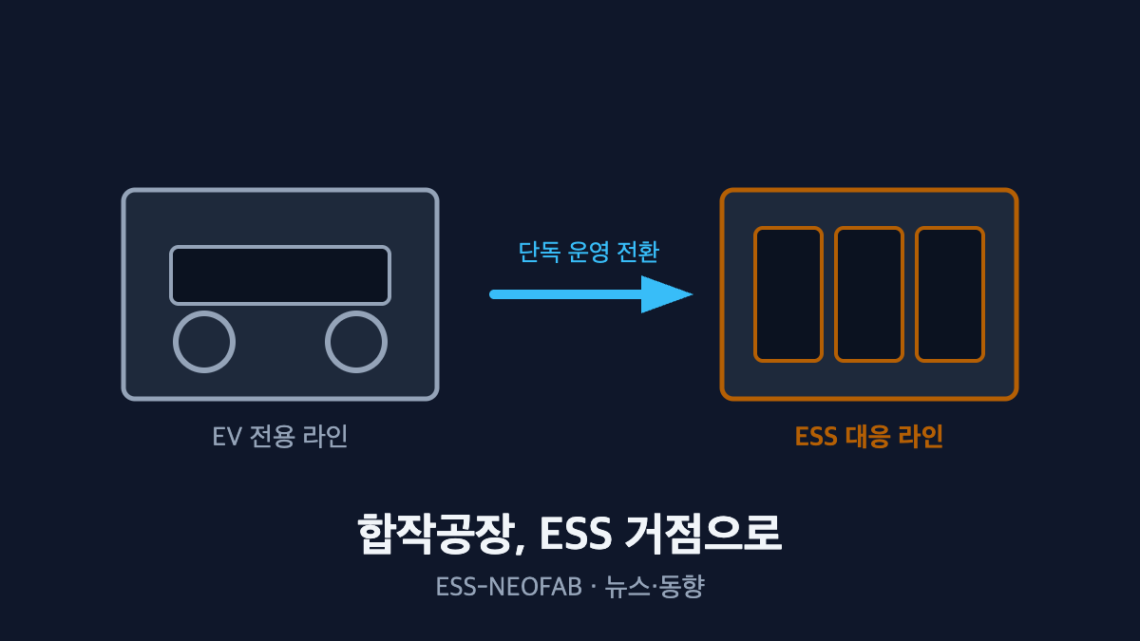
When EV cells are replaced with ESS cells within the same GWh, the load on processes proportional to cell count falls sharply while the load on processes proportional to energy does not, so the focus of conversion design is not assembly speed but the specification-changeover flexibility of the electrode process.
Situation (S): While growth in EV battery demand has slowed more than expected, U.S. ESS demand is rising rapidly on the back of AI data centers and the expansion of renewable energy. Complication (C): Samsung SDI secured its first wholly owned plant in North America by unwinding the joint-venture stake, and described it as a foundation of production flexibility for ESS expansion. Question (Q): When a line designed exclusively for EVs takes on ESS, which process reaches its limit first? Answer (A): The processes that follow electrode area rather than cell count.
2. Facts
| Item | Before (joint-venture structure) | After conversion (sole operation) |
|---|---|---|
| Ownership structure | Samsung SDI–GM joint venture | Samsung SDI acquires GM’s 49.99 % stake; wholly owned entity |
| Plant | New Carlisle, Indiana, USA; 27 GWh per year (expansion plan of up to 36 GWh) | |
| Product | Mainly EV batteries | EV + ESS (specific share and timing not disclosed) |
| Relationship with GM | Joint development of next-generation prismatic batteries maintained separately | |
| Company target | U.S. ESS battery production capacity of about 30 GWh by end of 2026 | |
For reference, this plant is a separate site from StarPlus Energy, which Samsung SDI operates with Stellantis in Kokomo, Indiana. The ESS conversion share and timing for the New Carlisle plant have not been officially announced, so they are treated as items for which verification is required.
3. Mechanism — Same GWh, Different Cell Count
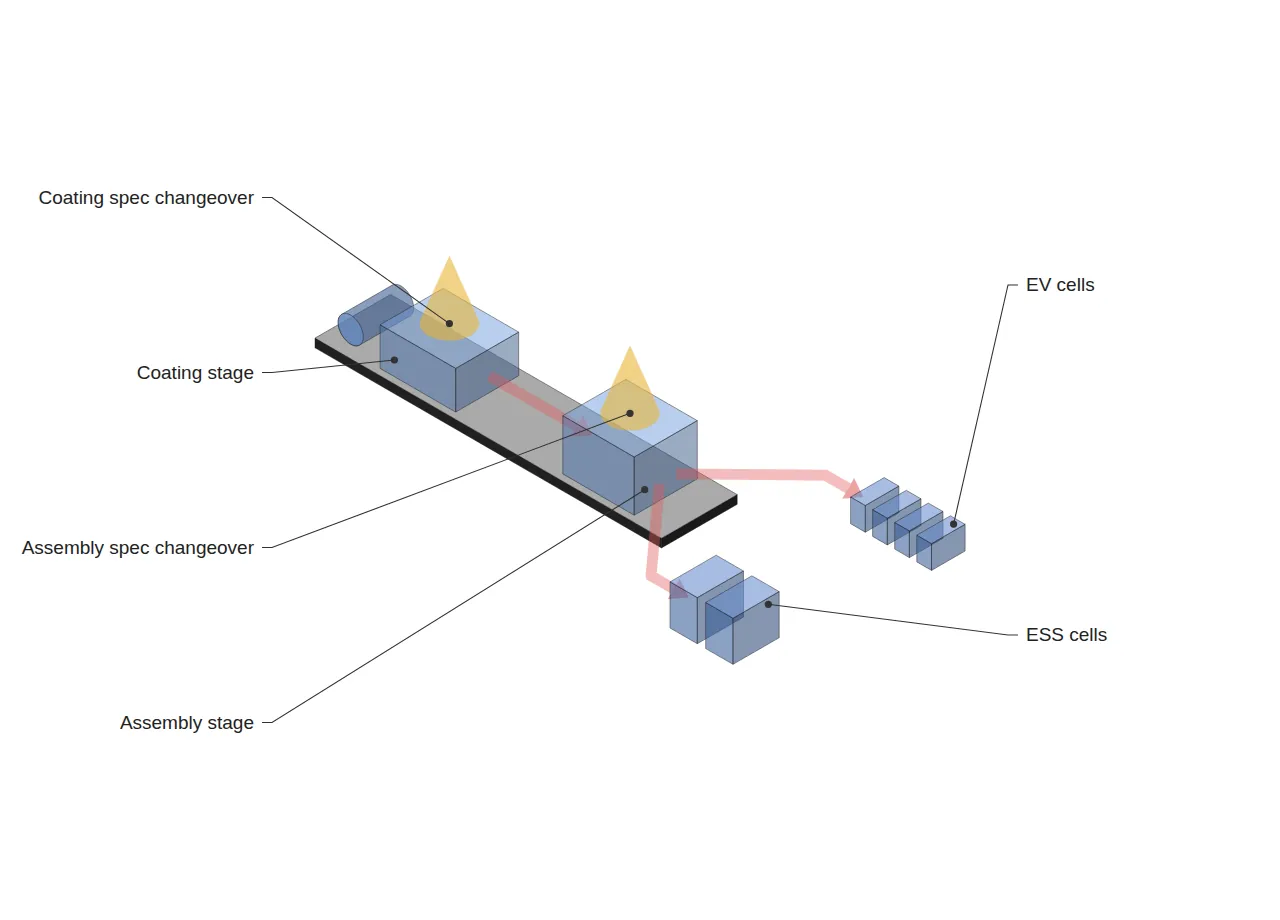
If plant capacity is fixed in GWh, the annual cell count is inversely proportional to energy per cell. Processes that occur once per cell, such as assembly, inspection, and cell-ID recording, are proportional to cell count, while processes that handle electrode area, such as electrode coating, are proportional to energy (assuming equal energy per unit area). The following is an assumed scenario intended to show the structure and does not reflect the actual specifications of Samsung SDI products.
| Item | Filled with EV cells (assumed) | Filled with ESS cells (assumed) | Change |
|---|---|---|---|
| Energy per cell | 0.37 kWh | 0.896 kWh | ×2.42 |
| Annual cell count (27 GWh) | about 72.97 million | about 30.13 million | −58.7 % |
| Plant-wide takt time[1] | 0.326 s/cell | 0.788 s/cell | Relaxed ×2.42 |
| Load on cell-count-proportional processes | Baseline 100 | 41.3 | Spare capacity created |
| Load on electrode-area-proportional processes | Baseline 100 | 100 | No change |
Takt time (available operating time ÷ customer demand quantity) is the available operating time of 23,760,000 s divided by the annual cell count. Switching to ESS cells relaxes takt time by a factor of 2.42 and creates spare capacity in the assembly section, but because the area the electrode coating line must process is unchanged, the required coating line speed (m/min) does not decrease. In other words, the bottleneck moves from the cell-count-proportional processes toward the electrode process.
4. Limits of Application
This calculation assumes that EV and ESS electrodes have the same energy per unit area. In practice, cathode materials (e.g., LFP versus high-nickel) and electrode designs differ, so energy per unit area may differ, in which case the electrode load could increase or decrease (further verification required). If the form factor changes when cell specifications are switched, the assembly equipment itself may need replacement, so “spare assembly capacity” does not immediately imply reusability.
This shares the same principle as Sebang Lithium Battery’s Simultaneous HEV Pack and ESS Module Orders — Analyzing the Cell-Inbound Interface and Cell-ID Traceability Load, which showed that cell-inbound traceability load is proportional to cell count rather than GWh, but this article addresses the level inside the cell plant at which the loads of cell-count-proportional processes and energy-proportional processes move in opposite directions.
5. Conclusions and Implications
Samsung SDI’s sole-ownership conversion is a structural change that accelerates decisions to shift between EV and ESS within a single plant. From a line-design perspective, the primary constraint of ESS conversion is not assembly speed but the processing area and specification-changeover flexibility of the electrode process. Once the conversion share is disclosed, the assumed scenario in this article should be replaced with actual cell specifications to re-verify the bottleneck location.
FAQ
Q. Does this mean cooperation with GM is completely over?
A. No. Only the battery joint-venture stake is unwound; the joint development agreement for next-generation prismatic batteries is maintained separately.
Q. Since ESS cells mean fewer cells, won’t the line become idle?
A. That is true for cell-count-proportional processes (load of 41.3 in the assumed scenario). However, if the GWh is the same, the electrode-area throughput does not decrease, so the load on electrode processes such as coating remains the same. For the plant as a whole, only the bottleneck location changes.
Field Application Notes
| Check | How to execute | Remarks |
|---|---|---|
| ☐ Classify processes by load basis | Mark each process as proportional to cell count or to electrode area (energy) | Determines direction of load change on conversion |
| ☐ Recalculate takt time after conversion | Obtain the cell count as target GWh ÷ new energy per cell, then divide the available operating time by it | Plant-wide basis |
| ☐ Check coating line-speed margin | Calculate the required m/min as required electrode area after conversion ÷ available time | Use measured energy per unit area |
| ☐ Standardize the specification-changeover procedure | Record changeover time in the coating and assembly stages in s | OEE availability management in mixed production |
Footnotes
[1] Takt Time: available operating time ÷ customer demand quantity. This article uses a value treating the entire plant as one unit, and it is not to be used interchangeably with the Cycle Time of a single piece of equipment or with FPY. OEE (Overall Equipment Effectiveness) is defined as Availability × Performance × Quality.
Sources: Samsung SDI Unwinds GM Joint Venture… Accelerating Reorganization of North American JVs (Newspim, 2026-08-12, https://www.newspim.com/news/view/20260812000715) / Samsung SDI Ends U.S. Battery Joint Venture With GM… Acquires Entire Stake (Joseilbo, https://m.joseilbo.com/news/view.htm?newsid=573625) / Samsung SDI Converts GM Battery Joint Venture to Sole Ownership (The Big Data, 2026-08-11, https://www.thebigdata.co.kr/view.php?ud=2026081115051065420ecbf9426b_23)
Measurement & Calculation Conditions: (The body was supplemented on 2026-09-23.) The production capacity of 27 GWh is the reported figure. EV cell 0.37 kWh (3.7 V × 100 Ah), ESS cell 0.896 kWh (3.2 V × 280 Ah), available operating time 23,760,000 s (300 days per year × 22 h), and equal electrode energy per unit area are all assumed values and not Samsung SDI product specifications. Verification by measurement is required.
Related reading — From EV to ESS Use: What Ultium Cells and Cosmos Lab Show About Converting a Line’s Purpose · StarPlus Energy’s Indiana Plant — The Blended-OEE Illusion Created by Sequential NCA/LFP Commissioning


3 Comments
Pingback:
Pingback:
Pingback: