
NFPA 855 (2026 Edition) Revision: ESS Safety Standards Expand From the Cell to the Entire System
Since August 2017, 21 lithium-ion battery ESS fires have occurred in Korea alone, but only a portion of these incidents can be explained by battery cell defects alone. In many cases, the direct cause of fire spread was equipment outside the battery itself — the Balance of System (BOS) — such as missing surge arresters, defective wiring installation, or cooling/HVAC failures. With the release of the 2026 edition of NFPA 855, the National Fire Protection Association (NFPA) has shifted its evaluation criterion from “whether an internal cell defect exists” to “whether propagation to adjacent cells, modules, or racks is blocked.”
NFPA 855 is the Standard for the Installation of Stationary Energy Storage Systems established by the NFPA. It defines installation location, separation distances, capacity limits, and fire-response requirements, and is revised on a three-year cycle. The core of the 2026 edition is that it codifies performance criteria for Thermal Runaway Propagation Prevention (TRPP).
1. Revision Overview: TRPP Becomes the Core Evaluation Criterion
- Through the 2023 edition, NFPA 855 focused on post-fire response and damage mitigation.
- The 2026 edition codifies a performance criterion that “thermal runaway must not propagate to adjacent cells, modules, or racks.”
- To meet this criterion, an active safety layer — the Thermal Runaway Propagation Prevention (TRPP) system — has been made mandatory under a newly added provision (9.7.6.6).
2. Core Subsystems: TRPP and Large-Scale Fire Testing (LSFT)
TRPP is an active system that detects thermal-runaway precursor signals such as off-gassing and abnormal temperature and automatically discharges cooling or suppression media; it cannot be substituted by passive design elements such as spacing or barriers alone.
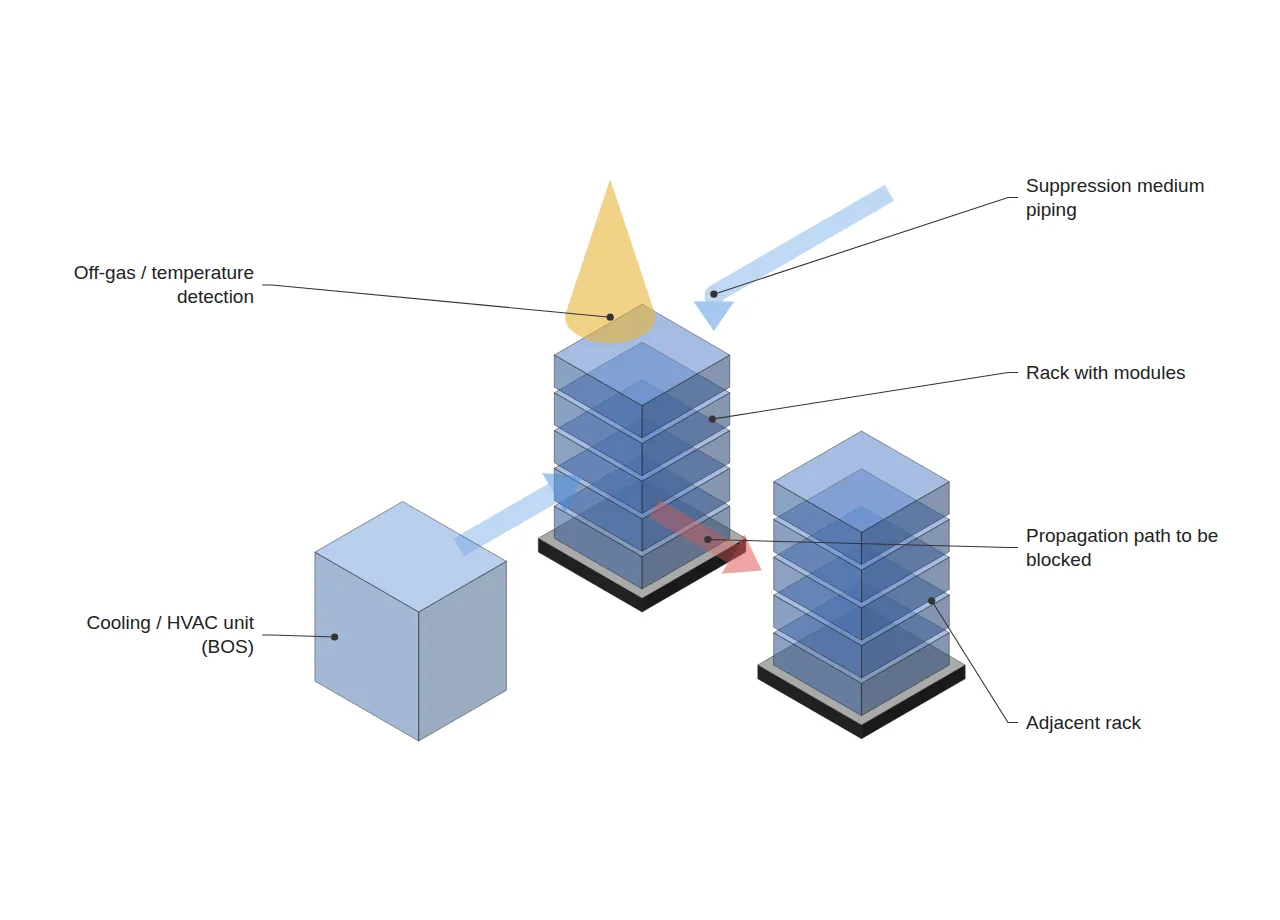
Whereas the existing UL 9540A involved staged testing at the cell, module, and unit level, the 2026 edition adds a Large-Scale Fire Test (LSFT) that reproduces an actual fire with suppression systems disabled, in the as-installed configuration, requiring verification of worst-case performance.
3. Interfaces and Linkage Points: Combining HMA With UL 9540 Certification
The 2026 edition designates a Hazard Mitigation Analysis (HMA) as a baseline requirement for most ESS installations. This assessment is an engineering process that automatically determines the specifications of each safety layer — TRPP, separation distance, ventilation, and so on — based on the battery chemistry and configuration, and must be led by a licensed Professional Engineer (PE).
As the range of battery chemistries covered has expanded, detection methods have also broadened from radiant-energy detection to smoke and thermal-imaging detection. For interoperability with UL 9540 certification, compliance with ASME B31.1/B31.3 is also now included among the documentation requirements.
4. Bottlenecks and Risks in Korea’s Domestic Response
- Lack of certification infrastructure: Domestic test facilities capable of performing UL 9540A-based LSFT are limited, so many operators rely on certification obtained overseas.
- Regulatory gap: Korea’s domestic safety standards remain centered on fire response and damage mitigation, and there is not yet a domestic case that codifies propagation prevention (TRPP) as a performance target.
- Standards-participation gap: Direct participation by domestic institutions and companies in international standards-development bodies such as the NFPA committee, UL STP, and FM technical committees is limited, which can create a time lag between domestic regulation and international standards.
5. Summary and Management Metrics
| Category | 2023 Edition | 2026 Edition |
| Evaluation Criterion | Post-fire response and damage mitigation | Blocking thermal-runaway propagation itself (TRPP mandatory) |
| Scope of Fire Causes | Centered on the battery cell | Includes BOS — wiring, cooling, BMS, etc. |
| Test Method | UL 9540A staged testing at cell/module/unit level | Adds installation-level Large-Scale Fire Test (LSFT) |
Field Application Note
If TRPP is added retroactively after the line design stage, rack spacing and piping/wiring routes often need to be redesigned. Reserving space for suppression-media piping and detector installation from the initial layout stage can significantly reduce the frequency and cost of design changes at the certification stage.
FAQ
Q. Does NFPA 855 (2026) apply retroactively to already-installed ESS?
Applicability is determined by the Authority Having Jurisdiction (AHJ) based on battery chemistry and total storage capacity, and is not uniformly applied retroactively. However, new installations and large-scale expansions are increasingly being designed on the assumption of the 2026 edition’s requirements.
Q. Can sufficient separation distance alone substitute for TRPP?
No. Passive design elements such as spacing and barriers are recognized as supplementary measures, but the core of TRPP lies in an active system that detects precursor signals — such as off-gassing and abnormal temperature — and actively discharges cooling or suppression media.
Related Reading — From EV to ESS Use: What Ultium Cells and Cosmos Lab Show About Converting a Line’s Purpose · Samsung SDI Turns Its GM Joint-Venture Plant Into an ESS Hub · “Capturing the U.S. ESS Market” — K-Battery Supply Chain’s Wave of Localization: What’s Going Where


One Comment
Pingback: