-
NFPA 855 (2026 Edition) Revision: ESS Safety Standards Expand From the Cell to the Entire System
Since August 2017, 21 lithium-ion battery ESS fires have occurred in Korea alone, but only a portion of these incidents can be explained by battery cell defects alone. In many cases, the direct cause of fire spread was equipment outside the battery itself — the Balance of System (BOS) — such as missing surge arresters, defective wiring installation, or cooling/HVAC failures. With the release of the 2026 edition of NFPA 855, the National Fire Protection Association (NFPA) has shifted its evaluation criterion from "whether an internal cell defect exists" to "whether propagation to adjacent cells, modules, or racks is blocked." NFPA 855 is the Standard for the Installation of Stationary…
-
ESS Fire Investigation and Traceability: Decomposing Reverse-Trace Time from the Incident Rack to Same-Lot Sites
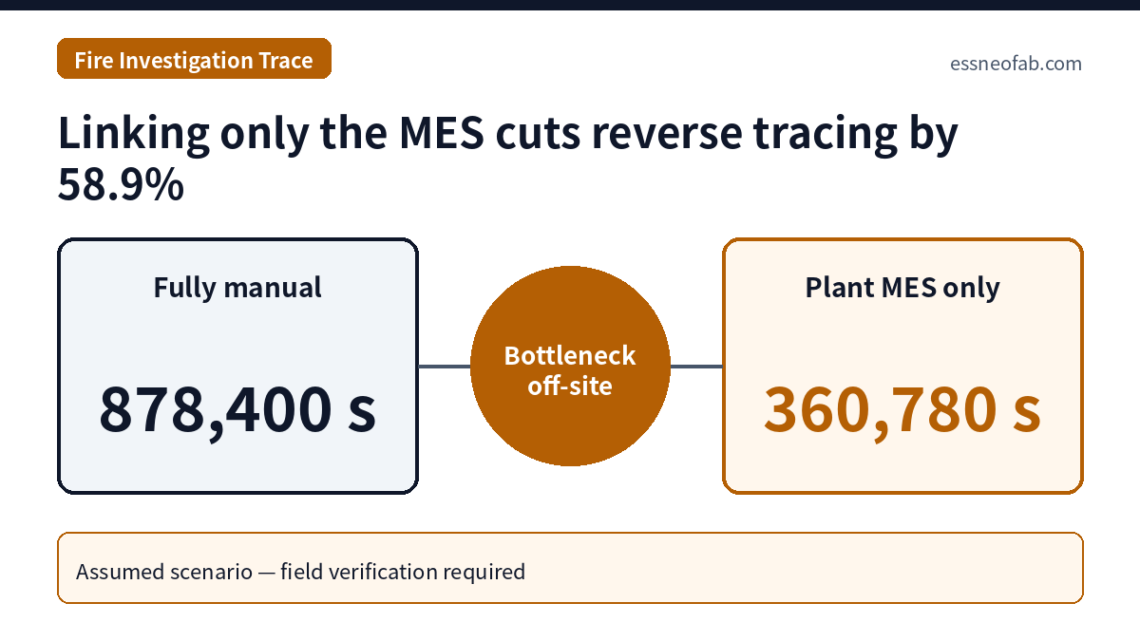
According to EPRI's 2024 white paper, only 26 of the 81 incidents (32.1%) in its BESS Failure Incident Database had sufficient information to assign a root cause, and the loss of physical evidence after fire was cited as the reason manufacturing defects were the least-classified root cause. What remains once physical evidence has burned is the linked data stored outside the site, namely traceability. Decomposing a five-step reverse trace from one incident rack to cell lot, process parameters, and the installation positions of the same lot at other sites under an assumed scenario gives 878,400 s for a fully manual path and 1,710 s for a fully connected database. However,…
You May Also Like
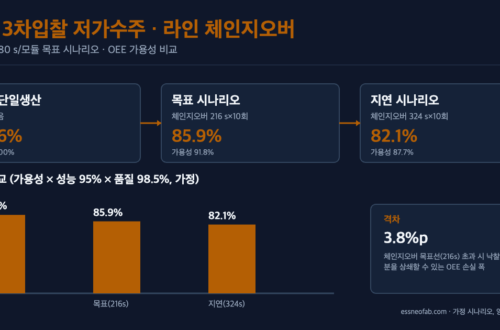
Line Changeover Design in the Era of Low-Price ESS Round-3 Bidding — Flexible Assembly Viewed Through Takt Time and OEE
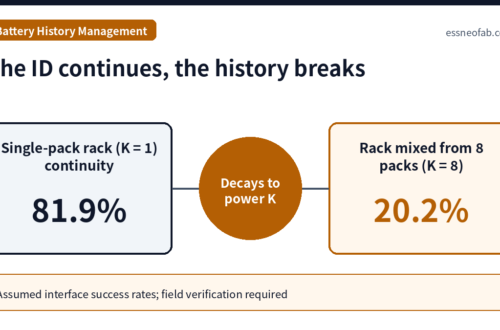
After Korea’s Battery History Management System: IDs Continue, Operating History Breaks — History Continuity of ESS Reuse Racks
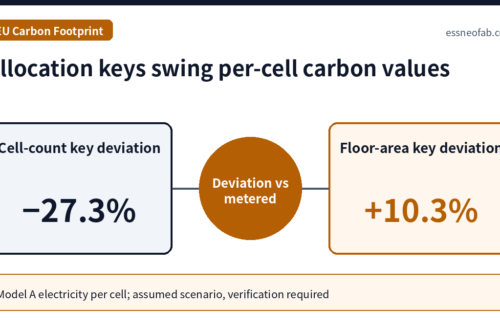
EU Battery Carbon Footprint Methodology Still Pending: How Line Energy Metering Resolution and Allocation Choice Shift Per-Cell Values