
From EV to ESS Use: What Ultium Cells and Cosmos Lab Show About Converting a Line’s Purpose
Abstract
In summer 2026, cases of cell lines being converted to a different purpose followed one another in North America and Korea. Ultium Cells, the GM–LG Energy Solution joint venture, retooled one EV line at its Spring Hill (Tennessee) plant into an LFP cell line for ESS at a cost of USD 70 million and began production on July 8, 2026, while its Warren (Ohio) plant resumed production of NCMA cells for EVs after a shutdown of about seven months, with about 1,400 workers returning. In the same period, Cosmos Lab raised a KRW 22 billion Series A and is preparing mass production of aqueous zinc-halogen batteries. This article distinguishes “purpose conversion” into recipe changeover (same chemistry) and retooling (chemistry change), and uses an assumed scenario to show that, in mixed EV↔ESS operation within the same chemistry, changeover frequency determines OEE availability.
1. The Conclusion First — There Are Two Kinds of Purpose Conversion, With Different Cost Structures
Converting a line’s purpose from EV to ESS is an equipment-retooling investment problem when the chemistry changes, and an operational problem in which recipe-changeover frequency erodes availability when the chemistry stays the same.
Situation (S): With slowing EV demand coinciding with expanding ESS demand, cell manufacturers are redefining the use of their existing EV lines. Complication (C): Spring Hill changed its chemistry from NCMA to LFP and retooled its equipment, while existing NCMA production was consolidated at Warren. Question (Q): Does every purpose conversion incur the same kind of cost? Answer (A): No. For a chemistry change, the cost is a one-time investment and retraining; for a purpose conversion within the same chemistry, the cost is recurring changeover time.
2. Facts — Line Status in the Three Cases
| Item | Ultium Cells Warren (Ohio) | Ultium Cells Spring Hill (Tennessee) | Cosmos Lab |
|---|---|---|---|
| Product | Large-format NCMA pouch cells for EVs | LFP cells for ESS (one EV line converted) | Aqueous zinc-halogen cells for AI data centers and long-duration ESS |
| Line status | Restarted after about 7 months of shutdown; about 1,400 workers returned | Production started 2026-07-08 after retooling | Preparing for mass production (target: start of mass production next year) |
| Conversion mode | Consolidation hub for NCMA production | Chemistry change (retooling USD 70 million, workforce retraining) | New line built for a new chemistry |
| Capacity | 45 GWh or more per year | Not disclosed | Not disclosed |
| Notes | — | Supplied through LG Energy Solution’s North American ESS subsidiary (Vertech) | Non-flammable aqueous electrolyte; integrated cell with no external electrolyte tank or circulation pump |
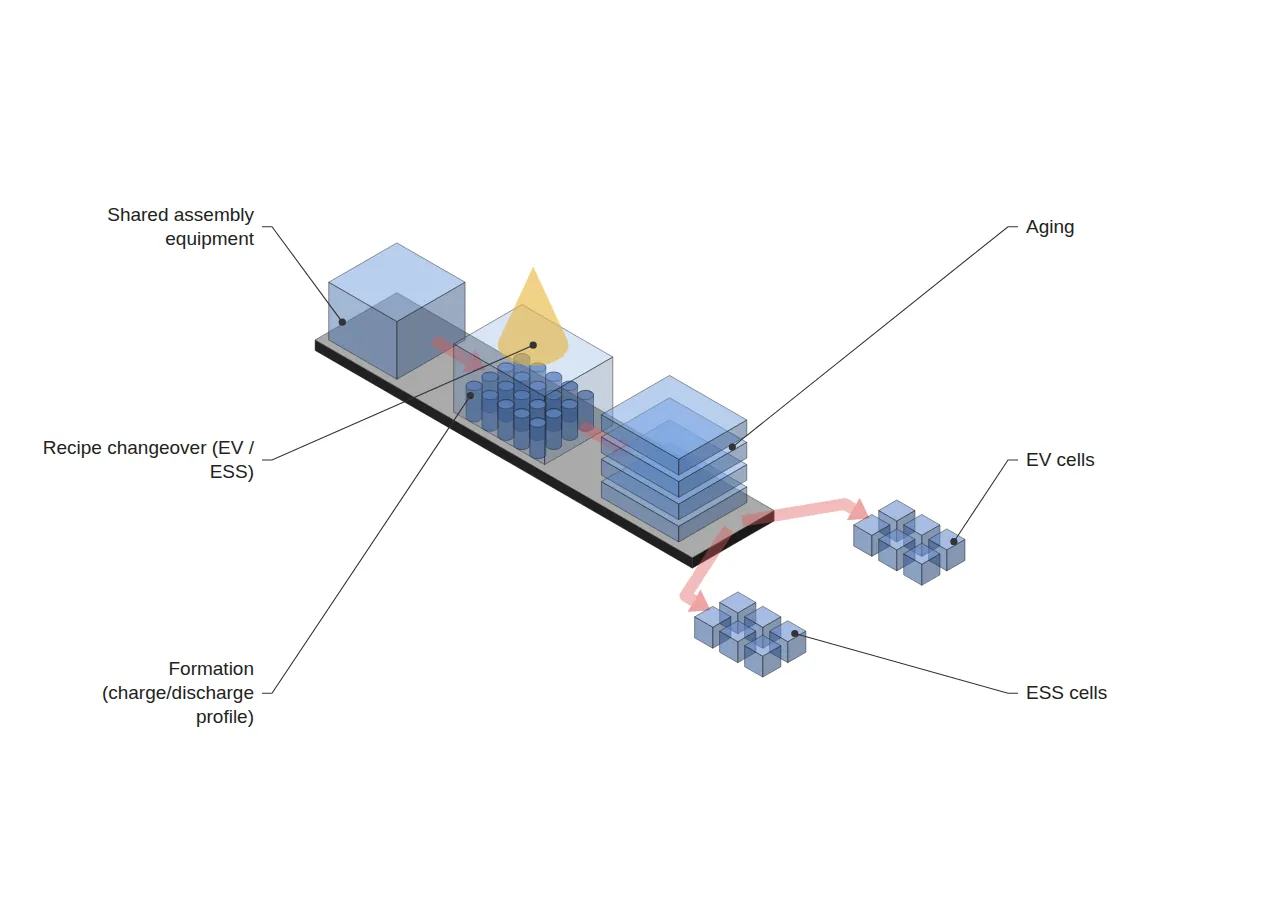
The notable fact in the Spring Hill case is that the conversion was not merely a matter of “changing the recipe.” According to the company’s announcement, USD 70 million was invested in retooling cell production equipment, and 700 workers furloughed in January returned after retraining aligned with LFP manufacturing requirements.
3. Mechanism — In Same-Chemistry EV↔ESS Mixed Production, Changeover Frequency Determines Availability
When EV and ESS cells of the same chemistry are produced alternately, the line stops while the recipe is changed, such as electrode specifications or the charge/discharge profile of formation[1]. This time directly reduces the availability factor of OEE (Overall Equipment Effectiveness = Availability × Performance × Quality). The following is an assumed scenario intended to show the structure.
| Recipe changeovers per month | Downtime per changeover (assumed) | Total monthly downtime | Availability loss (basis: 2,592,000 s per month) |
|---|---|---|---|
| 1 | 28,800 s | 28,800 s | 1.11 %p |
| 2 | 28,800 s | 57,600 s | 2.22 %p |
| 4 | 28,800 s | 115,200 s | 4.44 %p |
Even with the same downtime per changeover, quadrupling the number of monthly changeovers quadruples the availability loss. The design variable of a mixed-production line is therefore not only shortening changeover time but also “how many changeovers the production plan is built around.” Takt time[2] (available operating time ÷ customer demand quantity) must likewise be recalculated with the available operating time reduced by the changeover downtime.
4. Limits of Application — Non-Lithium Lines Have a Different Comparison Baseline
Cosmos Lab’s aqueous zinc-halogen cells differ from lithium-ion in their electrolyte and material system, so the recipe-changeover logic above cannot be applied as is. Publicly disclosed information is limited to the investment size, the non-flammable aqueous electrolyte, the integrated cell structure, and the target of mass production next year; process conditions and capacity have not been disclosed (verification required). For a line built for a new chemistry, the dominant variable is likely to be quality stabilization during the initial ramp-up period rather than changeover cost, but this must be confirmed through measurement.
This differs in scope from Converting EV Lines to ESS: Where Does OEE Break Down?, which examined which OEE factor fails first when an EV line is converted to ESS. Whereas that article addressed the loss points of a single line after conversion, this article addresses the distinction between conversion modes (retooling versus recipe changeover) and the changeover frequency of mixed-production operation.
5. Conclusions and Implications
Ultium Cells separated its sites by chemistry (Warren for NCMA, Spring Hill for LFP), choosing dedication over mixed production. If EV and ESS cells of the same chemistry are mixed on one line, availability loss can be managed only by controlling changeover frequency at the production-planning stage. In ranges where high changeover frequency drives large losses, it is reasonable to also calculate the break-even point for line separation.
FAQ
Q. Can EV cells and ESS cells be produced on the same line?
A. Physically, yes, if the chemistry is the same. However, recipe-changeover downtime lowers OEE availability; in the assumed scenario, four changeovers per month cause a loss of 4.44 %p. When changeover frequency is high, separating dedicated lines may be advantageous.
Q. Is the Spring Hill conversion a recipe changeover?
A. No. It is a retooling case in which the chemistry changed from NCMA to LFP, accompanied by a USD 70 million equipment investment and workforce retraining.
Field Application Notes
| Check | How to execute | Remarks |
|---|---|---|
| ☐ Classify the conversion type | First classify the purpose conversion under review as a chemistry change (retooling) or a recipe changeover | Cost characteristics differ |
| ☐ Measure changeover downtime separately | Record the time from the start of recipe changeover to the first good unit, in s | Keep separate from ordinary breakdown downtime |
| ☐ Set a cap on monthly changeovers | Calculate the allowable number of monthly changeovers as target availability loss ÷ loss per changeover | Reflect in the production plan |
| ☐ Calculate the break-even point for line separation | Compare cumulative changeover losses and dedicated-line investment over the same period | Consider the Spring Hill-style dedication alternative |
Footnotes
[1] Formation: the process of applying the first charge/discharge to an assembled cell to activate it electrochemically. The charge/discharge profile and aging conditions may differ depending on the application (EV/ESS).
[2] Takt Time: available operating time ÷ customer demand quantity. Not to be used interchangeably with Cycle Time or FPY.
Sources: Ultium Cells Spring Hill Diversifies Production with LFP Batteries for Energy Storage Systems (Ultium Cells, 2026-03-17, https://www.ultiumcell.com/newsroom/latest-news/2026/03/17/Ultium-Cells-Spring-Hill-Diversifies-Production-with-LFP-Batteries-for-Energy-Storage-Systems) / Ultium Cells starts ESS battery production at Tennessee plant (KED Global, 2026-07-08, https://www.kedglobal.com/batteries/newsView/ked202607080003) / GM And LG Restart EV Battery Production In Ohio After Seven-Month Shutdown (InsideEVs, https://insideevs.com/news/804775/gm-lg-ultium-cells-production-restart-ohio/) / A “Non-Burning Battery” for Data Centers and ESS… Cosmos Lab Attracts KRW 22 Billion in Investment (Money Today, 2026-08-12, https://www.mt.co.kr/future/2026/08/12/2026081209192198123)
Measurement & Calculation Conditions: (The body was supplemented on 2026-09-23.) Monthly available time of 2,592,000 s (30 days × 86,400 s), downtime of 28,800 s per recipe changeover, and 1 to 4 changeovers per month are all assumed values for explaining the structure and are not measurements from any specific plant. Verification by measurement is required.
Related reading — Samsung SDI Turns Its GM Joint-Venture Plant Into an ESS Hub · Converting EV Lines to ESS: Where Does OEE Break Down? · “Capturing the U.S. ESS Market” — K-Battery Supply Chain’s Wave of Localization: What’s Going Where


7 Comments
Pingback:
Pingback:
Pingback:
Pingback:
Pingback:
Pingback:
Pingback: