-
The 2026 Edition of NFPA 855 Changes ESS Rack Design and Traceability Documentation at the Same Time
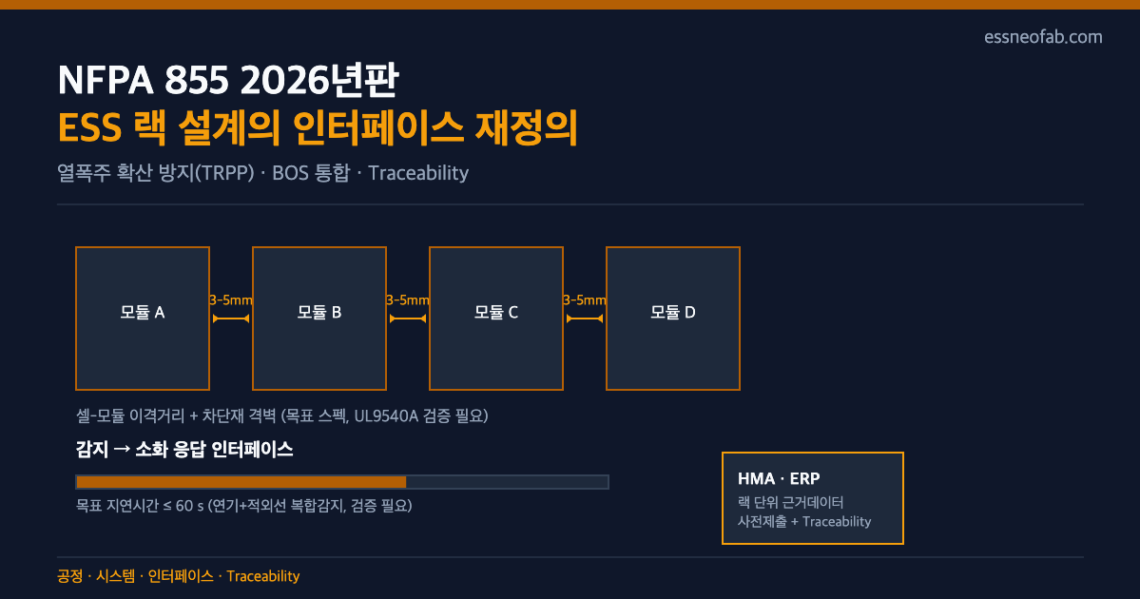
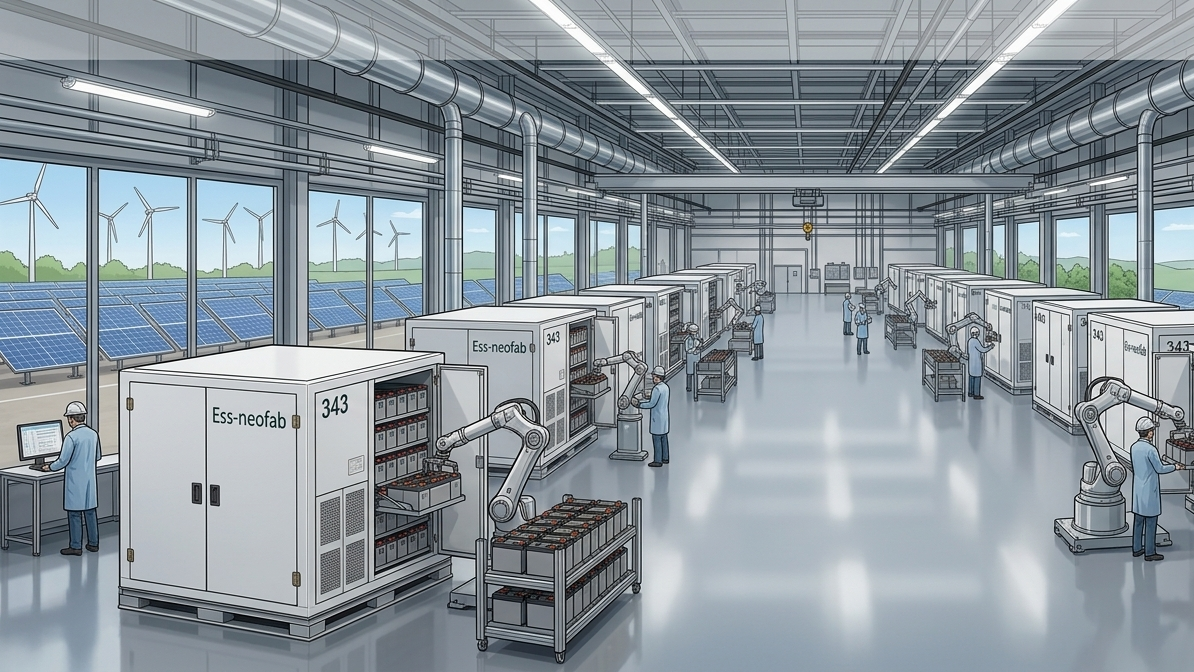
The 2026 edition of NFPA 855 shifts the center of gravity of ESS (Energy Storage System) safety standards from preventing ignition at the cell level to Thermal Runaway Propagation Prevention (TRPP) at the rack/container level. This revision is a line/system-engineering matter, not a problem of the battery's own material properties, in that it brings the entire BOS (Balance of System) — including cell-to-cell spacing, detection interfaces, and cooling wiring — into the scope of design. At the same time, mandatory pre-submission of the HMA (Hazard Mitigation Analysis) and ERP (Emergency Response Plan) to fire authorities has made a Traceability system that tracks and retains design-basis data at the rack level…
-
K-BATTERY SHOW 2026 Fire Safety Seminar: What to Look for in a Line-Level Fire Response System
K-BATTERY SHOW 2026 was held from September 9 to 11, 2026, in Hall 7 of KINTEX Exhibition Center 2, with 185 exhibiting companies and 15,311 visitors over three days. The exhibition featured a special EV fire-response pavilion gathering fire prevention, detection, and suppression technologies, and the SFPE Korea Chapter’s “2026 International Lithium Battery and EV Fire Safety Seminar” shared thermal-runaway prediction and suppression technologies. This article treats line-level fire response as a closed loop of three serially connected segments (detection, isolation, and suppression) and shows that, in an assumed scenario, suppression-discharge delay accounts for 54 % of the loop’s total response time of 18.5 s. In other words, the performance…
You May Also Like
Doubling the Renewable-Energy Budget and Underground-Parking EV Fire-Detection AI — Two Signals the 2027 Budget Sends to the ESS Line
Today’s ESS/Battery System Trends — U.S. LFP Mass Production Imminent, Megapack 3 Launched, Used-Battery Platform Integration (2026.08.11)
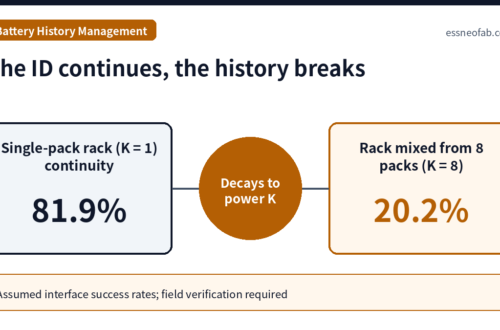
After Korea’s Battery History Management System: IDs Continue, Operating History Breaks — History Continuity of ESS Reuse Racks
-
NFPA 855 (2026 Edition) Revision: ESS Safety Standards Expand From the Cell to the Entire System
Since August 2017, 21 lithium-ion battery ESS fires have occurred in Korea alone, but only a portion of these incidents can be explained by battery cell defects alone. In many cases, the direct cause of fire spread was equipment outside the battery itself — the Balance of System (BOS) — such as missing surge arresters, defective wiring installation, or cooling/HVAC failures. With the release of the 2026 edition of NFPA 855, the National Fire Protection Association (NFPA) has shifted its evaluation criterion from "whether an internal cell defect exists" to "whether propagation to adjacent cells, modules, or racks is blocked." NFPA 855 is the Standard for the Installation of Stationary…
You May Also Like
Dry Electrode: Where Does the Line Bottleneck Move?
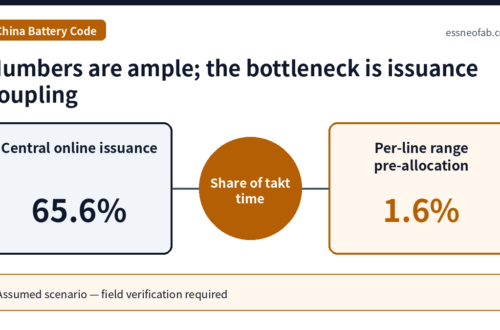
China’s GB/T 34014 24-Character Battery Code: How Code Structure Fixes Issuance Timing and Authority on the Line
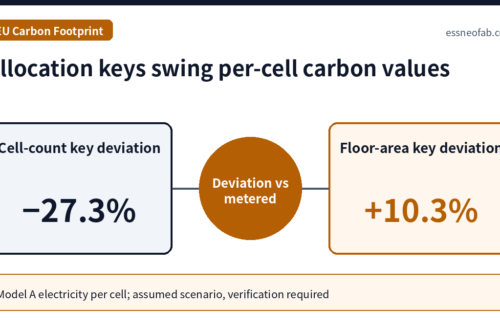
EU Battery Carbon Footprint Methodology Still Pending: How Line Energy Metering Resolution and Allocation Choice Shift Per-Cell Values