Doubling the Renewable-Energy Budget and Underground-Parking EV Fire-Detection AI — Two Signals the 2027 Budget Sends to the ESS Line
Abstract
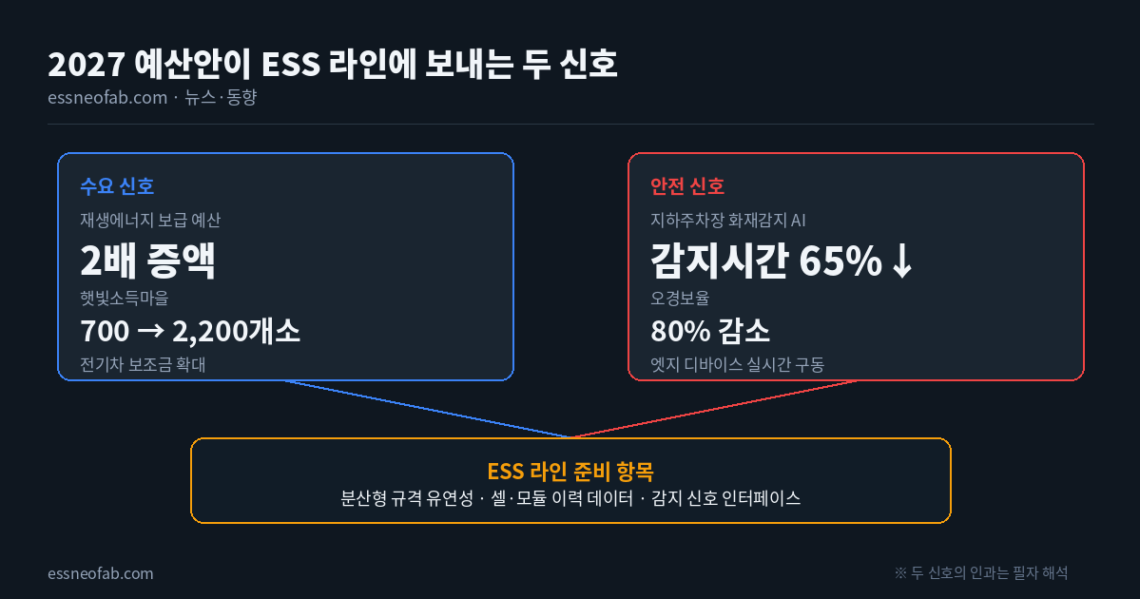
The 2027 government budget doubles the renewable-energy deployment budget, expands “Sunlight Income Villages” from 700 to 2,200 sites, and expands EV subsidies (Source 1). During the same period, an AI model for early detection of EV fires in underground parking garages has been developed domestically to the point of running in real time on edge devices (Source 2). This article reads the two items from an ESS¹ line/system perspective — as a demand signal and a safety signal, respectively — and sets out what the line side should prepare. The conclusion is that “as distributed generation increases, ESS demand increases, but expanded installation is accompanied by tightening fire-safety standards”; this causal link is the author’s interpretation, not something stated in the source documents.
1. Background: The Energy Line Items in the Budget
To state the conclusion first: the energy line items in the 2027 budget send a signal to the line side that budget has been concentrated toward expanding renewable-energy deployment. Until now, ESS line production planning has been based on large-capacity orders at the scale of major power-generation operators. However, this budget concentrates funding on items that increase the number of small-scale distributed generation points, such as Sunlight Income Villages, by more than threefold — from 700 to 2,200 sites (Source 1). So what does the line need to additionally prepare, beyond its large-capacity order response system?
| Item | Content | Source |
|---|---|---|
| Renewable-energy deployment budget | Doubled | Source 1, key SME investment content |
| Sunlight Income Villages | 700 sites → 2,200 sites | Source 1, government budget table item 2 |
| EV subsidies | Expanded | Source 1, key SME investment content |
| Frontier technologies (SMR, fusion, etc.) | KRW 11.0 trillion → KRW 13.8 trillion | Source 1, government budget table item 2 |
Implication: The name “Sunlight Income Village” reads as solar-based distributed generation. As the number of sites more than triples, the mismatch between generation timing and consumption timing grows proportionally. Because ESS is the equipment that fills this mismatch, this item is an ESS demand signal (author’s view). However, whether an ESS line item is directly specified in the budget cannot be confirmed from the information provided.
2. Safety Signal: Fire-Detection AI
SuperbAI, together with the National Fire Research Institute, developed an AI model for early detection of EV fires in underground parking garages, reporting a 65% reduction in detection time, an 80% reduction in false-alarm rate, and real-time operation on edge devices (Source 2).
Implication: EV fires and ESS fires belong to the same problem class in that the battery cell is the heat source. If early detection has shown results in the enclosed space of an underground parking garage, the same approach is likely to be required for indoor ESS installation sites as well (author’s view). The comparison baseline and device specifications are not stated in the source documents.
3. The Assumption This Article Breaks
The assumption is that “if the deployment budget increases, the ESS line only needs to increase production volume.” As the number of installation sites increases, statistical exposure to fire incidents also increases, and detection/suppression requirements are strengthened accordingly. From the line’s perspective, “traceability² of safety data by shipment unit” is required before production volume, in that order.
4. Items to Prepare on the Line/System Side
| Category | Preparation item | Basis |
|---|---|---|
| Demand response | Line flexibility for small-capacity distributed ESS specifications | 2,200 Sunlight Income Villages (Source 1) |
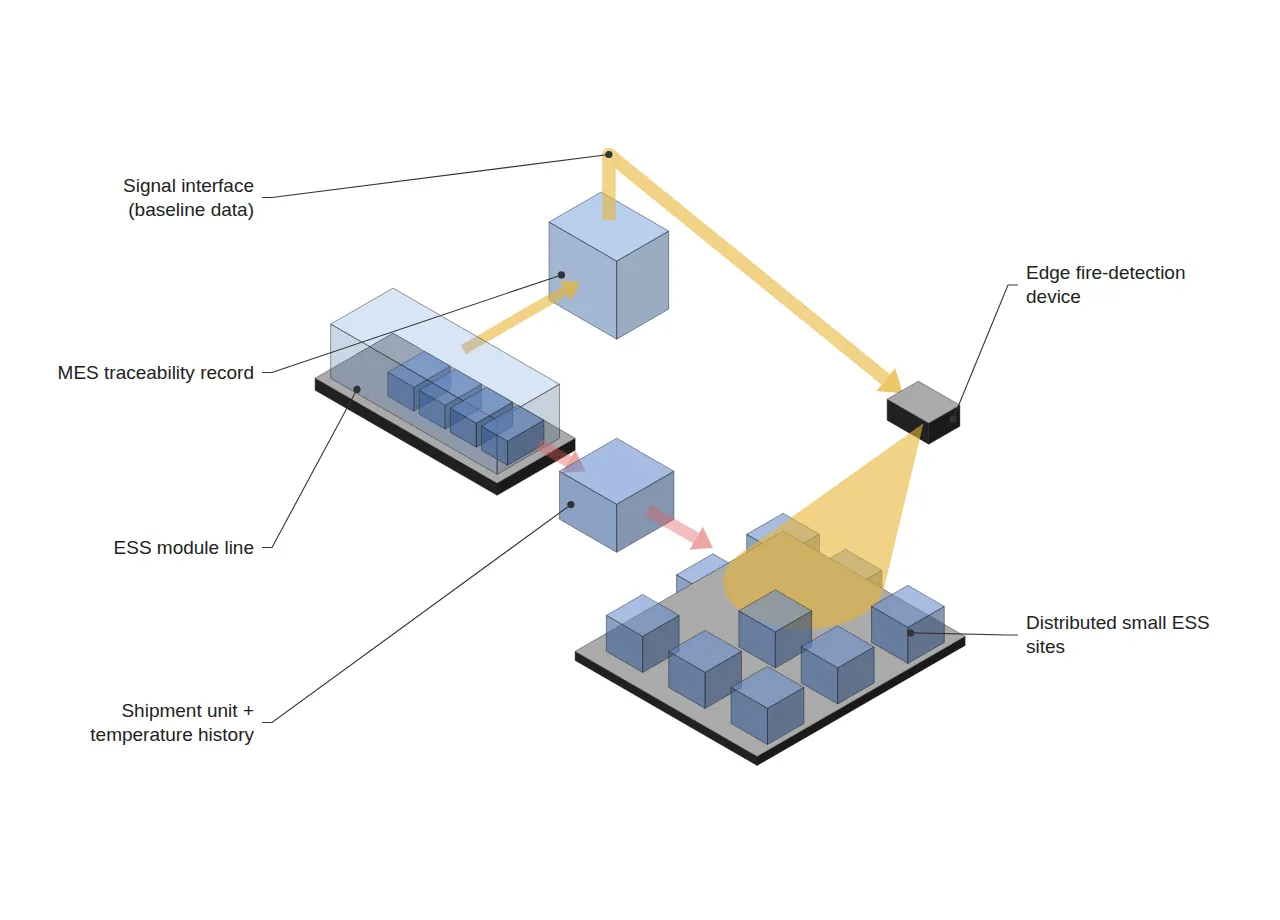
| Safety response | Attach cell/module-level temperature history data at shipment | Fire early-detection AI development (Source 2) — a detection model requires a normal-state data baseline (author’s view) |
| System | Signal interface for linking with detection devices at ESS installation sites | Real-time operation on edge devices (Source 2) |
Implication: None of these three items involves building new line equipment — they involve defining the data output format and interface.
5. Limitations and Counterargument
Counterargument: “Fire detection is an installation-site issue, not a manufacturing-line issue.” This is partly correct. However, lowering a detection model’s false-alarm rate requires normal-state data, and the starting point for that data is the cell/module characteristic values recorded at the time of manufacture. If the line does not retain those values, the field starts detection without a baseline (author’s view).
Limitation: Neither source document contains ESS-specific figures (installation targets, fire-safety standards, certification requirements). Every connection drawn in this article is interpretation, and requires re-review once the budget’s detailed programs are disclosed.
FAQ
Q. Does doubling the renewable-energy budget mean the ESS budget is also doubled?
A. The source documents do not list a separate ESS line item. This cannot be found in the information provided.
Q. What is the comparison baseline for the fire-detection AI’s 65% and 80% figures?
A. The comparison baseline is not stated in the source documents.
Q. How does the EV subsidy expansion connect to ESS?
A. The source documents do not mention a connection. It can only be viewed as an indirect signal in that EVs and ESS share the same cell technology (author’s view).
Field Application Notes
- Does the line MES³ link cell/module-level temperature and voltage history to the shipment unit?
- Changeover⁴ time required when converting the line to small-capacity distributed specifications
- List of BMS⁵ output signals that can interface with detection devices at installation sites
- Re-confirm whether a direct ESS line item exists once the budget’s detailed programs are disclosed
¹ ESS (Energy Storage System): equipment that stores electric power and discharges it when needed.
² Traceability: the property of being able to trace a shipped product’s manufacturing-history data back through its records.
³ MES (Manufacturing Execution System): a production execution management system.
⁴ Changeover: the work of switching a line over to produce a different specification.
⁵ BMS (Battery Management System): a system that monitors and controls battery status.
Related reading: The NFPA 855 revision and the ESS TRPP interface/Traceability
Related reading: ESS Fire-Safety Kits Across 20 Sites — What the System Must Prepare


You May Also Like
Today’s ESS/Battery Process Trends — Expanded Support for Materials/Parts/Equipment Lines, Solid-State/LFP Pilot Lines Launch (2026.08.07)
EU Battery Passport 2027: Which Station on an ESS Pack Line Commits What