EU Battery Passport 2027: Which Station on an ESS Pack Line Commits What
Abstract
Under Article 77 of the EU Batteries Regulation (Regulation (EU) 2023/1542), industrial batteries above 2 kWh require a battery passport from 18 February 2027, and as of September 2026 no legislative proposal changing that date has been identified. Breaking down the passport data attribute list (the version aligned with DIN DKE SPEC 99100) for the stationary ESS category shows that, of 80 mandatory attributes, only 5 static attributes must be recorded on the line at individual-battery level; the remaining static attributes are fixed once at battery-model level.
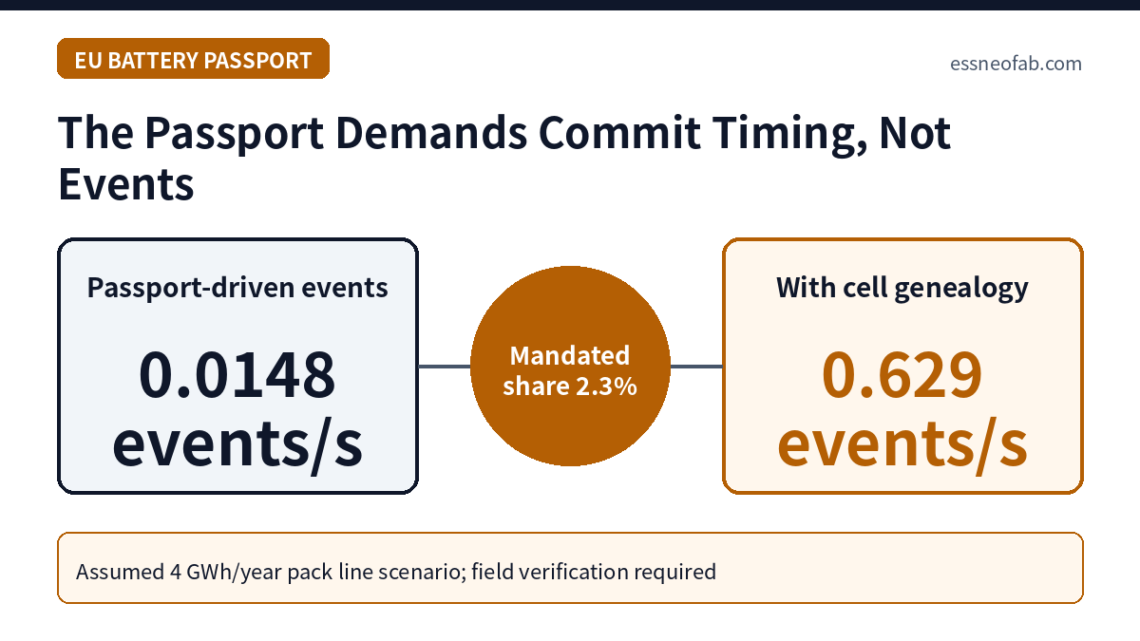
In an assumed scenario (4 GWh/year pack line, pack takt time 338.6 s), passport-driven line capture events amount to 5 per pack (0.0148 events/s), only 2.3% of the 213 events captured when cell genealogy is included. However, measuring the initial value of the dynamic attribute “remaining capacity” at pack EOL without inheriting cell grading data requires 32 additional test channels, so the real load variable of passport compliance is not data volume but the station at which initial values are committed.
1. Conclusion First — What the Passport Demands from the Line Is Commit Timing, Not Event Count
The common belief that battery passport compliance explodes line data volume does not hold when tested against the regulation text and the attribute list. The core constraint the passport places on the line is which values are committed, at which station, and in what order.
Situation (S): Article 77(1) requires an electronic record (battery passport) for every LMT battery, industrial battery above 2 kWh and EV battery placed on the market or put into service from 18 February 2027. Complication (C): Article 13(6) requires a QR code[1] from the same date, and Article 77(4) obliges the operator placing the battery on the market to keep passport information accurate, complete and up to date. Question (Q): At which process stations must an ESS cell and pack line capture what, and when, to fill these items, and what is the resulting load? Answer (A): Line capture required by the regulation at individual-battery level is about 5 events per pack; what separates the load is the derivation path for the initial values of dynamic attributes.
This article does not recalculate cell-count-proportional traceability load itself. Instead, it maps each passport attribute to a process station and separates the regulation-driven share from the share that is a company design choice.
2. Mechanism — Translating Passport Attributes into Capture Points
The data attribute longlist (v1.2) that the Battery Pass consortium updated in January 2025 to align with DIN DKE SPEC 99100[2] flags 93 attributes by battery category. For the stationary >2 kWh category, 80 are mandatory (x) and 9 voluntary (o). Of the 80 mandatory attributes, 64 are static[3] and 16 dynamic, and most static attributes are classified at “battery model” level.
From a line perspective, granularity is what matters. Only 5 mandatory static attributes sit at individual-battery level: battery passport identifier, battery identifier, manufacturing date, date of putting into service, and extinguishing agent. The carbon footprint is declared “per battery model per manufacturing plant” under Article 7(1), so it comes from line- and plant-level energy metering data, not from individual pack events.
| Passport attribute (examples) | Granularity | Data source (capture point) | Commit timing |
|---|---|---|---|
| Material composition, hazardous substances, critical raw materials | Model | Cell maker specification and BOM (outside the line) | Before model launch |
| Carbon footprint (manufacturing-stage contribution) | Model × plant | Line and utility energy meters (period aggregation) | After the accounting period closes |
| BMS[4]-to-battery binding | Individual | S4 BMS installation and firmware record | Before EOL test |
| Initial values of dynamic attributes (SoC, remaining capacity, etc.) | Individual | S5 pack EOL[5] test or inherited cell grading data | At final EOL pass |
| Passport identifier, battery identifier, QR | Individual | S6 identifier issuance, label printing, read verification | After final EOL pass, before packing |
| Manufacturing date, battery status (“original”) | Individual | S7 packing and shipment | At placing on the market |
The sequencing constraint in Table 1 is clear. Passport identifier issuance must follow the final EOL pass, and QR attachment must precede packing. If an EOL-fail rework loop sits downstream of identifier issuance, an already issued passport can carry a history that differs from the physical unit, which conflicts with the accuracy requirement of Article 77(4).
3. Calculation — 5 Regulation-Driven Events vs. 213 with Cell Genealogy
The assumed scenario is as follows. With 314 Ah, 3.2 V cells (1.0048 kWh per cell), 52-cell series packs (52.25 kWh) and a line capacity of 4 GWh/year, annual output is 76,556 packs and 3,980,912 cells. Setting annual available operating time at 25,920,000 s gives a pack takt time[6] of 25,920,000 ÷ 76,556 = 338.6 s.
Capture events are set as: S1 cell inbound read and OCV/ACIR (52 events, 0.5 KB), S2 cell-to-pack binding (52 events, 0.2 KB), S3 busbar welding parameters (104 events, 1 KB), S4 BMS binding (1 event, 2 KB), S5 pack EOL result (1 event, 8 KB), S6 identifier issuance and label verification (2 events, 1 KB each), and S7 shipment (1 event, 0.5 KB). All byte values are assumptions and require field verification.
| Scenario | Stations included | Events/pack | Event rate (events/s) | Annual data volume | Initial remaining-capacity path |
|---|---|---|---|---|---|
| T1 Passport-driven minimum | S4–S7 | 5 | 0.0148 | 0.96 GB | Measured at pack EOL → 32 additional test channels |
| T2 Including cell-to-pack binding | S1, S2, S4–S7 | 109 | 0.322 | 3.74 GB | Inherited cell grading data → 0 additional channels |
| T3 Including process parameters | S1–S7 | 213 | 0.629 | 11.71 GB | Inherited cell grading data → 0 additional channels |
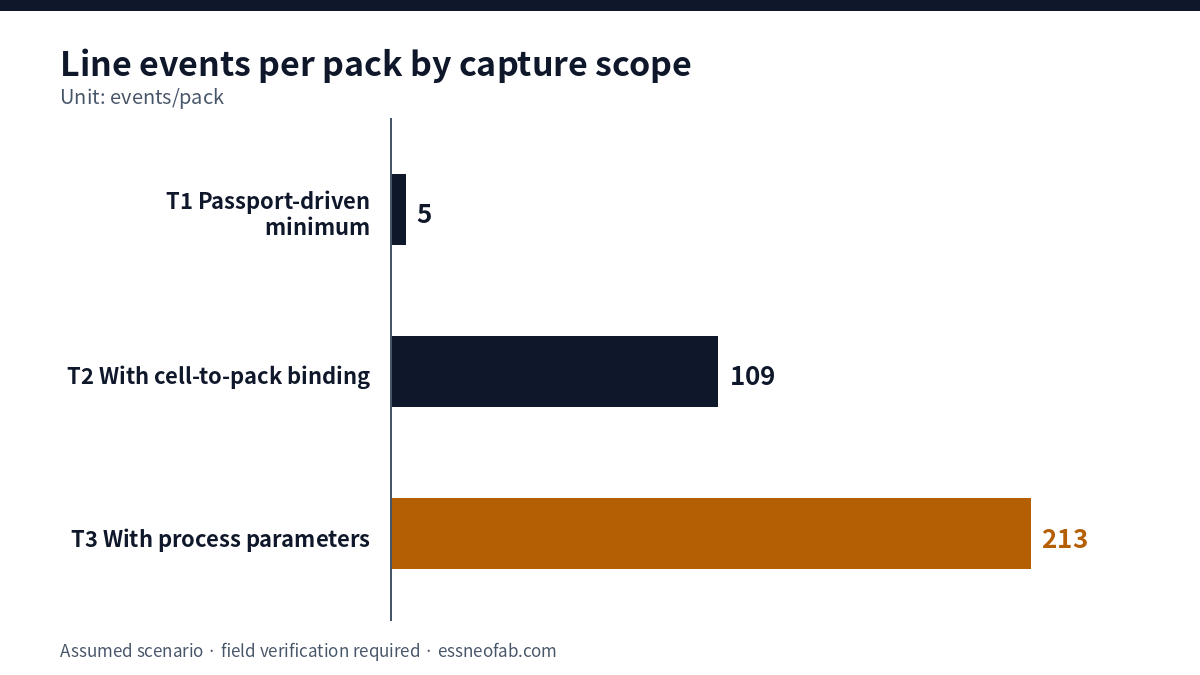
Taking T3 (213 events) as the baseline, the regulation-driven T1 is 2.3% by event count and 8.2% by data volume. In other words, most of the passport-related line load arises not from the regulation but from the company’s traceability design choices. Even the full event rate of 0.629 events/s is unlikely to become a bottleneck in a current MES collection layer.
The reversal comes from T1’s cost structure. Measuring the initial remaining capacity on the pack without inheriting cell data requires 10,800 s, combining a 0.5C discharge of 7,200 s and a 3,600 s recharge back to shipping SoC (assumed); matching the 338.6 s takt time then requires 10,800 ÷ 338.6 = 31.9, i.e. 32 parallel test channels. Because saving 2.78 GB/year of data (3.74 − 0.96) is paid for with added test equipment and floor space, the passport paradoxically makes cell-to-pack binding (T2) the rational minimum.
4. 2026 Status and Limits of Application
The regulatory developments confirmed as of 23 September 2026 are listed below. The application date itself has not moved, but the definitions of passport items and the access rules are still in motion.
- Application date unchanged: No legislative proposal amending Article 77(1) (18 February 2027) has been identified. The simplification proposal COM(2025) 981 submitted by the Commission on 10 December 2025 targets Article 3, Article 11(5), Article 76(4) and point 8 of Annex VI Part A, and does not include Article 77.
- Indirect effect: The same proposal redefines the hazardous-substance labelling in point 8 of Annex VI Part A as “substances of very high concern (SVHC) at or above 0.1%”. Because Annex XIII point 1(a) references Annex VI Part A, the definition of a public passport item may change (legislative status: verification required).
- Postponement precedent: Supply chain due diligence obligations were postponed by two years to 18 August 2027 by the “stop-the-clock” regulation adopted by the Council on 18 July 2025. In September 2025 EUROBAT called for postponing the passport to 2030 and excluding industrial batteries from the initial phase, but this is a position paper and has not been confirmed as a legislative proposal.
- Delayed secondary legislation: Article 77(9) required an implementing act defining access for “persons with a legitimate interest” by 18 August 2026; it was not adopted, and secondary reporting expects it in Q4 2026 (verification required). The Commission page lists the DPP registry going live on 2026-07-20 and a July 2026 decision adopting 6 of 8 harmonised standards from CEN-CENELEC JTC24 as “indicative timelines”.
The limits of application should also be stated. The figures in Table 2 depend on a single configuration assumption of a module-less 52-cell pack; with a module structure or a different cell count, T2 and T3 event counts change proportionally. Whether deriving the initial remaining capacity from cell grading data is accepted as an “accurate” value cannot be settled until a delegated act defines updating, so further verification is required.
That cell-level event rates scale with cell count was covered in the cell inbound interface and cell ID event rate. This article takes a different angle. Separating the commit order of passport fields and the regulation-driven share, rather than total event volume, also distinguishes it from the article on cell history management, which identified where line-level traceability breaks.
5. Conclusion and Implications
The line design sequence for passport compliance is not “collect more data” but “relocate the commit gates”. First, fix identifier issuance after the final EOL pass. Second, decide explicitly whether initial values of dynamic attributes are derived from inherited cell grading data or measured on the pack. Third, prepare the carbon footprint as a model- and plant-level energy aggregation system rather than as individual pack events.
The structural conclusion of this analysis (the regulation-driven share is small, and the initial-value path determines equipment load) holds regardless of cell configuration. However, figures such as 2.3% and 32 channels are outputs of an assumed scenario, and pilot-line results cannot be transferred 1:1 to mass production, so further verification is required.
FAQ
Q. If the regulation-driven share is only 2.3%, is cell-level tracking unrelated to the passport and safe to reduce?
A. No. As calculated in Section 3, omitting cell binding means measuring the initial remaining capacity on the pack, which adds 32-channel test equipment. In addition, the Battery Pass Content Guidance interprets module or cell replacement repairs after placing on the market as requiring static data updates, so cell-to-pack binding is better regarded as the lowest-cost means of maintaining the passport’s “accuracy” requirement.
Q. Since the Article 77(9) implementing act is late, isn’t the February 2027 application effectively postponed?
A. There is no confirmed basis for that. The implementing act only defines the scope of access rights and does not make the application date in Article 77(1) conditional. Changing the application date would require separate amending legislation, and as of 23 September 2026 no such proposal has been identified.
Field Application Notes
The items below can be executed on Monday morning.
| Check | How to execute | Remarks |
|---|---|---|
| ☐ Map the 80 mandatory passport attributes to stations | Filter the Battery Pass longlist v1.2 for rows with “Stationary >2kWh = x” and add columns for source station and commit timing | Mark model-level attributes separately as sourced outside the line |
| ☐ Check the position of the identifier issuance gate | Verify in the MES routing that the passport ID issuance step comes after the final EOL pass and rework loops | If it comes earlier, first define ID void and reissue rules for rework |
| ☐ Decide the initial remaining-capacity path | Compare equipment requirements of inherited cell grading data vs. pack EOL measurement (channels = test time ÷ takt time) | Acceptance requires verification until the delegated act is finalised |
| ☐ Measure the QR label print and read station cycle | Measure the print, apply and read-verification cycle in s at least 10 times and compute its ratio to takt time | Include the reprint loop for read failures |
| ☐ Review line energy metering granularity | For model × plant carbon footprint declarations, check whether energy meters are separated by line and utility and what the aggregation period is | Application to industrial batteries is tied to entry into force of delegated/implementing acts (verification required) |
Footnotes
[1] QR code (Quick Response code): A two-dimensional code marked on the battery under Article 13(6) that links to the passport. The unique identifier follows the ISO/IEC 15459 series or equivalent standards.
[2] DIN DKE SPEC 99100: Specification “Requirements for data attributes of the battery passport” published by Germany’s DIN and DKE in February 2025, based on the Battery Pass consortium’s Content Guidance.
[3] Static/dynamic data: Data that do not change often or on a regular basis / data that do (definitions quoted from Article 2 of Delegated Regulation (EU) 2022/670).
[4] BMS (Battery Management System): The control layer that monitors cell and pack voltage, temperature and current and performs state estimation and protection.
[5] EOL test (End-of-Line test): The pre-shipment test at the final line stage that judges insulation, voltage, resistance, communication functions and similar items.
[6] Takt Time: Available operating time ÷ customer demand quantity. Not to be confused with Cycle Time or FPY.
Sources: Regulation (EU) 2023/1542 (Articles 7, 13, 14, 77, 78; Annexes VI, XIII), EUR-Lex, 2023-07-28, https://eur-lex.europa.eu/eli/reg/2023/1542/oj/eng / European Commission, COM(2025) 981 final “Proposal amending Regulation (EU) 2023/1542 and (EU) 2024/1244”, 2025-12-10, https://environment.ec.europa.eu/document/download/ad737347-bf74-476e-9159-a05214844cb6_en?filename=COM_2025_981_1_EN_ACT_part1_v4.pdf / Council of the EU, “Simplification: Council adopts law to stop-the-clock on due diligence rules for batteries”, 2025-07-18, https://www.consilium.europa.eu/en/press/press-releases/2025/07/18/simplification-council-adopts-law-to-stop-the-clock-on-due-diligence-rules-for-batteries/ / EUROBAT, “Battery passport omnibus position paper”, 2025-09, https://www.eurobat.org/wp-content/uploads/2025/09/EUROBAT-battery-passport-omnibus-position-paper-.pdf / European Commission, “Digital Product Passport – Batteries”, accessed 2026, https://single-market-economy.ec.europa.eu/single-market/digital-product-passport/batteries_en / EU Digital Product Passport (secondary reporting), “Battery passport access rights: the Article 77(9) implementing act missed its 18 August 2026 deadline”, 2026-09-08, https://eudigitalproductpassport.org/updates/battery-passport-access-rights-implementing-act-delay / Battery Pass consortium, “Battery Passport Data Attribute Longlist v1.2”, 2025-01, https://github.com/batterypass/BatteryPassDataModel / DIN Media, “DIN DKE SPEC 99100:2025-02”, https://www.dinmedia.de/en/technical-rule/din-dke-spec-99100/385692321 / Battery Pass consortium, “Battery Passport Content Guidance v1.1”, 2023, https://thebatterypass.eu/assets/images/content-guidance/pdf/2023_Battery_Passport_Content_Guidance.pdf
Measurement & Calculation Conditions: Line capacity 4 GWh/year, 314 Ah and 3.2 V cells, 52-cell series pack (module-less), annual available operating time 25,920,000 s, station layout S1–S7, data size per event (0.2–8 KB) and pack EOL capacity measurement time of 10,800 s (0.5C discharge 7,200 s + recharge 3,600 s) are all assumed values. Conversions use 1 KB = 1,000 bytes and 1 GB = 109 bytes. Attribute counts are based on the “Stationary >2kWh” column of the Battery Pass longlist v1.2 and may change with delegated and implementing acts. Field verification under actual line conditions is required.

You May Also Like
Dry Electrode: Where Does the Line Bottleneck Move?

Today’s ESS/Battery Process Trends — Expanded Support for Materials/Parts/Equipment Lines, Solid-State/LFP Pilot Lines Launch (2026.08.07)