본문으로 바로가기
Ess-neofab

A line- and system-level record of ESS and secondary-battery manufacturing processes

  • 한국어
  • English
  • Home
  • Process
  • System
  • Interface
  • Traceability
  • News & Trends
  • About
  • Contact
  • 한국어
  • English
  • Home
  • Process
  • System
  • Interface
  • Traceability
  • News & Trends
  • About
  • Contact

카테고리

  • Interface (28)
  • News & Trends (20)
  • Process (32)
  • System (31)
  • Traceability (22)

최근 글

  • Five million ACC cells equal 2.7 to 3.6 months of nameplate outputOctober 15, 2026
  • A 160 MW battery’s six-week commissioning has two baselinesOctober 8, 2026
  • Two Cycles a Day Take 106.8 % of a Day, and the Retention Tier Shifts Cell Volume by 1.47 GWhOctober 1, 2026
  • Battwoo’s Second-Life EV Batteries — When an 80 % Acceptance Threshold Overlaps the Retirement Distribution, Incoming Screening Becomes the BottleneckSeptember 30, 2026
  • US storage set an energy record in Q2 as installed power fell 7%September 29, 2026
  • CATL Starts Trial Production in Debrecen — The Digits of the Defect-Rate Target, Not the Equipment, Set the Length of a Trial RunSeptember 29, 2026
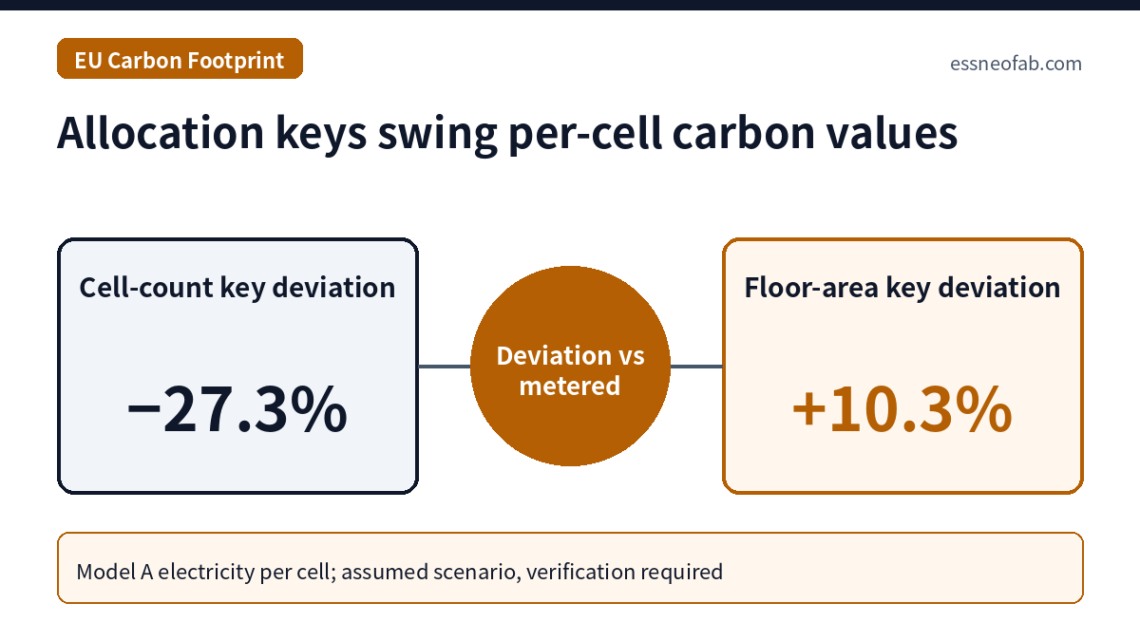
  • Allocation keys swing per-cell carbon values
    News & Trends,  System,  Traceability

    EU Battery Carbon Footprint Methodology Still Pending: How Line Energy Metering Resolution and Allocation Choice Shift Per-Cell Values

    July 8, 2026 /

    According to the EU's official consultation portal, the delegated act setting the carbon footprint calculation methodology under Article 7 of the EU Batteries Regulation (2023/1542) had not moved to the adoption stage as of 23 September 2026, and the portal still shows the planned adoption period as "Q3 2025". In an assumed 8 GWh/year plant producing two models, allocating the same 200,000,000 kWh of electricity by floor area, operating time, capacity or cell count makes the per-cell electricity of model A swing from −27.3% to +10.3% against the process-metered value of 7.860 kWh. Area-based allocation reverses the low-carbon ranking of the two models, and capacity-based allocation has the smallest total…

    read more
    ESS-neofab Comments Off on EU Battery Carbon Footprint Methodology Still Pending: How Line Energy Metering Resolution and Allocation Choice Shift Per-Cell Values

    You May Also Like

    From EV to ESS Use: What Ultium Cells and Cosmos Lab Show About Converting a Line’s Purpose

    August 13, 2026

    LS Electric Ships First Units of Next-Gen ESS PCS “G2” — Is Liquid Cooling the Answer?

    August 10, 2026
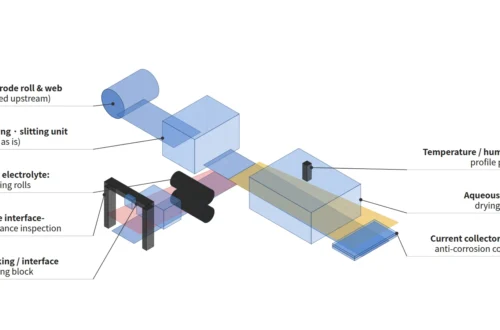
    Isometric concept diagram: after shared electrode coating and slitting, a solid-electrolyte line shifts focus to pressing rolls, stacking and inline interface-resistance inspection, while an aqueous zinc line shifts to drying-oven temperature/humidity control and current-collector corrosion protection

    Solid Electrolyte and Aqueous Zinc Batteries: Investment Is Up — Is the Line Ready?
    August 14, 2026
  • The Passport Demands Commit Timing, Not Events
    News & Trends,  System,  Traceability

    EU Battery Passport 2027: Which Station on an ESS Pack Line Commits What

    July 1, 2026 /

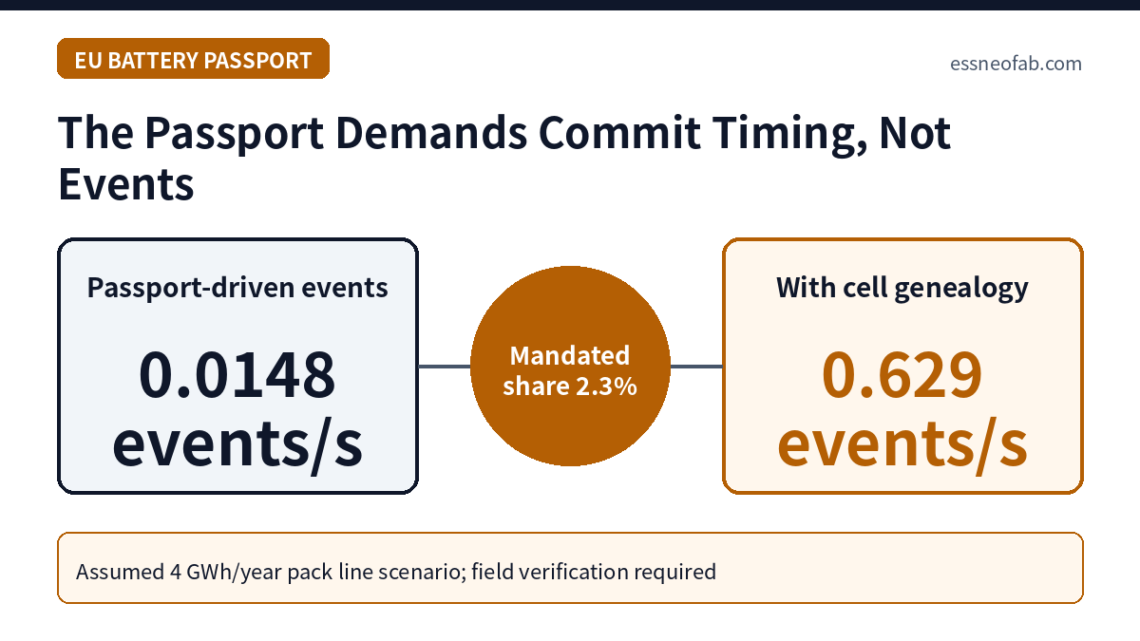
    Under Article 77 of the EU Batteries Regulation (Regulation (EU) 2023/1542), industrial batteries above 2 kWh require a battery passport from 18 February 2027, and as of September 2026 no legislative proposal changing that date has been identified. Breaking down the passport data attribute list (the version aligned with DIN DKE SPEC 99100) for the stationary ESS category shows that, of 80 mandatory attributes, only 5 static attributes must be recorded on the line at individual-battery level; the remaining static attributes are fixed once at battery-model level. In an assumed scenario (4 GWh/year pack line, pack takt time 338.6 s), passport-driven line capture events amount to 5 per pack (0.0148…

    read more
    ESS-neofab 0 Comments

    You May Also Like

    Isometric concept diagram: after shared electrode coating and slitting, a solid-electrolyte line shifts focus to pressing rolls, stacking and inline interface-resistance inspection, while an aqueous zinc line shifts to drying-oven temperature/humidity control and current-collector corrosion protection

    Solid Electrolyte and Aqueous Zinc Batteries: Investment Is Up — Is the Line Ready?

    August 14, 2026
    LG에너지솔루션 ESS 후방기지화 라인 관리체계 재설계 흐름도

    LG Energy Solution’s ESS Rear-Base Positioning — What Changes in Line Management
    September 3, 2026

    Today’s ESS/Battery System Trends — U.S. LFP Mass Production Imminent, Megapack 3 Launched, Used-Battery Platform Integration (2026.08.11)

    August 11, 2026
© 2026 Ess-neofab · A line- and system-level record of ESS and secondary-battery manufacturing processes
  • About
  • Contact
  • Privacy Policy
  • Disclaimer
Ashe Theme by WP Royal.