Long-Duration ESS Interface Design in the Era of Power-Grid Saturation
Abstract
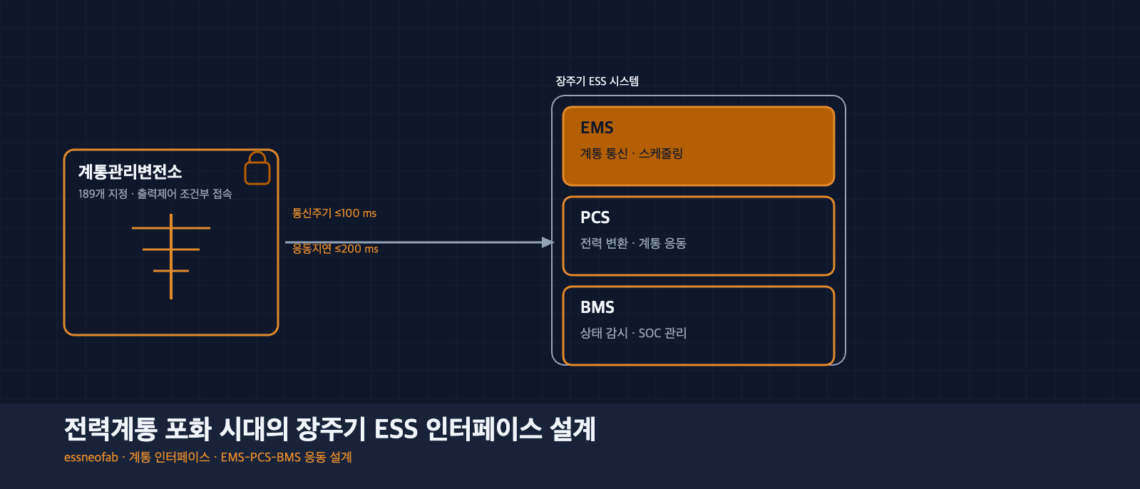
As 189 grid-management substations nationwide have, starting in 2026, been restricting new interconnection of renewable energy and large-scale demand through conditional curtailment, long-duration ESS (Energy Storage System) is shifting from a simple generation-consumption buffer into an essential variable in grid interface design. Korea’s Ministry of Trade, Industry and Energy’s centralized-contract market has presented a target of securing approximately 0.5 GW annually from 2026 to 2029, and a cumulative 21.5 GW by 2038, of long-duration ESS, which translates directly into standardization pressure on the communication and response specifications across the three-tier BMS-PCS-EMS hierarchy.
In the current structure, where grid-interconnection queue information is not disclosed, designing margin into an individual ESS system’s interface is effectively the only practical countermeasure available to absorb project risk. This article cross-verifies the grid-management-substation designation criteria, the long-duration ESS bid-market requirements, and EMS-PCS response-design target values, and organizes them into a checklist that can be verified on-site immediately.
1. Grid-Connection Restriction Is Now a Precondition of ESS System Design
To state the conclusion first, practitioners designing and procuring long-duration ESS have entered a phase where grid-connection availability can no longer be treated as an external variable. Even in the third week of August 2026, after the heat wave had passed, domestic power demand remained stable in the 80 GW range, but this week — when industrial demand returns following the end of the vacation season — is forecast to be the year’s peak (measurement condition: based on Korea Power Exchange grid measurements from mid-August 2026, a 1-week sample period). While demand remains structurally elevated, new interconnection applications for renewable energy and ESS continue to increase.
The problem is interconnection capacity. The government has designated 189 substations nationwide as grid-management substations, restricting new interconnections, and instead operates a conditional-connection system premised on curtailment. However, information on why grid saturation occurred on a particular feeder is not disclosed. In other words, the party designing the ESS system must begin design without being able to determine in advance “when, and how much, this site can connect.” Under this condition, there is only one practical response available — to build margin for grid-side communication cycles and response delay into the interface specification at the system-design stage.
2. Long-Duration ESS Bid-Market Targets and System-Layer Requirements
The Ministry of Trade, Industry and Energy has announced that, building on the 1st and 2nd competitive-bidding rounds of the centralized-contract market held in 2025, it is moving forward in earnest from 2026 with a new bid-market system centered on long-duration ESS. Under the 11th Basic Plan for Long-term Electricity Supply and Demand, the target is a cumulative 21.5 GW of long-duration ESS capacity by 2038, with an estimated approximately 0.5 GW to be secured annually through the centralized-contract market from 2026 to 2029 (measurement condition: a policy target as announced in the first half of 2026; actual awarded volume varies year to year based on each year’s bidding results — not a fixed spec, and requires further verification).
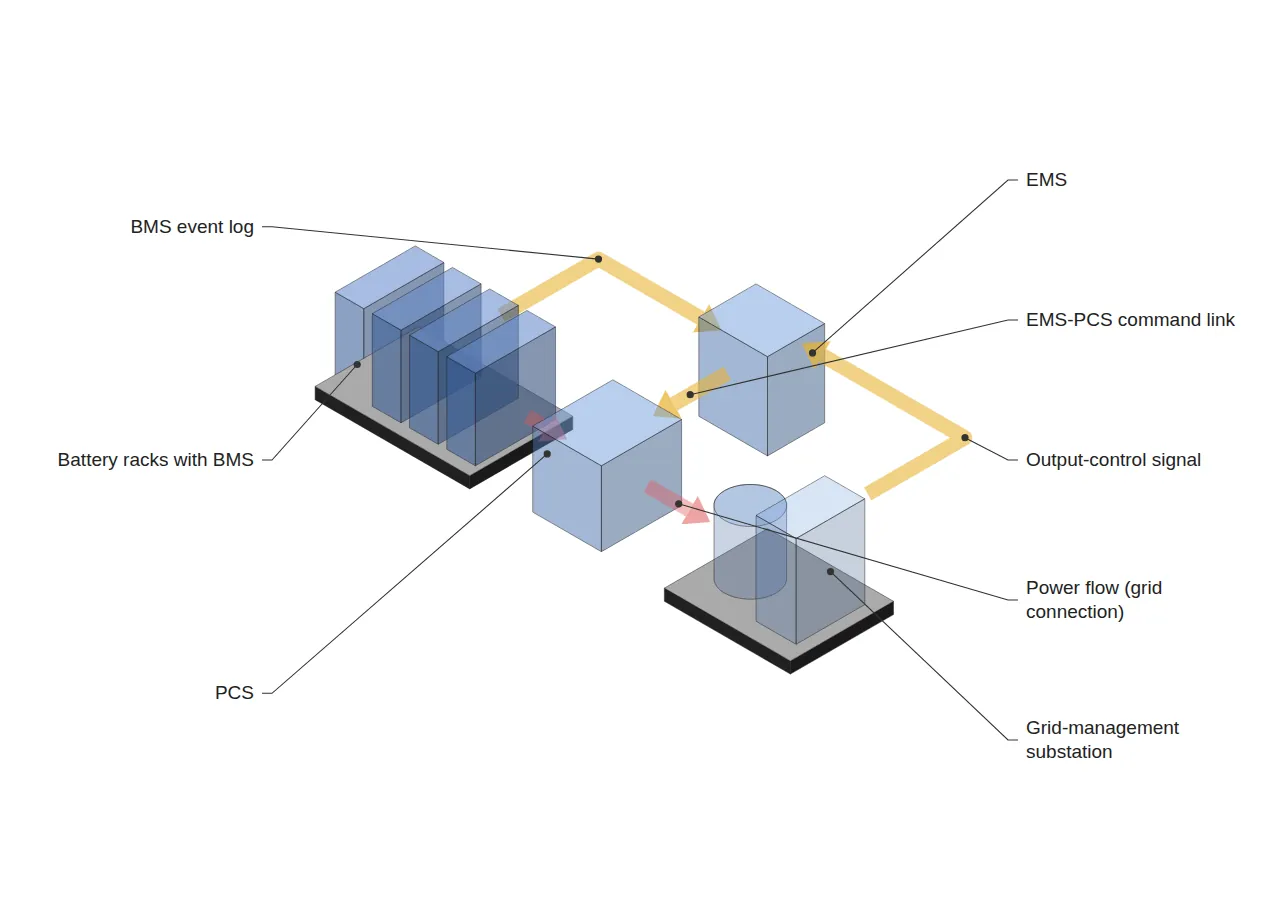
What this target means for system design is not scale but the interface between layers. Long-duration ESS has a looser charge/discharge cycle than short-duration ESS, but its requirements for response delay to grid signals and communication reliability are, if anything, tighter. Organized around the three-tier BMS-PCS-EMS hierarchy, this is as follows.
| Layer | Primary Function | Grid-Interface-Perspective Requirement |
|---|---|---|
| BMS | Cell/module status monitoring | Secure an SOC margin relative to PCS commands; minimize the delay in notifying the EMS of an abnormality |
| PCS | Power conversion / grid interconnection | Frequency/voltage response; managing the delay from receiving a curtailment command to initiating response |
| EMS | Operational scheduling / grid communication | Processing curtailment signals from the grid-management substation; alignment with the centralized-contract market bid schedule |
3. Grid-Management-Substation Connection Restrictions and Interface-Margin Design
Under a structure where the grid-saturation determination criteria and interconnection-queue information are not disclosed, recent analyses by civic groups and law firms repeatedly point out that operators have little negotiating leverage. From an ESS-system-design perspective, the way to absorb this uncertainty is to build explicit margin into the EMS-PCS communication specification. For items whose target performance has not been officially fixed, this article presents the following as practical reference targets.
- EMS-PCS communication cycle: 100 ms or less
- Delay from receiving a curtailment command to initiating response: 200 ms or less
- BMS log retention cycle upon a grid-management-substation curtailment event: 1 s resolution, retained for at least 90 days
The figures above are not measured values from a specific project but reference targets derived from general BESS response-design practice, and, per the principle that lab-scale or pilot verification results cannot be substituted directly as mass-production-system performance, require further verification for each individual project. However, this article’s practical suggestion is that documenting these targets in advance can narrow the scope of interface redesign even if the grid-management-substation designation or curtailment conditions later change.
4. Adjacent Trend Snapshot — Line Readiness and the Three Cell Makers’ ESS Shift
Developments on the cell-manufacturing side during the same period could also affect grid/system design. China’s CATL has officially set a target of beginning solid-state battery trial production in 2027, planning to raise its technology readiness level (TRL) from the current lab-scale evaluation stage 4 to stage 7–8, where pilot production and real-vehicle verification become possible. BYD likewise targets 2027 trial production and real-vehicle testing. However, at both companies, initial trial volumes are expected to be loaded first onto high-priced premium platforms, and analysts judge that entry into million-unit-scale mass production is unlikely before 2030. The same principle applies here as elsewhere — pilot-line performance indicators should not be converted directly into mass-production-line specs; this remains an area requiring separate review.
Domestically, LG Energy Solution, Samsung SDI, and SK On all cite ESS line conversion as a key variable for improving second-half performance, and SK On has stated its goal of completing the ESS line conversion at its Georgia plant within the second half of 2026 and beginning full-scale shipment. This expansion of ESS volume by the three cell makers, being a supply-side response to the long-duration ESS bid market outlined above, points in the same direction as the system-layer requirements discussed in Section 2.
5. Interface-Design Direction Read from Standardization and Patent Trends
Regarding dispatch and lifecycle management for grid-connected ESS, US patent application US20250251453 (“Systems and Method for Managing Dispatch and Lifecycle of Energy Storage Systems on an Electrical Grid”) addresses an ESS operations-management structure for providing multiple services, while US20250125630A1 (“Systems and methods for microgrid asset dispatch”) addresses optimizing dispatch scheduling for microgrid assets. Both applications adopt a structure that aligns grid signals with asset schedules at the EMS layer, in line with the EMS-PCS interface-design direction presented above. However, it should be separately noted that these are individual companies’ patent claims, not a standard directly applicable to Korea’s grid-management-substation connection system.
FAQ
Q1. Is the 21.5 GW / 0.5 GW-per-year target already a fixed procurement spec?
No. This is a policy target based on the 11th Basic Plan for Long-term Electricity Supply and Demand, and the actual awarded volume varies each year based on that year’s centralized-contract-market bidding results. Presuming this as fixed demand at the system-design stage creates a risk of over- or under-design. The target should be used only to confirm the market’s directional scale, and an individual project’s connection capacity must be separately confirmed through that substation’s grid-impact-assessment results.
Q2. If a grid-management-substation designation is lifted, does this interface-margin design become unnecessary?
In the short term, that may be true, but as long as the queue-information non-disclosure structure itself is not resolved, connection uncertainty is likely to recur on a site-by-site basis. Because a design with margin built into communication cycle and response delay is a reusable design asset regardless of a specific substation’s designation status, it is reasonable to retain it independently of whether the designation is lifted.
Field Application Notes
| Check Item | Monday-Morning Action | Verification Method |
|---|---|---|
| Site grid capacity | Confirm whether the relevant substation is designated as a grid-management substation | Inquire in advance before applying for KEPCO’s grid-impact assessment |
| EMS-PCS communication spec | Document the requirement of a communication cycle of 100 ms or less in the design documentation | Cross-check against the PCS vendor’s spec sheet and test report |
| Curtailment-response log | Check whether the BMS log retention cycle (1 s resolution, 90+ days) is configured | Confirm the EMS log server’s retention policy |
| Bid-schedule alignment | Cross-check the centralized-contract-market bid announcement schedule against the completion schedule | Check the Ministry of Trade, Industry and Energy / Korea Power Exchange announcement pages |
Related Reading
- Grid-Forming PCS Mandate Redesigns FAT Takt Time and the BMS-PCS-EMS Interface
- Why three qualified products landed on the same duration — in DSX Ready BESS, sizing is set by the output axis
- When the Station Block Grows to 62 MWh, What Actually Shrinks Is Commissioning Labor, Not Cell Count


You May Also Like
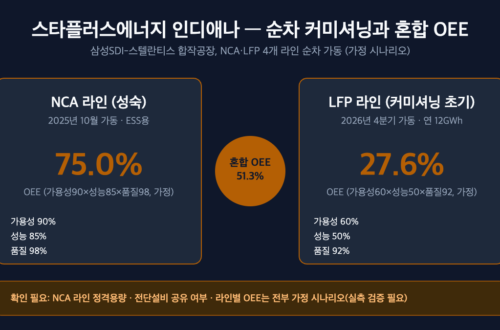
StarPlus Energy’s Indiana Plant — The Blended-OEE Illusion Created by Sequential NCA/LFP Commissioning
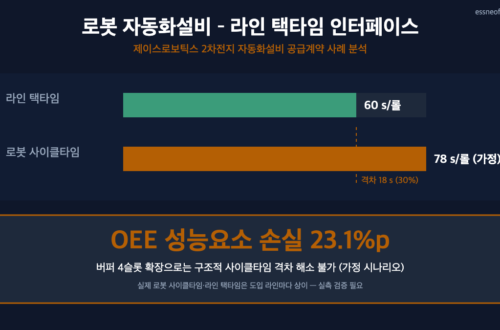
Introducing Robotic Automation Equipment — Where Does the Interface with Line Takt Time Break Down
One Comment
Pingback: