-
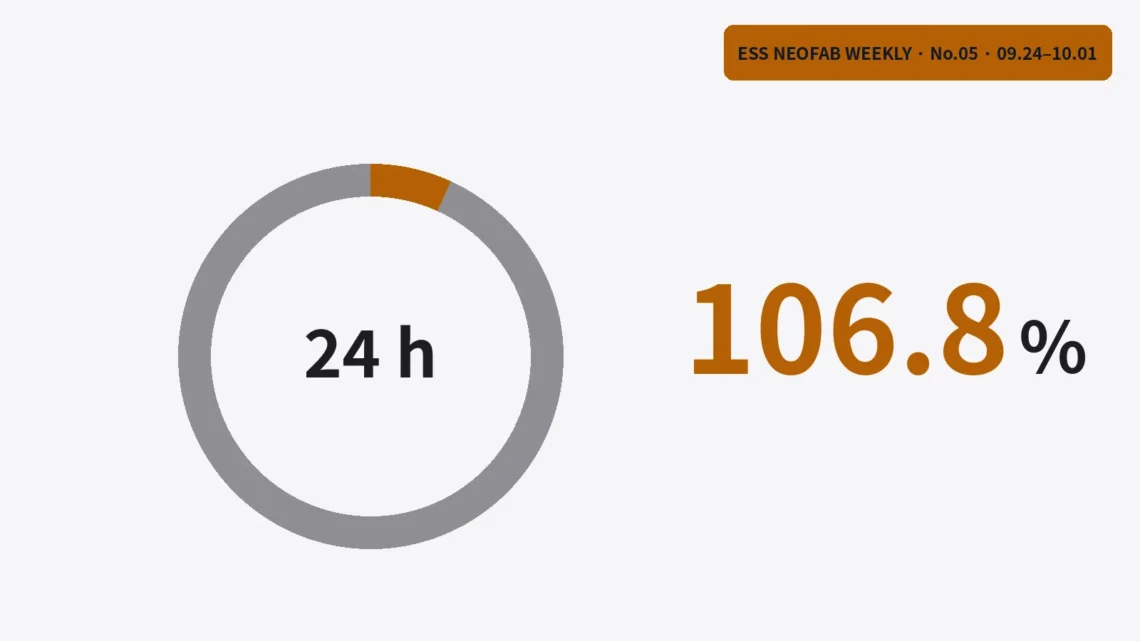
Two Cycles a Day Take 106.8 % of a Day, and the Retention Tier Shifts Cell Volume by 1.47 GWh
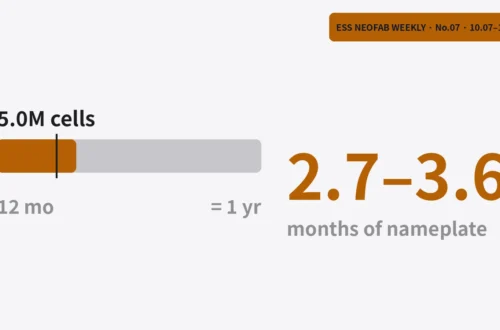
Korea's 25-year Jeju contract asks for at least 730 charge and discharge cycles a year from an 80 MW, 480 MWh system that runs for 21,600 s (6 hours) at full power. If each cycle is a full one and round-trip efficiency is assumed at 0.88, two cycles a day take 92,291 s, which is 106.8 % of the 86,400 s in a day. The warranty-life score pays 7 points for 90 % or more capacity at contract end and 1.75 points for 75 to 80 %. With no cells allowed to be added mid-term, the mainland's 6.6 GWh needs between 7.33 and 8.80 GWh of installed cells, a gap…
You May Also Like
Embedding an AI Vision Inspection Gate in the Line: Redefining OEE and Takt-Time Design Variables
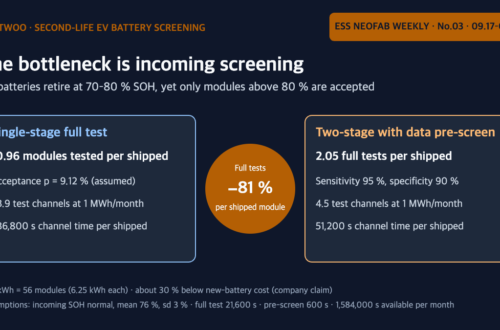
Battwoo’s Second-Life EV Batteries — When an 80 % Acceptance Threshold Overlaps the Retirement Distribution, Incoming Screening Becomes the Bottleneck
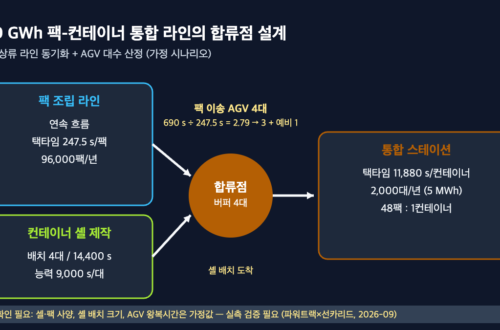
Designing the Merge Point in a 10 GWh Pack-Container Integration Line: Synchronizing Two Upstream Lines and Sizing AGV Fleet from the Powertrac × Sunka Lead Order
-
US storage set an energy record in Q2 as installed power fell 7%
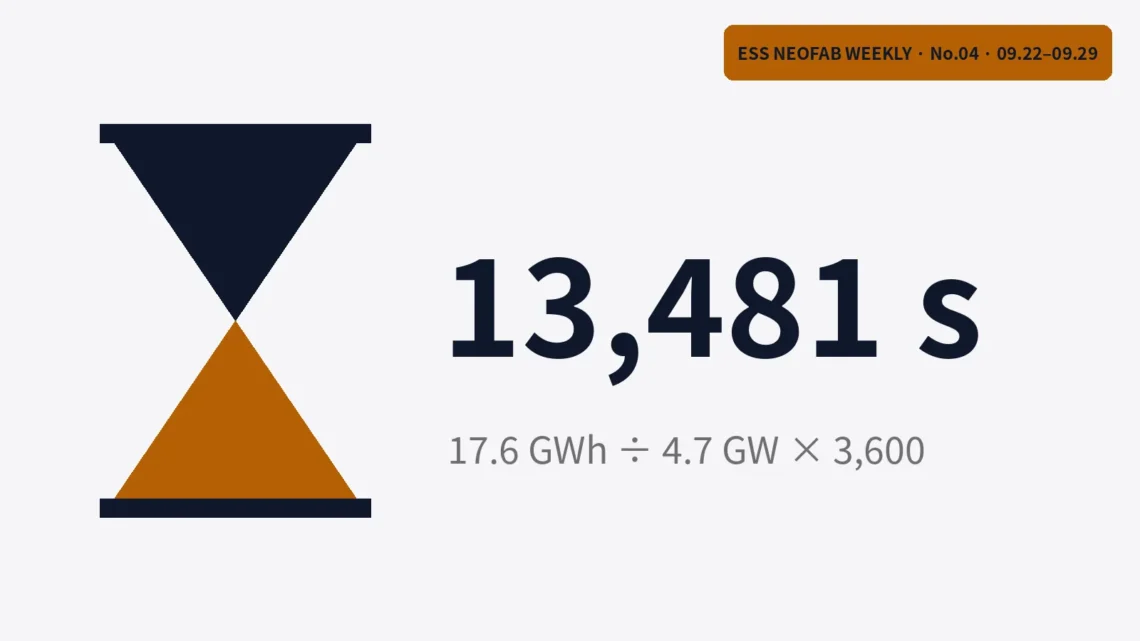
The US installed a record 18.9 GWh of energy storage in the second quarter of 2026, yet installed power fell 7% from a year earlier. Duration, the energy divided by the power, got longer, and for utility-scale projects it reached 13,481 s (about 3.74 hours). If duration stretches to the 14,788 s average in the 2026–2031 outlook, a 10% rise in energy calls for only 0.3% more PCS capacity. Battery lines follow GWh and PCS-transformer lines follow GW, and each conversion unit carries a larger share as duration grows.
You May Also Like
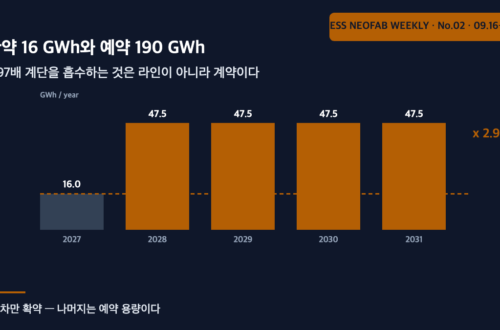
16 GWh committed and 190 GWh reserved — what absorbs the 2.97x step is the contract, not the line
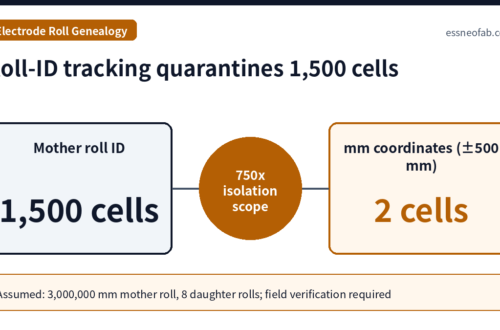
Electrode Roll Genealogy: How Key Reissue at Slitting and Stacking Shrinks Defect Isolation from 1,500 Cells to 2
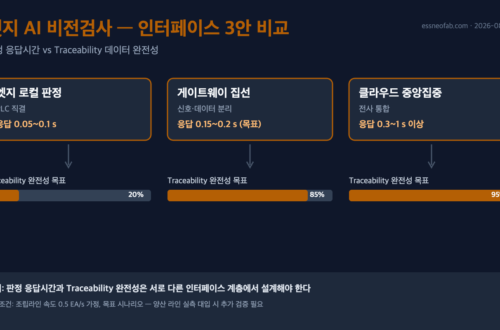
Edge AI Vision Inspection and Battery-Pack Leak Testing: How Gateway Aggregation Affects Traceability Completeness
-
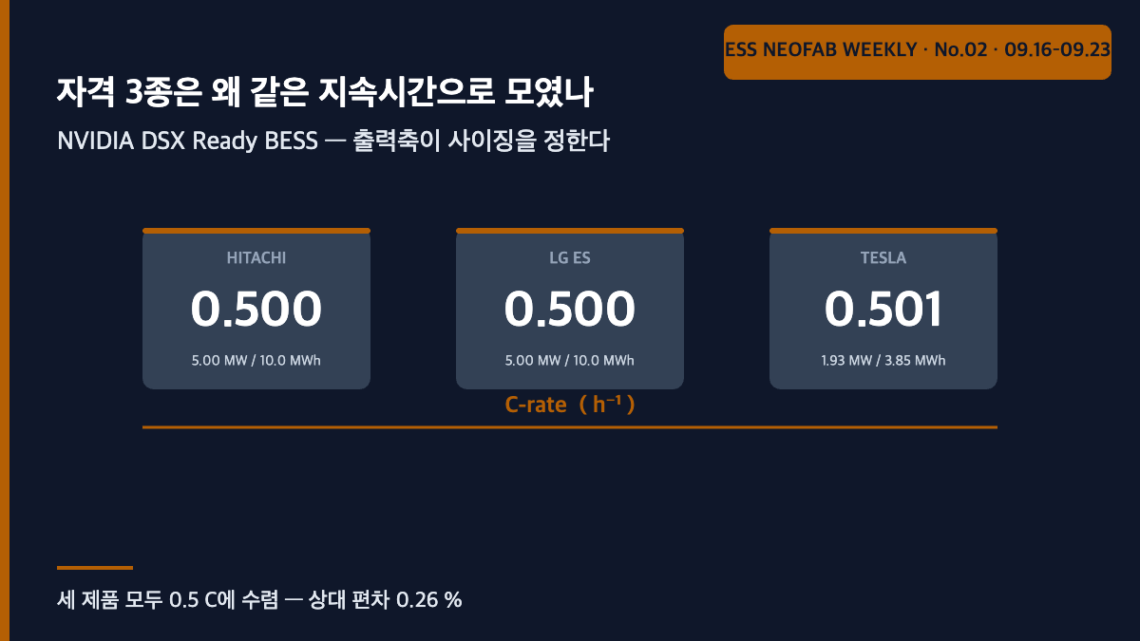
Why three qualified products landed on the same duration — in DSX Ready BESS, sizing is set by the output axis
NVIDIA's DSX Ready qualification programme, launched 21 September 2026, lists three BESS offerings whose C-rates converge within 0.26 % at 0.5 C. Of the three qualified functions only demand response governs energy capacity; under a 100 MW / 30 s assumption load buffering carries a 240x energy margin for free. Sizing is dominated by the output axis, and the remaining design variable is unit granularity, not energy capacity.
-
Grid-Forming PCS Mandate Redesigns FAT Takt Time and the BMS-PCS-EMS Interface
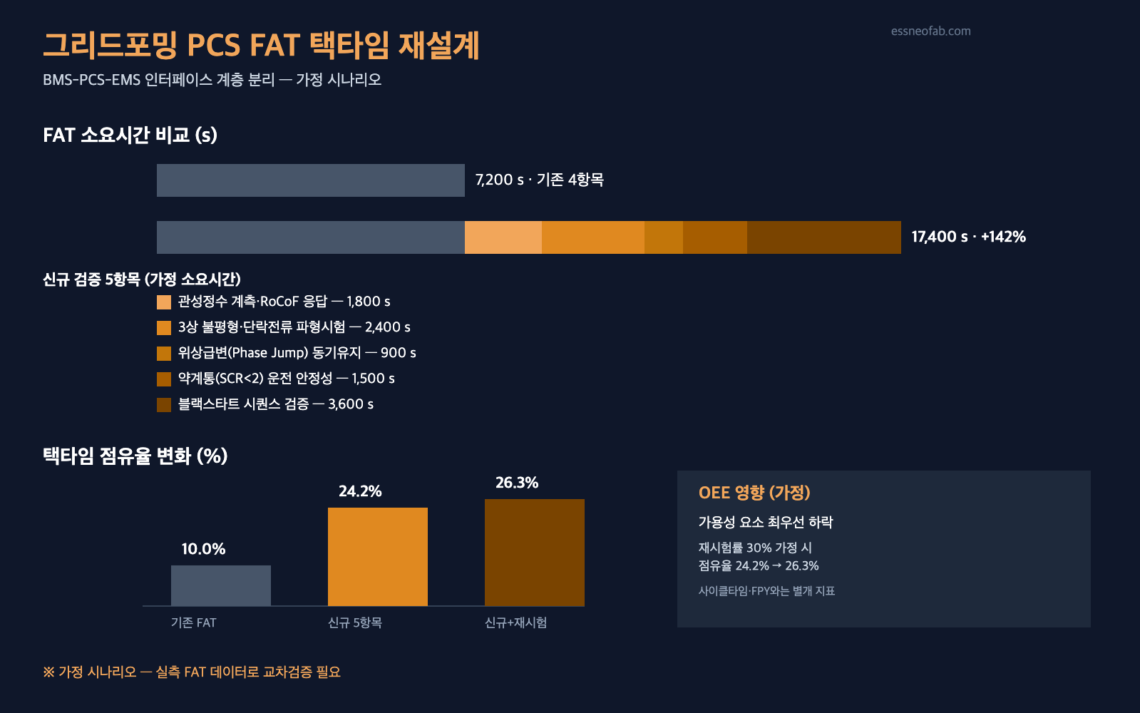
As grid-forming (GFM) inverter performance requirements become mandatory starting with long-duration BESS (Battery Energy Storage System) in the centralized-contract market scheduled for commercial operation in December 2027, five new verification stages are added to PCS (Power Conversion System) manufacturers' Factory Acceptance Test (FAT) lines. In an assumed-scenario calculation, per-unit FAT time increases by approximately 142% over the existing baseline, pushing the takt-time share from the 10% range to the 24% range, and if retests recur, the Availability factor of OEE (Overall Equipment Effectiveness) is the first to be shaken. At the same time, a design challenge emerges: a layer separation is needed between the grid-forming control loop, which requires sub-cycle…
You May Also Like
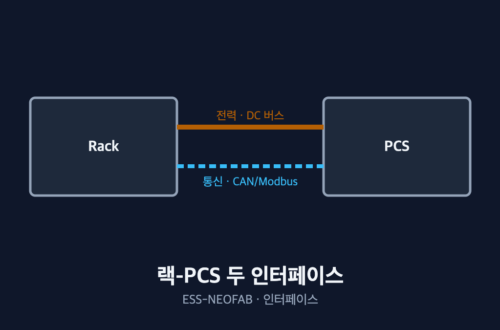
Between the Battery Rack and the PCS: Two Points Where the Interface Diverges
Embedding an AI Vision Inspection Gate in the Line: Redefining OEE and Takt-Time Design Variables
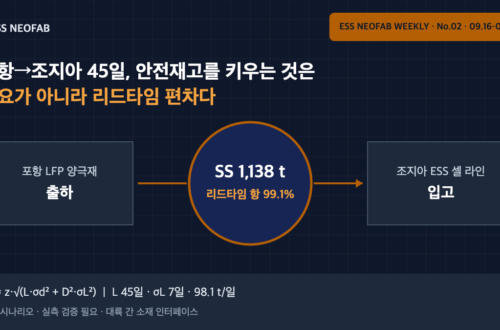
45 Days from Pohang to Georgia — Safety Stock at an Intercontinental Cathode Interface Is Driven by Lead-Time Variability, Not Demand
-
Long-Duration ESS Interface Design in the Era of Power-Grid Saturation
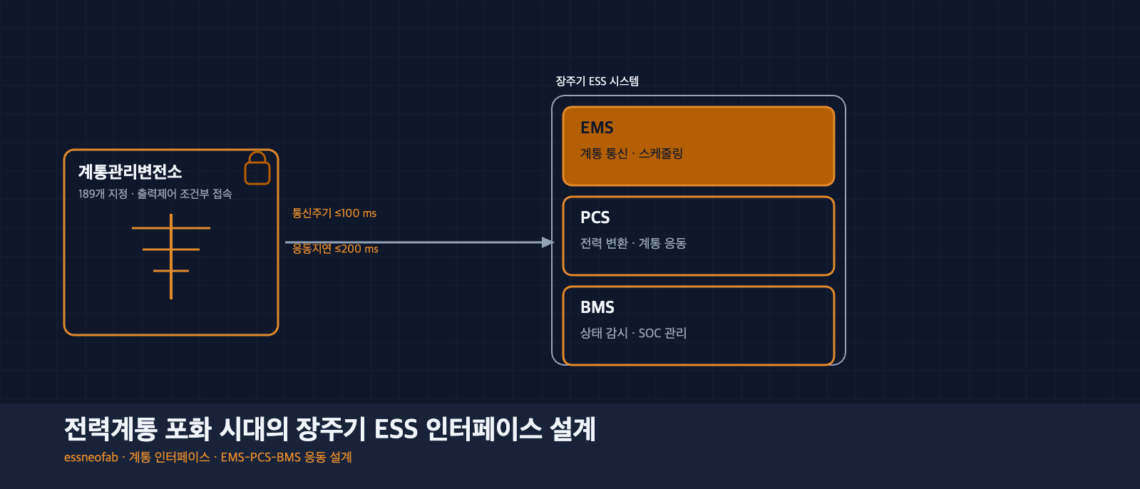
As 189 grid-management substations nationwide have, starting in 2026, been restricting new interconnection of renewable energy and large-scale demand through conditional curtailment, long-duration ESS (Energy Storage System) is shifting from a simple generation-consumption buffer into an essential variable in grid interface design. Korea's Ministry of Trade, Industry and Energy's centralized-contract market has presented a target of securing approximately 0.5 GW annually from 2026 to 2029, and a cumulative 21.5 GW by 2038, of long-duration ESS, which translates directly into standardization pressure on the communication and response specifications across the three-tier BMS-PCS-EMS hierarchy. In the current structure, where grid-interconnection queue information is not disclosed, designing margin into an individual ESS system's…
-
Between the Battery Rack and the PCS: Two Points Where the Interface Diverges
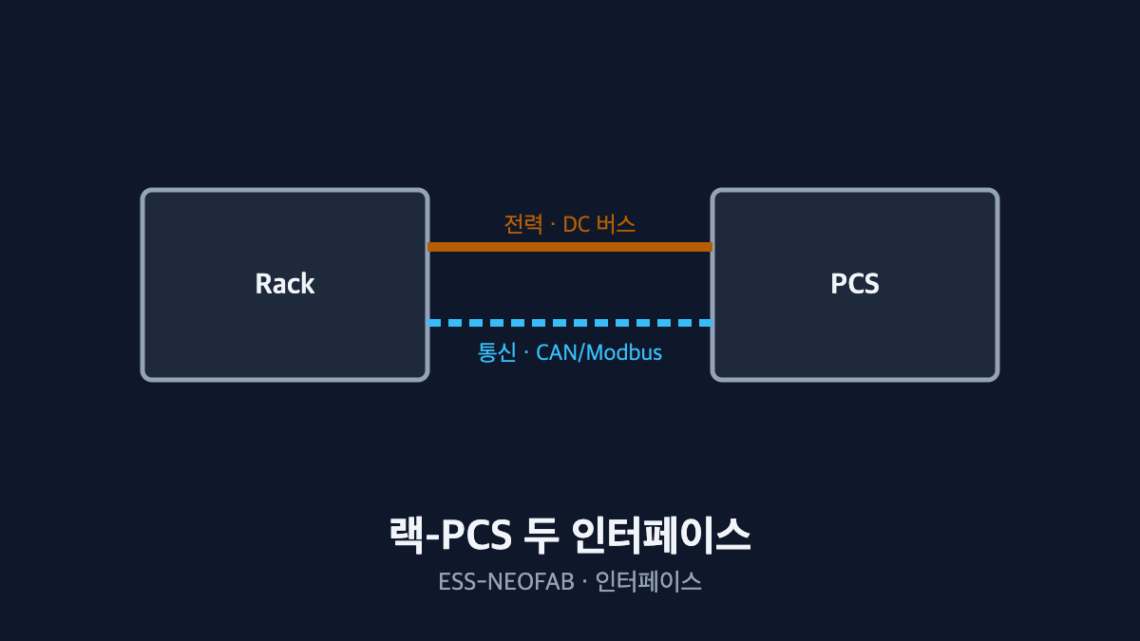
A battery rack and a PCS look like they are joined by a single cable, but two interfaces — power and communication — must line up simultaneously before the system will come up. On the power side, changing the number of series cells in a rack shifts both ends of the DC voltage window at once, so checking one end leaves the PCS unable to start in the low-SOC region. On the communication side, the register map and scale factors sit outside what the standard defines, so a single unit mismatch makes SOC read ten times high. Every figure below is an assumed value for illustration and must be recalculated…
You May Also Like
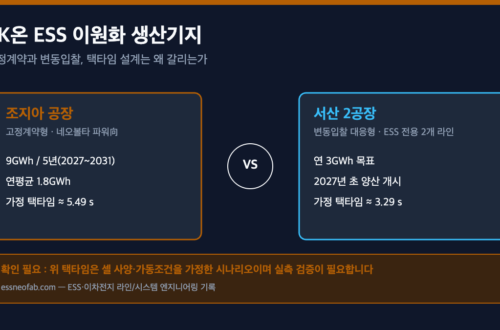
SK On’s Dual-Site ESS Production Bases — Where Fixed Contracts and Variable Bidding Split Takt Time Design
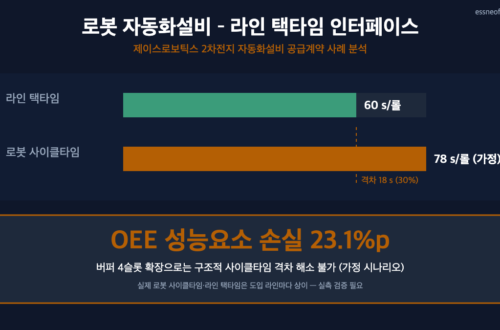
Introducing Robotic Automation Equipment — Where Does the Interface with Line Takt Time Break Down
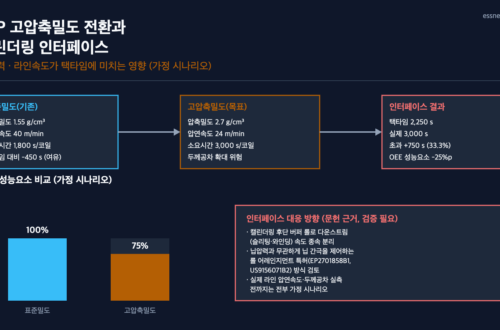
LFP High-Compaction-Density Conversion and the Calendering Interface: How Nip Pressure and Line Speed Affect Takt Time