Embedding an AI Vision Inspection Gate in the Line: Redefining OEE and Takt-Time Design Variables
Abstract
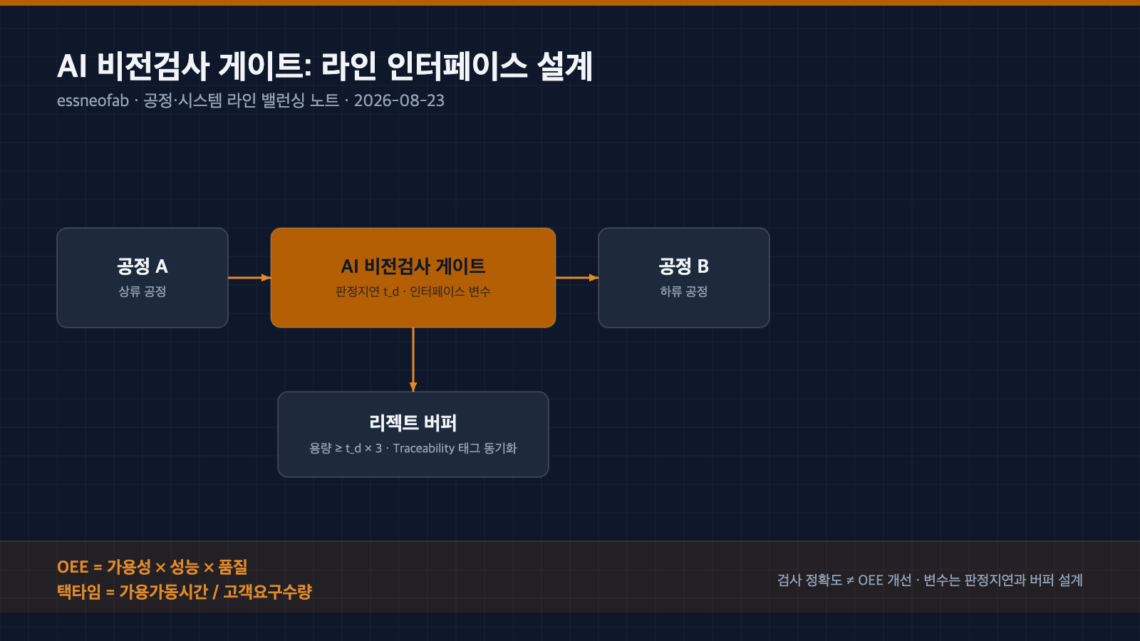
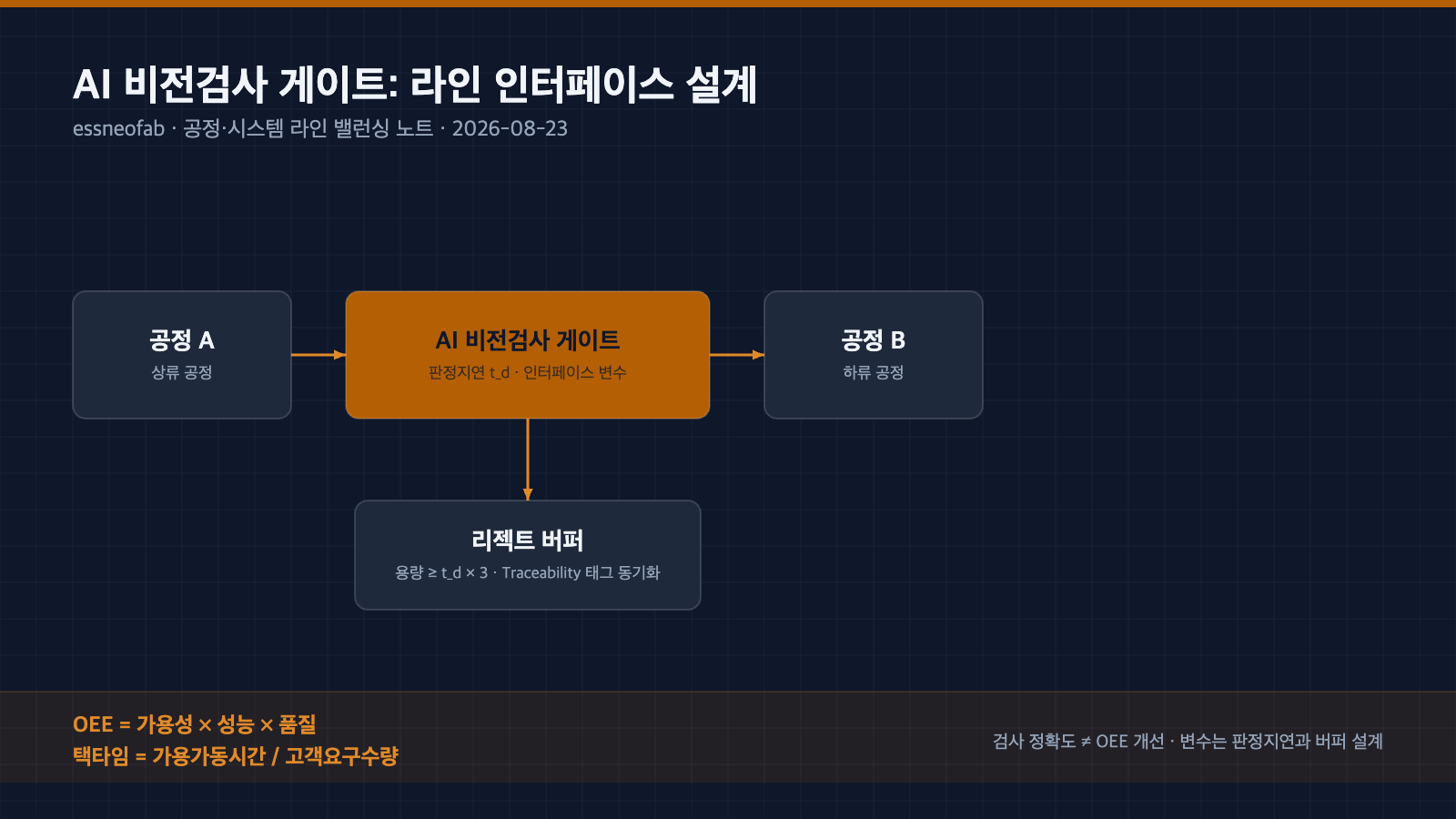
Across battery-line procurement specifications from 2024 to 2026, a trend is confirmed in which the Cognex, Keyence, ISRA, and MVTec deep-learning vision-inspection platforms have effectively become standard fixtures. However, only inspection-accuracy specs are typically stated, while the effect an AI vision-inspection gate has on the line’s overall OEE performance rate and takt-time variance is often not treated as a separate design item. This article redefines the AI vision-inspection gate as two interface variables — judgment delay and reject-merge point — and addresses the procedure for incorporating them into line-balancing calculations. To state the conclusion first, it is not the accuracy of the AI vision inspection itself, but the buffer-capacity design before and after the gate, that governs OEE and takt-time stability.
1. The AI Vision-Inspection Gate Is Not Inspection Equipment, It Is an Interface
The conclusion is presented first. While discussion of AI vision-inspection adoption concentrates on selecting cameras, lighting, and algorithms, controlled observation repeatedly confirms that what actually determines line performance is the buffer design before and after the gate. A line-balancing calculation only holds together if AI vision inspection is treated not as a standalone piece of equipment but as an interface between two processes.
To summarize the background (Situation), the combination of Cognex VisionPro Deep Learning, Keyence VS-Series AI, ISRA Atlas, and MVTec MERLIC+HALCON is understood to account for a large share of bid specifications from 2024 to 2026. The complication (Complication) is that while these specifications define inspection accuracy and throughput, the judgment-delay and reject-merge logic that arises when the gate is inserted into the line is often left as the responsibility of the line integrator (SI) rather than the inspection-equipment supplier. The question (Question) follows naturally — as which variables should the line designer define the AI vision-inspection gate in order to reflect it in the takt-time calculation? The answer (Answer) is to specify two variables — judgment delay time and reject-buffer capacity — in the process interface specification.
2. How Judgment Delay Enters the Takt-Time Calculation
The definition takt time = Available Operating Time / Customer Required Quantity still holds even in front of an AI vision-inspection gate. However, care is needed because the way the gate’s judgment delay erodes available operating time differs from cycle time. Cycle time is the time a single process takes to complete one unit of processing, while judgment delay is the time until that processing result is communicated to the downstream process. Conflating the two concepts renders the line-balancing table itself meaningless.
The trend of deep-learning inference moving on-device (to the edge) can be interpreted as a change that reduces this judgment delay. As in the case of an industrial edge AI camera (with a replaceable M12 optical system) disclosed on August 18, 2026, structures in which primary inference is performed at the sensor level and the upper system handles only exception processing are increasing. However, how many seconds this change actually shortens line judgment delay by has not been confirmed by any line-measured data beyond vendor announcement materials, so independent measurement and cross-verification are needed before adoption.
3. Why the OEE Performance Rate and Quality Indicator Must Be Viewed Separately
Let us reconfirm the definition OEE = Availability × Performance × Quality. When an AI vision-inspection gate is inserted into the line, the Quality factor (reduced defect-escape rate) among the three factors tends to be reported as improving, but it is often overlooked that the Performance factor (speed loss) can either improve or worsen depending on the gate design. In one domestic battery-line case, it was announced that auto-deep-learning vision inspection increased the detection accuracy of X-ray-image-based electrode irregularity defects (measurement condition: vendor’s own verification material, sample size and line conditions undisclosed — since no cross-verification against an independent sample has been performed, it is premature to substitute this figure directly as mass-production performance).
What must be emphasized here is that an improvement in inspection accuracy improving the Quality factor does not automatically raise total OEE. If judgment delay erodes the downstream buffer and lowers the Performance factor, it can offset the Quality factor’s improvement. Until the three factors are statistically separated and a significant difference is confirmed, it is safer not to assert the equation “AI vision-inspection adoption = OEE improvement.”
4. Reject-Merge Points and Traceability Tagging Timing
The point at which rejected units either rejoin the line or are diverted to a separate path is bound up not only with buffer design but also with traceability design. If the judgment result issued at the AI vision-inspection gate and the cell/module-level history tag do not use the same timestamp basis, a delay occurs when tracing defects in downstream processes. This effect is more sensitive in a line structure that omits the module stage, such as the cell-to-pack (CTP) integrated package solution SK On disclosed at InterBattery 2026. When the module — an intermediate verification point — disappears, the required level of judgment reliability and tagging consistency at the preceding AI vision-inspection gate rises.
However, what quantitative effect the CTP structure actually has on inspection-gate design in an actual mass-production line cannot be confirmed from the exhibition-disclosure material alone. Pilot/exhibition demonstration results are not substituted directly as mass-production-line performance, and this is left as an area requiring separate verification.
5. Pressure from Supply-Chain Expansion Toward Inspection-Gate Standardization
With the US Department of Energy (DOE) announcing $500 million in support for battery materials, manufacturing, and recycling on August 20, 2026, and Forge Nano breaking ground on August 19 to expand its North Carolina plant, amid this continuing wave of new-line construction, pressure is likely to grow toward standardizing inspection specs around the four platforms noted above, rather than redefining inspection specs for each individual line. This is not yet an observed result but an implication inferred from currently confirmed trends (accelerating new-line construction, vendor standardization taking hold), so it is separated out here as a forward-looking area requiring separate review.
FAQ
Q. If AI vision-inspection accuracy is higher than human visual inspection, does OEE improve by that same margin?
A. No. As covered in Section 3, inspection accuracy is directly involved only in OEE’s Quality factor. The Performance factor depends on judgment delay and buffer design, so whether an accuracy improvement translates into an overall line OEE increase must be separately confirmed with gate-specific measured data. Asserting an OEE improvement from accuracy figures alone is difficult to regard as a controlled-variable comparison.
Field Application Notes
The following items should be checked first during Monday-morning line inspection.
| Check Item | Verification Method | Target (Assumed, Requires Per-Line Reset) | Owner |
|---|---|---|---|
| AI vision-inspection judgment delay | Measure the difference between the gate input timestamp and the judgment-notification timestamp | ≤ 2 s (edge-inference basis) | Process Engineering |
| Reject-buffer capacity | Convert maximum buffer load × unit processing time into the delay width it can cover | Cover at least 3× the judgment delay | Line Engineer |
| Tagging timestamp consistency | Check the time-synchronization error between the vision-inspection judgment log and the MES history tag | Error ≤ 0.5 s | Traceability Owner |
| Separate logging of the three OEE factors | Tally Availability, Performance, and Quality as separate logs (do not look only at the combined index) | Report all three factors weekly, side by side | Production Control |
| Cross-verification of vendor specs | Re-measure the supplier-announced accuracy/throughput figures against an in-house sample | Sample N≥100, independent verification 1x/quarter | Quality Assurance |
Related Reading
- Edge AI Vision Inspection and Battery-Pack Leak Testing: How Gateway Aggregation Affects Traceability Completeness
- Introducing Robotic Automation Equipment — Where Does the Interface with Line Takt Time Break Down
- 46-Phi Cylindrical Cell Line Conversion: The Pressure-Sensor–BMS Interface Determines Takt Time


You May Also Like
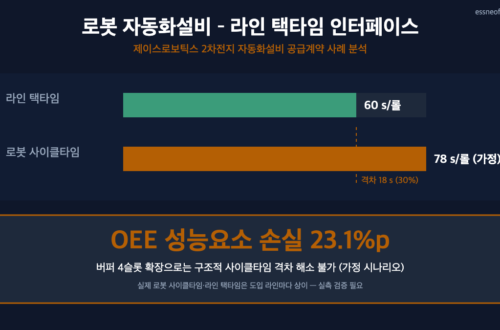
Introducing Robotic Automation Equipment — Where Does the Interface with Line Takt Time Break Down
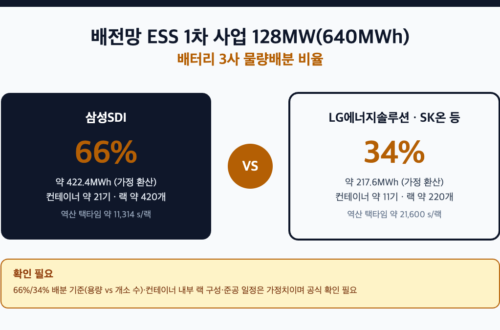
128 MW of Distribution-Grid ESS Volume Allocated — Can the Battery Pack Assembly Line Absorb the Takt Time?