-
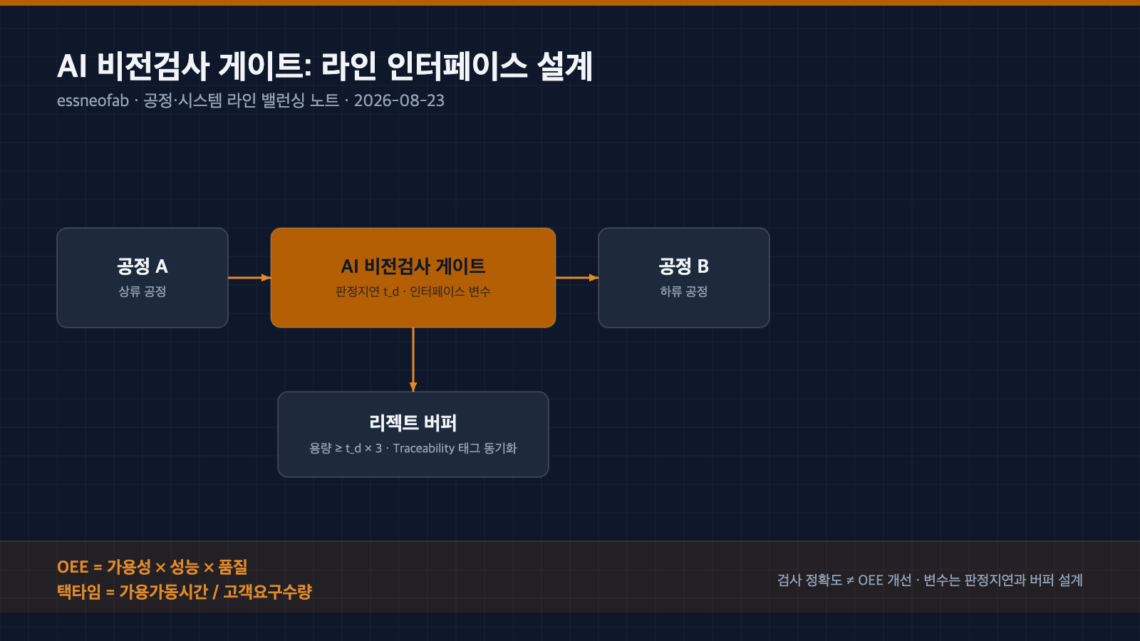
Embedding an AI Vision Inspection Gate in the Line: Redefining OEE and Takt-Time Design Variables
Across battery-line procurement specifications from 2024 to 2026, a trend is confirmed in which the Cognex, Keyence, ISRA, and MVTec deep-learning vision-inspection platforms have effectively become standard fixtures. However, only inspection-accuracy specs are typically stated, while the effect an AI vision-inspection gate has on the line's overall OEE performance rate and takt-time variance is often not treated as a separate design item. This article redefines the AI vision-inspection gate as two interface variables — judgment delay and reject-merge point — and addresses the procedure for incorporating them into line-balancing calculations. To state the conclusion first, it is not the accuracy of the AI vision inspection itself, but the buffer-capacity design…
You May Also Like
Re-Reading the ESS Grid-Interconnection Queue in the Language of Line Balancing
Between the Continuous Solid-Electrolyte Process and the Assembly Line: How Should the Buffer Interface Be Designed?
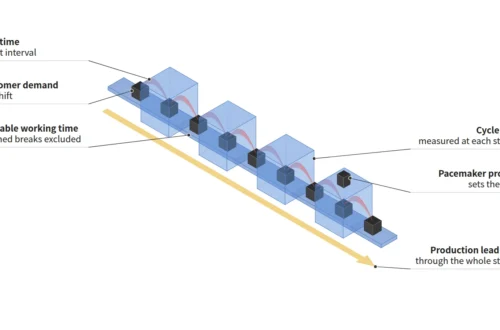
Don’t Subtract Breakdowns When Calculating Takt Time — Takt Time vs. Cycle Time vs. Lead Time
-
ESS Assembly Line: Why Immersion Cooling Becomes a Bottleneck
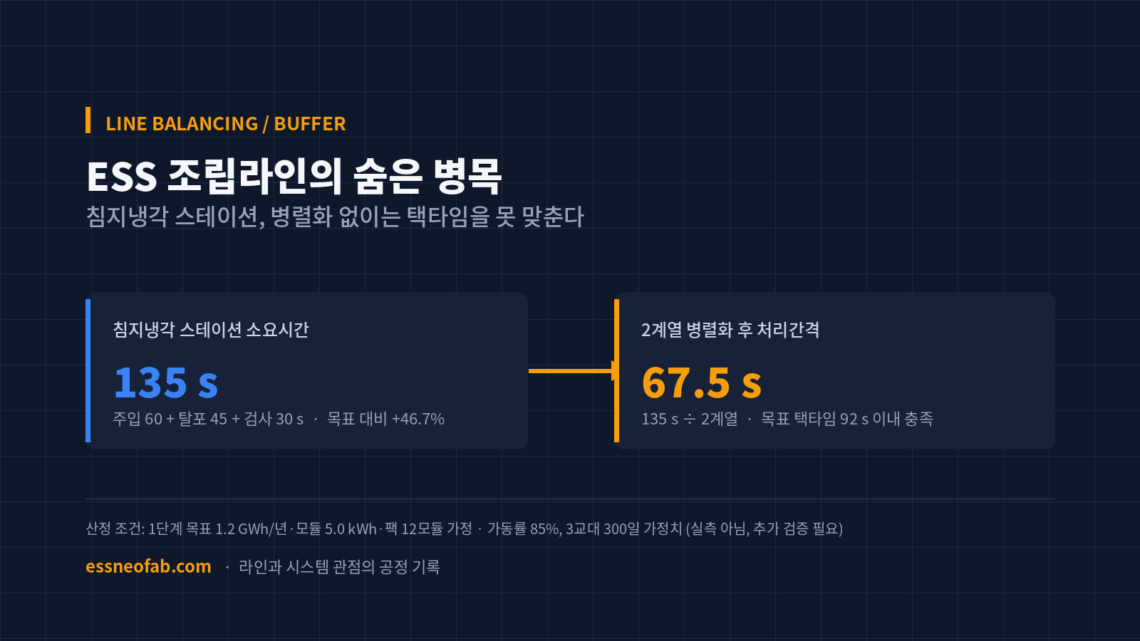
This article addresses the line-balancing problem that arises when immersion cooling and AI cell monitoring are simultaneously integrated in-line into an ESS module-pack assembly line. Under the estimation scenario, the immersion-cooling station's process time is 135 s, exceeding the target module takt time of 92 s by 46.7%, making a bottleneck unavoidable with a single-station configuration. Parallelizing into 2 lines lowers the effective processing interval to 67.5 s, satisfying the takt-time condition, but this in turn raises the FIFO buffer size at the point where the two lines merge, and the module-serial tagging of AI monitoring data, as new interface risks. This estimation is a scenario based on assumed values…
-
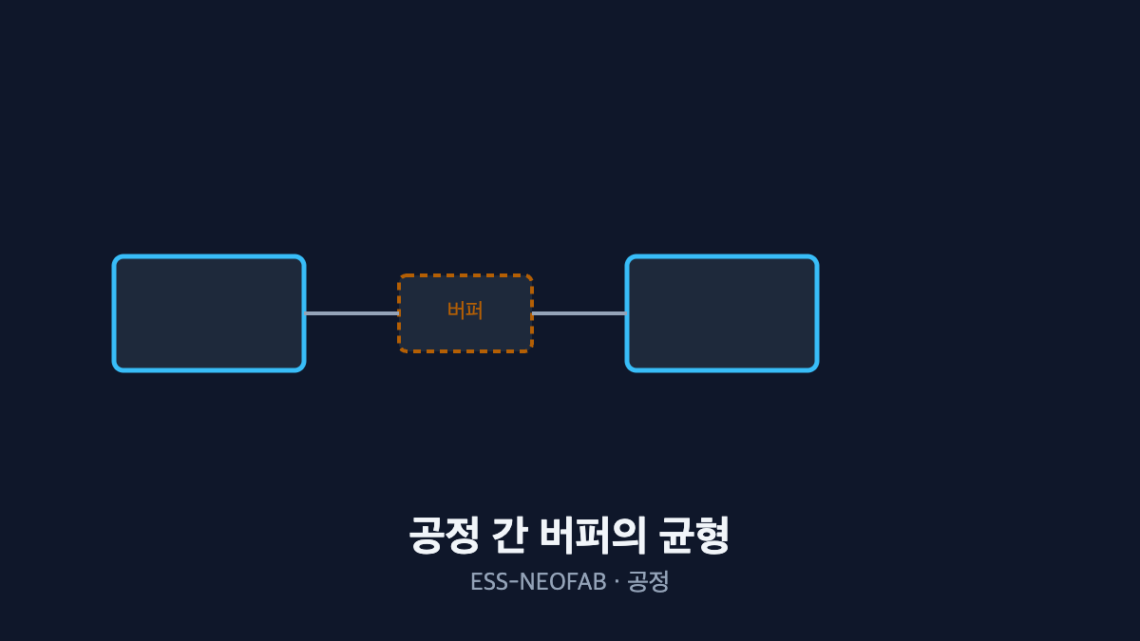
Inter-Process Buffers: Bigger Isn’t Always Better
An inter-process buffer (work-in-process inventory) is not a device that gets safer as it grows. It is a range problem, bounded below by what availability demands and above by what quality tolerates. Under the assumed line conditions below, the availability-driven minimum is 2 coils while the quality-driven maximum is 1 coil — the two bounds conflict. That conflict is not resolved by enlarging or shrinking the buffer; it is resolved by reducing upstream MTTR (Mean Time To Repair) or by moving the defect-detection point ahead of the buffer. Every figure below is an assumed value set for illustration, and applying it 1:1 to a mass-production line requires separate verification. 1.…
You May Also Like
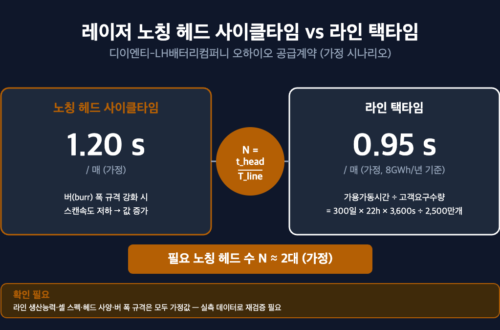
The Interface Between Laser Notching Cycle Time and Line Takt Time — The Head-Count Sizing Problem Revealed by DI ENT’s Ohio Supply Contract
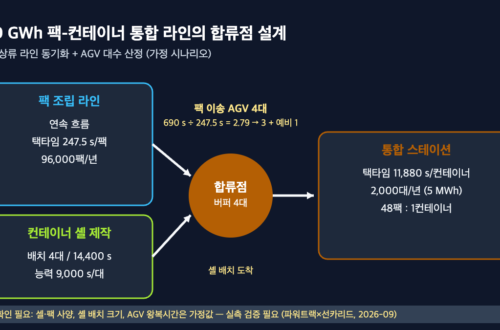
Designing the Merge Point in a 10 GWh Pack-Container Integration Line: Synchronizing Two Upstream Lines and Sizing AGV Fleet from the Powertrac × Sunka Lead Order
Market Trends from a Battery Process/Equipment Perspective — 46-Phi Ramp-Up, Dry Process, Equipment In-Housing