K-BATTERY SHOW 2026 Fire Safety Seminar: What to Look for in a Line-Level Fire Response System
Abstract
K-BATTERY SHOW 2026 was held from September 9 to 11, 2026, in Hall 7 of KINTEX Exhibition Center 2, with 185 exhibiting companies and 15,311 visitors over three days. The exhibition featured a special EV fire-response pavilion gathering fire prevention, detection, and suppression technologies, and the SFPE Korea Chapter’s “2026 International Lithium Battery and EV Fire Safety Seminar” shared thermal-runaway prediction and suppression technologies. This article treats line-level fire response as a closed loop of three serially connected segments (detection, isolation, and suppression) and shows that, in an assumed scenario, suppression-discharge delay accounts for 54 % of the loop’s total response time of 18.5 s. In other words, the performance of the closed loop is determined not by the most sensitive sensor but by the slowest segment.
1. The Conclusion First — The Performance of a Fire-Response Closed Loop Is Set by Its Slowest Segment
When evaluating a line-level fire-response system, the total detection→isolation→suppression response time and the longest segment within it should be examined before sensor sensitivity.
Situation (S): Safety sessions at secondary-battery exhibitions are broadening their scope from cell-level thermal-runaway suppression to system-level response. Complication (C): This exhibition ran a special fire-response pavilion together with an international fire-safety seminar. Question (Q): By what criterion should line engineers map such technology presentations onto their own lines? Answer (A): Not by the performance of individual technologies, but by converting them into how much time each technology removes from which segment of the closed loop[1].
2. Event Overview (updated 2026-09-23)
| Item | Details |
|---|---|
| Dates and venue | 2026-09-09 (Wed) to 11 (Fri), Hall 7, KINTEX Exhibition Center 2 |
| Scale | 185 exhibiting companies; 15,311 visitors over three days |
| Organizers | Korea E&X and the Korea Battery Technology Professionals Association (sponsored by MOTIE and KOTRA) |
| Fire-safety related | Special EV fire-response pavilion (fire prevention, detection, and suppression; battery protection solutions); SFPE Korea Chapter International Lithium Battery and EV Fire Safety Seminar (domestic and international response cases; thermal-runaway prediction and suppression technologies) |
| Co-located events | K-Mtech 2026, ESS & EV TECH |
| Business | 21 overseas buyer companies from 10 countries; 189 one-on-one consultations |
This article was first published on 2026-08-14 as a pre-event notice and has been updated to reflect the results after the event closed. Speakers and detailed presentation content for each seminar could not be confirmed in public reports and are therefore not cited.
3. Mechanism — The Time Budget of the Detection–Isolation–Suppression Closed Loop
When abnormal gas is generated in a formation[2] line or an ESS rack storage area, the sequence of detection sensor → BMS interlock → equipment power isolation → suppression system activation must occur in order. Because the segments are in series, the total response time is the sum of the segment times. The following is an assumed scenario intended to show the structure and is not a measurement of any specific equipment.
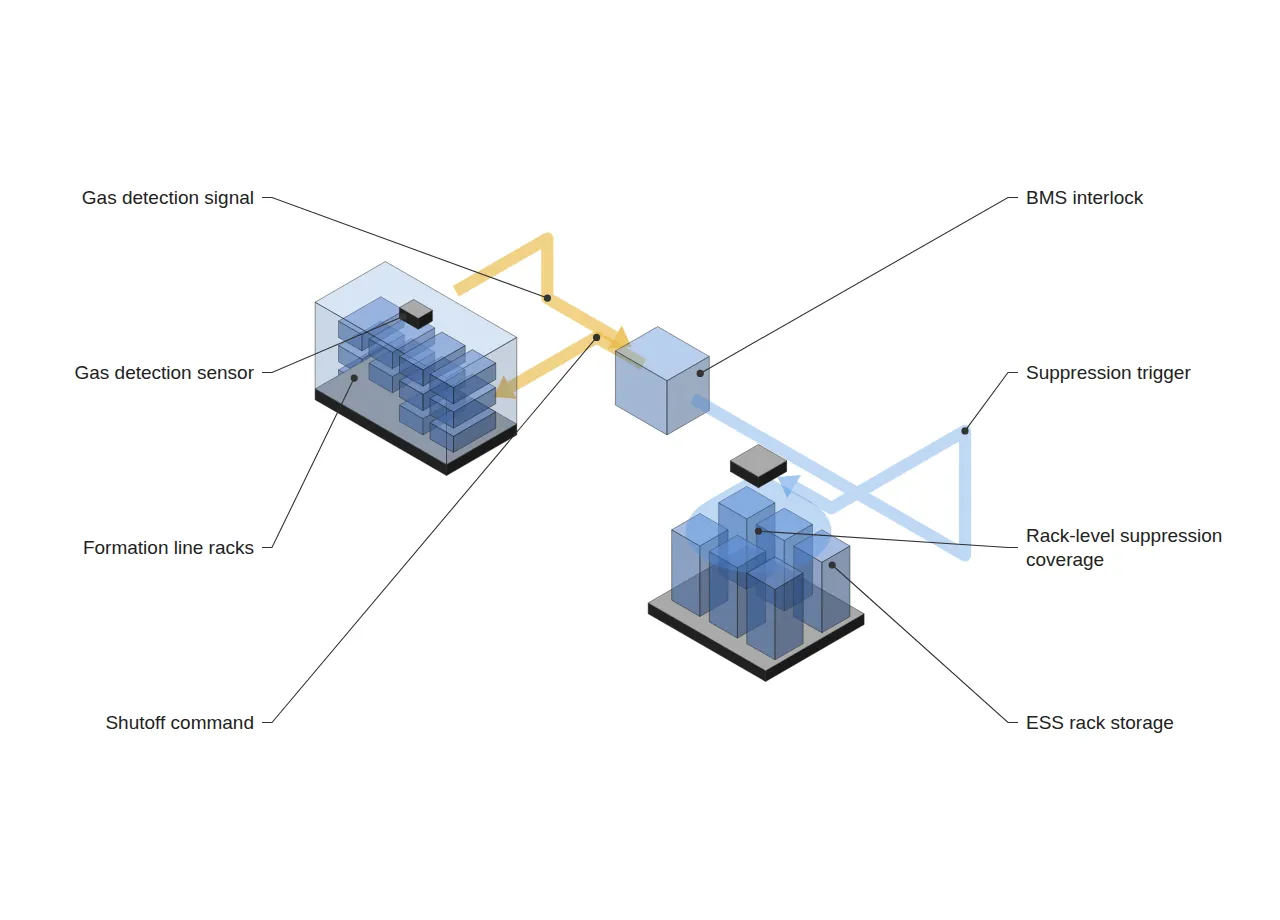
| Segment | Response time (assumed) | Share of total |
|---|---|---|
| ① Gas detection (sensor response) | 5.0 s | 27.0 % |
| ② Signal transmission (sensor→BMS) | 1.0 s | 5.4 % |
| ③ Interlock decision (BMS logic) | 0.5 s | 2.7 % |
| ④ Equipment isolation (power and conveyance stop) | 2.0 s | 10.8 % |
| ⑤ Start of suppression discharge | 10.0 s | 54.1 % |
| Total | 18.5 s | 100 % |
Under the assumed conditions, replacing the sensor with one twice as fast (5.0 s → 2.5 s) reduces the total from 18.5 s to 16.0 s, a 13.5 % reduction. Reducing the start of suppression discharge by the same ratio, from 10.0 s to 5.0 s, reduces the total to 13.5 s, a 27.0 % reduction. When translating technologies seen at an exhibition into adoption priorities, a meaningful comparison requires converting them in this way into their contribution to the total closed-loop time.
4. Limits of Application
Segment response times vary greatly with sensor type, installation location, communication method, and suppression agent and discharge method. In particular, the suppression segment sometimes includes an intentional confirmation delay to prevent false activation, so simple shortening is not always desirable. The values in Table 2 are assumptions for explaining the structure; on one’s own line, segment times should be measured from actual event logs (further verification required).
This differs in scope from NFPA 855 (2026 Edition) Revision: ESS Safety Standards Expand From the Cell to the Entire System, which addressed the trend of ESS safety standards expanding from the cell to the entire system through the NFPA 855 revision. Whereas that article addressed the scope of standard requirements, this article addresses the time structure of the response system inside the line.
5. Conclusions and Implications
This exhibition showed that fire-response technology has broadened across detection, suppression, and protection solutions. What line engineers need is not a list of individual technologies but a segment-by-segment time budget table for their own closed loop. Only with this table can one judge which technology reduces total response time the most.
FAQ
Q. Wouldn’t installing a more sensitive gas sensor improve fire response the most?
A. It depends on the share of total time taken by the detection segment. In the assumed scenario, the start of suppression discharge accounted for 54.1 %, so making the sensor twice as fast reduced the total by only 13.5 %. The share of each segment should be measured first.
Q. Where can the event seminar materials be found?
A. Whether detailed presentation materials have been made public has not been confirmed. The organizers’ notices should be checked directly.
Field Application Notes
| Check | How to execute | Remarks |
|---|---|---|
| ☐ Define closed-loop segments | Define the start and end events of the five segments: detection, transmission, decision, isolation, and suppression | Designate segment boundaries as log events |
| ☐ Measure segment times | During fire-alarm tests, record the timestamp differences between segment events in s | Organize in the format of Table 2 |
| ☐ Improve the longest segment first | Review improvement alternatives starting from the segment with the largest share of the total | Sensor replacement may not be the top priority |
| ☐ Check SOP scope | Confirm whether the fire-response SOP ends at the cell level or includes the system level (isolation and suppression interlocking) | Cross-check against NFPA 855 criteria |
Footnotes
[1] Closed Loop: a control structure in which detection results are automatically linked to isolation and suppression actions, and the outcome is fed back into the detection state.
[2] Formation: the process of applying the first charge/discharge to an assembled cell to activate it; because gas may be generated, it is a key monitoring section for line fire response.
Sources: K-BATTERY SHOW 2026 Opens… Full Battery Life Cycle and Safety Technologies Gathered (Korea Industrial Design News, https://kidd.co.kr/news/247366) / ‘K-BATTERY SHOW 2026’ Closes Successfully… 185 Companies Participate, 15,311 Visitors Over Three Days (Aving, https://kr.aving.net/news/articleView.html?idxno=1814608)
Measurement & Calculation Conditions: (The body was supplemented on 2026-09-23 to reflect the event results.) The segment response times of 5.0 / 1.0 / 0.5 / 2.0 / 10.0 s are all assumed values for explaining the structure and are not measurements of any specific equipment or product. The segments are in series, and parallel redundant paths were not considered. Verification by measurement is required.
Related reading — NFPA 855 (2026 Edition) Revision: ESS Safety Standards Expand From the Cell to the Entire System · ESS Fire-Safety Kits Across 20 Sites — What the System Must Prepare


You May Also Like
Solid Electrolyte and Aqueous Zinc Batteries: Investment Is Up — Is the Line Ready?
Hanwha Energy Sells Two Large Italian BESS Projects to Sweden’s OX2 — Evidence of European Development Capability