China’s GB/T 34014 24-Character Battery Code: How Code Structure Fixes Issuance Timing and Authority on the Line
Abstract
China’s “Interim Measures for the Administration of Recycling and Comprehensive Utilization of Waste Power Batteries from New Energy Vehicles” (MIIT and five other departments, Order No. 73), effective 1 April 2026, made power battery coding under GB/T 34014 and labeling of cells, modules and packs an explicit mandatory provision, and in August 2026 the rollout of a “power battery digital identity card” system built on the 24-character code was made official. Because the 24-character code contains a manufacture date (3 characters) and a serial number unique within “the same specification on the same day” (7 characters), the line must fix the code on the day of production and issue, mark and register it accordingly.
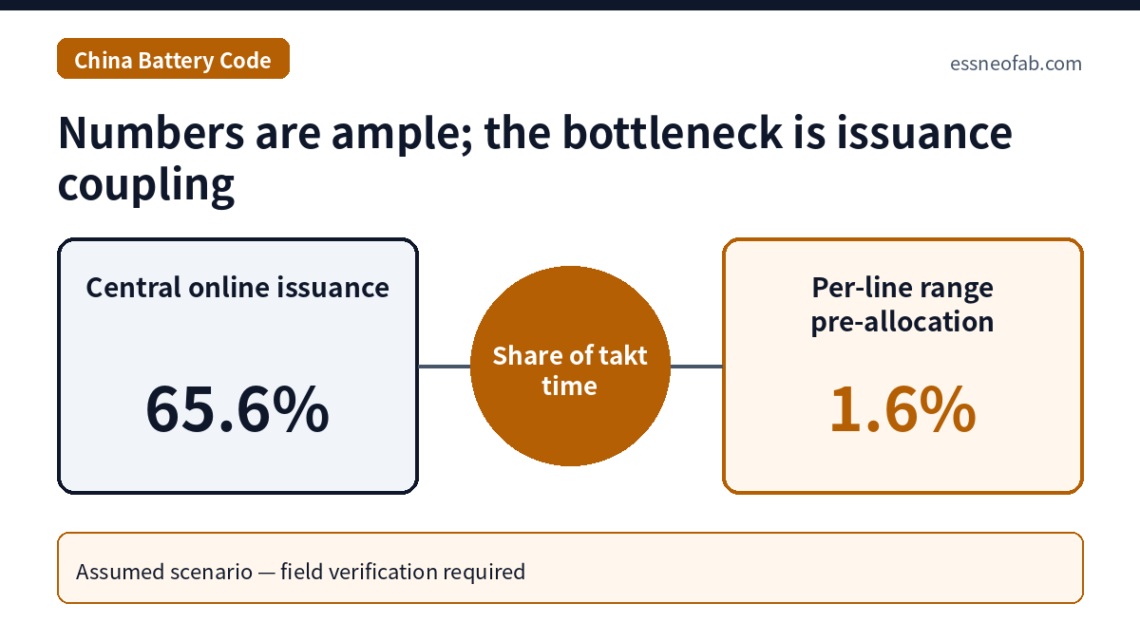
Assuming an 8 GWh/year cell line, serial-number space utilization is only 0.26%, so number shortage is not a constraint; the real constraint is how tightly code issuance is coupled, under a takt time[1] of 3.05 s, to the critical path[2]. Central-server online issuance can occupy 65.6% of takt time, whereas pre-allocating number ranges per line can reduce this to 1.6% (assumed scenario; field verification required).
1. Conclusion First — The Code Structure Dictates When Codes Are Issued and How Issuing Authority Is Distributed
Before it is an identifier, the GB/T 34014 24-character code is a line interface specification defining “when, and by whom, a number is fixed.” Because the code contains the manufacture date and a date-scoped serial number, it is not a label attached after production but data that must be synchronized with line events on the day of production.
Situation (S): GB/T 34014-2017 “Coding regulation for automotive traction battery” is a recommended national standard published on 12 July 2017 and implemented on 1 February 2018; a review on 8 December 2025 concluded it “remains valid.” Complication (C): Order No. 73, promulgated on 31 December 2025, requires in Article 9 coding in accordance with GB/T 34014 and labels on cells, modules and packs, and in Article 10 that codes be unique and accurate and labels be clear, visible, durable and not easily replaced.
There are also reports that Amendment No. 1 to GB/T 34014 was announced on 28 January 2026 (effective 1 August 2026); the amendment’s content requires verification against the original text. Question (Q): What does this coding system require of the line’s code issuance, marking and registration interfaces? Answer (A): The design variable is issuance availability, not number space, and the key constraint is that the uniqueness scope of the serial number (“same specification, same day”) spans multiple lines.
The common assumption is that “24 characters give ample room, so the coding system is an IT department issue.” The analysis below shows that, regardless of spare digits, the issuance structure can couple directly to line availability.
2. Mechanism — The 24-Character Composition and What Each Segment Demands of the Line
According to published standard summaries and explanatory materials, the code consists of two parts: design information (first 7 characters) and production information (last 17 characters). As data carriers[3], the standard normatively references 1D barcodes (GB/T 15425, Code 128), QR codes (GB/T 18284) and Data Matrix (ISO/IEC 16022). The table below summarizes when each segment is fixed and which line system is responsible.
| Position | Segment | Characters | Content | When fixed | Line interface requirement |
|---|---|---|---|---|---|
| X1–X3 | Manufacturer code | 3 | Uniformly allocated code | In advance (master) | No change; master-data management only |
| X4 | Product type | 1 | P (pack), M (module), C (cell) | Process stage | Cell, module and pack lines each become separate issuing entities |
| X5 | Battery type | 1 | Chemistry letter (e.g., B = LFP) | In advance (part number) | 1:1 mapping to part-number master |
| X6–X7 | Specification code | 2 | Enterprise-defined | In advance (part number) | Maintain part number ↔ specification code conversion table |
| X8–X14 | Traceability information code | 7 | Enterprise-defined traceability information | At issuance | The only free segment able to carry internal traceability data such as line or equipment identification |
| X15–X17 | Manufacture date | 3 | Year (30-year cycle), month, day, one character each | At issuance | The process event regarded as the “manufacture date” must be fixed as an internal rule (standard definition requires verification) |
| X18–X24 | Serial number | 7 | Serial number of units of the same specification made on the same day (0000000–9999999) | At issuance | If several lines produce the same specification on the same day, number uniqueness must be coordinated |
| X25–X26 | Cascade-use code | 2 | Appended only to cascade-use products (optional) | At cascade use | Not applicable to new-product lines |
In Table 1, the segments that directly affect line design are the 10 characters X15–X24. Because the manufacture date is in the code, the code must be issued at the process event where the manufacture date is fixed; and because the serial-number uniqueness scope is “specification and date” rather than “line,” multiple lines within one plant share one number space. Combined, these two conditions create a design problem of issuing authority: “who hands out the numbers?”
3. Calculation — Number Space Is Sufficient; the Constraint Is Issuance Availability
Assume an 8 GWh/year cell line, cells of 280 Ah and 3.2 V (0.896 kWh), 350 operating days per year, and 77,760 s of available operating time per day. Annual output is about 8,928,571 cells, daily output about 25,510 cells, and takt time (available operating time ÷ customer demand) is 77,760 s ÷ 25,510 cells = 3.05 s/cell.
The daily capacity of a 7-digit serial is 10,000,000, so utilization is 25,510 ÷ 10,000,000 = 0.26%. With serial capacity as the baseline, number shortage effectively does not occur. The design decision therefore depends not on number space but on how issuance is coupled to the line’s critical path.
| Issuance method | Critical-path occupancy (s/cell) | Share of takt time (3.05 s) | Line behavior if issuing server stops | Additional break risk |
|---|---|---|---|---|
| A. Central-server online issuance (request per cell) | 2.0 (assumed p99.9 round-trip latency) | 65.6% | Marking impossible → line stop | Low (registered at issuance) |
| B. Pre-allocated number range per line (local issuance) | 0.05 | 1.6% | Production continues until allocated range is exhausted; registration batched afterward | Medium (post-registration omissions must be managed) |
| C. Issuance after grading (internal ID → national code binding[4]) | 0.8 (assumed binding scan and issuance) | 26.2% | Congestion at binding process; upstream absorbed by buffer | High (binding event becomes a new break point) |
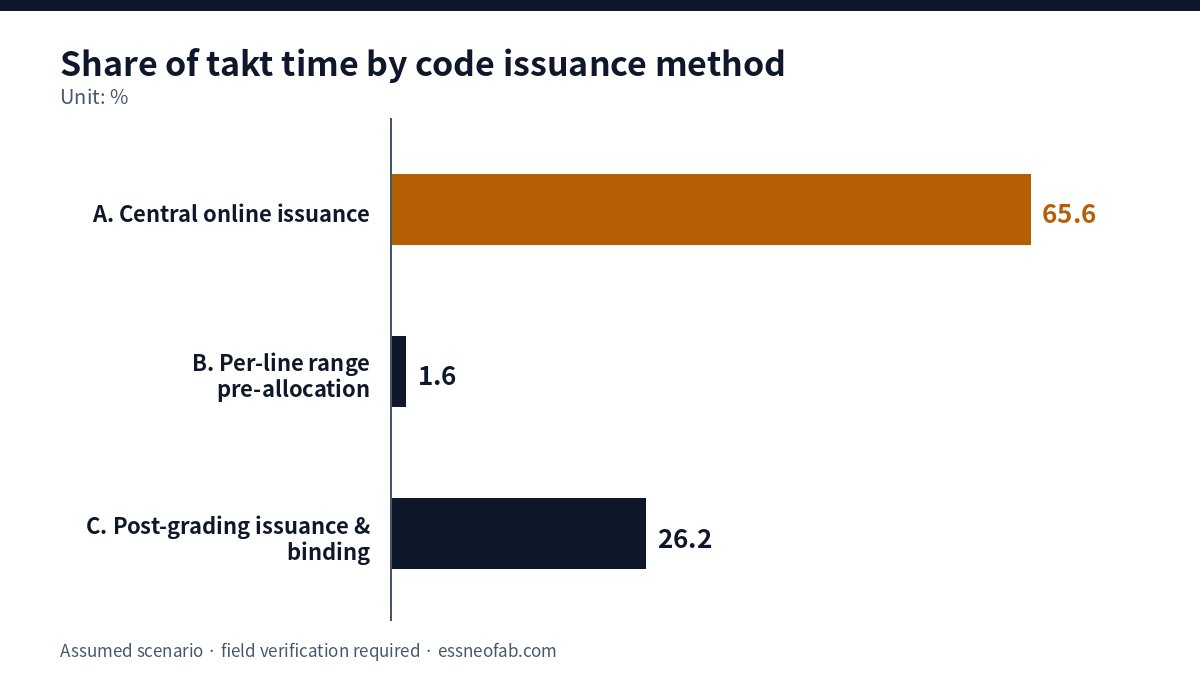
Using takt time of 3.05 s as the baseline, A consumes 65.6% of takt time through tail latency alone, eroding the margin of marking and verification processes. B, at 1.6%, effectively decouples issuance from line availability; even splitting the number range into 1,000,000 per line across 10 lines gives 39.2 times the plant-wide daily demand of 25,510 cells. The implication is that the ample number space is precisely the resource that makes method B possible. Spare digits should be interpreted not as waste but as design margin that allows issuing authority to be distributed.
C arises from choosing the “release-eligible grading date” as the manufacture date. In this case cells are tracked by internal ID during formation and aging dwell and bound to the national code after grading; if this binding event is missed, internal history and national code become separated. It has the advantage of not consuming numbers on scrapped cells, but it adds one more binding event proportional to cell count.
4. Trends, Comparison and Limits of Application
Summarizing 2026 developments: Order No. 73 (promulgated 31 December 2025, effective 1 April 2026) elevated GB/T 34014-compliant coding to a mandatory provision, and on 26 August 2026 MIIT Vice Minister Xin Guobin stated at a State Council Information Office press conference that a power battery digital identity management system will be implemented during the 15th Five-Year Plan period. At the World Power Battery Conference in Yibin on 4–6 September 2026, it was reported that the digital identity card comprises 96 items (54 basic, 24 operation and maintenance, 18 recycling), that the 24-character code runs through the whole life cycle, and that QR codes are encouraged as the carrier. By contrast, the specific changes in Amendment No. 1 to GB/T 34014 could not be confirmed from the original text at the time of writing (verification required).
- One-line comparison with Korea and the EU: Since 17 February 2025, Korea has assigned an identification number to each battery at the manufacturing stage under the amended Motor Vehicle Management Act and recorded it in the vehicle registration record, and the EU applies the battery passport from 18 February 2027 under Regulation (EU) 2023/1542. The distinguishing feature of the Chinese system is that it is a “semantic code” carrying manufacture date and serial-number meaning in the code itself; comparing the digit structures of the other two identifiers is outside the scope of this article (verification required).
- ESS applicability limit: GB/T 34014 targets automotive traction batteries, and Order No. 73 covers waste NEV power batteries. Whether the same code is mandatory for ESS-dedicated cells has not been confirmed and requires separate review. On shared EV/ESS lines, however, the same cell may ship for either use, leaving the practical question of how to code cells whose end use is undetermined at issuance.
- Numerical limit: The latency values in Table 2 vary widely with network and MES architecture. The structure of the conclusion (issuance coupling, not number space, is the constraint) holds, but the share figures require field verification.
This differs in grain from Cell Inbound Interface and Cell ID Event Rate. That article addressed ID event load proportional to cell count, whereas this one addresses how the structure of the number itself (date and serial) fixes issuance timing and issuing authority, rather than the number of events.
5. Conclusions and Implications
Because the GB/T 34014 24-character code carries the manufacture date and a “same specification, same day” serial number, it ties code issuance to line events on the day of production. In the assumed scenario, number-space utilization is 0.26% and not a constraint; the actual design variable is the degree to which issuance is coupled to takt time. Central online issuance can occupy 65.6% of takt time, and per-line range pre-allocation reduces this to 1.6%.
Lines producing cells, modules and packs for China should therefore document three things first: the definition of the process event corresponding to the “manufacture date”; the rule for splitting specification- and date-scoped serial numbers into per-line ranges; and the recording points of binding events among the three code tiers of cell, module and pack. Table 1 should be updated once the details of Amendment No. 1 are confirmed from the original text.
FAQ
Q. If the central issuing server is made redundant, isn’t method A sufficient?
A. Redundancy lowers the probability of server outage, but as long as a round-trip request is made per cell, network tail latency remains on the critical path. The problem is not the magnitude of availability but the coupling between issuance and takt time, and method B breaks that coupling. A quantitative comparison of redundancy effects requires in-house network measurement.
Q. With per-line range pre-allocation, serial numbers are not contiguous within a day; is that a problem?
A. Based on the summary materials confirmed, the requirement is “unique within the same specification and the same day,” and whether contiguity is required has not been confirmed (verification against the original standard required). If contiguity is required, method B creates gaps at range boundaries, so the interpretation must be agreed in advance with the certification and registration function.
Field Application Notes
The following items can be executed on Monday morning.
| Check | How to execute | Remarks |
|---|---|---|
| ☐ Classify the current code issuance method | For each cell, module and pack line, classify whether codes come from central requests, local ranges or post-issuance binding, as A, B or C in Table 2 | Methods may differ by line |
| ☐ Measure issuance latency | Collect the round-trip latency of issuance requests just before marking over 604,800 s, compute p50 and p99.9 (s), and compare with takt time | Judge by tail latency, not the mean |
| ☐ Document the “manufacture date” event | Agree with quality and certification functions which process pass defines the date in X15–X17 and fix it in a document | Standard’s definition of manufacture date requires verification |
| ☐ Check number collisions for multi-line production of the same specification | List lines producing the same specification code on the same day and confirm whether serial-assignment rules are shared | Separate lines by range split or traceability information code |
| ☐ Obtain the original Amendment No. 1 | Obtain the original text of the amendment reported as announced on 28 January 2026 and effective 1 August 2026, and check for changes to the segment definitions in Table 1 | If changed, update marking templates and parsers together |
Footnotes
[1] Takt Time: Available operating time ÷ customer demand. Not to be confused with cycle time or FPY.
[2] Critical Path: The sequential segment of the path a unit travels on the line where any delay translates directly into output delay.
[3] Data Carrier: The medium that physically holds the code, such as 1D barcodes, QR codes and Data Matrix.
[4] Binding: Recording two different identifiers (internal ID and national code, cell code and module code, etc.) as linked in a single event.
Sources: National Public Service Platform for Standards Information, GB/T 34014-2017 “Coding regulation for automotive traction battery” detail page, https://std.samr.gov.cn/gb/search/gbDetailed?id=71F772D818B4D3A7E05397BE0A0AB82A ; ChineseStandard.net, GB/T 34014-2017 English preview, https://www.chinesestandard.net/PDF-EN/GBT34014-2017EN-P06P-H5002H-234499.pdf ; Mysteel, lithium battery coding rules explainer (2024-05-17, Chinese), https://xny.m.mysteel.com/a/24051715/E18DE30F8C4F7165_abc.html ; China Certification, “China Announces GB/T 34014 Battery Coding Amendment” (2026), https://www.china-certification.com/en/china-announces-gb-t-34014-battery-coding-amendment/ ; MIIT et al., Interim Measures for the Administration of Recycling and Comprehensive Utilization of Waste Power Batteries from New Energy Vehicles (Order No. 73, promulgated 2025-12-31, effective 2026-04-01, Chinese), https://www.miit.gov.cn/gyhxxhb/jgsj/cyzcyfgs/bmgz/jdcjxl/art/2026/art_392462fdc40c415ea4a4129cac3028c2.html ; Fujian Provincial Department of Industry and Information Technology reprint, https://gxt.fujian.gov.cn/jdhy/zxzcfg/gjzcfg/202601/t20260119_7082067.htm ; Tencent News, MIIT on the power battery digital identity system during the 15th Five-Year Plan (2026-08-26, Chinese), https://news.qq.com/rain/a/20260826A07ATL00 ; China News Service, 96-item power battery digital identity card (2026-09-06, Chinese), https://www.chinanews.com.cn/cj/2026/09-06/10691402.shtml ; Korea Policy Briefing, EV battery safety certification from 17 February (2025, Korean), https://www.korea.kr/news/policyNewsView.do?newsId=148939669 ; EUR-Lex, Regulation (EU) 2023/1542, https://eur-lex.europa.eu/eli/reg/2023/1542/oj
Measurement & Calculation Conditions: Annual capacity of 8 GWh, cells of 280 Ah and 3.2 V, 350 operating days per year, 77,760 s of available operating time per day, equal range split across 10 lines, and critical-path occupancy by issuance method (A 2.0 s, B 0.05 s, C 0.8 s) are all assumed values. Code segment definitions are based on standard summaries and explanatory materials, and whether Amendment No. 1 is reflected has not been confirmed. Results vary with network architecture, MES configuration and label specifications; field verification required.