News & Trends
This category tracks market, policy, and international standards and safety regulation trends in the ESS, secondary battery, and clean energy industries from a line- and system-level perspective.
-
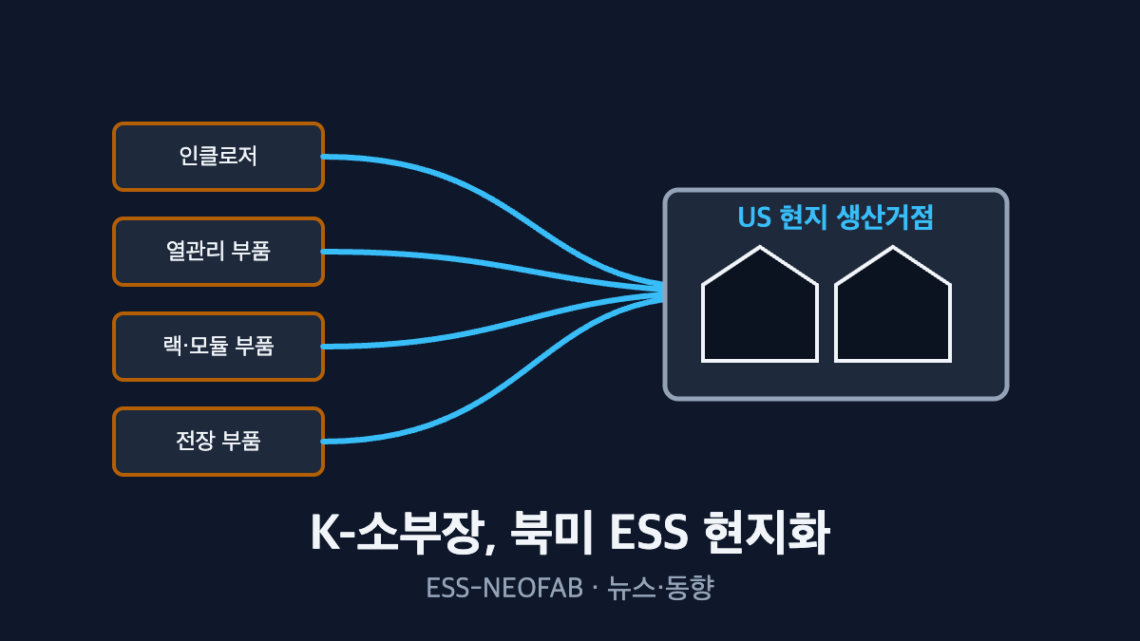
“Capturing the U.S. ESS Market” — K-Battery Supply Chain’s Wave of Localization: What’s Going Where
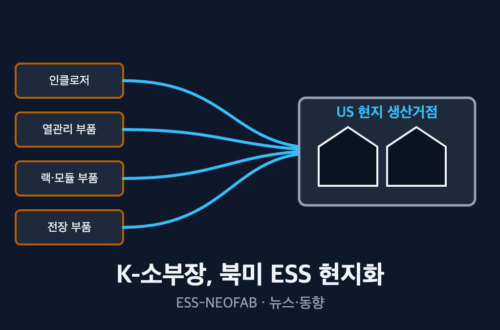
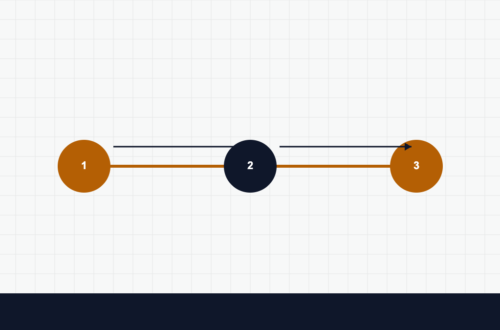
Four Korean ESS materials, parts, and equipment companies are simultaneously establishing production sites in the United States. Seojin System began final assembly of battery enclosures for Samsung SDI America in Indiana in July 2026; Shinsung ST is preparing liquid-cooled thermal management parts in Kentucky, Hanjoong NCS liquid-cooled cooling systems in Indiana, and Sebang Global Battery an ESS business base through its U.S. subsidiary. This article reads this trend not as “component-by-component localization” but through a system variable: “the number of supply interfaces connected in series to the local assembly line.” In an assumed scenario, even if each supplier’s on-time supply probability is 95 %, increasing the number of serial suppliers…
You May Also Like
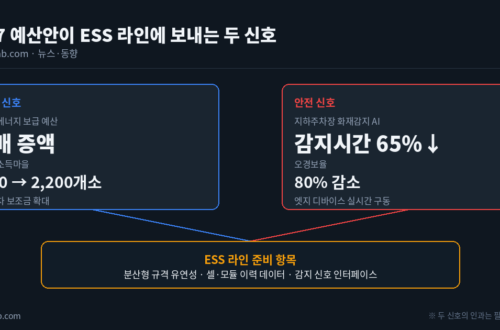
Doubling the Renewable-Energy Budget and Underground-Parking EV Fire-Detection AI — Two Signals the 2027 Budget Sends to the ESS Line
K-BATTERY SHOW 2026 Fire Safety Seminar: What to Look for in a Line-Level Fire Response System
EU Battery Passport 2027: Which Station on an ESS Pack Line Commits What
-
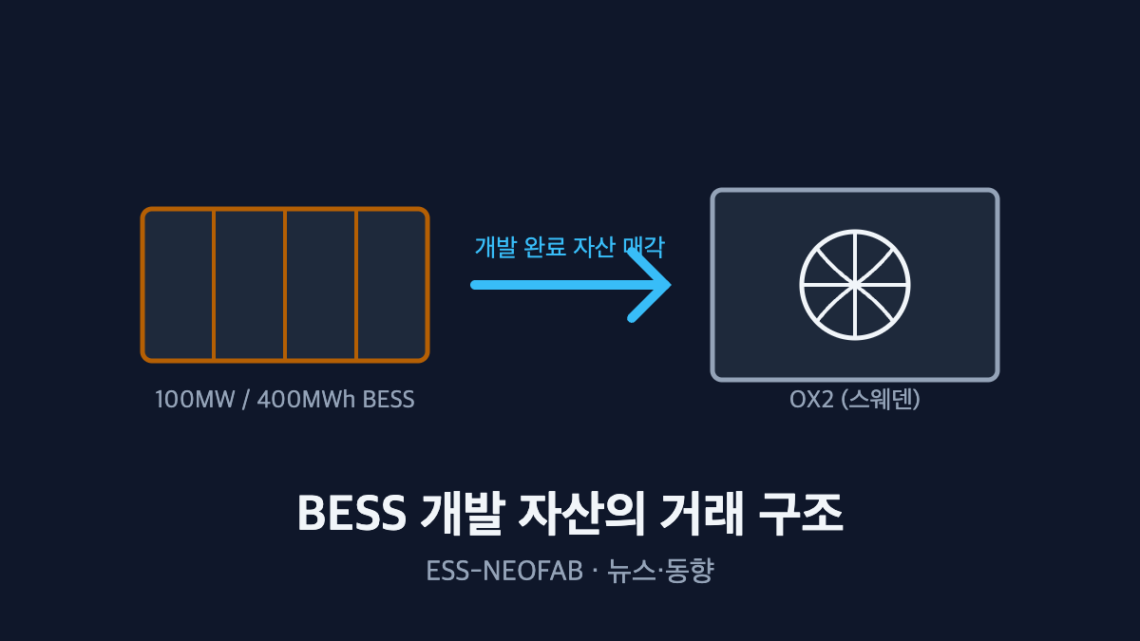
Hanwha Energy Sells Two Large Italian BESS Projects to Sweden’s OX2 — Evidence of European Development Capability
Hanwha Energy’s European subsidiary has sold two standalone BESS projects developed in the Puglia (Apulia) region of southern Italy (100 MW/400 MWh each, 200 MW/800 MWh in total) to OX2, a Swedish renewable energy developer (OX2 announcement, 2026-08-05). The two projects target construction start in Q2 2027 and commercial operation by the end of 2028. This article views the transaction not as a battery sale but as the transfer of “assets whose power (MW) and energy (MWh) were fixed at the permitting stage,” and uses an assumed scenario to show that a 4-hour-duration configuration skews site interfaces toward the battery side. At the same 100 MW, extending duration from 2…
You May Also Like
Doubling the Renewable-Energy Budget and Underground-Parking EV Fire-Detection AI — Two Signals the 2027 Budget Sends to the ESS Line
Converting EV Lines to ESS: What the H1 Utilization Gap Reveals About Line-Conversion Speed
LG Energy Solution’s ESS Rear-Base Positioning — What Changes in Line Management
-
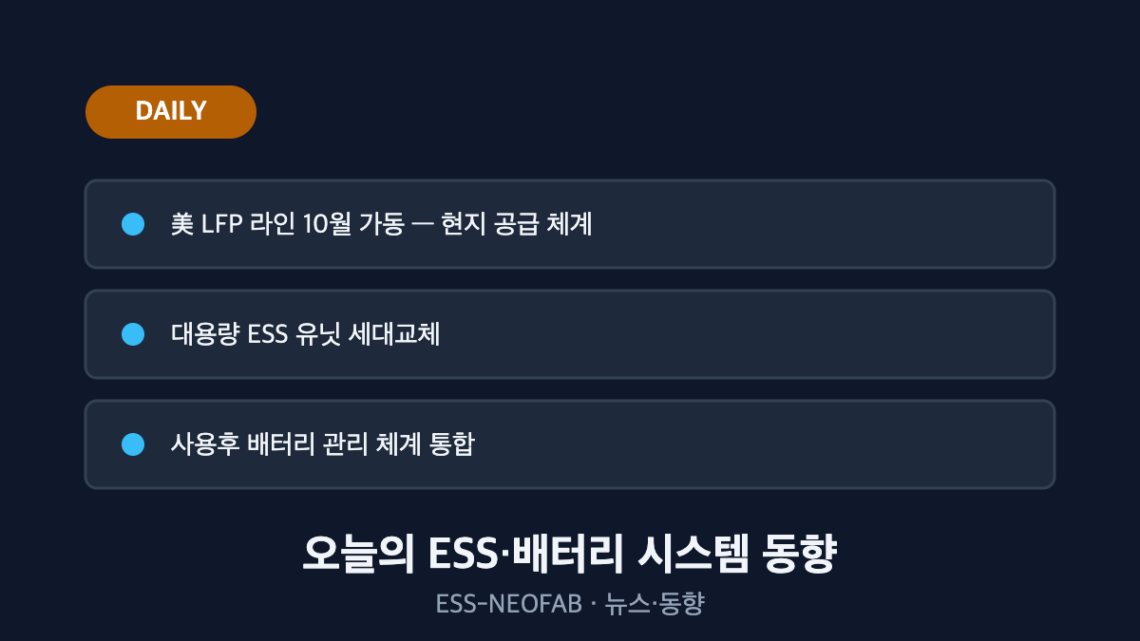
Today’s ESS/Battery System Trends — U.S. LFP Mass Production Imminent, Megapack 3 Launched, Used-Battery Platform Integration (2026.08.11)
Photo: Kumpan Electric (Unsplash) Three notable trends from a systems perspective in ESS and battery manufacturing lines today: the launch of U.S.-local LFP production, a generational upgrade of large-capacity ESS units, and the integration of used-battery management systems. All three point toward the same direction — "system-level scale-up." 1. Samsung SDI's U.S. LFP Line Launches in October — SBB 2.0 Supply System Samsung SDI will begin mass production of ESS-use prismatic LFP cells at its U.S. local production line this coming October. The company plans to make its first customer delivery of the SBB 2.0 battery-box unit product by year-end, with the key driver being the surge in power demand…
You May Also Like
Today’s ESS/Battery Process Trends — Expanded Support for Materials/Parts/Equipment Lines, Solid-State/LFP Pilot Lines Launch (2026.08.07)
K-BATTERY SHOW 2026 Fire Safety Seminar: What to Look for in a Line-Level Fire Response System
ESS Fire-Safety Kits Across 20 Sites — What the System Must Prepare
-
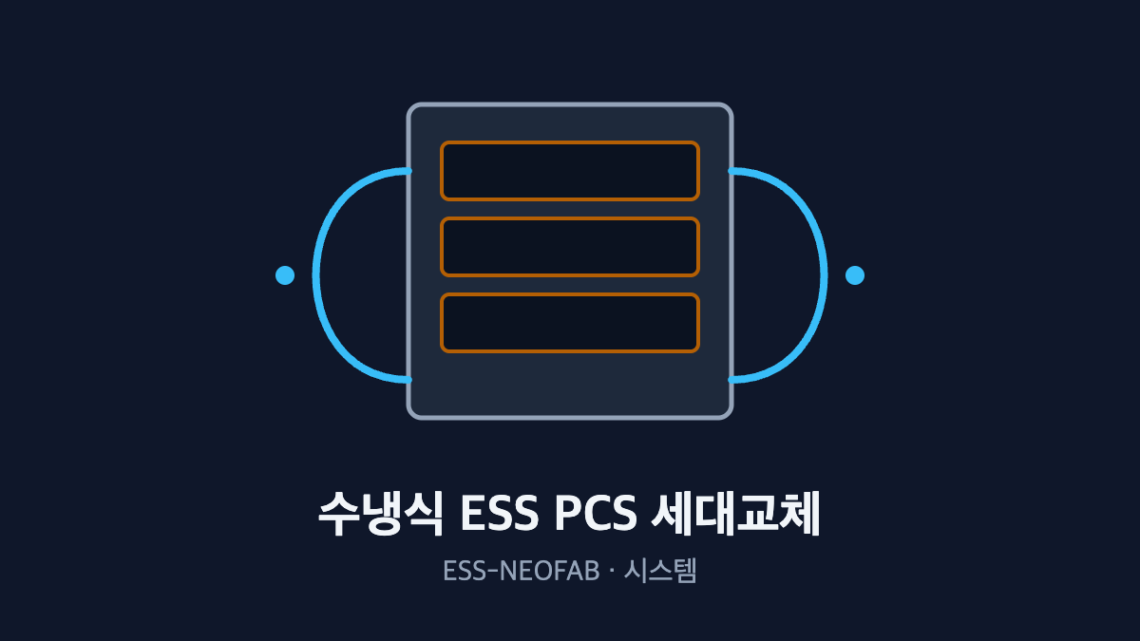
LS Electric Ships First Units of Next-Gen ESS PCS “G2” — Is Liquid Cooling the Answer?
On August 5, 2026, LS ELECTRIC held a first-shipment ceremony at its Cheonan DC Factory for ‘G2’, its next-generation power conversion system (PCS) for ESS. The key change is a switch in cooling method from air cooling to liquid cooling, and the reported benefits are improved heat control and durability together with a reduced installation footprint. This article redefines the cooling method not as “stand-alone PCS efficiency” but as a system variable: “how much the output availability of an ESS site fluctuates by season.” It shows that, in an assumed scenario, the annual average output availability of an air-cooled PCS is 98.6 %, which makes the difference appear small, but…
You May Also Like
K-BATTERY SHOW 2026 Fire Safety Seminar: What to Look for in a Line-Level Fire Response System
EU Battery Carbon Footprint Methodology Still Pending: How Line Energy Metering Resolution and Allocation Choice Shift Per-Cell Values

From EV to ESS Use: What Ultium Cells and Cosmos Lab Show About Converting a Line’s Purpose
-
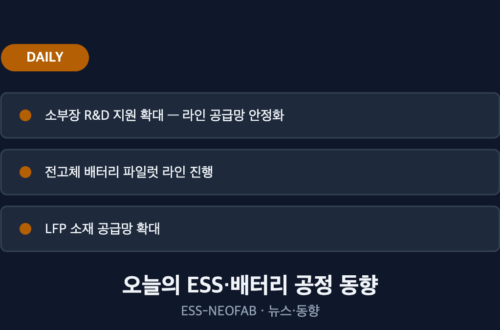
Today’s ESS/Battery Process Trends — Expanded Support for Materials/Parts/Equipment Lines, Solid-State/LFP Pilot Lines Launch (2026.08.07)
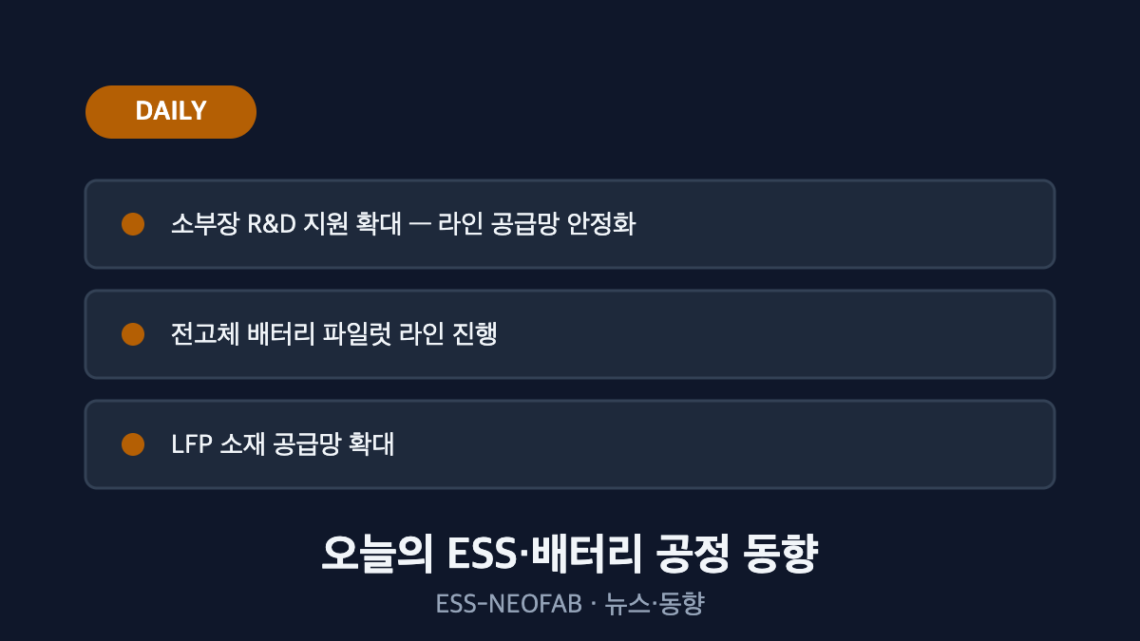
Photo by Homa Appliances on Unsplash This is a line/systems-perspective summary of industry trends for August 7, 2026. Today three axes stand out: expanded R&D support for materials/parts/equipment companies, progress on solid-state battery pilot lines, and expansion of the LFP material supply chain. 1. Materials/Parts/Equipment R&D Support — Stabilizing the Line Supply Chain The Ministry of Trade, Industry and Energy has newly approved five materials/parts/equipment cooperation models and selected five companies as "Super Eul" enterprises. A total of KRW 91 billion in R&D funding will be invested over five years; Ecopro BM will develop sulfide-based solid electrolyte for solid-state batteries, and Hanwha Ocean will develop core fuel-cell equipment for submarines.…
-
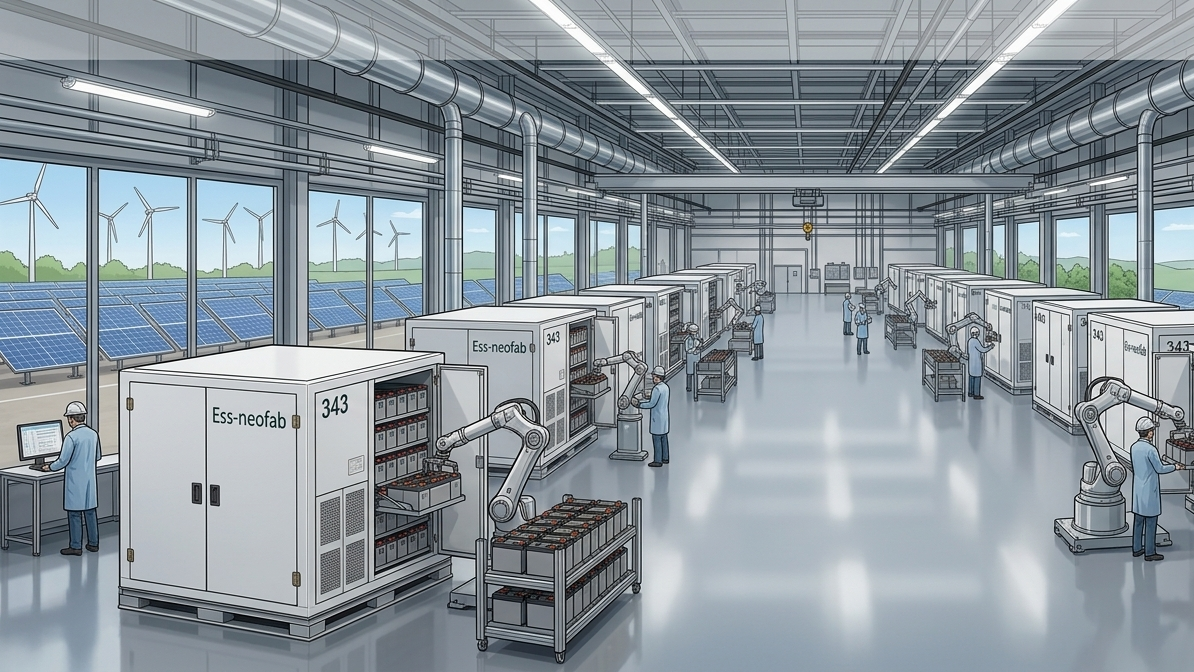
NFPA 855 (2026 Edition) Revision: ESS Safety Standards Expand From the Cell to the Entire System
Since August 2017, 21 lithium-ion battery ESS fires have occurred in Korea alone, but only a portion of these incidents can be explained by battery cell defects alone. In many cases, the direct cause of fire spread was equipment outside the battery itself — the Balance of System (BOS) — such as missing surge arresters, defective wiring installation, or cooling/HVAC failures. With the release of the 2026 edition of NFPA 855, the National Fire Protection Association (NFPA) has shifted its evaluation criterion from "whether an internal cell defect exists" to "whether propagation to adjacent cells, modules, or racks is blocked." NFPA 855 is the Standard for the Installation of Stationary…
You May Also Like
After Korea’s Battery History Management System: IDs Continue, Operating History Breaks — History Continuity of ESS Reuse Racks
China’s GB/T 34014 24-Character Battery Code: How Code Structure Fixes Issuance Timing and Authority on the Line
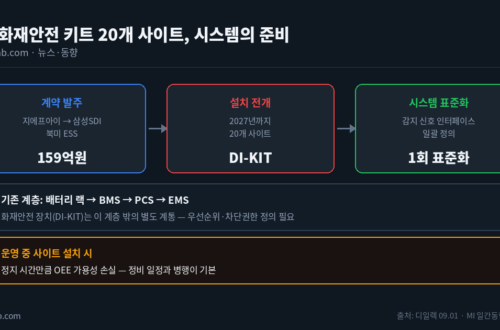
ESS Fire-Safety Kits Across 20 Sites — What the System Must Prepare
-
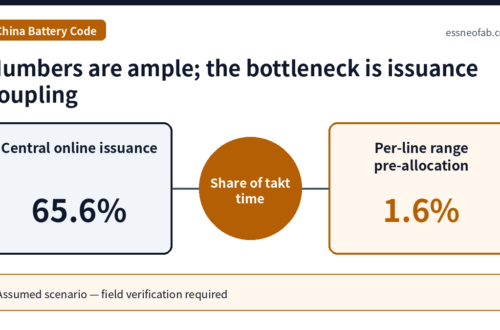
China’s GB/T 34014 24-Character Battery Code: How Code Structure Fixes Issuance Timing and Authority on the Line
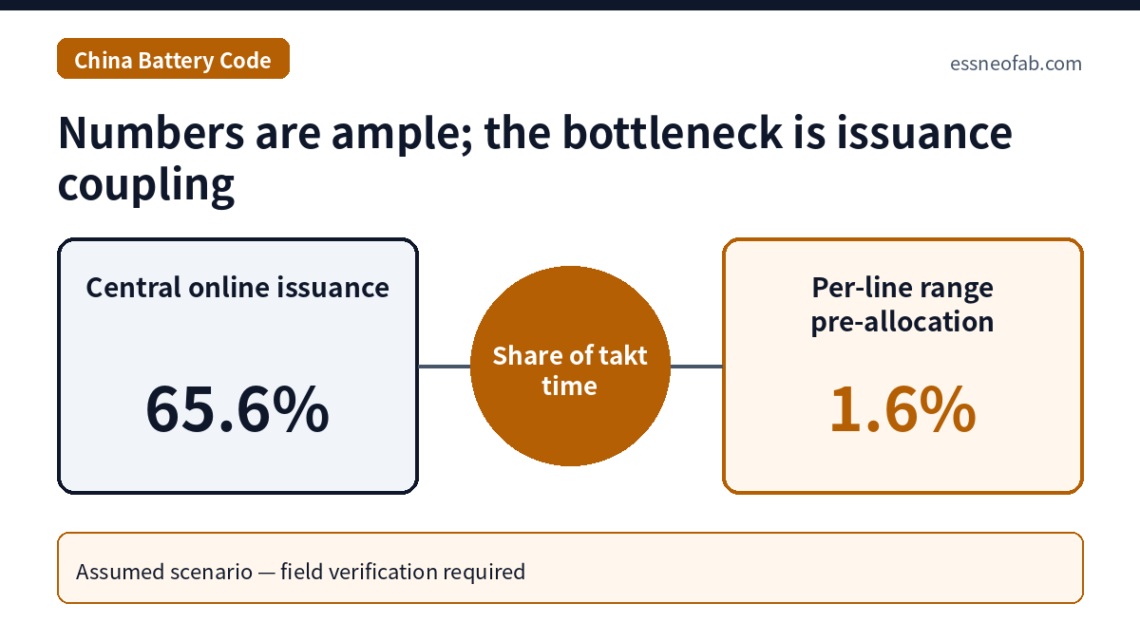
China's "Interim Measures for the Administration of Recycling and Comprehensive Utilization of Waste Power Batteries from New Energy Vehicles" (MIIT and five other departments, Order No. 73), effective 1 April 2026, made power battery coding under GB/T 34014 and labeling of cells, modules and packs an explicit mandatory provision, and in August 2026 the rollout of a "power battery digital identity card" system built on the 24-character code was made official. Because the 24-character code contains a manufacture date (3 characters) and a serial number unique within "the same specification on the same day" (7 characters), the line must fix the code on the day of production and issue, mark…
-
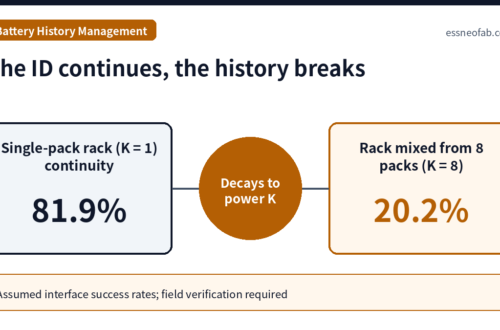
After Korea’s Battery History Management System: IDs Continue, Operating History Breaks — History Continuity of ESS Reuse Racks
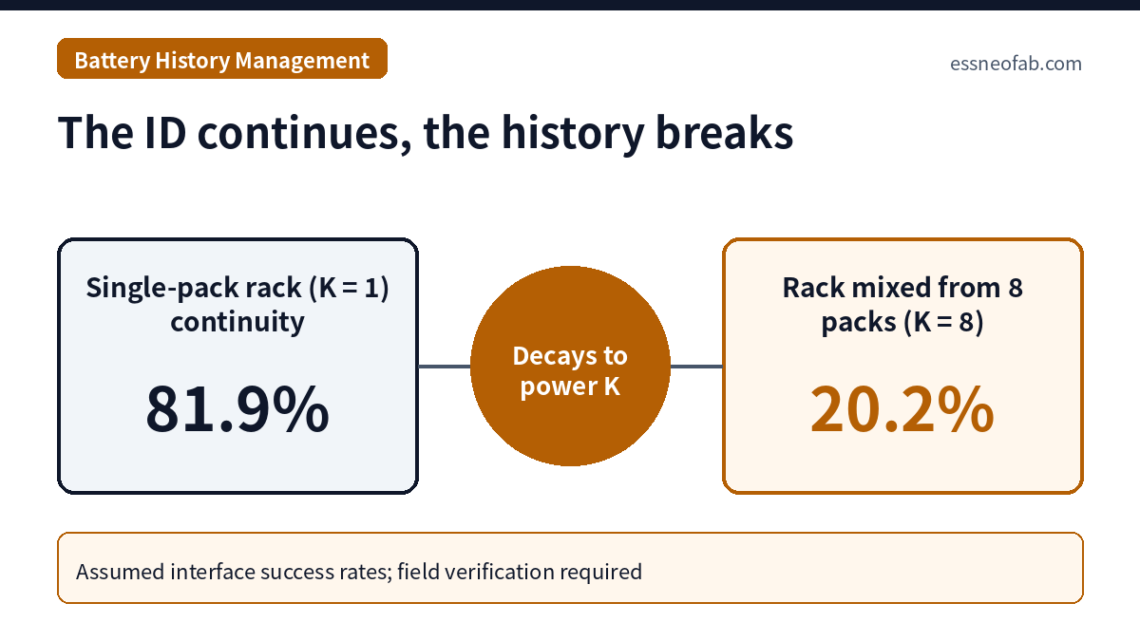
Korea's battery history management system under the amended Motor Vehicle Management Act, in force since 17 February 2025, requires the battery identification number assigned at the manufacturing stage to be registered in the vehicle registration record and tracked through operation and scrapping; the Used Battery Act promulgated in May 2026 (in force 27 May 2027) and the August 2026 agreement between the industry and climate-environment ministries on an integrated platform now extend it to later stages. Yet when assumed success rates are compounded across the six lifecycle interfaces, identification-number continuity is 91.0% while history continuity, including BMS operating data, falls to 81.9%. The larger variable lies in the reuse stage.…
You May Also Like
China’s GB/T 34014 24-Character Battery Code: How Code Structure Fixes Issuance Timing and Authority on the Line
Today’s ESS/Battery System Trends — U.S. LFP Mass Production Imminent, Megapack 3 Launched, Used-Battery Platform Integration (2026.08.11)
NFPA 855 (2026 Edition) Revision: ESS Safety Standards Expand From the Cell to the Entire System
-
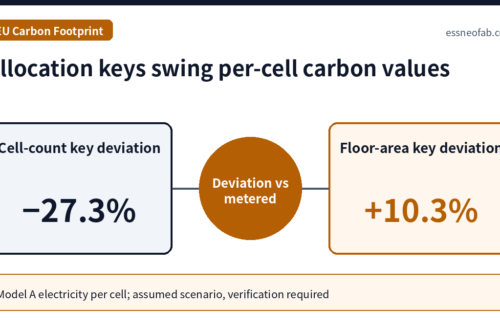
EU Battery Carbon Footprint Methodology Still Pending: How Line Energy Metering Resolution and Allocation Choice Shift Per-Cell Values
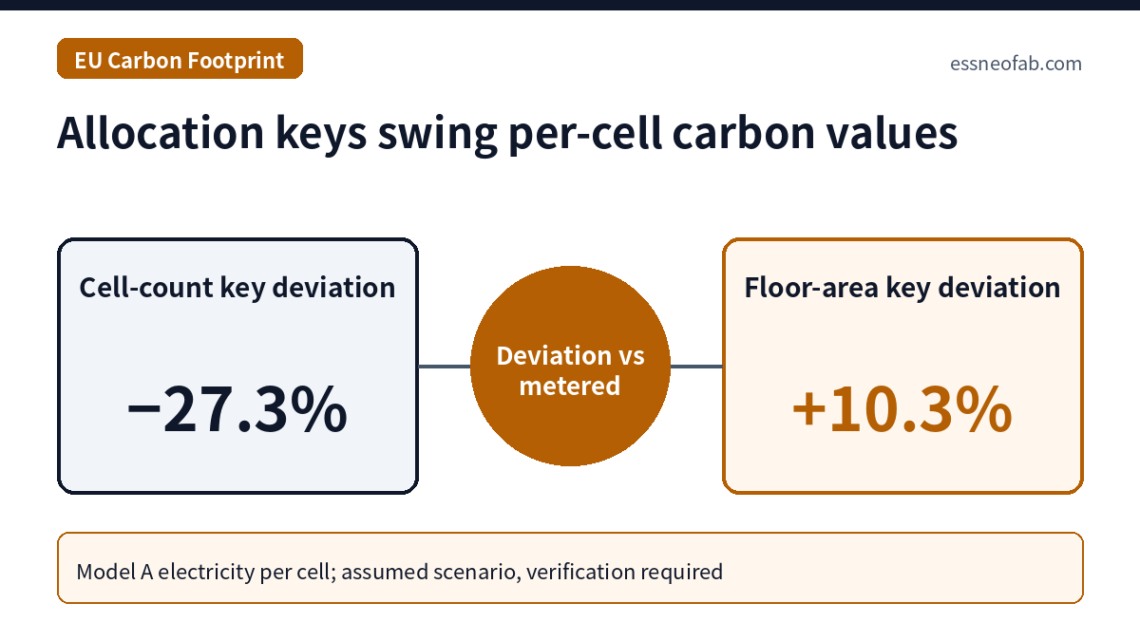
According to the EU's official consultation portal, the delegated act setting the carbon footprint calculation methodology under Article 7 of the EU Batteries Regulation (2023/1542) had not moved to the adoption stage as of 23 September 2026, and the portal still shows the planned adoption period as "Q3 2025". In an assumed 8 GWh/year plant producing two models, allocating the same 200,000,000 kWh of electricity by floor area, operating time, capacity or cell count makes the per-cell electricity of model A swing from −27.3% to +10.3% against the process-metered value of 7.860 kWh. Area-based allocation reverses the low-carbon ranking of the two models, and capacity-based allocation has the smallest total…
-
EU Battery Passport 2027: Which Station on an ESS Pack Line Commits What
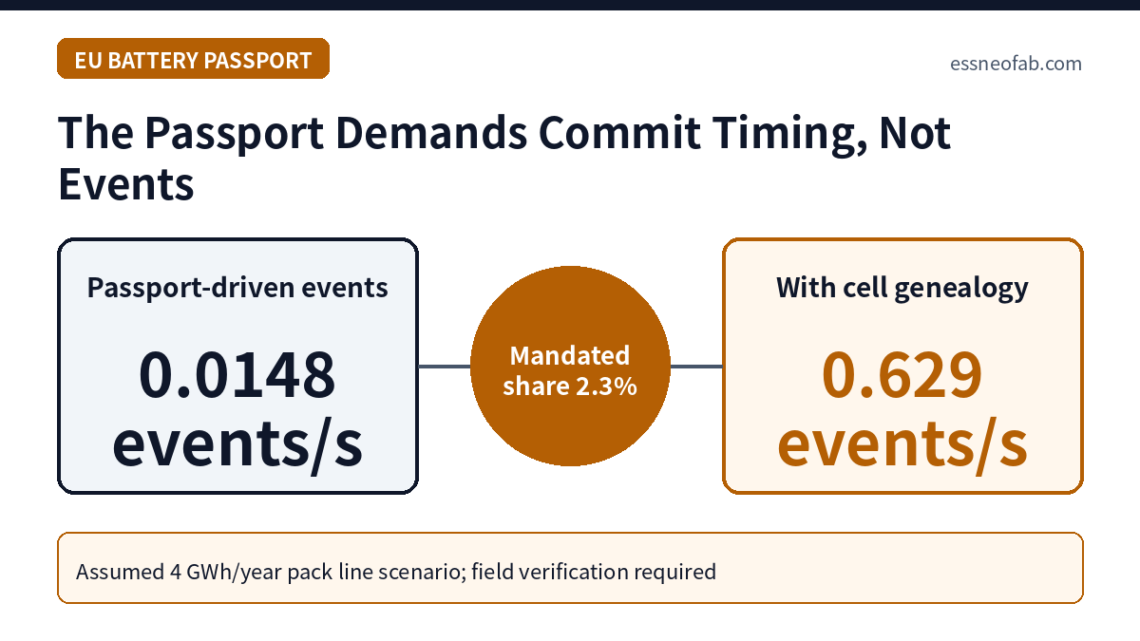
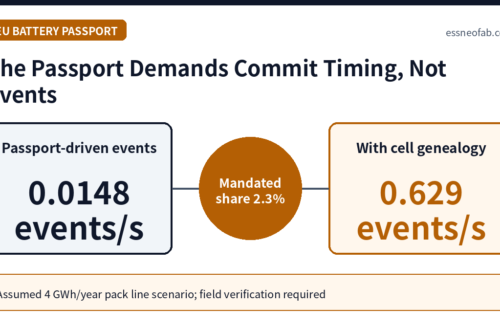
Under Article 77 of the EU Batteries Regulation (Regulation (EU) 2023/1542), industrial batteries above 2 kWh require a battery passport from 18 February 2027, and as of September 2026 no legislative proposal changing that date has been identified. Breaking down the passport data attribute list (the version aligned with DIN DKE SPEC 99100) for the stationary ESS category shows that, of 80 mandatory attributes, only 5 static attributes must be recorded on the line at individual-battery level; the remaining static attributes are fixed once at battery-model level. In an assumed scenario (4 GWh/year pack line, pack takt time 338.6 s), passport-driven line capture events amount to 5 per pack (0.0148…
You May Also Like
Converting EV Lines to ESS: What the H1 Utilization Gap Reveals About Line-Conversion Speed
LG Energy Solution’s ESS Rear-Base Positioning — What Changes in Line Management
Today’s ESS/Battery Process Trends — Expanded Support for Materials/Parts/Equipment Lines, Solid-State/LFP Pilot Lines Launch (2026.08.07)