Serial Genealogy in ESS Operation: Where Module Swaps, Refurbishment and BMS Board Replacements Break Parent-Child Links
Abstract
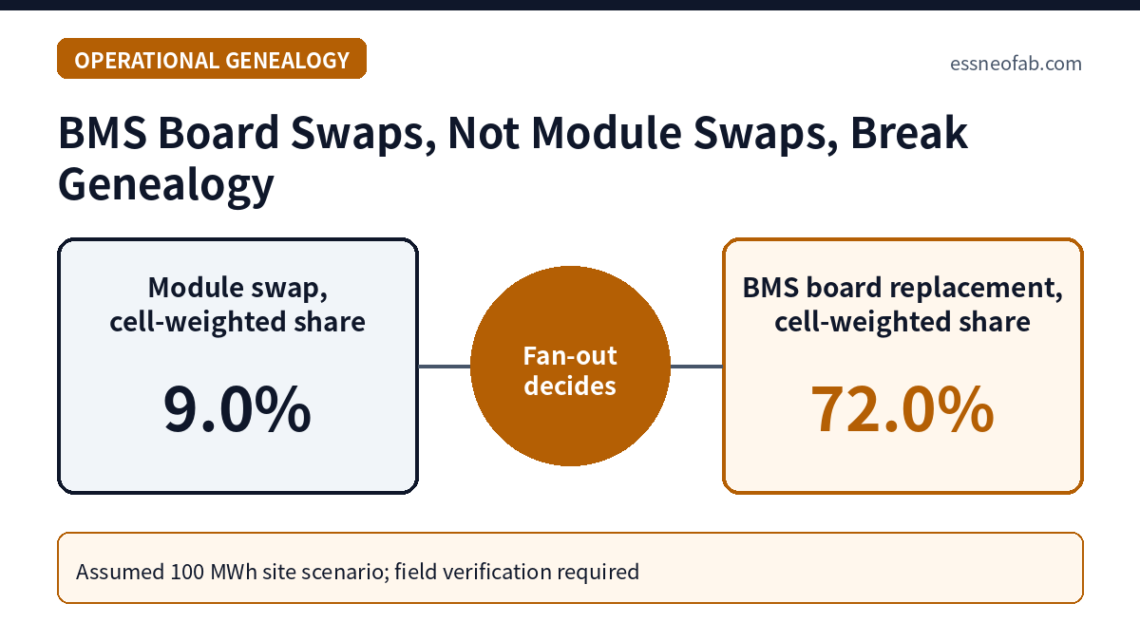
After shipment, genealogy mismatches at an ESS site accumulate less from module swaps, which are managed as genealogy events, than from BMS board (BMU/BCU) replacements, which are not recognized as genealogy events at all. Assuming annual replacement rates and record-omission rates for a 100 MWh site (99,840 cells, 1,920 modules, 240 racks), cells whose parent chain cannot be verified accumulate at 554 per year and 5,541 over 10 years (5.55% of the total), with 72.0% originating from board replacements. Module swaps account for 25.3% by event count but only 9.0% when weighted by cells. Since Article 77(7) of the EU Batteries Regulation requires repurposed and remanufactured batteries to carry a new passport linked to the original, genealogy management should be prioritized not by event count but by ‘omission rate × fan-out (number of child cells)’.
1. Conclusion First — What Breaks Genealogy Is ‘Replacement Not Recognized as Replacement’
The work that most damages serial genealogy[1] in the operating phase is not module swapping but BMS board replacement, which is classified as electronic repair unrelated to genealogy. The reason lies not in frequency but in fan-out[2]—the number of child cells rendered unverifiable by a single omission.
Situation (S): The Parent-Child relationships of cell→module→rack→container→site exist in complete form in the MES at factory shipment. Complication (C): Once in operation, genealogy ownership splits between the BMS[3] serial registry and the asset management database[4], and each field replacement or refurbishment[5] updates the two registries through different paths. Question (Q): Over 10 years of operation, how much genealogy mismatch accumulates, and where? Answer (A): In the assumed scenario, about 5.55% of all cells become unverifiable, and 72.0% of that arises from board replacements outside the control of the module-swap procedure.
The assumption this article challenges is that “genealogy is maintained as long as module-swap work orders are managed rigorously.” The calculation below shows that when only module swaps are managed as genealogy events, over 90% of cell-weighted mismatch remains outside the managed scope.
2. Mechanism — Two Registries and Four Break Points
The site analyzed is assumed as follows. With 314 Ah, 3.2 V cells, 1P52S modules (52 cells), racks of 8 modules (416 cells), containers of 12 racks (4,992 cells, about 5.0 MWh) and 20 containers per site, nominal DC capacity is about 100.3 MWh. The Parent-Child links to be maintained are shown in Table 1.
| Level (Child→Parent) | Child count | Links | Child cells per parent (fan-out) | Main record owner in operation |
|---|---|---|---|---|
| Cell → Module | 99,840 | 99,840 | 52 | MES shipment record (no field update path) |
| Module → Rack | 1,920 | 1,920 | 416 | BMS registry + asset management DB |
| Rack → Container | 240 | 240 | 4,992 | Asset management DB |
| Container → Site | 20 | 20 | 99,840 | Asset management DB |
In Table 1, 97.9% of links sit at the cell→module level, yet in the operating phase there is usually no path to update this level. Cell genealogy is maintained only indirectly through the module serial, so when the module serial and its location information waver, the genealogy of its 52 child cells wavers with it.
The BMS registry is keyed on electronically readable identifiers—the hardware IDs and slot addresses of BMU[6] and BCU[7] boards. The asset management DB, by contrast, is keyed on the label serial on the module housing. The two registries agree only while the binding between the two keys is maintained, and breaks occur at the following four points.
- Module swap: The BMS automatically recognizes the new board, but the module→rack link in the asset management DB depends on manual work-order entry.
- BMU board replacement: The module stays, but the BMS key changes. If rebinding is omitted, the BMS treats the slot as a different module or leaves the serial blank.
- BCU replacement / recommissioning: Rack-level address reassignment makes the bindings of 8 modules subject to re-verification at once.
- Refurbished module re-entry: Even if cells are replaced at the service depot, the module label serial is retained, so an unreported cell→module link change creates a mismatch that looks normal.
3. Calculation — Mismatch Accumulates by Fan-out, Not by Count
For each break point, an annual occurrence rate and record-omission rate are assumed, and multiplied by the number of cells a single omission renders unverifiable (fan-out) to obtain unverifiable cells per year. Annual occurrence rates are set at 0.5% for module swaps, 1.0% for BMU replacement, 1.0% for BCU replacement, and a 70% refurbishment re-entry ratio for swapped modules.
| Break cause | Annual occurrences | Omission rate (assumed) | Mismatched links (per year) | Fan-out (cells) | Unverifiable cells (per year) | Share by event count | Share by cell weight |
|---|---|---|---|---|---|---|---|
| Module swap | 9.6 | 10% | 0.96 | 52 | 49.9 | 25.3% | 9.0% |
| BMU board replacement | 19.2 | 20% | 3.84 | 52 | 199.7 | 50.6% | 36.0% |
| BCU replacement / recommissioning | 2.4 | 20% | 0.48 | 416 | 199.7 | 6.3% | 36.0% |
| Refurbished module re-entry | 6.72 | 30% | 2.02 | 52 | 104.8 | 17.7% | 18.9% |
| Total | 37.92 | — | 7.30 | — | 554.1 | 100% | 100% |
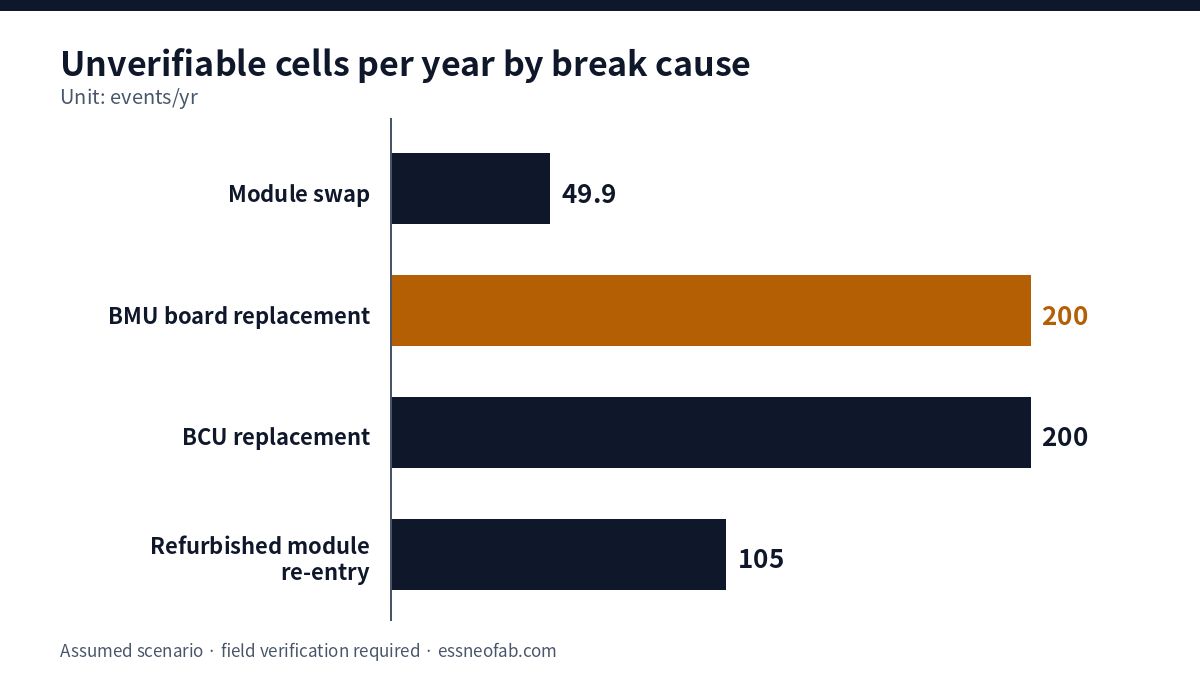
The comparison baseline in Table 2 is the module swap. By event count, module swaps account for a non-negligible 25.3%, but their cell-weighted share falls to 9.0%. Conversely, BCU replacement accounts for only 6.3% of events, but its 416-cell fan-out lifts its cell-weighted share to 36.0%. There are two implications. Managing only module swaps as genealogy events leaves 91.0% of cell-weighted mismatch unmanaged, and ranking priorities by count pushes BCU replacement, tied for first by cell weight, to last place.
In cumulative terms, 10 years of operation without reconciliation yields 5,541 unverifiable cells, 5.55% of all 99,840. Assuming an annual full comparison of the BMS registry and asset management DB resolves 90% of that year’s mismatch, the residual at the end of year 10 (before that year’s reconciliation) falls to about 616 (0.62%). The only controlled variable is reconciliation frequency, yet the residual shrinks to about one-ninth.
4. Regulatory Context and Limits of Application
Article 77(1) of the EU Batteries Regulation (Regulation (EU) 2023/1542) requires, as of September 2026, a battery passport[8] for industrial batteries with a capacity above 2 kWh from 18 February 2027, and Article 77(3) links the passport to a unique identifier complying with the ISO/IEC 15459 series. Article 77(7) provides that a battery subject to preparation for re-use, repurposing or remanufacturing shall have a new passport linked to the passport of the original battery. The Article 77(9) implementing act on access rights missed its 18 August 2026 deadline, but the 18 February 2027 application date itself has been reported as unchanged.
BMS-side provisions also touch genealogy. Article 14(1) requires, from 18 August 2024, that the BMS of stationary battery energy storage systems contain up-to-date data for the parameters determining state of health (SoH) and expected lifetime, and Article 14(3) requires a software reset function so that repurposing and remanufacturing operators can upload different BMS software. If the serial registry and SoH history are initialized per board during a reset, a break of the same type as the BMU/BCU replacements in Table 2 could occur all at once. Whether a site module constitutes a “battery” subject to an individual passport under the regulation requires separate review.
This differs in kind from the cell inbound interface and cell ID event rate. That article addressed event load proportional to cell count inside the factory before shipment, whereas this one addresses the accumulation of mismatch after shipment, once genealogy ownership splits between the BMS and the asset management DB. All figures in this article depend linearly on the assumed occurrence and omission rates, so further verification against one’s own maintenance records is required.
5. Conclusions and Implications
The deciding variable for genealogy integrity in operation is not replacement count but the product of omission rate and fan-out. In the assumed scenario, BMS board replacements produced 72.0% of cell-weighted mismatch with a 56.9% share of events, while module swaps accounted for 25.3% of events and only 9.0% by cell weight.
Genealogy procedures should therefore extend their scope from “module-swap work orders” to “every task that changes a BMS key.” At the same time, an annual full reconciliation alone reduces 10-year cumulative mismatch to about one-ninth, so making reconciliation frequency a formal item in the maintenance plan is the most cost-effective measure.
FAQ
Q. Is it necessary to maintain cell-level genealogy in the operating phase? Isn’t module level enough?
A. Module level may be sufficient for daily operation. However, cell recalls, safety incident investigations and repurposing require tracing which module and rack contain cells from a specific manufacturing lot, and if the cell→module link is unverifiable, the investigation scope widens from one module to the entire rack. The required level depends on the site’s recall-response requirements and regulatory interpretation, so separate review is required.
Q. If the BMS can read the module serial electronically, isn’t the problem solved?
A. A large part of module-swap and BMU-replacement breaks would be resolved. But where the BMU is replaced separately from the module housing, the key question is whether the serial is stored on the board or in the module body, and cell→module changes from refurbishment cell replacement remain invisible to the BMS. Electronic reading is a means of lowering omission rates, not of eliminating the fan-out structure.
Field Application Notes
Items that can be executed first thing Monday morning.
| Check | How to execute | Remarks |
|---|---|---|
| ☐ List tasks that change BMS keys | From the last year of maintenance records, extract BMU/BCU replacements, firmware updates and recommissioning separately from module swaps | Targets tasks not registered as “genealogy events” |
| ☐ Sample registry comparison | Pick one rack and three-way compare BMS registry slot-module serials, the asset management DB and module housing labels | Compare the mismatch rate with the omission rates assumed here |
| ☐ Build a fan-out-weighted priority table | Sort break causes by (occurrences × omission rate × fan-out) and reselect management targets | Use the Table 2 format as is |
| ☐ Add refurbishment receiving conditions | Require modules returning from the service depot to include cell replacement details (including replaced cell serials) as a receiving condition | Whether this constitutes remanufacturing requires separate review |
| ☐ Add annual full reconciliation | Add a full BMS registry vs. asset management DB comparison to the periodic maintenance plan | Reduces 10-year accumulation to about one-ninth under this article’s assumptions |
Footnotes
[1] Genealogy (Parent-Child): A record of which parent assembly serial each child component serial belongs to.
[2] Fan-out: The number of child cells dependent on one parent identifier; it determines the impact scope of a single omission.
[3] BMS (Battery Management System): A system that monitors cell, module and rack voltage and temperature and performs protection and state estimation.
[4] Asset Management Database: The operational database that manages installation location, maintenance history and serials of site equipment (EAM, CMMS, etc.).
[5] Refurbishment: Replacing defective cells or parts in a recovered module and returning it as a spare. Its boundary with remanufacturing under the regulation requires separate review.
[6] BMU (Battery Management Unit): A lower-level BMS board measuring module-level cell voltage and temperature.
[7] BCU (Battery Control Unit): An upper-level BMS board aggregating and controlling BMUs at rack level.
[8] Battery Passport: The electronic record of an individual battery under Article 77 of the EU Batteries Regulation.
Sources: Regulation (EU) 2023/1542, consolidated version (2025-07-31), Articles 14 and 77, https://eur-lex.europa.eu/eli/reg/2023/1542/oj/eng (text checked at: https://faolex.fao.org/docs/pdf/eur223915.pdf) · “Battery passport access rights: the Article 77(9) implementing act missed its 18 August 2026 deadline”, eudigitalproductpassport.org (2026-09-08), https://eudigitalproductpassport.org/updates/battery-passport-access-rights-implementing-act-delay
Measurement & Calculation Conditions: 314 Ah and 3.2 V cells, 52 cells per module, 8 modules per rack, 12 racks per container, 20 containers per site (nominal DC about 100.3 MWh), annual occurrence rates (module swap 0.5%, BMU 1.0%, BCU 1.0%, refurbishment re-entry 70%), omission rates (10%, 20%, 20%, 30%) and 90% resolution with annual reconciliation are all assumed values. Mismatch accumulation is a simple sum under no reconciliation, and results vary with the site’s maintenance system, BMS architecture and recording procedures, so field verification is required.