본문으로 바로가기
Ess-neofab

A line- and system-level record of ESS and secondary-battery manufacturing processes

  • 한국어
  • English
  • Home
  • Process
  • System
  • Interface
  • Traceability
  • News & Trends
  • About
  • Contact
  • 한국어
  • English
  • Home
  • Process
  • System
  • Interface
  • Traceability
  • News & Trends
  • About
  • Contact

카테고리

  • Interface (28)
  • News & Trends (20)
  • Process (32)
  • System (31)
  • Traceability (22)

최근 글

  • Five million ACC cells equal 2.7 to 3.6 months of nameplate outputOctober 15, 2026
  • A 160 MW battery’s six-week commissioning has two baselinesOctober 8, 2026
  • Two Cycles a Day Take 106.8 % of a Day, and the Retention Tier Shifts Cell Volume by 1.47 GWhOctober 1, 2026
  • Battwoo’s Second-Life EV Batteries — When an 80 % Acceptance Threshold Overlaps the Retirement Distribution, Incoming Screening Becomes the BottleneckSeptember 30, 2026
  • US storage set an energy record in Q2 as installed power fell 7%September 29, 2026
  • CATL Starts Trial Production in Debrecen — The Digits of the Defect-Rate Target, Not the Equipment, Set the Length of a Trial RunSeptember 29, 2026
  • BMS Board Swaps, Not Module Swaps, Break Genealogy
    System,  Traceability

    Serial Genealogy in ESS Operation: Where Module Swaps, Refurbishment and BMS Board Replacements Break Parent-Child Links

    July 6, 2026 /

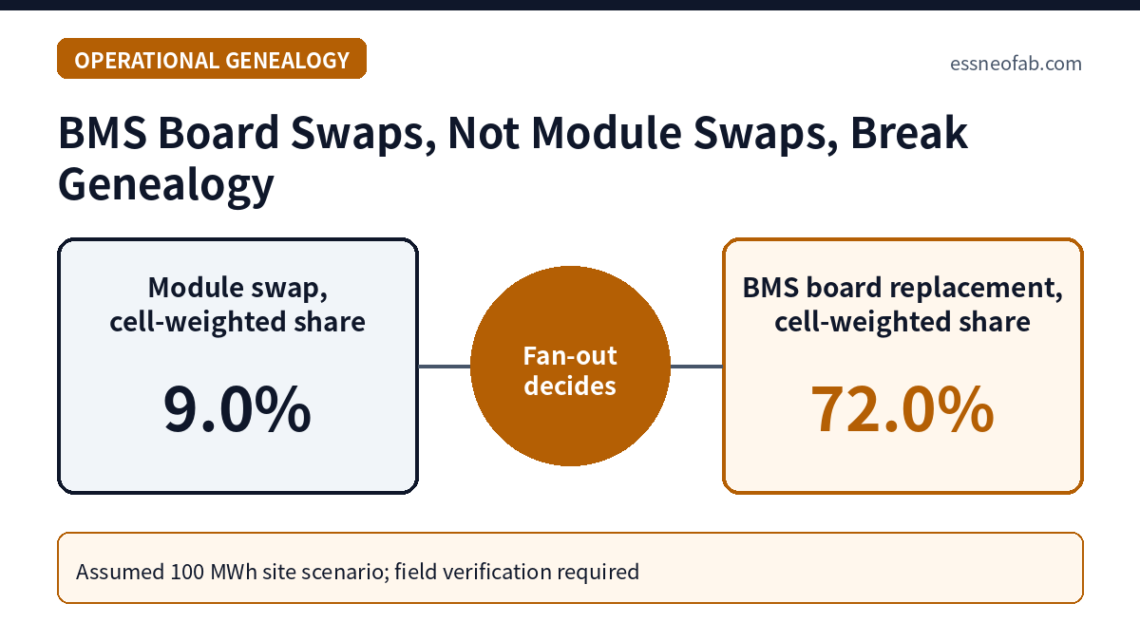
    After shipment, genealogy mismatches at an ESS site accumulate less from module swaps, which are managed as genealogy events, than from BMS board (BMU/BCU) replacements, which are not recognized as genealogy events at all. Assuming annual replacement rates and record-omission rates for a 100 MWh site (99,840 cells, 1,920 modules, 240 racks), cells whose parent chain cannot be verified accumulate at 554 per year and 5,541 over 10 years (5.55% of the total), with 72.0% originating from board replacements. Module swaps account for 25.3% by event count but only 9.0% when weighted by cells. Since Article 77(7) of the EU Batteries Regulation requires repurposed and remanufactured batteries to carry a…
    read more
    ESS-neofab Comments Off on Serial Genealogy in ESS Operation: Where Module Swaps, Refurbishment and BMS Board Replacements Break Parent-Child Links

    You May Also Like

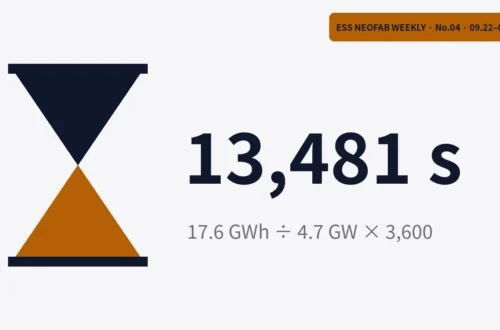
    Hourglass graphic with the Q2 2026 US utility-scale storage duration of 13,481 s and its formula

    US storage set an energy record in Q2 as installed power fell 7%

    September 29, 2026
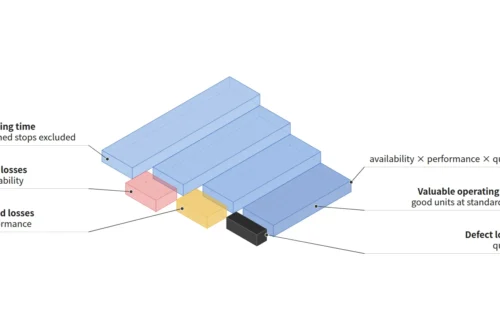
    Isometric concept of translucent blocks stepping down from loading time through stop, speed and defect losses to valuable operating time

    If Availability, Performance and Quality Are All 80 %, OEE Is 51.2 % — How to Calculate OEE

    September 25, 2026
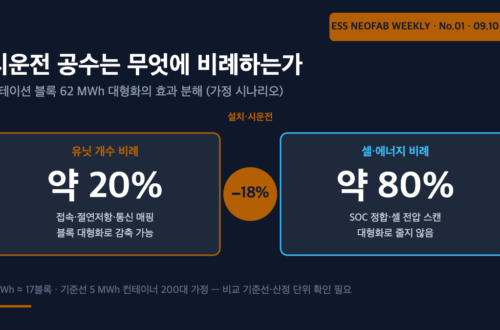
    스테이션 블록 대형화 시 현장 시운전 공수를 유닛 개수 비례 약 20%와 셀·에너지 비례 약 80%로 분해한 비교 도식

    When the Station Block Grows to 62 MWh, What Actually Shrinks Is Commissioning Labor, Not Cell Count

    September 17, 2026
© 2026 Ess-neofab · A line- and system-level record of ESS and secondary-battery manufacturing processes
  • About
  • Contact
  • Privacy Policy
  • Disclaimer
Ashe Theme by WP Royal.