본문으로 바로가기
Ess-neofab

A line- and system-level record of ESS and secondary-battery manufacturing processes

  • 한국어
  • English
  • Home
  • Process
  • System
  • Interface
  • Traceability
  • News & Trends
  • About
  • Contact
  • 한국어
  • English
  • Home
  • Process
  • System
  • Interface
  • Traceability
  • News & Trends
  • About
  • Contact

카테고리

  • Interface (28)
  • News & Trends (20)
  • Process (32)
  • System (31)
  • Traceability (22)

최근 글

  • Five million ACC cells equal 2.7 to 3.6 months of nameplate outputOctober 15, 2026
  • A 160 MW battery’s six-week commissioning has two baselinesOctober 8, 2026
  • Two Cycles a Day Take 106.8 % of a Day, and the Retention Tier Shifts Cell Volume by 1.47 GWhOctober 1, 2026
  • Battwoo’s Second-Life EV Batteries — When an 80 % Acceptance Threshold Overlaps the Retirement Distribution, Incoming Screening Becomes the BottleneckSeptember 30, 2026
  • US storage set an energy record in Q2 as installed power fell 7%September 29, 2026
  • CATL Starts Trial Production in Debrecen — The Digits of the Defect-Rate Target, Not the Equipment, Set the Length of a Trial RunSeptember 29, 2026
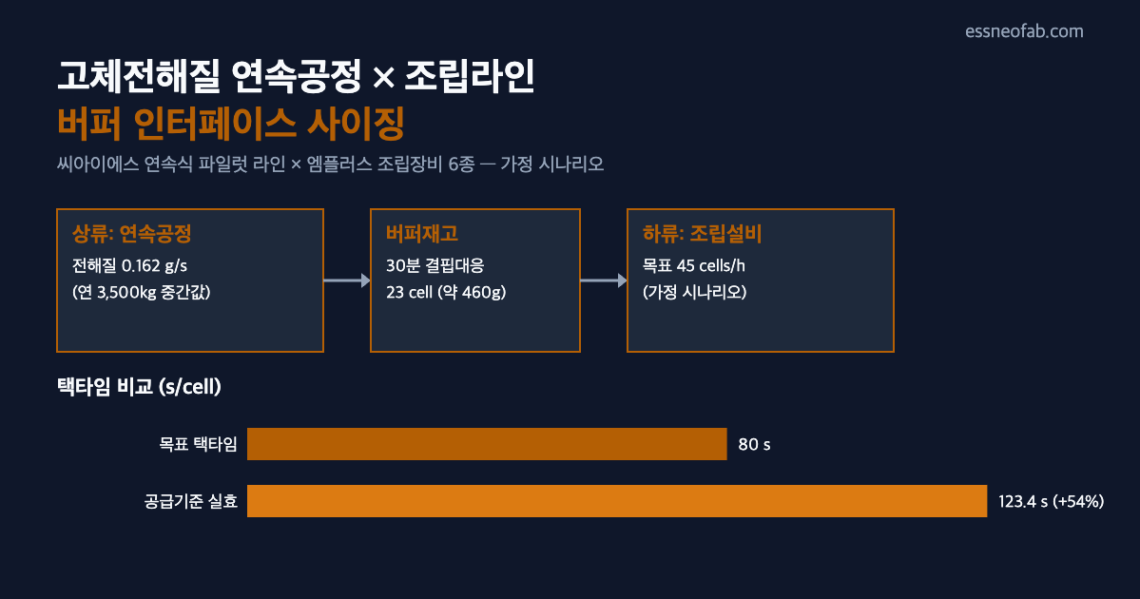
  • 고체전해질 연속공정과 조립라인 사이 버퍼재고 인터페이스 다이어그램
    Interface,  Process

    Between the Continuous Solid-Electrolyte Process and the Assembly Line: How Should the Buffer Interface Be Designed?

    August 31, 2026 /

    CIS's continuous-process pilot line for sulfide-based solid electrolyte at its Daegu Plant 3 (2–5 t/year, expanded from the existing batch process's 840 kg) and M Plus's order for six types of all-solid-state battery assembly equipment (targeting development/fabrication completion by end-2026) reveal a textbook interface problem: the production capacities of the upstream materials process and the downstream assembly process are not scaled up on the same timeline. This article estimates, as an assumed scenario, the buffer stock and takt-time loss required between these two processes, to quantitatively pin down why the materials-assembly interface design is a leading variable for the line's overall OEE (Overall Equipment Effectiveness). The downstream assembly equipment's target…
    read more
    ESS-neofab 1 Comment

    You May Also Like

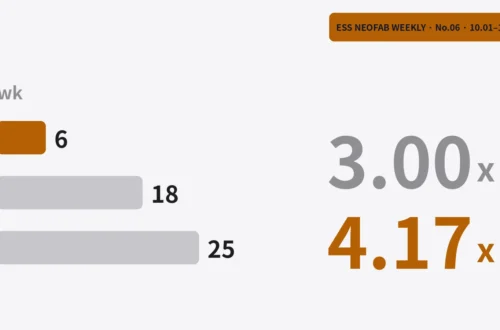
    Two baselines on a six-week commissioning: 3.00x against 18 weeks, 4.17x against 25 weeks

    A 160 MW battery’s six-week commissioning has two baselines

    October 8, 2026
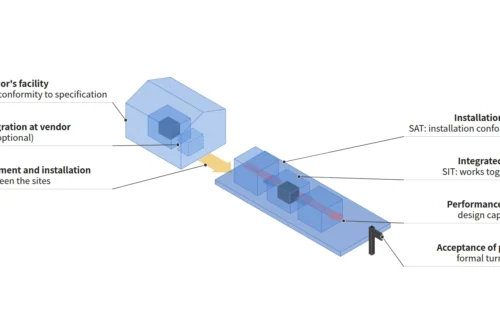
    Isometric concept linking FAT and FIT at the vendor's facility with SAT, SIT, the performance test and acceptance of plant on site

    FAT and SAT Differ in More Than Location — How IEC 62381:2024 Defines the Tests

    September 25, 2026
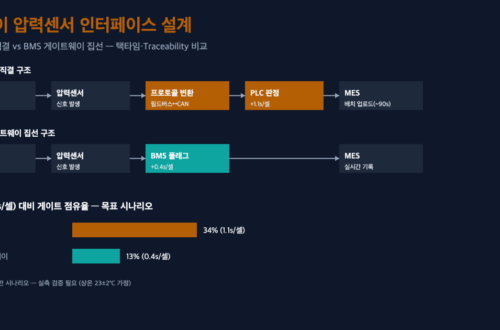
    46파이 원통형 셀 압력센서 데이터가 라인 PLC 직결과 BMS 게이트웨이 집선 중 어느 경로로 흐르는지 비교하는 다이어그램. 택타임 대비 게이트 점유율 34%와 13% 비교 막대그래프 포함

    46-Phi Cylindrical Cell Line Conversion: The Pressure-Sensor–BMS Interface Determines Takt Time

    August 26, 2026
© 2026 Ess-neofab · A line- and system-level record of ESS and secondary-battery manufacturing processes
  • About
  • Contact
  • Privacy Policy
  • Disclaimer
Ashe Theme by WP Royal.