Solid Electrolyte and Aqueous Zinc Batteries: Investment Is Up — Is the Line Ready?
In August 2026, two domestic battery-material startups raised large investment rounds in quick succession. A solid-electrolyte specialist secured KRW 23.0 billion in a Series C round, and an aqueous zinc-ion battery company secured KRW 22.0 billion in a Series A round. Both companies handle materials whose process conditions differ from the conventional lithium-ion system, so from a shop-floor standpoint, the more important question is not the investment news itself but “what changes once this material actually reaches a mass-production line.”
Key Points at a Glance
| Category | Solid Electrolyte | Aqueous Zinc-Ion Battery |
|---|---|---|
| Funding round | Series C | Series A |
| Funding amount | KRW 23.0 billion | KRW 22.0 billion |
| Difference from conventional lithium-ion | The liquid-electrolyte impregnation process itself disappears or shrinks | Uses an aqueous electrolyte instead of an organic electrolyte |
| Key line-level issue | Growing share of bonding/pressing processes; interfacial-resistance management | Room to ease explosion-proof/drying equipment burden, but separate corrosion/moisture management needed |
From a Line/System Perspective
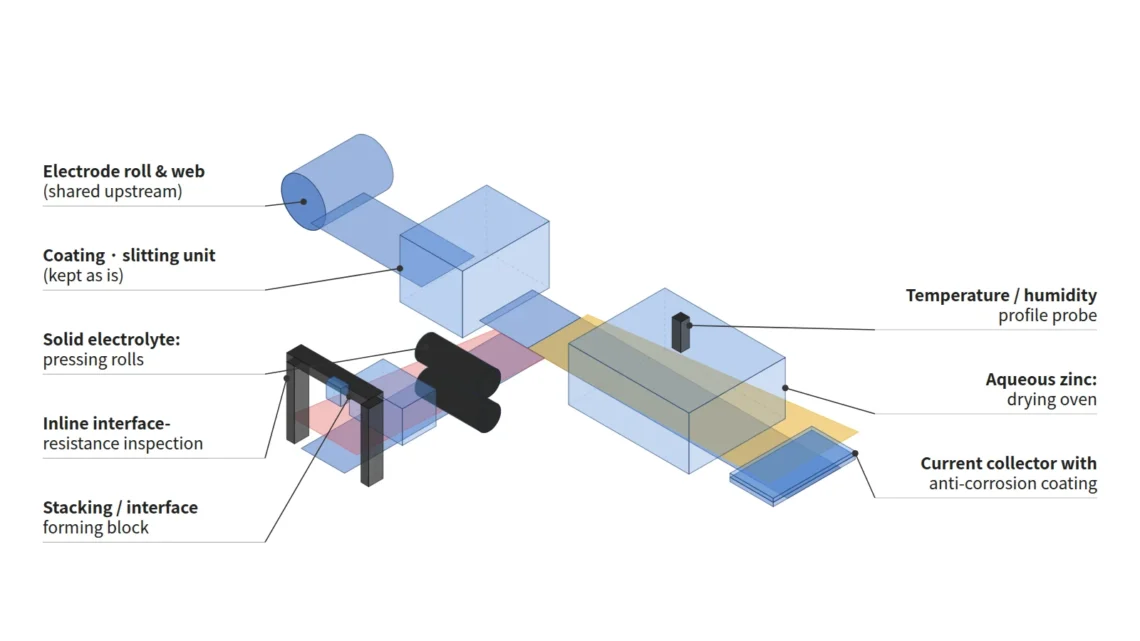
As solid-electrolyte adoption grows, the center of gravity shifts within the existing coating/drying line. As the liquid-electrolyte impregnation and formation section shrinks, precision requirements rise for the pressing/lamination processes that form the electrode–electrolyte interface. In other words, the problem shifts from “lengthening the drying oven” to “how to manage pressing-pressure uniformity and interfacial contact.”
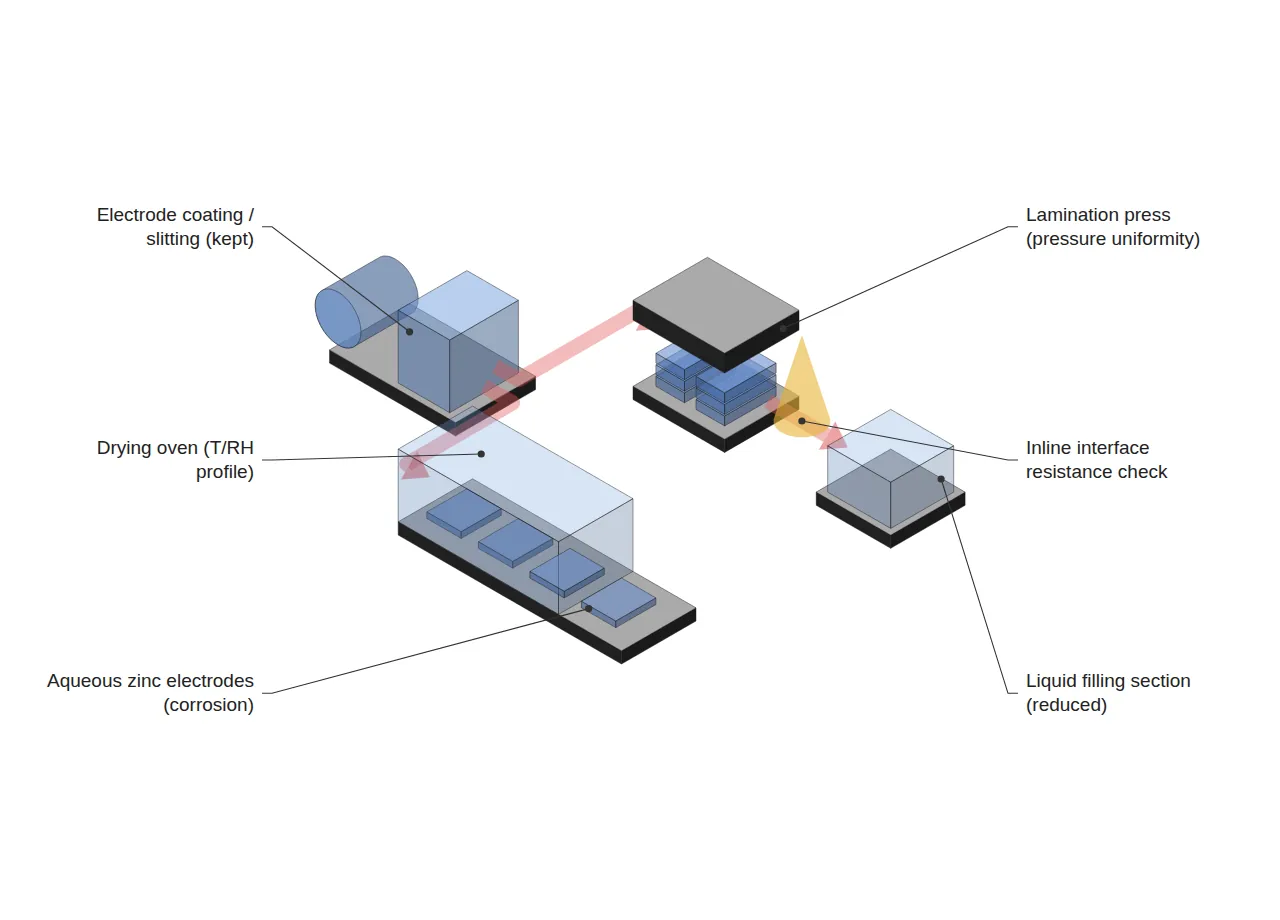
Because aqueous zinc-ion batteries do not use an organic electrolyte, there is room to relax explosion-proof and ventilation-grade requirements. However, given the characteristics of an aqueous system, corrosion management for the electrode plates and current collectors, along with drying conditions (over-drying degrades performance), become new management points. It would be premature to lower explosion-proof specifications early in line design based solely on the assumption that “the liquid is water, so it’s safe.”
Checkpoints
- When reviewing a solid-electrolyte line: pressure-uniformity specification for the pressing unit, and the inline inspection location for measuring interfacial resistance
- When reviewing an aqueous zinc-ion battery line: whether the drying-oven temperature/humidity profile needs to be redesigned, and the corrosion-prevention coating specification for the current collector
FAQ
Q. If solid electrolytes are commercialized, will existing coating and slitting lines become unusable?
A. In many cases, the electrode coating and slitting processes themselves remain usable. However, since the share and method of the downstream processes (electrolyte impregnation, formation) change, redesigning the downstream section is a more realistic approach than building an entirely new line.
Q. Is safety management really easier with aqueous batteries?
A. Fire risk tends to be lower, but this should be viewed alongside a different kind of management burden — corrosion and moisture control.
Field Application Notes
Investment news for material startups can generally be viewed as a leading indicator that tends to translate into pilot-line orders two to three years later. For a line-design organization, setting a wider variance range now for pressing-unit and drying-oven specifications is a way to reduce the cost of responding to future specification changes.
Related Reading
- Between the Continuous Solid-Electrolyte Process and the Assembly Line: How Should the Buffer Interface Be Designed?
- Dry Electrode: Where Does the Line Bottleneck Move?
- LFP High-Compaction-Density Conversion and the Calendering Interface: How Nip Pressure and Line Speed Affect Takt Time


You May Also Like
LG Energy Solution’s ESS Rear-Base Positioning — What Changes in Line Management
Dry Electrode: Where Does the Line Bottleneck Move?