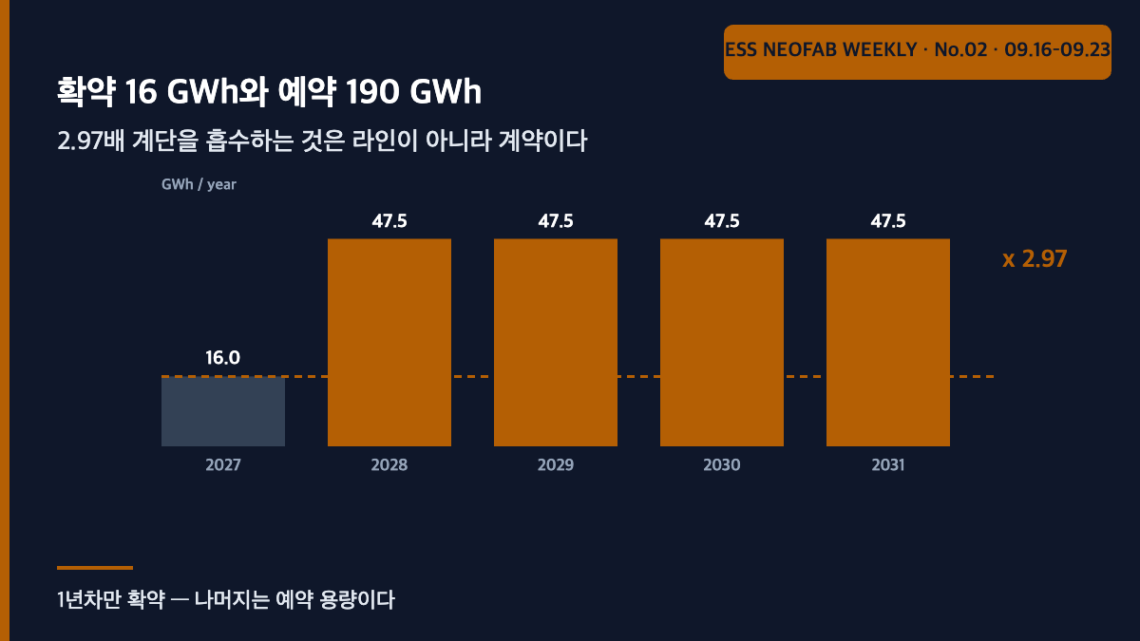
16 GWh committed and 190 GWh reserved — what absorbs the 2.97x step is the contract, not the line
Abstract
On 17 September 2026 Hubei EVE Power, a subsidiary of EVE Energy, disclosed a framework agreement with Fluence covering up to 206 GWh of battery supply from 2027 to 2031. What stands out is not the total but the way it is split — only the 16 GWh for 2027 is a committed volume; the remaining 190 GWh is reserved capacity. Converting to line count under an assumed scenario produces a 2.97× step, from three lines in year one to eight in year two — five additional lines within a single year — yet backing that out against order-to-production lead time shows the step was already 2.6 months late at the date of disclosure. The conclusion is simple: what absorbs this step is not the line but the contractual wording “reserved capacity” itself, and the only number that actually binds line planning is 16 GWh.
1. The conclusion first — 206 GWh is not a production planning number
Situation. Long-term, high-volume supply agreements for ESS cells keep arriving. This one is among the largest: up to 206 GWh over five years¹.
Complication. In equipment and line planning practice such a number is immediately read as “41.2 GWh per year × five years”, and at that moment the required line count and order schedule follow automatically. But the disclosure did not distribute the total evenly. It split the wording: the 16 GWh of year one is committed, while the remaining 190 GWh is reserved capacity².
Question. What does that difference in wording actually change for line planning?
Answer. Everything. Read as an even distribution, the line plan works; read as the disclosed step, it yields a schedule that is already physically late. The only interpretation that resolves that contradiction is that the 190 GWh is an option rather than a production promise. “Reserved capacity” is thus not a convenience for the demand side but a buffer absorbing a lead-time mismatch on the supply side.
2. Contract structure — look at the step, not the total
| Item | 2027 | 2028–2031 (4 years) | Total |
|---|---|---|---|
| Contractual wording | committed | reserved capacity | framework |
| Volume | 16 GWh | 190 GWh | 206 GWh |
| Annual average | 16.0 GWh/yr | 47.5 GWh/yr | 41.2 GWh/yr |
| Versus even five-year split | 38.8 % | 115.3 % | 100 % |
| Step ratio | 47.5 ÷ 16.0 = 2.97× | — | |
What to read in Table 1 is the 2.97. Production capacity has to jump nearly threefold between year one and year two. Looking only at the 206 GWh total conceals this step completely.
3. Converting to lines — five within a year
Set up an assumed scenario. The values below are arbitrary and must be replaced with actual figures and recalculated.
- Capacity of one large prismatic ESS cell line: 6 GWh/yr (assumed)
- Order → mass production lead time: 18 months = equipment build 10 + installation and commissioning 4 + production qualification 4 (assumed)
| Year | Required volume | Theoretical lines | Actual lines required | Added versus prior year |
|---|---|---|---|---|
| 2027 | 16.0 GWh | 2.67 | 3 | — |
| 2028–2031 | 47.5 GWh/yr | 7.92 | 8 | +5 |
The meaningful difference here is not “three versus eight” but the time constraint of “five within one year”. The line count itself is a question of capital; the one-year window is a question of lead time.
4. Backing out the lead time — already 2.6 months late at disclosure
| Target production start | Lines needed | Order deadline backed out at 18 months | Actual disclosure date | Verdict |
|---|---|---|---|---|
| 2027-01-01 | 3 | 2025-07-01 | 2026-09-17 | Already passed — impossible without line conversion or an early start |
| 2028-01-01 | 8 (+5) | 2026-07-01 | about 2.6 months over |
There are only three ways to resolve the contradiction Table 3 creates.
- Expansion was already under way before the agreement. If negotiations preceded the framework disclosure and orders were placed ahead of it, the deadline problem disappears. The original text notes the agreement follows “earlier cooperation between the companies”², which makes this plausible, but whether orders were placed in advance is not disclosed.
- Existing lines are being converted to ESS. Conversion rather than new build has a far shorter lead time than 18 months, though conversion carries its own loss interval.
- The 190 GWh is not committed, so drawdown can slip. This is the reading the contract wording supports directly.
Which of the three is true cannot be determined from public material. What matters, however, is that all three converge on the same conclusion — volumes after 2028 do not bind line planning. Under (1) the lines already stand so the contract does not bind; under (2) conversion headroom is the buffer; under (3) the contract itself is the buffer. The only number a line planner should accept from this disclosure as a fixed input is 16 GWh.
5. “Reserved capacity” is a buffer in time, not in inventory
When designing buffers between processes we are used to thinking in volume (WIP). The buffer this contract exhibits is not volume but the timing of obligation. A commitment is an obligation with a fixed date; a reservation is a right with an open date. The gap between them absorbs the lead-time mismatch.
This view changes the format of the line planning document. When a long-term supply agreement is taken as an input, the columns should not be “year / volume” but “year / volume / binding force / drawdown notice deadline”. Without the last column an expansion schedule cannot be built. In this case the drawdown notice deadline is undisclosed, and whether any drawdown obligation or penalty clause attaches to the 190 GWh of reserved capacity is unknown — this is where the article stops, and further verification is required.
The layer differs from the earlier piece on marginal capacity gain across the three OEE levers under an approval freeze. That article decomposed, through OEE factors, how much headroom exists inside existing lines when new equipment cannot be installed. This one examines how time becomes the constraint when building new lines is permitted. In practice the two calculations come in sequence — first how far existing lines go, then by when the remainder can be built.
FAQ
Q1. Isn’t 6 GWh/yr per line too small? Modern large lines are bigger than that.
A fair point. At 10 GWh/yr per line, 2027 becomes 1.6 → 2 lines and 2028 becomes 4.75 → 5 lines, so +3, and the burden eases. But the 2.97× step ratio is unchanged, because the volume ratio does not depend on how line scale is set. This article’s conclusion is therefore insensitive to the line capacity assumption and sensitive only to the lead time assumption. The verdict in Table 3 flips when lead time is 15 months or less.
Q2. Committing only year one in a framework agreement is common — does it need a special reading?
It is common. The claim here is not “this is unusual” but “it is a common structure that nonetheless gets converted into a total in line planning.” The figure 206 GWh is repeated in coverage and internal reporting; the figure 16 GWh is almost never cited. An equipment investment review that takes the former as its input over-plans by 2.58×; one that takes the latter is correct. The problem is less that the conventional reading is wrong than that it is compressed into a total in transmission.
Q3. So can the 190 GWh be ignored?
Ignoring it errs in the opposite direction. Reserved capacity may be drawn down, so equipment planning should treat it as an option-response design rather than a fixed plan — secure site, utilities and incoming power for eight lines while placing equipment orders against the committed volume. Splitting the timing of capital expenditure in this way simply mirrors the contract structure itself.
Field application notes
Only items that can be started on Monday morning are listed.
| # | Action | Output | Effort |
|---|---|---|---|
| 1 | Re-tabulate every live long-term supply agreement in four columns: “year / volume / binding force / drawdown notice deadline”. Discard tables that carry the total only. | 1 contract input table | 1 day |
| 2 | Extract committed volumes only from item 1 and recompute the required line count. The gap against the existing plan is the over-investment risk band. | Line count comparison | 0.5 day |
| 3 | Pull your own order → mass production lead time record from the two or three most recent cell lines, split three ways (equipment build / installation and commissioning / production qualification). The verdict in Table 3 is sensitive to this value alone. | 3-way lead time record | 1 day |
| 4 | Using items 2 and 3, back out the order deadline by year and fix it in the calendar. For deadlines already passed, decide which of conversion, early order, or deferred drawdown will cover it. | Order deadline calendar | 0.5 day |
| 5 | Split capital expenditure into two tiers — site, utilities and incoming power on the reserved volume, equipment orders on the committed volume. | Two-tier CAPEX plan | 1 day |
Sources and measurement conditions
① EVE Energy filing with the Shenzhen Stock Exchange, 17 September 2026. Framework agreement between subsidiary Hubei EVE Power and Fluence Energy Global Production Operation, LLC.
② ESS News, “EVE Energy signs 206 GWh battery framework with US storage supplier Fluence”, Vincent Shaw, 18 September 2026. The standfirst states that the agreement “includes 16 GWh of committed deliveries for 2027 and 190 GWh of reserved capacity thereafter.” Source for the volume split in Table 1, the contract period (2027–2031), and the statement regarding earlier cooperation between the companies. The same content was carried by pv magazine and EnergyTrend.
Basis of calculation. The line capacity of 6 GWh/yr, the order-to-production lead time of 18 months (equipment build 10 + installation and commissioning 4 + production qualification 4), and the premise that this contract volume is produced on dedicated lines are all assumptions stated in the body text. The volumes and ratios in Table 1 are computed directly from the disclosed figures. Line utilisation and yield are not reflected, so the actual required line count exceeds Table 2.
To be confirmed. The legal binding force of the 190 GWh of reserved capacity — drawdown obligation, notice deadline, penalty clauses — is not disclosed. Nor is the share the committed 16 GWh represents within Fluence’s 2027 shipment plan. Until those two values are confirmed, Sections 3 and 4 of this article are a structural analysis, not a schedule forecast.
Patent note. No relevant patent was published within this issue’s research window (16–23 September 2026); the search was extended to 30 days and again returned none. Because this subject concerns contract structure and expansion scheduling, no prior art is forced into correspondence with it.
Also in this issue
- Why three qualified products landed on the same duration — in DSX Ready BESS, sizing is set by the output axis
- Even a tenfold faster model moves the whole by 1.29x — what “5 to 10 times faster commissioning” actually requires


You May Also Like
Don’t Subtract Breakdowns When Calculating Takt Time — Takt Time vs. Cycle Time vs. Lead Time
LFP High-Compaction-Density Conversion and the Calendering Interface: How Nip Pressure and Line Speed Affect Takt Time