본문으로 바로가기
Ess-neofab

A line- and system-level record of ESS and secondary-battery manufacturing processes

  • 한국어
  • English
  • Home
  • Process
  • System
  • Interface
  • Traceability
  • News & Trends
  • About
  • Contact
  • 한국어
  • English
  • Home
  • Process
  • System
  • Interface
  • Traceability
  • News & Trends
  • About
  • Contact

카테고리

  • Interface (28)
  • News & Trends (20)
  • Process (32)
  • System (31)
  • Traceability (22)

최근 글

  • Five million ACC cells equal 2.7 to 3.6 months of nameplate outputOctober 15, 2026
  • A 160 MW battery’s six-week commissioning has two baselinesOctober 8, 2026
  • Two Cycles a Day Take 106.8 % of a Day, and the Retention Tier Shifts Cell Volume by 1.47 GWhOctober 1, 2026
  • Battwoo’s Second-Life EV Batteries — When an 80 % Acceptance Threshold Overlaps the Retirement Distribution, Incoming Screening Becomes the BottleneckSeptember 30, 2026
  • US storage set an energy record in Q2 as installed power fell 7%September 29, 2026
  • CATL Starts Trial Production in Debrecen — The Digits of the Defect-Rate Target, Not the Equipment, Set the Length of a Trial RunSeptember 29, 2026
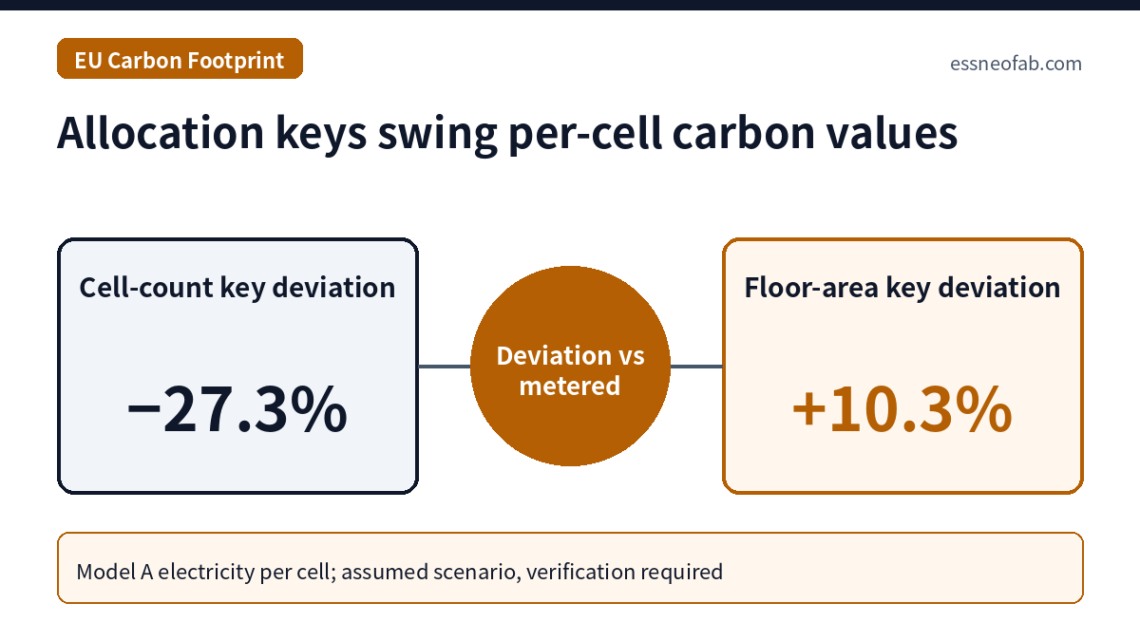
  • Allocation keys swing per-cell carbon values
    News & Trends,  System,  Traceability

    EU Battery Carbon Footprint Methodology Still Pending: How Line Energy Metering Resolution and Allocation Choice Shift Per-Cell Values

    July 8, 2026 /

    According to the EU's official consultation portal, the delegated act setting the carbon footprint calculation methodology under Article 7 of the EU Batteries Regulation (2023/1542) had not moved to the adoption stage as of 23 September 2026, and the portal still shows the planned adoption period as "Q3 2025". In an assumed 8 GWh/year plant producing two models, allocating the same 200,000,000 kWh of electricity by floor area, operating time, capacity or cell count makes the per-cell electricity of model A swing from −27.3% to +10.3% against the process-metered value of 7.860 kWh. Area-based allocation reverses the low-carbon ranking of the two models, and capacity-based allocation has the smallest total…

    read more
    ESS-neofab Comments Off on EU Battery Carbon Footprint Methodology Still Pending: How Line Energy Metering Resolution and Allocation Choice Shift Per-Cell Values

    You May Also Like

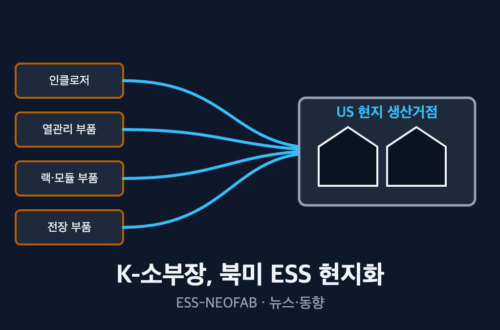
    “Capturing the U.S. ESS Market” — K-Battery Supply Chain’s Wave of Localization: What’s Going Where
    August 11, 2026
    LG에너지솔루션 ESS 후방기지화 라인 관리체계 재설계 흐름도

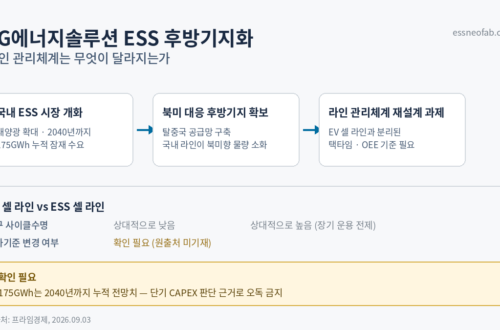
    LG Energy Solution’s ESS Rear-Base Positioning — What Changes in Line Management
    September 3, 2026
    Numbers are ample; the bottleneck is issuance coupling

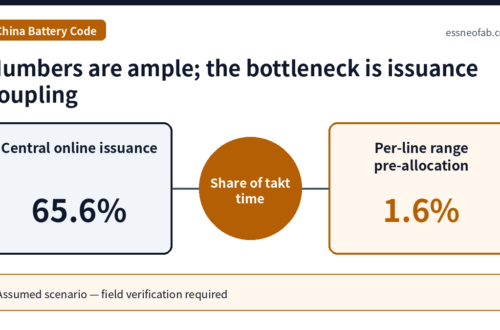
    China’s GB/T 34014 24-Character Battery Code: How Code Structure Fixes Issuance Timing and Authority on the Line
    July 14, 2026
© 2026 Ess-neofab · A line- and system-level record of ESS and secondary-battery manufacturing processes
  • About
  • Contact
  • Privacy Policy
  • Disclaimer
Ashe Theme by WP Royal.