본문으로 바로가기
Ess-neofab

A line- and system-level record of ESS and secondary-battery manufacturing processes

  • 한국어
  • English
  • Home
  • Process
  • System
  • Interface
  • Traceability
  • News & Trends
  • About
  • Contact
  • 한국어
  • English
  • Home
  • Process
  • System
  • Interface
  • Traceability
  • News & Trends
  • About
  • Contact

카테고리

  • Interface (28)
  • News & Trends (20)
  • Process (32)
  • System (31)
  • Traceability (22)

최근 글

  • Five million ACC cells equal 2.7 to 3.6 months of nameplate outputOctober 15, 2026
  • A 160 MW battery’s six-week commissioning has two baselinesOctober 8, 2026
  • Two Cycles a Day Take 106.8 % of a Day, and the Retention Tier Shifts Cell Volume by 1.47 GWhOctober 1, 2026
  • Battwoo’s Second-Life EV Batteries — When an 80 % Acceptance Threshold Overlaps the Retirement Distribution, Incoming Screening Becomes the BottleneckSeptember 30, 2026
  • US storage set an energy record in Q2 as installed power fell 7%September 29, 2026
  • CATL Starts Trial Production in Debrecen — The Digits of the Defect-Rate Target, Not the Equipment, Set the Length of a Trial RunSeptember 29, 2026
  • The ID continues, the history breaks
    News & Trends,  System,  Traceability

    After Korea’s Battery History Management System: IDs Continue, Operating History Breaks — History Continuity of ESS Reuse Racks

    July 10, 2026 /

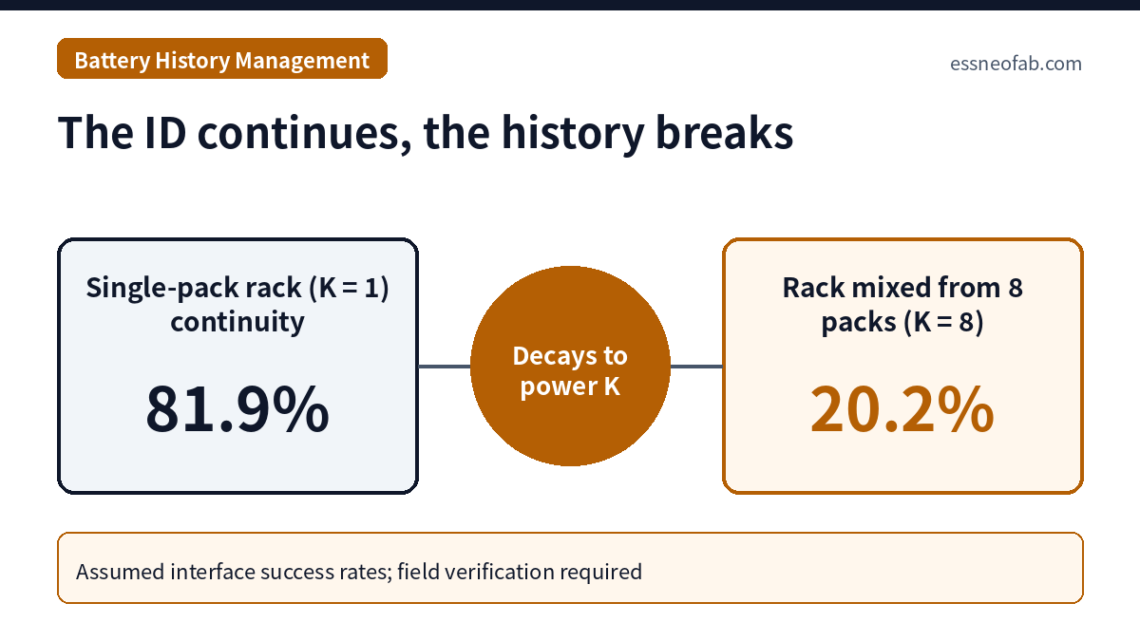
    Korea's battery history management system under the amended Motor Vehicle Management Act, in force since 17 February 2025, requires the battery identification number assigned at the manufacturing stage to be registered in the vehicle registration record and tracked through operation and scrapping; the Used Battery Act promulgated in May 2026 (in force 27 May 2027) and the August 2026 agreement between the industry and climate-environment ministries on an integrated platform now extend it to later stages. Yet when assumed success rates are compounded across the six lifecycle interfaces, identification-number continuity is 91.0% while history continuity, including BMS operating data, falls to 81.9%. The larger variable lies in the reuse stage.…
    read more
    ESS-neofab Comments Off on After Korea’s Battery History Management System: IDs Continue, Operating History Breaks — History Continuity of ESS Reuse Racks

    You May Also Like

    GFI DI-KIT ESS 화재안전 키트 20개 사이트 계약·설치·인터페이스 표준화 흐름도

    ESS Fire-Safety Kits Across 20 Sites — What the System Must Prepare

    September 2, 2026

    LS Electric Ships First Units of Next-Gen ESS PCS “G2” — Is Liquid Cooling the Answer?

    August 10, 2026

    “Capturing the U.S. ESS Market” — K-Battery Supply Chain’s Wave of Localization: What’s Going Where

    August 11, 2026
© 2026 Ess-neofab · A line- and system-level record of ESS and secondary-battery manufacturing processes
  • About
  • Contact
  • Privacy Policy
  • Disclaimer
Ashe Theme by WP Royal.