-
128 MW of Distribution-Grid ESS Volume Allocated — Can the Battery Pack Assembly Line Absorb the Takt Time?
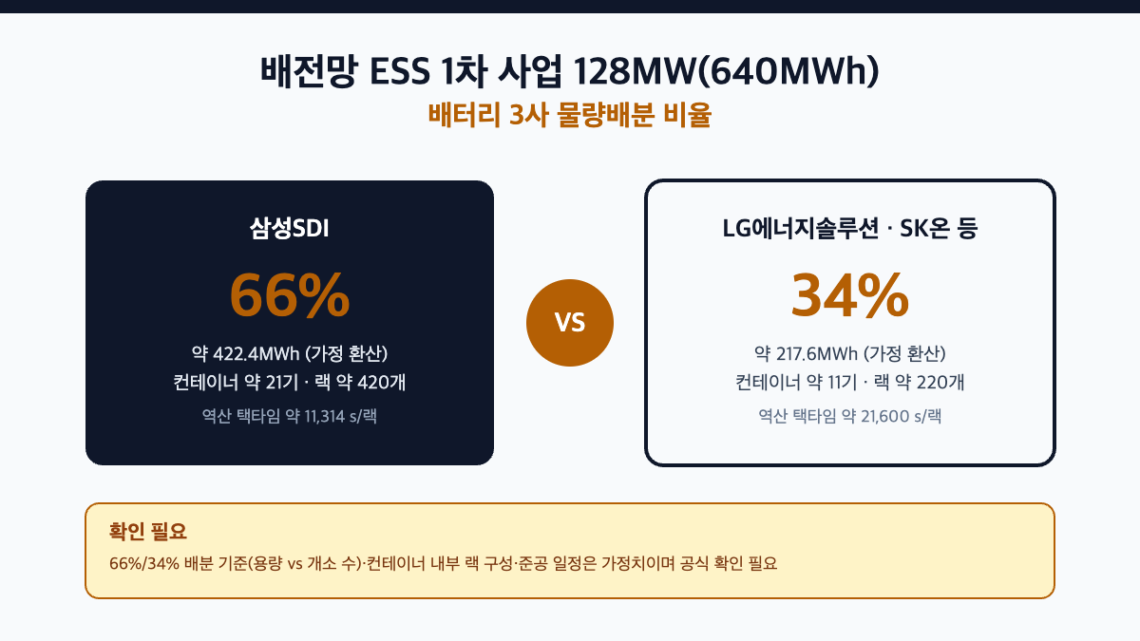
The Ministry of Climate, Energy and Environment’s Phase 1 distribution-grid ESS project — linked to additional renewable-energy interconnection — confirmed 9 operators and allocated a combined 128 MW (640 MWh) across 32 distribution feeders. Samsung SDI recorded the largest award at 66%, with LG Energy Solution and SK On splitting the remainder. This article converts that volume-allocation ratio into a load distribution across battery-pack assembly lines, and back-calculates, under an assumed scenario, how far the takt time diverges between operators. The conclusion is that a difference in procurement-volume ratio is carried straight through into a load imbalance at the production-line design stage, so Line Balancing review must be conducted together,…
-
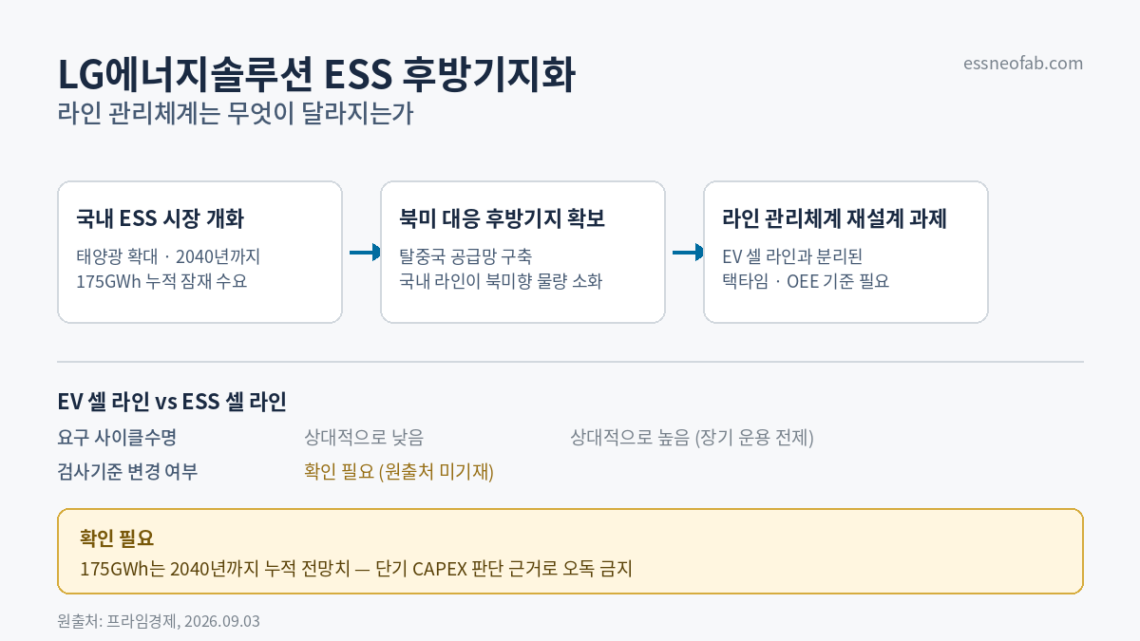
LG Energy Solution’s ESS Rear-Base Positioning — What Changes in Line Management
As Korea's domestic ESS market opens up, a trend is forming in which LG Energy Solution secures a role as a rear base responding to North American demand. Driven by solar power expansion, potential cumulative ESS battery demand of 175 GWh is projected through 2040, alongside attention to the effect of building a China-independent supply chain. However, absorbing this volume in domestic lines requires a takt time (Takt Time)¹ and OEE (Overall Equipment Effectiveness)² management system separate from existing EV cell lines, and the relevant detailed criteria are not given in the original source and require separate verification. 1. Situation and Challenge The opening of Korea's domestic ESS market is…
You May Also Like
China’s GB/T 34014 24-Character Battery Code: How Code Structure Fixes Issuance Timing and Authority on the Line
Solid Electrolyte and Aqueous Zinc Batteries: Investment Is Up — Is the Line Ready?
Today’s ESS/Battery System Trends — U.S. LFP Mass Production Imminent, Megapack 3 Launched, Used-Battery Platform Integration (2026.08.11)