본문으로 바로가기
Ess-neofab

A line- and system-level record of ESS and secondary-battery manufacturing processes

  • 한국어
  • English
  • Home
  • Process
  • System
  • Interface
  • Traceability
  • News & Trends
  • About
  • Contact
  • 한국어
  • English
  • Home
  • Process
  • System
  • Interface
  • Traceability
  • News & Trends
  • About
  • Contact

카테고리

  • Interface (28)
  • News & Trends (20)
  • Process (32)
  • System (31)
  • Traceability (22)

최근 글

  • Five million ACC cells equal 2.7 to 3.6 months of nameplate outputOctober 15, 2026
  • A 160 MW battery’s six-week commissioning has two baselinesOctober 8, 2026
  • Two Cycles a Day Take 106.8 % of a Day, and the Retention Tier Shifts Cell Volume by 1.47 GWhOctober 1, 2026
  • Battwoo’s Second-Life EV Batteries — When an 80 % Acceptance Threshold Overlaps the Retirement Distribution, Incoming Screening Becomes the BottleneckSeptember 30, 2026
  • US storage set an energy record in Q2 as installed power fell 7%September 29, 2026
  • CATL Starts Trial Production in Debrecen — The Digits of the Defect-Rate Target, Not the Equipment, Set the Length of a Trial RunSeptember 29, 2026
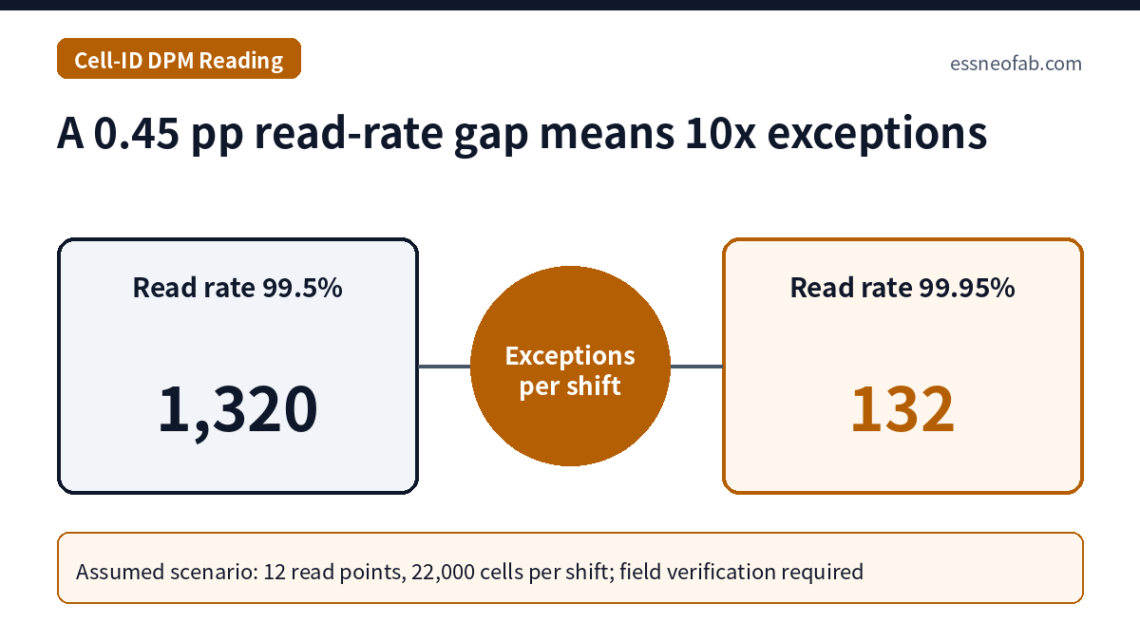
  • A 0.45 pp read-rate gap means 10x exceptions
    Process,  Traceability

    Cell-ID Laser DPM Read Rate 99.5% vs 99.95%: How No-Reads Drive Exceptions per Shift and OEE

    July 3, 2026 /

    The read rate of a cell-ID direct part mark (DPM) is a probability defined at a single read point, but the line experiences it raised to the power of the number of read points each cell passes. Assuming 12 read points and 22,000 cells per shift, a 99.5% read rate generates 1,320 No-Read exceptions per shift, while 99.95% generates 132. Under the same assumptions, OEE falls from a baseline of 84.64% to 75.50% at 99.5% (−9.14 pp), but only to 84.13% at 99.95% (−0.51 pp). A DPM specification should therefore be defined not as "read rate X%" but by three items: verification grade immediately after marking (ISO/IEC 29158), allowable exceptions…

    read more
    ESS-neofab Comments Off on Cell-ID Laser DPM Read Rate 99.5% vs 99.95%: How No-Reads Drive Exceptions per Shift and OEE

    You May Also Like

    Isometric concept of a changeover split into internal work while stopped and external work while running, from last piece to first good piece

    Is a Changeover Planned Downtime or an Availability Loss? — How the Definition Changes OEE
    September 25, 2026
    로봇 자동화설비 사이클타임 78초와 라인 택타임 60초 격차, OEE 성능요소 손실 23.1%p를 보여주는 막대그래프

    Introducing Robotic Automation Equipment — Where Does the Interface with Line Takt Time Break Down
    September 2, 2026
    포항 LFP 양극재 출하에서 조지아 ESS 셀 라인 입고까지 45일 리드타임과 안전재고 1,138 t를 나타낸 인터페이스 도식

    45 Days from Pohang to Georgia — Safety Stock at an Intercontinental Cathode Interface Is Driven by Lead-Time Variability, Not Demand
    September 23, 2026
© 2026 Ess-neofab · A line- and system-level record of ESS and secondary-battery manufacturing processes
  • About
  • Contact
  • Privacy Policy
  • Disclaimer
Ashe Theme by WP Royal.