DY Duckyang’s 10 MWh-Class Marine ESS — What the Water-Cooled Demonstration Means for System Design
Abstract
DY Duckyang has moved forward with a 10 MWh-class marine ESS business. The company has completed demonstration and certification of a 1.02 MWh-class water-cooled ESS and, building on this, is targeting supply of marine ESS at roughly 10 times that scale, at the 10 MWh class. While the battery system itself is similar between land-based and marine ESS, differing environmental constraints — installation space, vibration, and salt exposure — fundamentally diverge the cooling method and certification process design. This article organizes what completing the demonstration stage means from a system-design standpoint, and the nonlinear difficulty-escalation factors typically seen across a 10x scale-up.
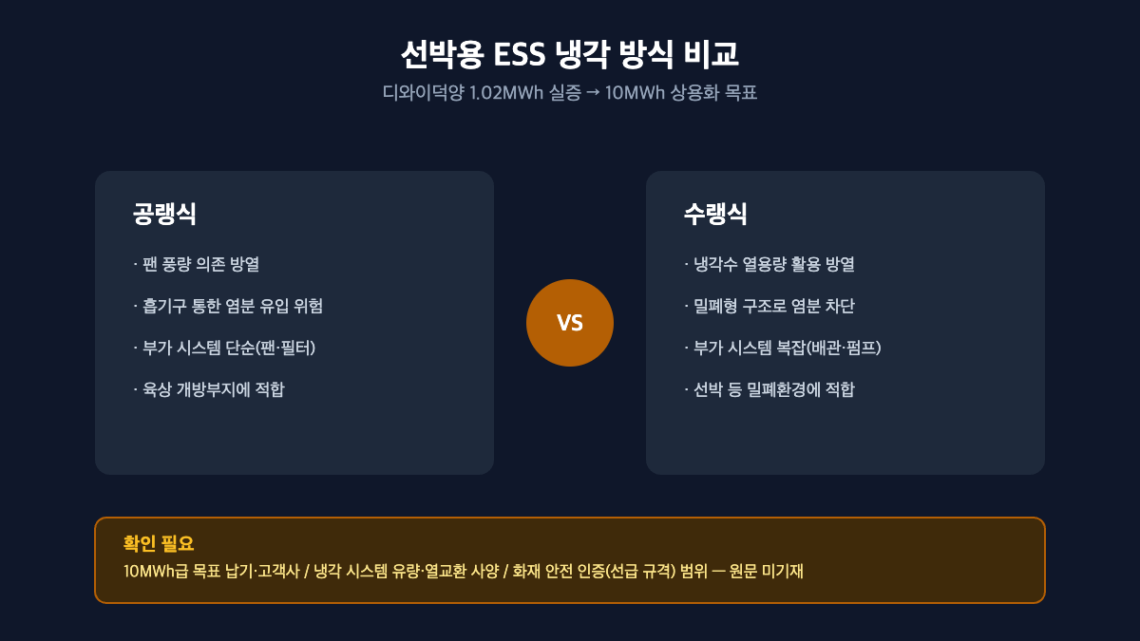
1. Why marine applications require water cooling
The conclusion first: the marine installation environment (limited space, constant vibration, salt exposure) is a structural constraint that pushes the cooling method choice from air cooling toward water cooling, and this demonstration should be read as a case confirming that a sealed thermal management design functions under that constraint. Land-based ESS is often installed as containers on open sites, where air cooling alone can provide sufficient heat rejection. On ships, however, installation space is limited and the system is continuously exposed to vibration and salt, making noise management of air-cooling fans and blocking salt-intrusion paths difficult.
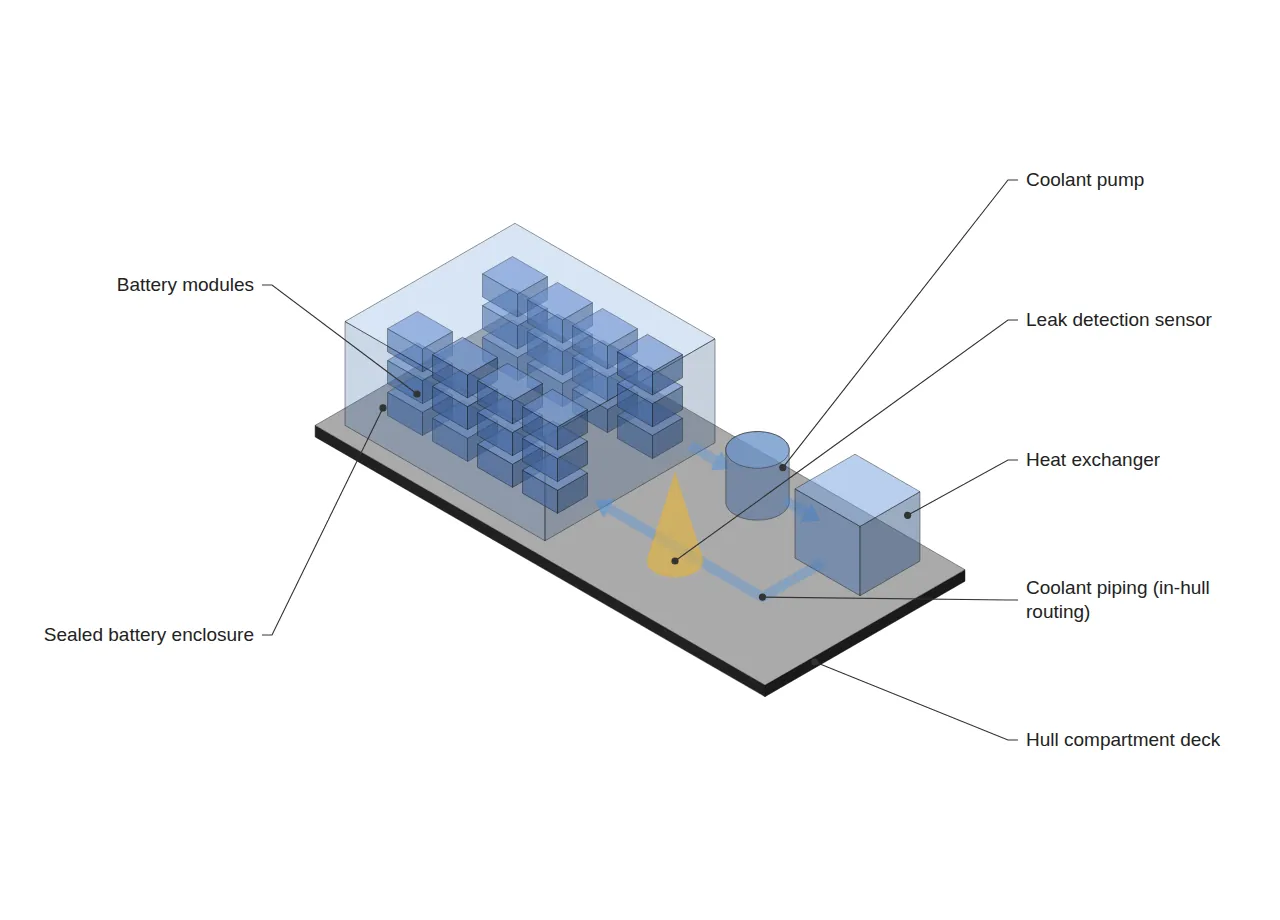
So why choose water cooling, which adds auxiliary systems such as piping and pumps? Because a sealed water-cooling structure can fundamentally block salt- and vibration-exposure pathways while still securing sufficient heat-rejection performance. However, the routing of cooling-water piping inside the hull and the risk of dielectric breakdown in the event of a leak remain trade-offs this structure must separately manage.
| Comparison item | Air cooling | Water cooling |
|---|---|---|
| Heat-rejection performance | Depends on fan airflow; relatively low | Utilizes coolant heat capacity; relatively high |
| Salt/moisture intrusion path | Intrusion risk persists through intake vents | Can be fundamentally blocked by a sealed structure |
| Auxiliary system complexity | Low (fan/filter-centered) | High (pump, piping, heat exchanger, leak detection) |
| Periodic inspection interval (assumed, requires verification) | Filter cleaning, assumed ~3-month cycle | Piping/pump inspection, assumed ~6-month cycle |
| Leakage risk | Not applicable | Dielectric breakdown / fire propagation risk (requires separate management) |
The inspection intervals in the table above are an assumed scenario set by reference to general marine equipment operating practice; DY Duckyang’s actual maintenance specifications are not stated in the source material and require verification.
2. From 1.02 MWh demonstration to 10 MWh commercialization
The difference between the demonstration scale (1.02 MWh) and the target scale (10 MWh) is approximately 10x. In a capacity scale-up of this kind, it is typical for thermal design, BMS communication load, and fire-propagation compartmentalization to become more difficult nonlinearly with increasing module count, rather than simply requiring more modules. The specific design changes involved in this scale-up are not confirmed in the source material and are not estimated here.
3. The weight of classification-society certification
Unlike land-based systems, marine ESS additionally requires certification from a classification society (a private inspection body that reviews and certifies a vessel’s structure and equipment). The phrase “demonstration and certification completed” means at least one formal verification stage has been passed, which is likely to serve as a reference in subsequent order-winning activity.
4. Market context
Amid tightening environmental regulations for vessels from bodies such as the International Maritime Organization (IMO), demand for electric-propulsion and hybrid vessels is increasing, and marine ESS is one of the core components of this trend. However, market-size forecasts for this specific case are not provided in the source material.
5. Items requiring verification
| Item | Reason |
|---|---|
| Target delivery date and customer for the 10 MWh-class system | Not stated in source |
| Specific cooling system specifications (flow rate, heat-exchange method) | Not stated in source |
| Scope of fire-safety certification (classification-society standard name) | Not stated in source |
| Thermal-design and BMS communication-load changes in the scale-up | Not stated in source; not to be estimated |
FAQ
Q. Is water cooling always superior to air cooling?
A. No. While water cooling offers superior cooling performance, the added auxiliary systems (piping, pumps) can reduce maintenance accessibility. The trade-off differs depending on the application (marine, high-density installation).
Q. Does land-based ESS experience transfer directly to marine applications?
A. System-level elements such as BMS and cell-management logic are shared, but vibration, salt exposure, and classification-society certification requirements must be separately verified.
Field Application Notes
| Check | Method / criteria | Notes |
|---|---|---|
| Pre-review classification-society certification requirements | If a marine ESS project exists, request a list of relevant classification standards (KR, DNV, etc.) from the procurement team and reflect them in early design | Verification needed: the specific classification standard DY Duckyang passed is not stated in the source |
| Launch a cooling-method trade-off study | Rewrite the Section 1 comparison table as a template, adapted to your own installation environment (vibration, salt exposure level) | Assumed values must be replaced with your own measured data |
| Draft a scale-up risk checklist | Confirm that thermal design, BMS communication load, and fire-propagation compartmentalization are all included in the 1.02 MWh → 10 MWh scale-up planning document | These items become nonlinearly more difficult, so advance review is recommended |
| Document piping routing and dielectric-breakdown risk management | If adopting water cooling, register the cooling-water piping routing drawing within the hull and leak-detection sensor placement as a design-review agenda item | Assumed scenario (inspection interval ~6 months); requires empirical verification |
Source
Newsis, “DY Duckyang Moves Forward with 10 MWh-Class Marine ESS Business,” 2026-09-16.
Related Reading
- LS Electric Ships First Units of Next-Gen ESS PCS "G2" — Is Liquid Cooling the Answer?
- ESS Assembly Line: Why Immersion Cooling Becomes a Bottleneck
- ESS Fire-Safety Kits Across 20 Sites — What the System Must Prepare


You May Also Like
Converting EV Lines to ESS: What the H1 Utilization Gap Reveals About Line-Conversion Speed
Today’s ESS/Battery Process Trends — Expanded Support for Materials/Parts/Equipment Lines, Solid-State/LFP Pilot Lines Launch (2026.08.07)