LG Energy Solution’s ESS Rear-Base Positioning — What Changes in Line Management
Abstract
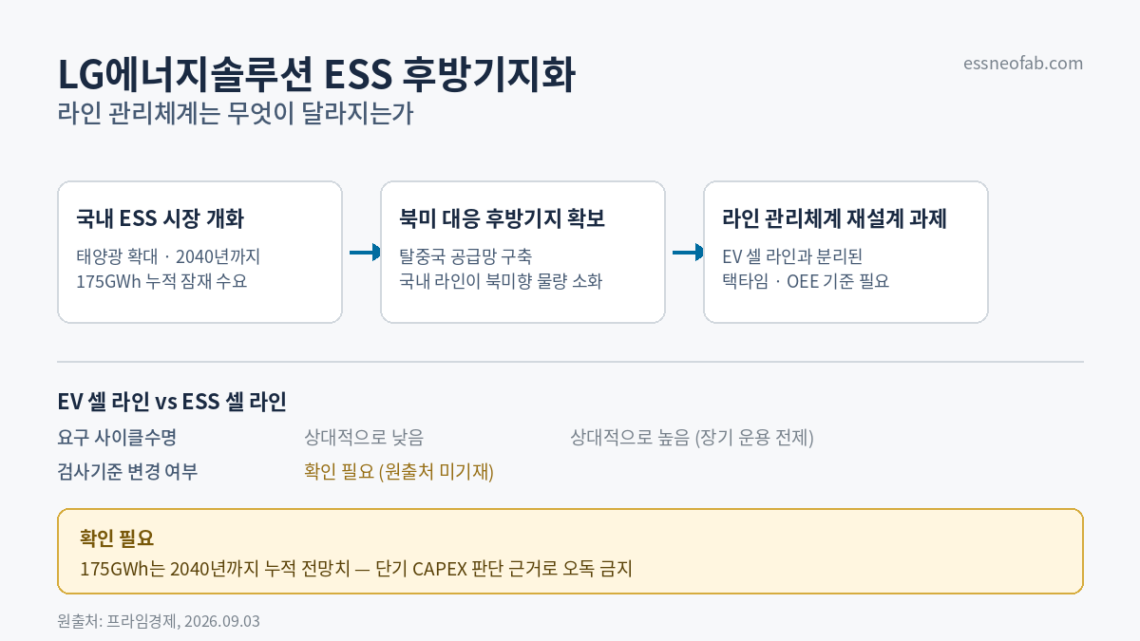
Abstract. As Korea’s domestic ESS market opens up, a trend is forming in which LG Energy Solution secures a role as a rear base responding to North American demand. Driven by solar power expansion, potential cumulative ESS battery demand of 175 GWh is projected through 2040, alongside attention to the effect of building a China-independent supply chain. However, absorbing this volume in domestic lines requires a takt time (Takt Time)¹ and OEE (Overall Equipment Effectiveness)² management system separate from existing EV cell lines, and the relevant detailed criteria are not given in the original source and require separate verification.
1. Situation and Challenge
The opening of Korea’s domestic ESS market is leading to a trend in which LG Energy Solution is assigned the role of a rear base responding to North American demand, which, from a line-operations standpoint, raises the new challenge of establishing a takt time/OEE management system different from existing EV cell lines.
Driven by the expansion of solar power generation, cumulative potential demand for ESS batteries is projected to reach 175 GWh by 2040, and against the policy backdrop of building a China-independent supply chain, a trend is forming in which LG Energy Solution positions itself as the rear base absorbing North America-bound volume domestically.
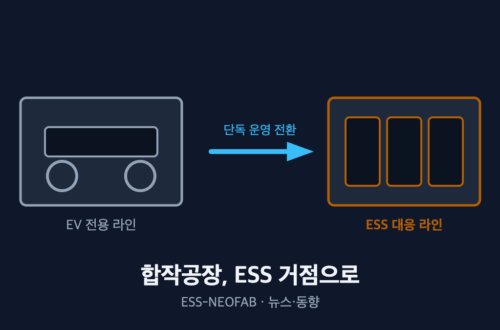
However, ESS cells require different cycle-life and inspection standards than EV cells, and the original source does not present specific conditions for converting between the two lines. If North America-bound volume is simply folded into existing EV cell lines as-is, differing takt time/OEE calculation standards could create confusion in line-allocation planning.
This raises the question: what specific new process bottlenecks actually arise during the ESS-directed line conversion/expansion process?
2. Differences in EV-ESS Management Systems from a Line Perspective
OEE is an overall-equipment-efficiency indicator defined as Availability x Performance x Quality², and takt time is defined as available operating time divided by customer required quantity¹ (not used interchangeably with Cycle Time or FPY). That ESS cells require a higher cycle life than EV cells suggests that, when the two products are mixed on the same line, the quality-factor judgment criteria (inspection items, acceptance range) may come to differ between them. However, the original source does not specify the details of any inspection-standard changes, so the actual magnitude of impact on the OEE quality factor requires verification.
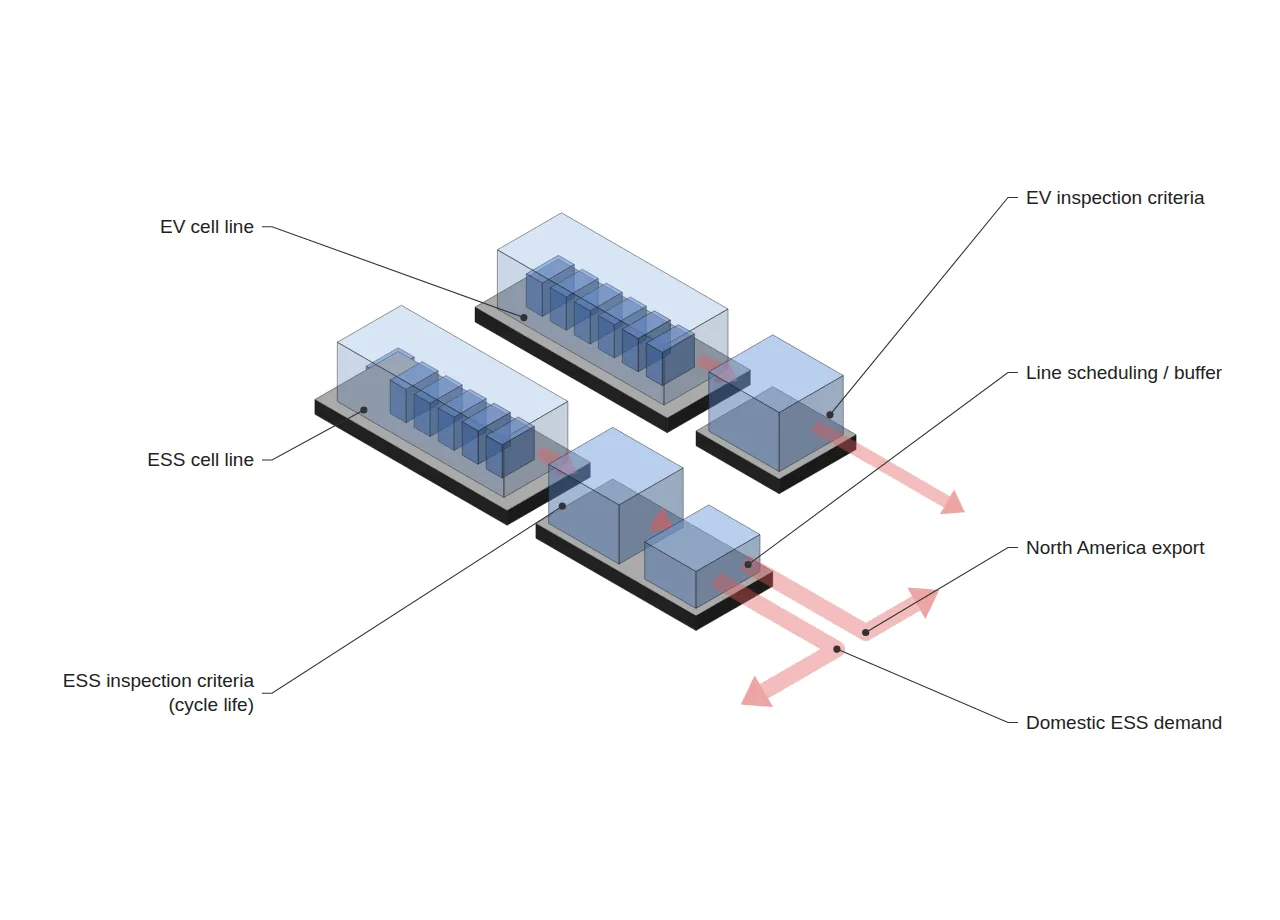
This becomes more pronounced in a situation of reallocating volume on an existing EV line rather than building a new one. If the customer required quantity that underlies the takt time calculation is itself split into domestic and North American (export) volumes, a structure could arise in which two takt time standards apply simultaneously on a single line. In this case, line scheduling and buffer design could change from the current setup, but the original source provides no information on whether this split actually occurs, or if it does, how it would be managed.
3. Comparison Table
| Category | EV cell line | ESS cell line |
|---|---|---|
| Required cycle life | Relatively low | Relatively high (premised on long-term operation) |
| Whether inspection standards must change upon line conversion | Verification needed (not stated in original source) | |
| Timing of 175 GWh demand | Cumulative projection through 2040 | |
What this table shows: 175 GWh is cumulative potential demand through 2040 and should not be misread as a basis for near-term CAPEX decisions. Whether inspection standards change and how volume would be split remain items requiring verification, as they are not presented in the original source.
4. Related Trend Snapshot
In the same context, the effect of EV-to-ESS line conversion on OEE loss points at the individual-plant level has already been addressed separately (Related article: Where Does OEE Break Down in an EV Line’s Conversion to ESS). Where that analysis addressed where OEE breaks down within the conversion process inside a specific plant, this article addresses a higher-level capacity-allocation problem in which Korea’s entire domestic production capacity is being restructured as a North American rear base – a different level of analysis. This snapshot is for reference only and is not used as separate supporting evidence for the conclusions in the body of this article.
5. Conclusion and Field Implications
The opening of Korea’s domestic ESS market and its positioning as a North American rear base raises, for line operators, the need to redesign the takt time/OEE management system separately from the EV cell line. However, since the 175 GWh demand projection is a cumulative figure through 2040, it would be premature to decide on immediate line expansion or conversion on this basis. Key variables – whether inspection standards change, and how takt time would be calculated under a split volume structure – are not confirmed in the original source, and require separate verification before being reflected in actual line plans.
FAQ
Q. Is the investment scale for ESS line expansion larger than for existing EV lines?
A. This cannot be confirmed, as the original source provides no comparative investment-scale information by line. No estimate is made.
Q. Can ESS cells and EV cells be produced in mixed flow on a single line?
A. The original source does not state whether mixed-flow production is possible. Only a difference in required cycle life and inspection standards is confirmed; the feasibility of mixed flow itself requires separate verification.
Field Application Notes
| Check/action item | Note |
|---|---|
| When an ESS-directed volume expansion is announced, first confirm at the line level whether the same takt time/OEE standards as EV-directed lines are being applied | Verification needed from internal process engineering team |
| Since the 175 GWh figure is a long-term (through 2040) cumulative projection, do not apply it directly to near-term line-allocation planning | To prevent CAPEX decision misreading |
| Whether inspection standards change, and how takt time would be calculated under a domestic/North America volume split, are not stated in the original source | Verification needed – no arbitrary estimation |
¹ Takt Time: available operating time divided by customer required quantity. Not used interchangeably with Cycle Time or FPY (First Pass Yield).
² OEE (Overall Equipment Effectiveness): an indicator defined as Availability x Performance x Quality.
Original source: “LG Energy Solution Benefits from the Opening of Korea’s Domestic ESS Market… Secures a ‘Rear Base’ Responding to North America,” Prime Economy, 2026.09.03


You May Also Like
Hanwha Energy Sells Two Large Italian BESS Projects to Sweden’s OX2 — Evidence of European Development Capability
Samsung SDI Turns Its GM Joint-Venture Plant Into an ESS Hub