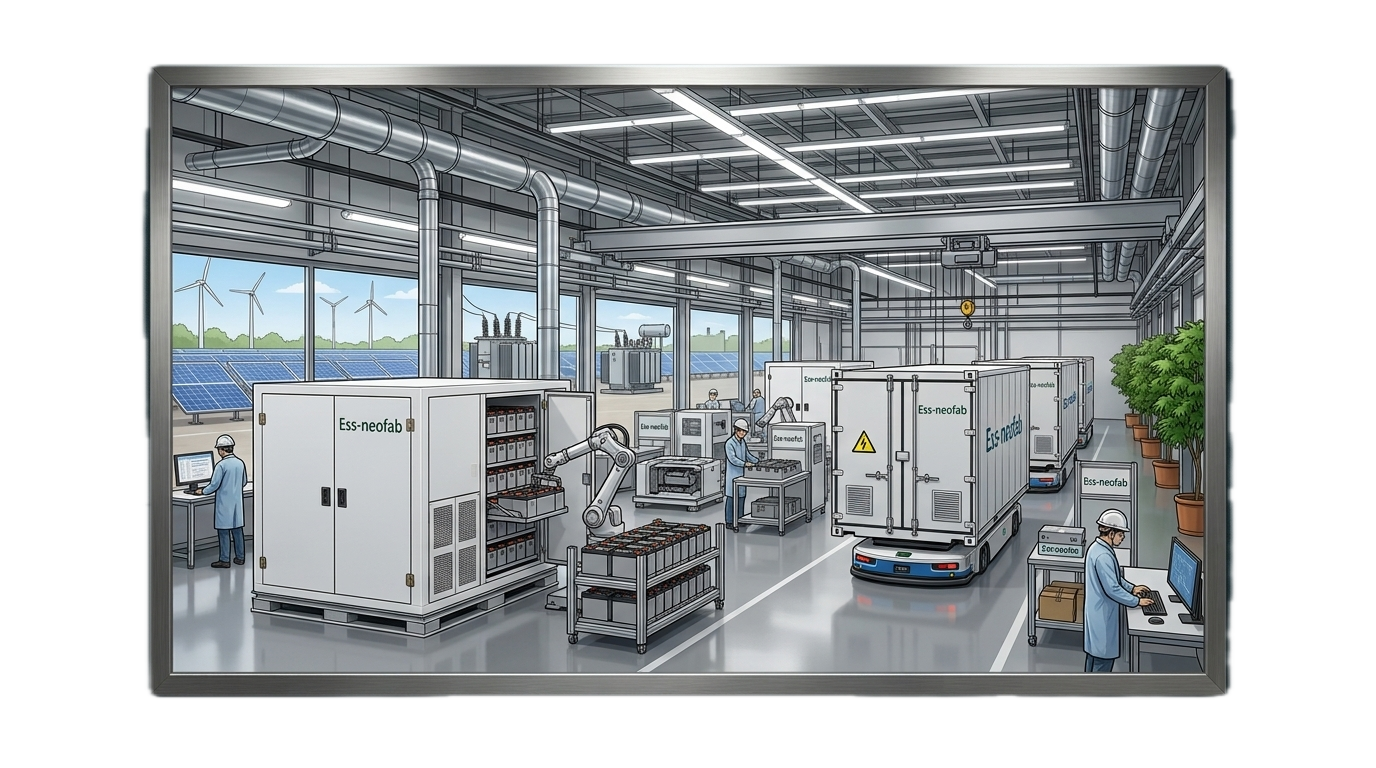
Market Trends from a Battery Process/Equipment Perspective — 46-Phi Ramp-Up, Dry Process, Equipment In-Housing
The battery process/equipment market covers the equipment used in cell-manufacturing processes — mixing, coating, calendering, slitting, winding/stacking, assembly, and formation — and the changes in its technical specifications. This article summarizes recent trends centered on three streams: the shift to the cylindrical 46-phi form factor, the dry electrode process, and equipment in-housing/efficiency improvement.
1. Mass-Production Ramp-Up and Process Upgrades for Cylindrical Batteries (46-Phi and Others)
- LG Energy Solution’s new cylindrical lines (2 units) at Nanjing Plant 9 to start operation in the second half of the year: Expansion pursued at 2GWh per line. Ramp-up accelerated by benchmarking the Shanghai Plant 6 model (30GWh) supplying Tesla.
- Tesla Giga Berlin production increase (to a 7,500 units/week regime): In-house battery cell production capacity at the plant expanded from 8GWh to 18GWh (additional $250 million investment) to address the European market.
- Samsung SDI’s 46-phi cylindrical battery becomes more visible: Process development underway targeting full-scale mass production in 2028.
Process Analysis
- Introducing gigacasting & AI processes to maximize productivity: Behind Tesla’s Giga Berlin production increase are gigacasting and AI-based production workflows. This suggests that precise synchronization control between equipment — beyond simple parts assembly — has become essential.
- Equipment specification changes driven by the 46-phi form-factor shift: Tesla, LGES, and Samsung SDI are all staking their futures on cylindrical (especially 46-series) expansion. Compared to the existing 2170 format, winding and assembly process difficulty rises sharply, so precision control of the tab-less process and high-speed production technology (linked to high-speed roll-to-roll technology) will become a core variable in equipment competitiveness.
2. Responding to Supply-Chain Regulation and the Rise of Next-Generation Battery Dry Processes
- U.S. Trade Act Section 301 additional tariff risk: LG Group has applied for a USTR exemption. With Korea’s dependence on China running high for cathode materials (96%) and anode materials (93%), material-supply uncertainty is increasing for U.S.-local production lines.
- L&F completes its Saemangeum precursor plant (40,000 tons/year): Commercial operation starting in Q4 secures a non-PFE (non-Prohibited Foreign Entity) supply chain in advance and completes vertical integration.
- National R&D projects and technology development for next-generation batteries (solid-state and dry processes): Dongwha Electrolyte (developing dry anode electrode material technology), MNTech (developing solid-electrolyte membrane technology based on a sulfide + oxide LLZO dry process).
Process Analysis
- The impact of material supply-chain diversification on equipment setup: Precursor in-housing and localization (as with the L&F case) is not simply a matter of cost reduction. From a battery-cell manufacturer’s standpoint, in the slurry-mixing and coating processes, high-precision die-coater and drying-equipment control capability — able to flexibly respond to property variation across material batches — becomes more important.
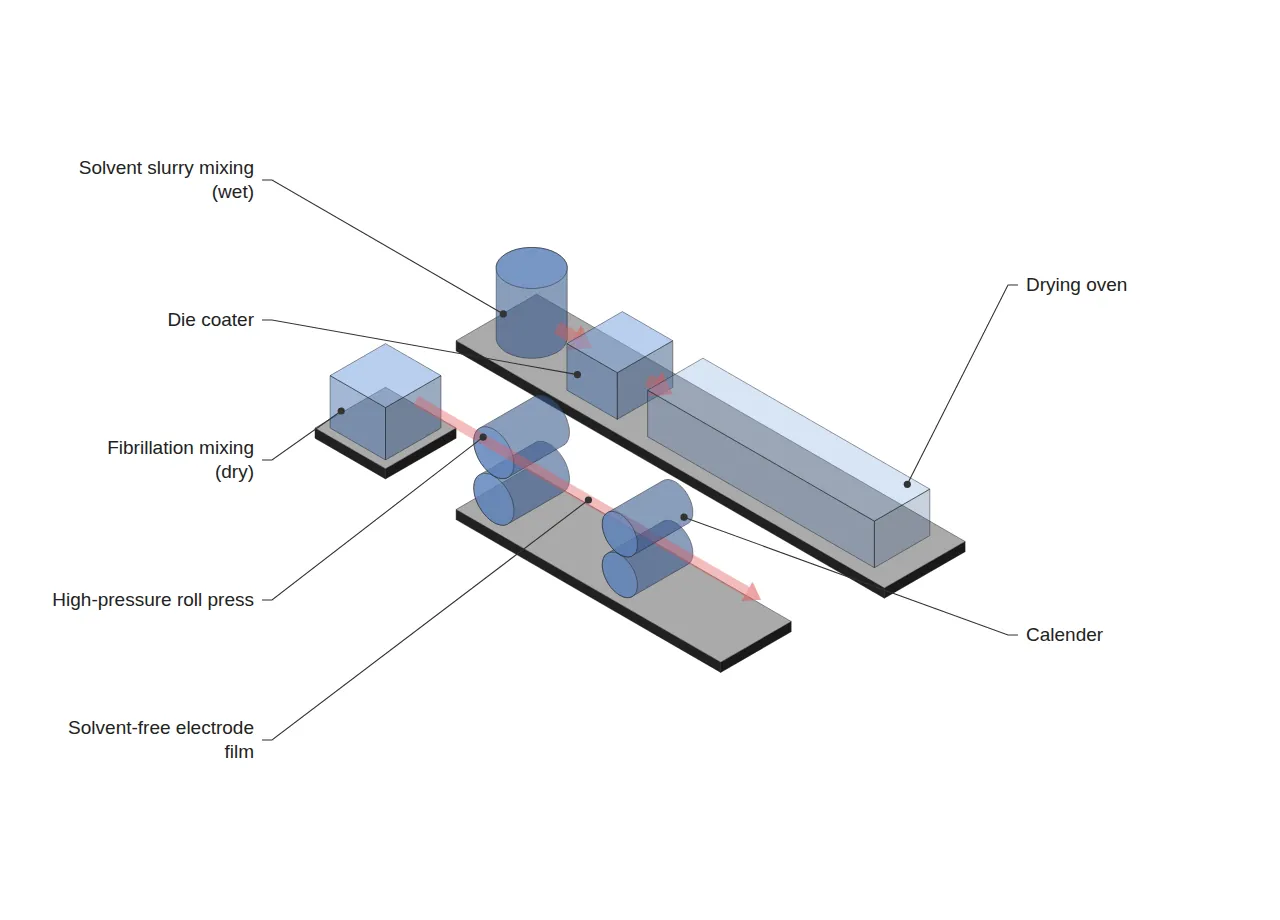
- The paradigm shift toward the dry-coating era: The moves by MNTech and Dongwha Electrolyte demonstrate that the dry process is emerging as the core mainstream for next-generation solid-state and lithium-ion batteries. When shifting from conventional wet coating (which requires solvent mixing, coating, and drying) to dry processing (forming binder and active material into a film without solvent, then pressing), the importance of ultra-high-pressure, high-precision roll press and calender equipment rises overwhelmingly. Technology to control thermal deformation of the rolls and secure micron-level thickness uniformity will dominate the market.
3. Summary
| Key Area | Trend Analysis | Equipment/Process Response Challenge |
|---|---|---|
| Cylindrical (46-Phi) | Rapid capacity ramp-up and new-line expansion centered on Tesla, LGES, and Samsung SDI | Securing reliability in high-speed tab-less winding and precision assembly equipment |
| Next-Gen Processes | Full-scale securing of dry anode electrode and solid-electrolyte-membrane dry-process technology | Gaining an early lead in high-precision deformation control technology for ultra-high-pressure roll press and calender equipment |
| Supply-Chain Risk | Accelerating supply-chain restructuring due to U.S. Section 301 tariffs and PFE regulations | Securing equipment flexibility matched to localized/diversified material properties |
The market has moved beyond simple capacity-expansion competition into a stage of process innovation (dry processing, 46-phi tab-less, etc.) and equipment in-housing/efficiency improvement. In particular, the full-scale adoption of the dry process will completely change the specifications of front-end process equipment, including roll presses. Companies that flexibly respond to material changes driven by regulatory risk while proactively securing equipment technology capable of ultra-high-pressure, high-speed control will hold the reins of the battery-equipment market going forward.
Frequently Asked Questions
Q. What changes does the shift to 46-phi cylindrical cells require of equipment?
Compared to the existing 2170 format, winding and assembly difficulty increases, requiring precision control of the tab-less process and high-speed production technology.
Q. What equipment specifications does the dry process change?
With solvent and drying ovens eliminated, fibrillation mixing/transport and high-precision deformation control of ultra-high-pressure roll press and calender equipment become the core specifications.
Q. How does supply-chain risk affect equipment?
As U.S. Section 301 tariffs and PFE regulations drive material localization and diversification, equipment flexibility that can adapt to changed material properties is required.
Related Reading — Inter-Process Buffers: Bigger Isn’t Always Better


You May Also Like
Is a Changeover Planned Downtime or an Availability Loss? — How the Definition Changes OEE
Formation Channel Sizing Read from a Cell Assembly Equipment FAT — How 1 Second of Takt Time Moves 3,350 Channels
One Comment
Pingback: