Process
This category analyzes the systemic impact of upstream process outcomes on downstream processes, going beyond the performance of individual unit equipment.
-
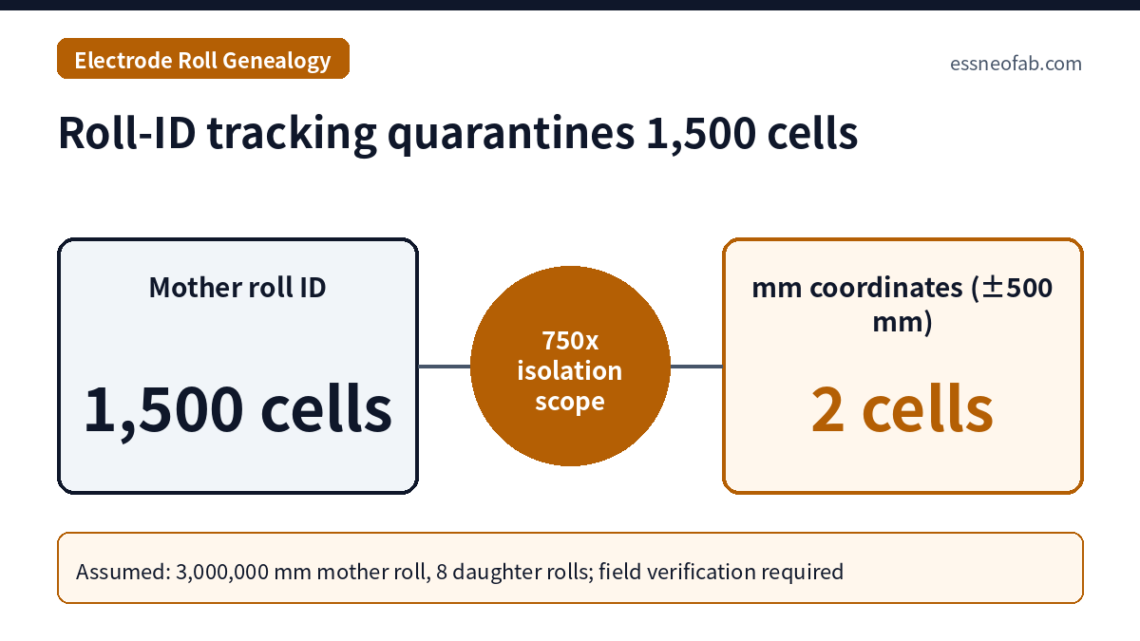
Electrode Roll Genealogy: How Key Reissue at Slitting and Stacking Shrinks Defect Isolation from 1,500 Cells to 2
When traceability resolution in the electrode R2R section stops at the "roll ID," a 5,000 mm coating defect in one mother roll expands the isolation scope to every cell derived from that mother roll. Assuming a 3,000,000 mm mother roll, 4 lanes, 8 daughter rolls, and 8,000 mm of cathode web per cell, the isolation scope is 1,500 cells at mother-roll-ID resolution, 188 cells at daughter-roll-ID resolution, and 2 cells at encoder-based mm-coordinate resolution (±500 mm), a difference of up to 750 times. This resolution is preserved only when a key consisting of "parent ID + parent coordinate interval + direction bit + transform coefficient" is reissued at every split…
You May Also Like
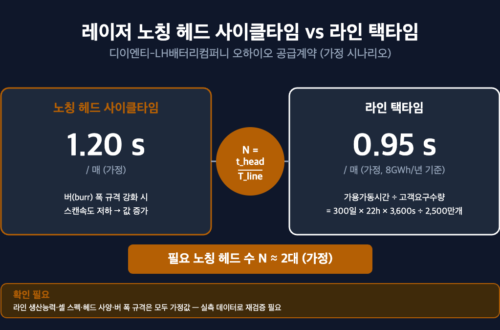
The Interface Between Laser Notching Cycle Time and Line Takt Time — The Head-Count Sizing Problem Revealed by DI ENT’s Ohio Supply Contract
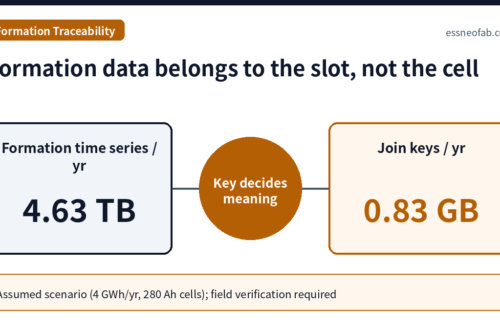
Linking Cell History in Formation and Aging: History Contamination from Tray ID + Slot Mapping
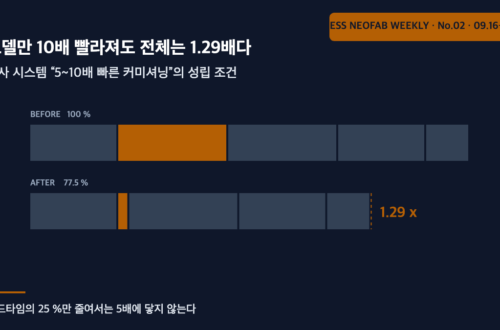
Even a tenfold faster model moves the whole by 1.29x — what “5 to 10 times faster commissioning” actually requires
-
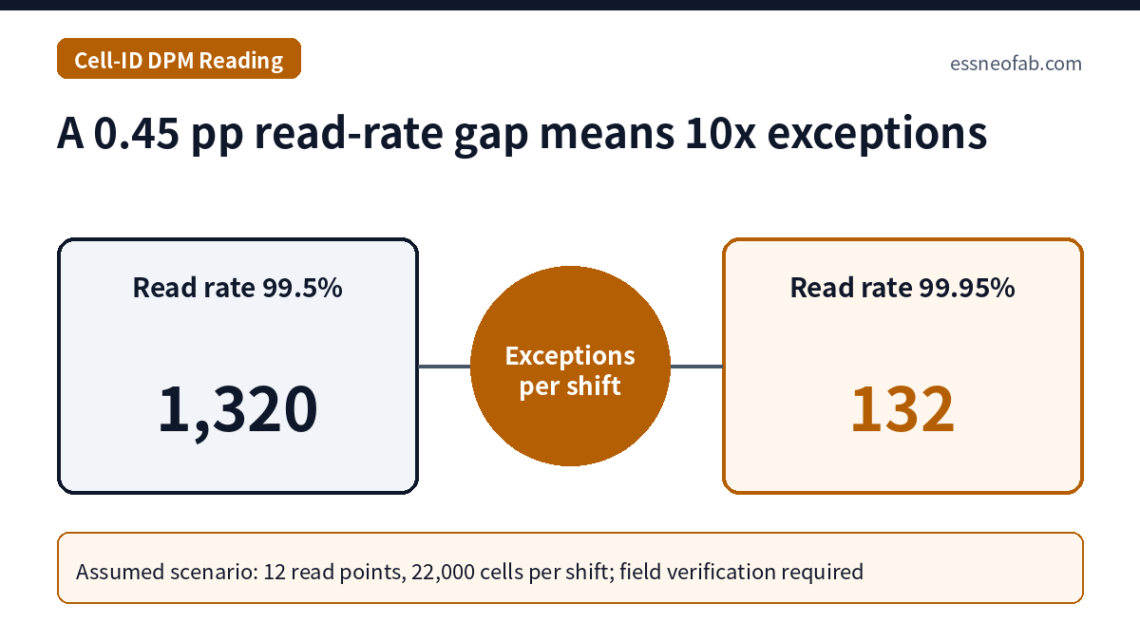
Cell-ID Laser DPM Read Rate 99.5% vs 99.95%: How No-Reads Drive Exceptions per Shift and OEE
The read rate of a cell-ID direct part mark (DPM) is a probability defined at a single read point, but the line experiences it raised to the power of the number of read points each cell passes. Assuming 12 read points and 22,000 cells per shift, a 99.5% read rate generates 1,320 No-Read exceptions per shift, while 99.95% generates 132. Under the same assumptions, OEE falls from a baseline of 84.64% to 75.50% at 99.5% (−9.14 pp), but only to 84.13% at 99.95% (−0.51 pp). A DPM specification should therefore be defined not as "read rate X%" but by three items: verification grade immediately after marking (ISO/IEC 29158), allowable exceptions…
You May Also Like
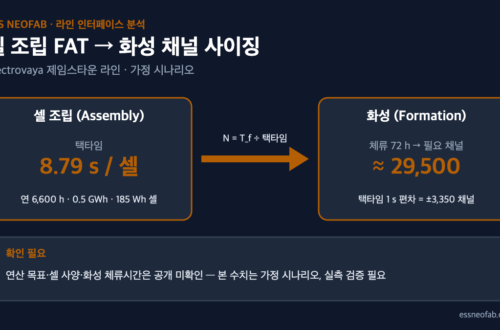
Formation Channel Sizing Read from a Cell Assembly Equipment FAT — How 1 Second of Takt Time Moves 3,350 Channels
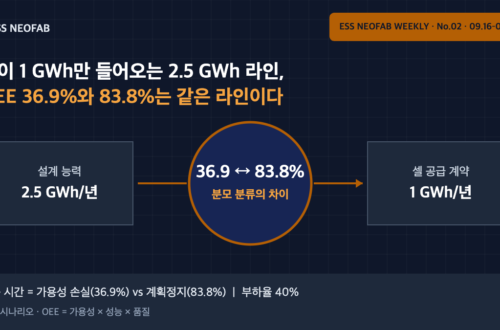
A 2.5 GWh Line Fed Only 1 GWh of Cells — OEE of 36.9% and 83.8% Describe the Same Line
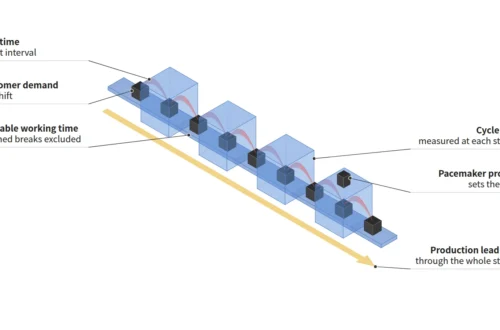
Don’t Subtract Breakdowns When Calculating Takt Time — Takt Time vs. Cycle Time vs. Lead Time