Process
This category analyzes the systemic impact of upstream process outcomes on downstream processes, going beyond the performance of individual unit equipment.
-
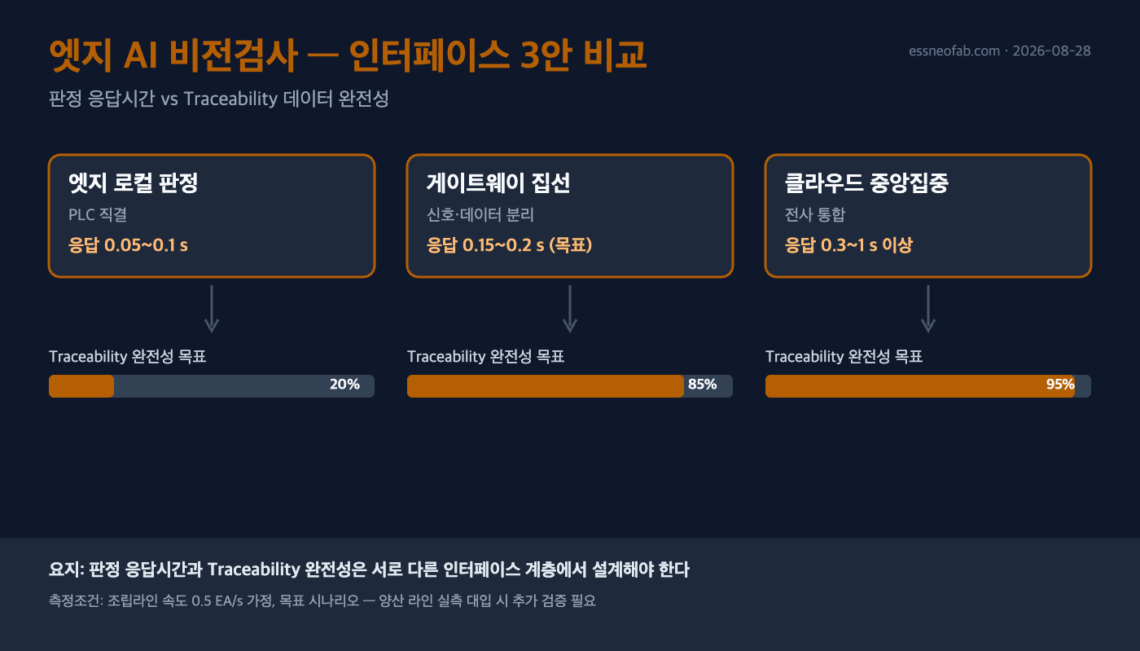
Edge AI Vision Inspection and Battery-Pack Leak Testing: How Gateway Aggregation Affects Traceability Completeness
Edge AI vision inspection has already solved the problem of judgment speed itself on battery-pack assembly lines. Combining gas imaging with edge computing, as in GM's disclosed leak-inspection system “BVSeal,” makes per-cell judgment within 3 seconds possible. However, depending on where the judgment result is stored — the edge device locally, a gateway, or the cloud — the completeness of Traceability data remains an entirely different problem. This article compares the data architecture of edge AI vision inspection from an interface-design perspective and presents, as a target scenario, a gateway-aggregation approach that secures Traceability completeness without takt-time loss. 1. Judgment Has Gotten Faster, But the Record Still Breaks To state…
You May Also Like
Don’t Subtract Breakdowns When Calculating Takt Time — Takt Time vs. Cycle Time vs. Lead Time
128 MW of Distribution-Grid ESS Volume Allocated — Can the Battery Pack Assembly Line Absorb the Takt Time?
Embedding an AI Vision Inspection Gate in the Line: Redefining OEE and Takt-Time Design Variables
-
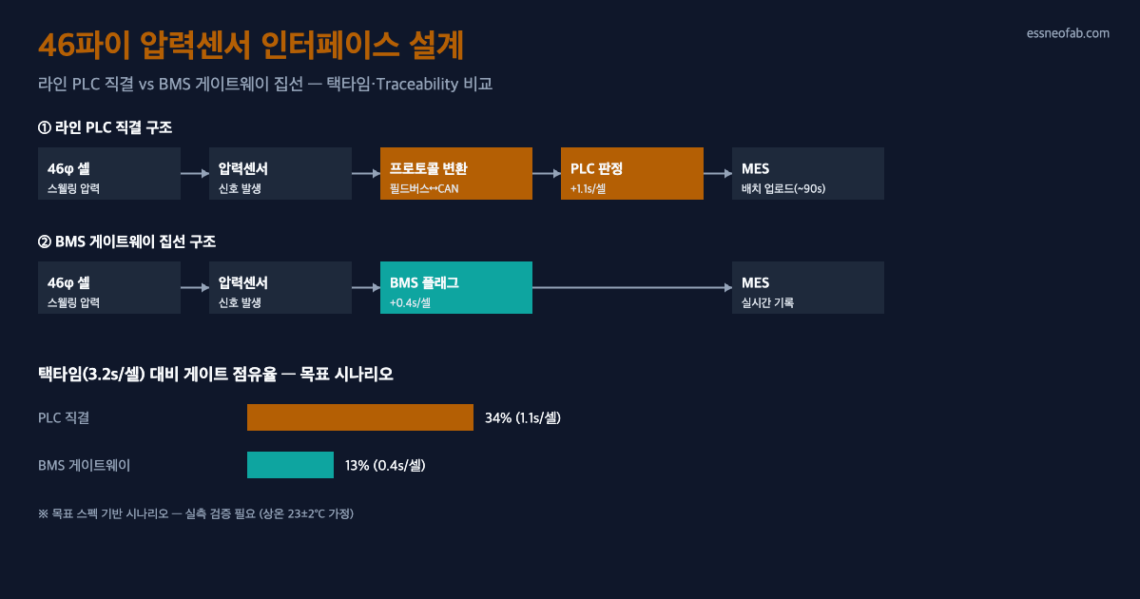
46-Phi Cylindrical Cell Line Conversion: The Pressure-Sensor–BMS Interface Determines Takt Time
As the transition to 46-series (46-phi) cylindrical cell mass production approaches, how much more finely the swelling-pressure behavior specific to the 46 mm-diameter cell must be measured compared to the 21700 has emerged as a practical line-design variable. As Korea's ESS Round-3 centralized-contract market bid size is under review for expansion to over 1 GW and new ESS orders for AI data centers surge, pressure to expand or convert 46-phi lines is expected to grow further. This article presents the proposition that an interface structure in which pressure-sensor data is first aggregated at the BMS gateway layer — rather than at the line PLC — absorbs per-gate judgment delay within…
You May Also Like
Don’t Subtract Breakdowns When Calculating Takt Time — Takt Time vs. Cycle Time vs. Lead Time
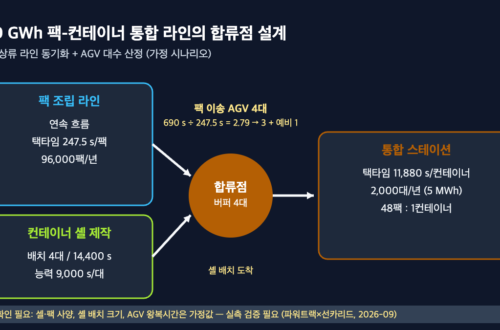
Designing the Merge Point in a 10 GWh Pack-Container Integration Line: Synchronizing Two Upstream Lines and Sizing AGV Fleet from the Powertrac × Sunka Lead Order
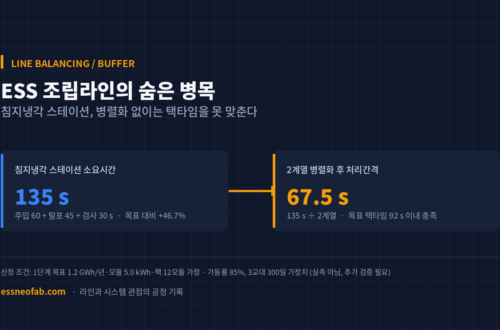
ESS Assembly Line: Why Immersion Cooling Becomes a Bottleneck
-
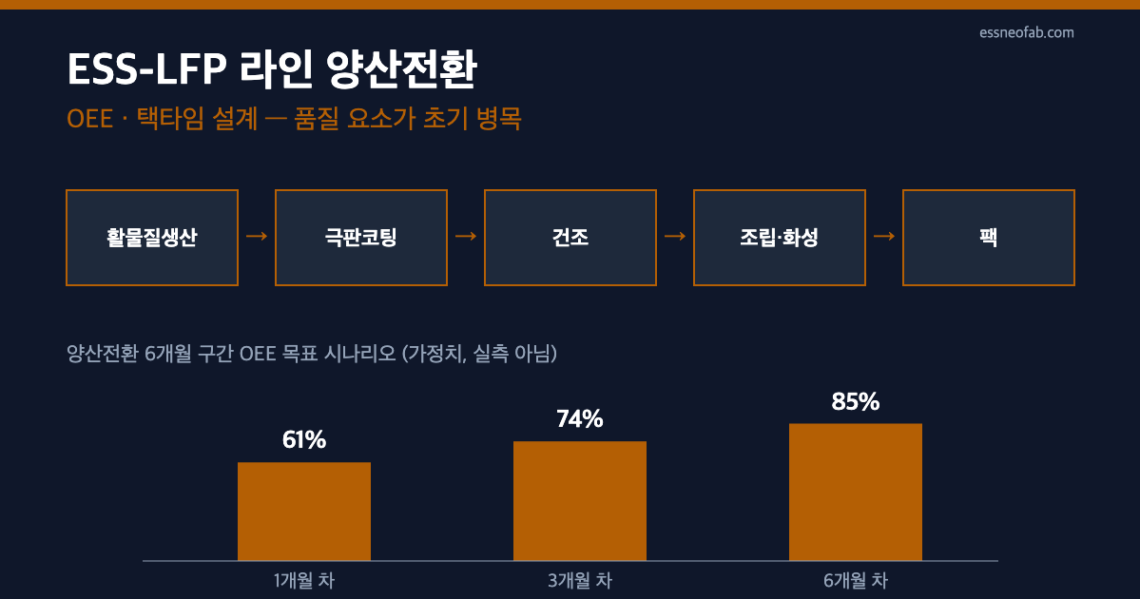
The Equipment Maker’s Line-Ownership Shift — OEE and Takt-Time Design During the ESS-LFP New-Line Mass-Production Ramp-Up
As more equipment suppliers directly operate their own ESS-LFP lines, a need has emerged to review line balancing and OEE management during the mass-production ramp-up separately from equipment-buyer-owned lines. Prompted by domestic equipment maker PNT's May 2026 earnings announcement, in which it stated it is focusing on yield stabilization for its Plant 4 ESS-LFP battery/cathode-active-material production line with a target of mass-production conversion in the second half of 2026, this article designs and verifies a target scenario for the order in which the three OEE factors — Availability, Performance, and Quality — improve during a ramp-up phase in which both new materials and a new line are introduced simultaneously. It…
You May Also Like
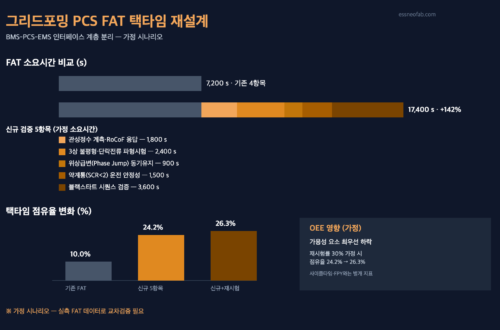
Grid-Forming PCS Mandate Redesigns FAT Takt Time and the BMS-PCS-EMS Interface
Designing the Merge Point in a 10 GWh Pack-Container Integration Line: Synchronizing Two Upstream Lines and Sizing AGV Fleet from the Powertrac × Sunka Lead Order
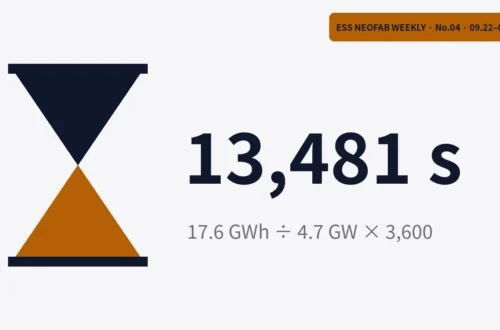
US storage set an energy record in Q2 as installed power fell 7%
-
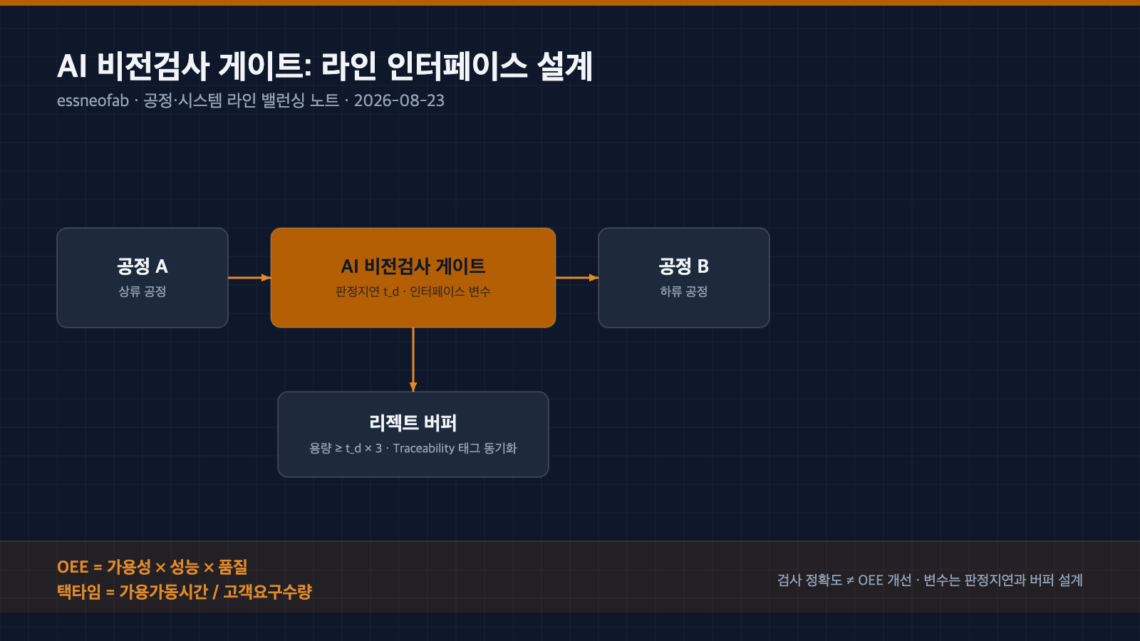
Embedding an AI Vision Inspection Gate in the Line: Redefining OEE and Takt-Time Design Variables
Across battery-line procurement specifications from 2024 to 2026, a trend is confirmed in which the Cognex, Keyence, ISRA, and MVTec deep-learning vision-inspection platforms have effectively become standard fixtures. However, only inspection-accuracy specs are typically stated, while the effect an AI vision-inspection gate has on the line's overall OEE performance rate and takt-time variance is often not treated as a separate design item. This article redefines the AI vision-inspection gate as two interface variables — judgment delay and reject-merge point — and addresses the procedure for incorporating them into line-balancing calculations. To state the conclusion first, it is not the accuracy of the AI vision inspection itself, but the buffer-capacity design…
You May Also Like
Grid-Forming PCS Mandate Redesigns FAT Takt Time and the BMS-PCS-EMS Interface
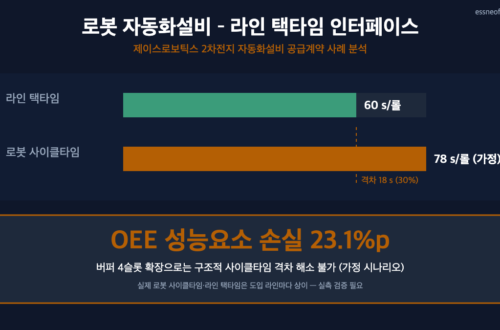
Introducing Robotic Automation Equipment — Where Does the Interface with Line Takt Time Break Down
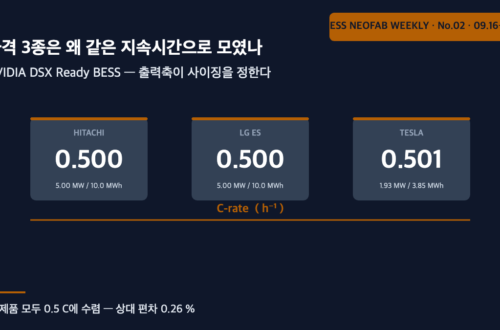
Why three qualified products landed on the same duration — in DSX Ready BESS, sizing is set by the output axis
-
Converting EV Lines to ESS: Where Does OEE Break Down?
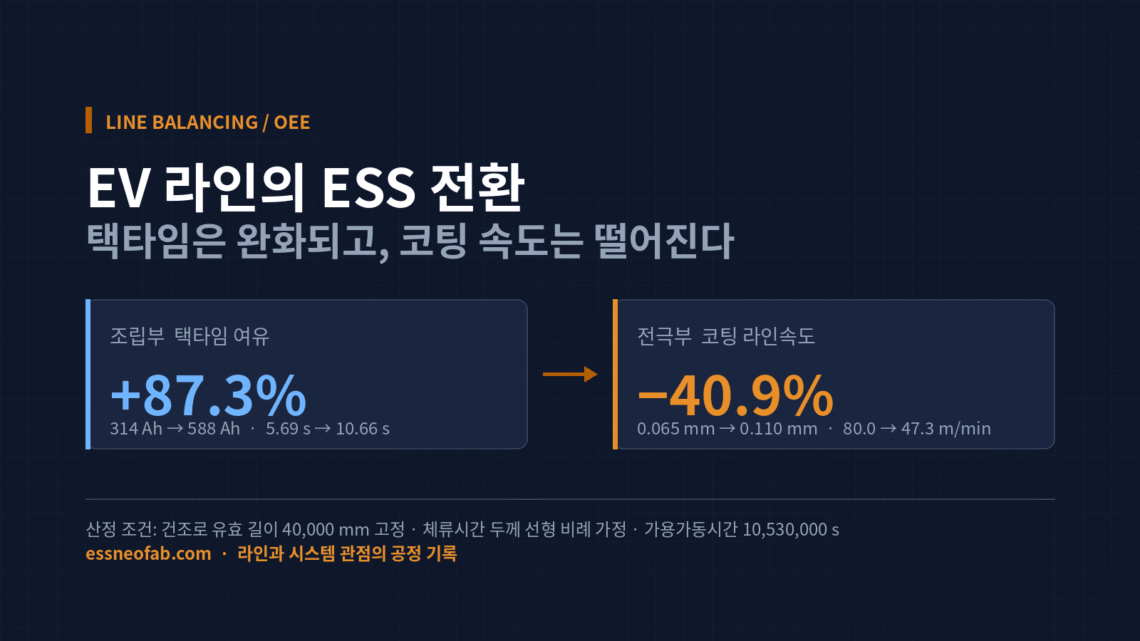
When converting an EV cell line for ESS use, retrofit effort and budget tend to concentrate on the assembly process. However, when a thick-film electrode and a large prismatic cell format are applied simultaneously while the drying-oven length remains fixed, the takt-time margin in the assembly section increases by 87.3% while the coating-section line speed drops by 40.9%. The conversion bottleneck shifts from assembly to the electrode section, and CAPEX priority should be reallocated accordingly. Furthermore, failing to update the abnormal-cycle-time baseline by part number books up to 36.3 percentage points of phantom performance loss into OEE, causing the improvement organization to chase a loss that does not exist. 1.…
You May Also Like
Designing the Merge Point in a 10 GWh Pack-Container Integration Line: Synchronizing Two Upstream Lines and Sizing AGV Fleet from the Powertrac × Sunka Lead Order
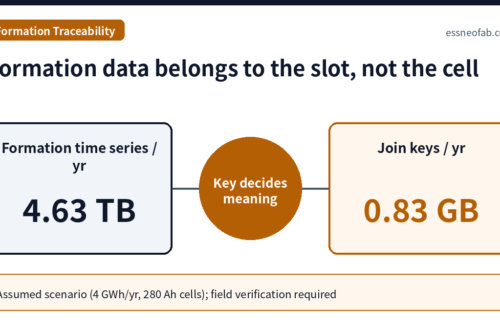
Linking Cell History in Formation and Aging: History Contamination from Tray ID + Slot Mapping

Market Trends from a Battery Process/Equipment Perspective — 46-Phi Ramp-Up, Dry Process, Equipment In-Housing
-
Inter-Process Buffers: Bigger Isn’t Always Better
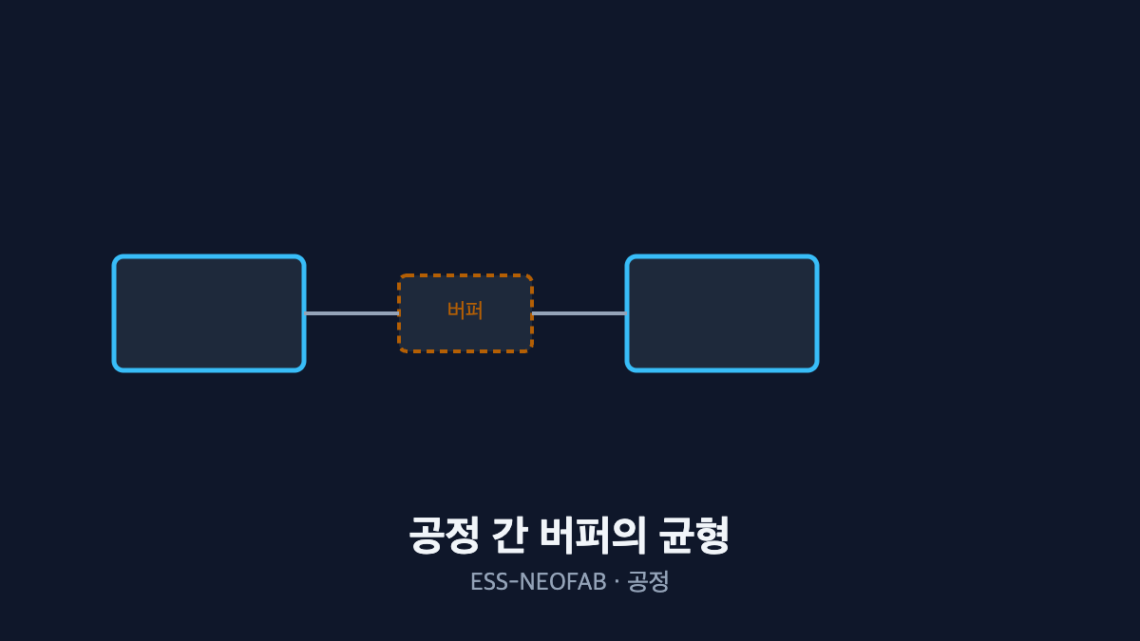
An inter-process buffer (work-in-process inventory) is not a device that gets safer as it grows. It is a range problem, bounded below by what availability demands and above by what quality tolerates. Under the assumed line conditions below, the availability-driven minimum is 2 coils while the quality-driven maximum is 1 coil — the two bounds conflict. That conflict is not resolved by enlarging or shrinking the buffer; it is resolved by reducing upstream MTTR (Mean Time To Repair) or by moving the defect-detection point ahead of the buffer. Every figure below is an assumed value set for illustration, and applying it 1:1 to a mass-production line requires separate verification. 1.…
You May Also Like
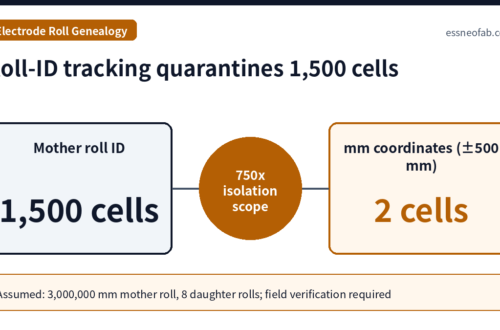
Electrode Roll Genealogy: How Key Reissue at Slitting and Stacking Shrinks Defect Isolation from 1,500 Cells to 2
Introducing Robotic Automation Equipment — Where Does the Interface with Line Takt Time Break Down
Linking Cell History in Formation and Aging: History Contamination from Tray ID + Slot Mapping
-
Cell Grading Bin Count and Grade-Specific WIP: What Module Matching History Must Retain
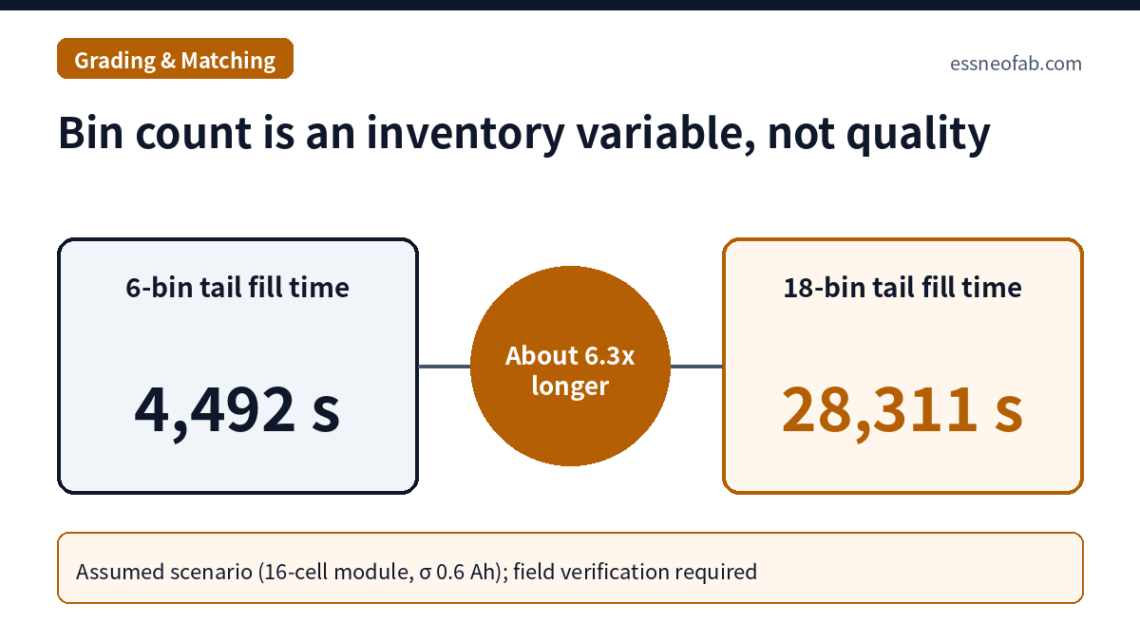
Increasing the number of cell grading bins reduces within-module capacity spread in proportion to bin width, but grade-specific waiting WIP rises in proportion to bin count, and the time for the rarest tail bin to fill one module's worth of cells rises faster still. On an assumed line of about 4.46 million cells per year with 16-cell modules, going from 6 bins to 18 bins (6 capacity × 3 internal resistance) leaves the 0.6 Ah capacity bin width unchanged while raising average partial-fill WIP from 45 to 135 cells and tail-bin fill time from about 4,492 s to about 28,311 s. During ramp-up (operating at 30% of rated rate) this…
You May Also Like
Introducing Robotic Automation Equipment — Where Does the Interface with Line Takt Time Break Down
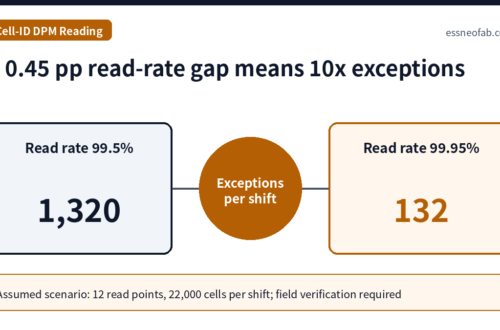
Cell-ID Laser DPM Read Rate 99.5% vs 99.95%: How No-Reads Drive Exceptions per Shift and OEE
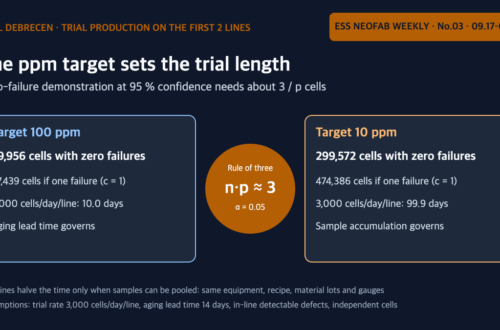
CATL Starts Trial Production in Debrecen — The Digits of the Defect-Rate Target, Not the Equipment, Set the Length of a Trial Run
-
Market Trends from a Battery Process/Equipment Perspective — 46-Phi Ramp-Up, Dry Process, Equipment In-Housing
The battery process/equipment market covers the equipment used in cell-manufacturing processes — mixing, coating, calendering, slitting, winding/stacking, assembly, and formation — and the changes in its technical specifications. This article summarizes recent trends centered on three streams: the shift to the cylindrical 46-phi form factor, the dry electrode process, and equipment in-housing/efficiency improvement. 1. Mass-Production Ramp-Up and Process Upgrades for Cylindrical Batteries (46-Phi and Others) LG Energy Solution's new cylindrical lines (2 units) at Nanjing Plant 9 to start operation in the second half of the year: Expansion pursued at 2GWh per line. Ramp-up accelerated by benchmarking the Shanghai Plant 6 model (30GWh) supplying Tesla. Tesla Giga Berlin production increase…
You May Also Like
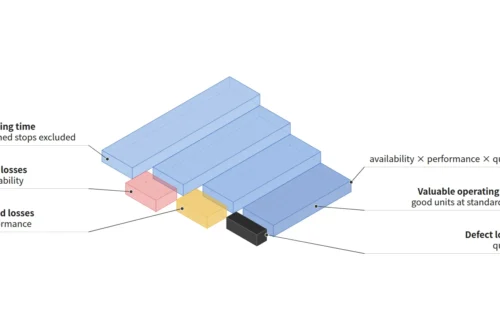
If Availability, Performance and Quality Are All 80 %, OEE Is 51.2 % — How to Calculate OEE
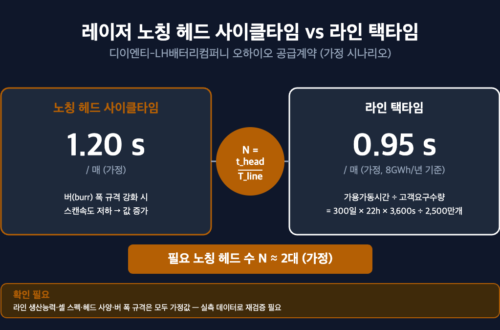
The Interface Between Laser Notching Cycle Time and Line Takt Time — The Head-Count Sizing Problem Revealed by DI ENT’s Ohio Supply Contract
Electrode Roll Genealogy: How Key Reissue at Slitting and Stacking Shrinks Defect Isolation from 1,500 Cells to 2
-
Linking Cell History in Formation and Aging: History Contamination from Tray ID + Slot Mapping
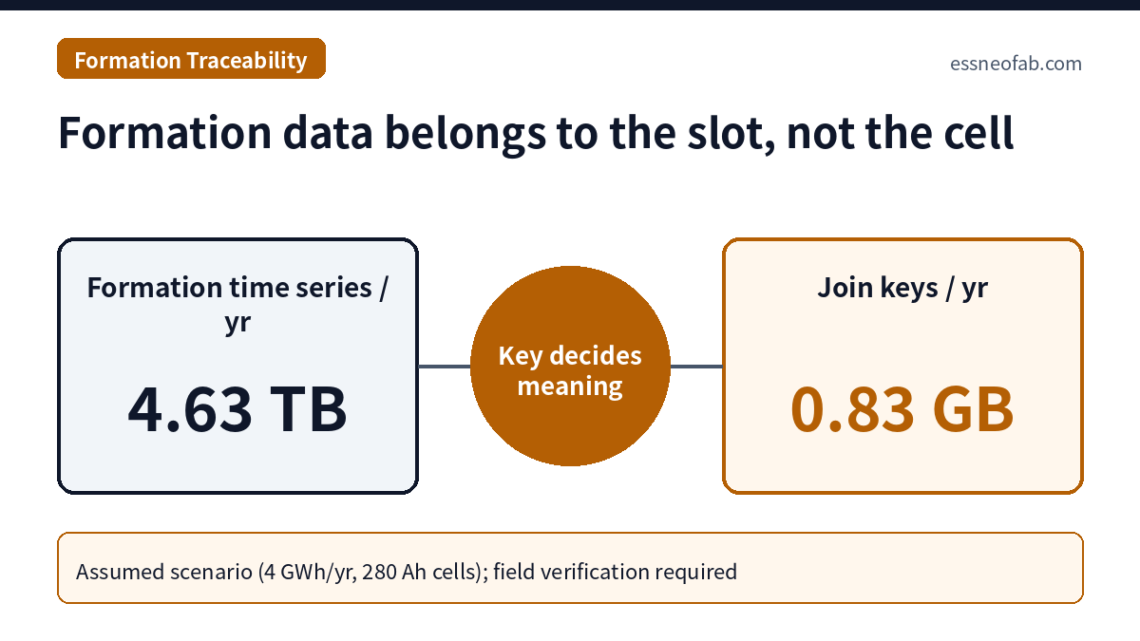
Measurement data in the formation and aging section are generated against equipment channels and tray slots, not against cell IDs; the completeness of cell history is therefore determined not by measurement accuracy but by the integrity of a join key composed of tray ID + slot position + load event. On an assumed line processing about 4.46 million cells per year, formation time series occupy about 1.04 MB per cell and about 4.63 TB per year, while the join-key record is 186 byte per cell, less than 0.02% of the total. Yet a slot misplacement rate of only 10 ppm per load event contaminates the history of about 268 cells…
You May Also Like
The Interface Between Laser Notching Cycle Time and Line Takt Time — The Head-Count Sizing Problem Revealed by DI ENT’s Ohio Supply Contract
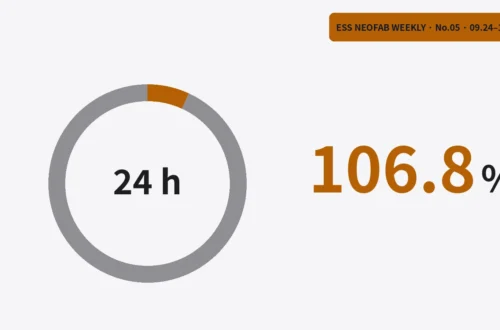
Two Cycles a Day Take 106.8 % of a Day, and the Retention Tier Shifts Cell Volume by 1.47 GWh
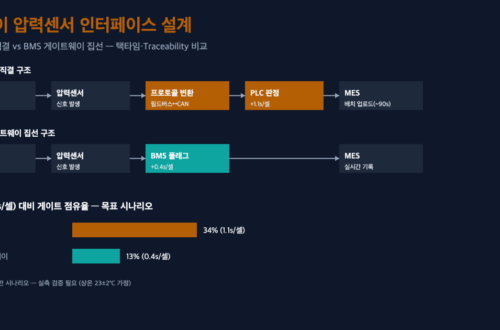
46-Phi Cylindrical Cell Line Conversion: The Pressure-Sensor–BMS Interface Determines Takt Time
-
Recall and Quarantine Scope vs Traceability Resolution: Lot Tracking Compared with Cell-Plus-Parameter Tracking
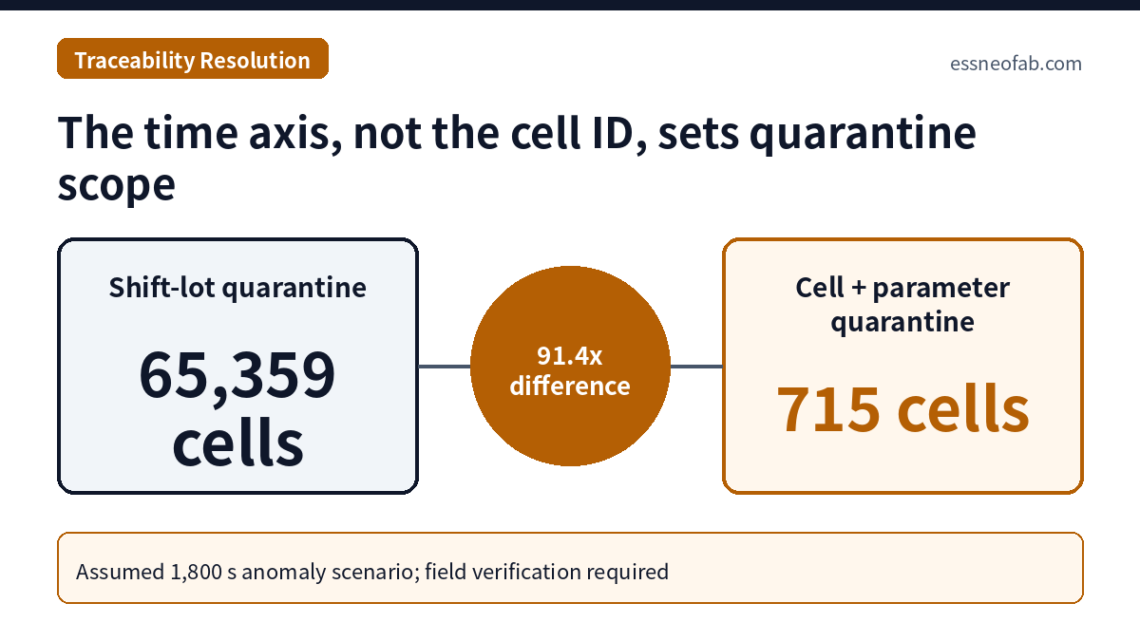
On an assumed line producing 25,000,000 cells per year, a process anomaly lasting 1,800 s at one station leads to a quarantine population of 196,078 cells at lot level (production-day lot plus adjacent lot), 65,359 cells at shift-lot level, 2,159 cells with cell-to-tray mapping, 2,045 cells with per-cell timestamps, and 715 cells with per-cell process-parameter linkage. The main lever that narrows the quarantine scope by roughly 30× is not the cell ID itself but time-axis resolution (lot → tray); per-cell parameter linkage narrows it by a further ~2.9×. Under 10-year retention, storage cost is below 0.1% of the quarantine cost of a single anomaly at shift-lot level, so the real…
You May Also Like
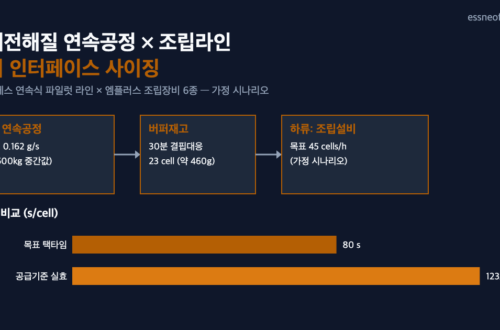
Between the Continuous Solid-Electrolyte Process and the Assembly Line: How Should the Buffer Interface Be Designed?
US storage set an energy record in Q2 as installed power fell 7%
Electrode Roll Genealogy: How Key Reissue at Slitting and Stacking Shrinks Defect Isolation from 1,500 Cells to 2