본문으로 바로가기
Ess-neofab

A line- and system-level record of ESS and secondary-battery manufacturing processes

  • 한국어
  • English
  • Home
  • Process
  • System
  • Interface
  • Traceability
  • News & Trends
  • About
  • Contact
  • 한국어
  • English
  • Home
  • Process
  • System
  • Interface
  • Traceability
  • News & Trends
  • About
  • Contact

카테고리

  • Interface (28)
  • News & Trends (20)
  • Process (32)
  • System (31)
  • Traceability (22)

최근 글

  • Five million ACC cells equal 2.7 to 3.6 months of nameplate outputOctober 15, 2026
  • A 160 MW battery’s six-week commissioning has two baselinesOctober 8, 2026
  • Two Cycles a Day Take 106.8 % of a Day, and the Retention Tier Shifts Cell Volume by 1.47 GWhOctober 1, 2026
  • Battwoo’s Second-Life EV Batteries — When an 80 % Acceptance Threshold Overlaps the Retirement Distribution, Incoming Screening Becomes the BottleneckSeptember 30, 2026
  • US storage set an energy record in Q2 as installed power fell 7%September 29, 2026
  • CATL Starts Trial Production in Debrecen — The Digits of the Defect-Rate Target, Not the Equipment, Set the Length of a Trial RunSeptember 29, 2026
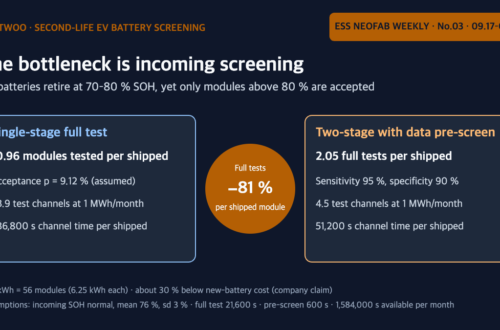
  • Bin count is an inventory variable, not quality
    Process,  Traceability

    Cell Grading Bin Count and Grade-Specific WIP: What Module Matching History Must Retain

    July 12, 2026 /

    Increasing the number of cell grading bins reduces within-module capacity spread in proportion to bin width, but grade-specific waiting WIP rises in proportion to bin count, and the time for the rarest tail bin to fill one module's worth of cells rises faster still. On an assumed line of about 4.46 million cells per year with 16-cell modules, going from 6 bins to 18 bins (6 capacity × 3 internal resistance) leaves the 0.6 Ah capacity bin width unchanged while raising average partial-fill WIP from 45 to 135 cells and tail-bin fill time from about 4,492 s to about 28,311 s. During ramp-up (operating at 30% of rated rate) this…

    read more
    ESS-neofab Comments Off on Cell Grading Bin Count and Grade-Specific WIP: What Module Matching History Must Retain

    You May Also Like

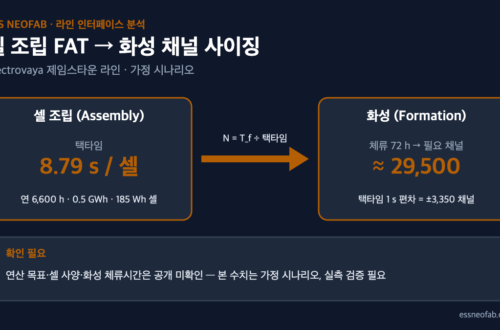
    EV 재사용 배터리 선별 공정에서 단일 전수 시험과 데이터 기반 2단 선별의 출하 모듈당 시험 수와 채널 수 비교 도식

    Battwoo’s Second-Life EV Batteries — When an 80 % Acceptance Threshold Overlaps the Retirement Distribution, Incoming Screening Becomes the Bottleneck
    September 30, 2026
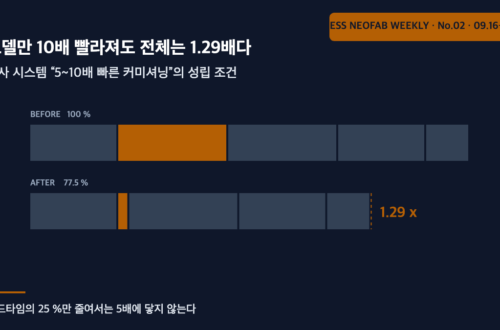
    셀 조립 택타임 8.79s와 화성 체류 72h로 역산한 필요 화성 채널 약 29,500개를 비교한 라인 인터페이스 도식(가정 시나리오)

    Formation Channel Sizing Read from a Cell Assembly Equipment FAT — How 1 Second of Takt Time Moves 3,350 Channels
    September 6, 2026
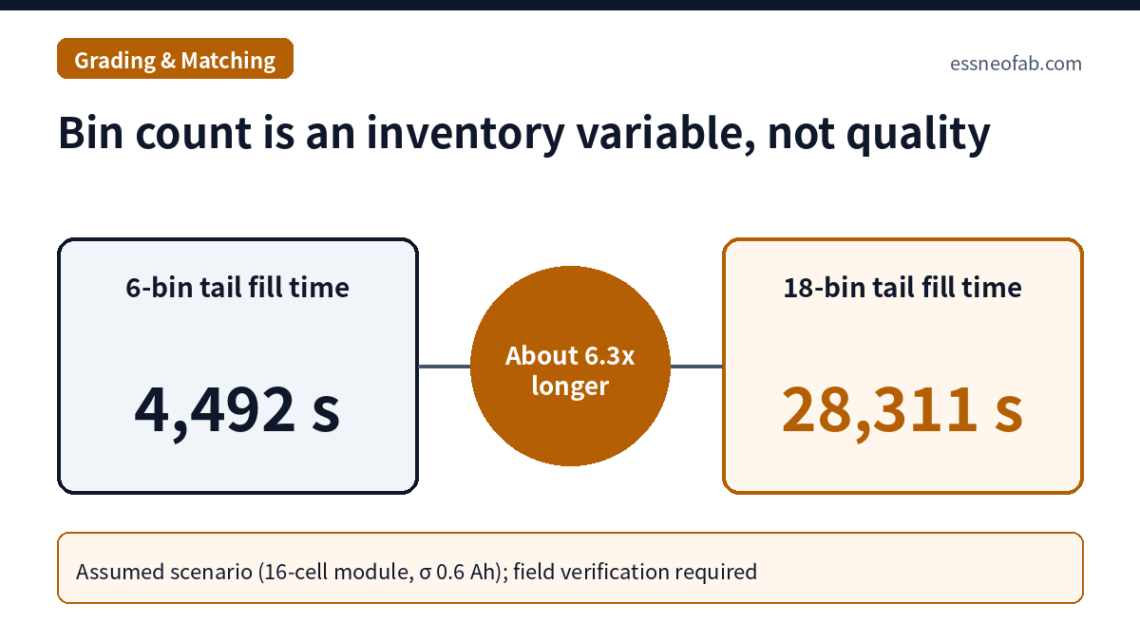
    비전 시스템 도입 리드타임 막대 도식 — 모델 단계만 축소될 때 전체가 77.5 %로만 줄어드는 구조

    Even a tenfold faster model moves the whole by 1.29x — what “5 to 10 times faster commissioning” actually requires
    September 26, 2026
© 2026 Ess-neofab · A line- and system-level record of ESS and secondary-battery manufacturing processes
  • About
  • Contact
  • Privacy Policy
  • Disclaimer
Ashe Theme by WP Royal.