-
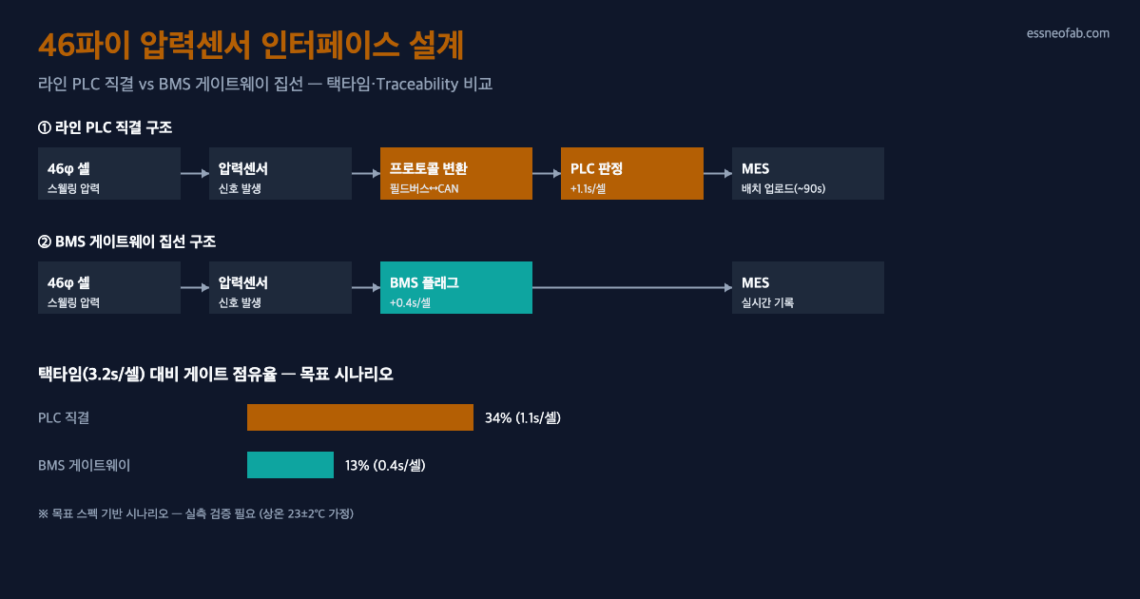
46-Phi Cylindrical Cell Line Conversion: The Pressure-Sensor–BMS Interface Determines Takt Time
As the transition to 46-series (46-phi) cylindrical cell mass production approaches, how much more finely the swelling-pressure behavior specific to the 46 mm-diameter cell must be measured compared to the 21700 has emerged as a practical line-design variable. As Korea's ESS Round-3 centralized-contract market bid size is under review for expansion to over 1 GW and new ESS orders for AI data centers surge, pressure to expand or convert 46-phi lines is expected to grow further. This article presents the proposition that an interface structure in which pressure-sensor data is first aggregated at the BMS gateway layer — rather than at the line PLC — absorbs per-gate judgment delay within…
You May Also Like
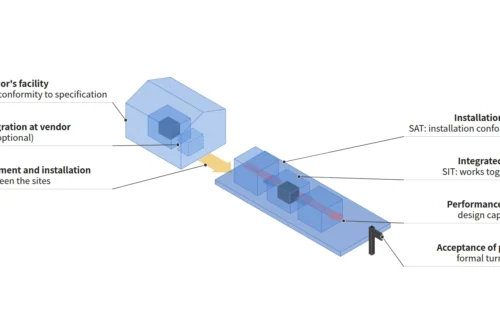
FAT and SAT Differ in More Than Location — How IEC 62381:2024 Defines the Tests
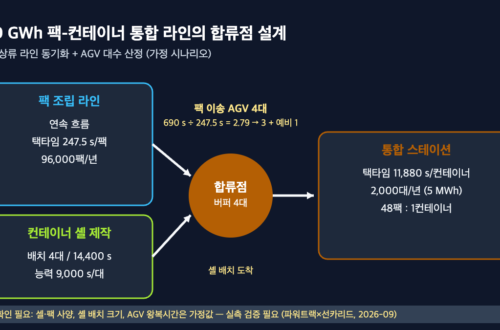
Designing the Merge Point in a 10 GWh Pack-Container Integration Line: Synchronizing Two Upstream Lines and Sizing AGV Fleet from the Powertrac × Sunka Lead Order
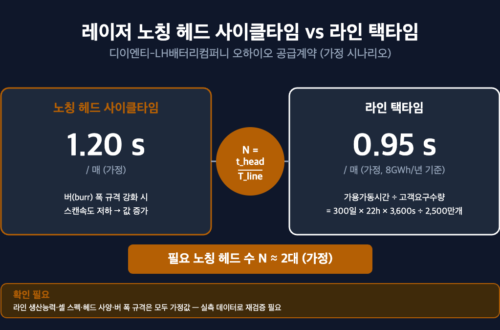
The Interface Between Laser Notching Cycle Time and Line Takt Time — The Head-Count Sizing Problem Revealed by DI ENT’s Ohio Supply Contract
-
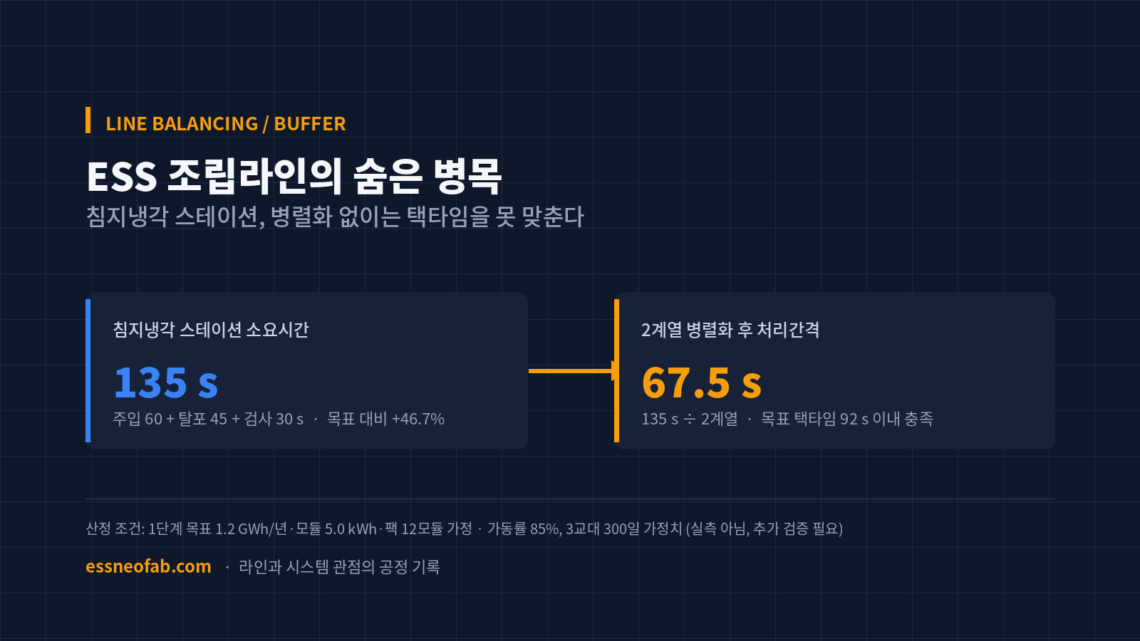
ESS Assembly Line: Why Immersion Cooling Becomes a Bottleneck
This article addresses the line-balancing problem that arises when immersion cooling and AI cell monitoring are simultaneously integrated in-line into an ESS module-pack assembly line. Under the estimation scenario, the immersion-cooling station's process time is 135 s, exceeding the target module takt time of 92 s by 46.7%, making a bottleneck unavoidable with a single-station configuration. Parallelizing into 2 lines lowers the effective processing interval to 67.5 s, satisfying the takt-time condition, but this in turn raises the FIFO buffer size at the point where the two lines merge, and the module-serial tagging of AI monitoring data, as new interface risks. This estimation is a scenario based on assumed values…
You May Also Like
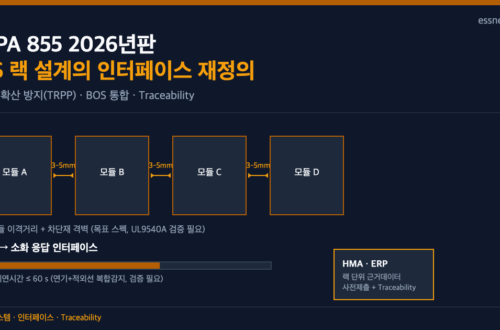
The 2026 Edition of NFPA 855 Changes ESS Rack Design and Traceability Documentation at the Same Time
Designing the Merge Point in a 10 GWh Pack-Container Integration Line: Synchronizing Two Upstream Lines and Sizing AGV Fleet from the Powertrac × Sunka Lead Order
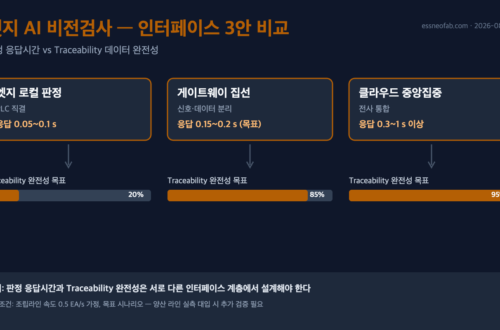
Edge AI Vision Inspection and Battery-Pack Leak Testing: How Gateway Aggregation Affects Traceability Completeness