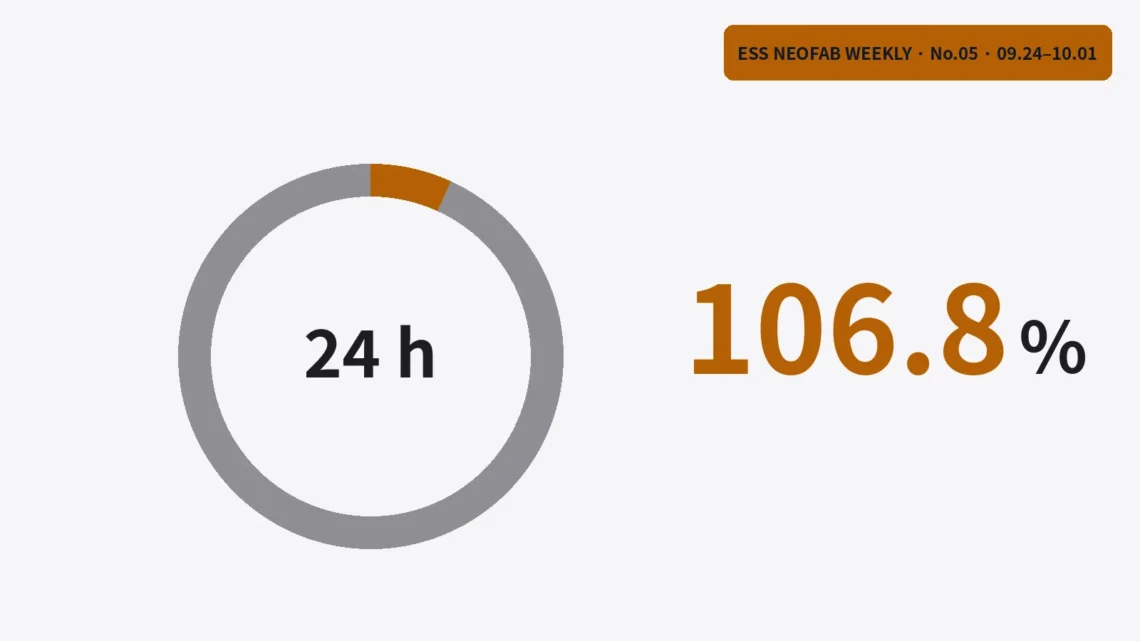
Two Cycles a Day Take 106.8 % of a Day, and the Retention Tier Shifts Cell Volume by 1.47 GWh
ESS NEOFAB WEEKLY · No.05 · System
Ask a 6-hour ESS for two full charge and discharge cycles a day, and 24 hours fall short.
Summary
Korea’s 25-year Jeju contract asks for at least 730 charge and discharge cycles a year from an 80 MW, 480 MWh system that runs for 21,600 s (6 hours) at full power. If each cycle is a full one and round-trip efficiency is assumed at 0.88, two cycles a day take 92,291 s, which is 106.8 % of the 86,400 s in a day. The warranty-life score pays 7 points for 90 % or more capacity at contract end and 1.75 points for 75 to 80 %. With no cells allowed to be added mid-term, the mainland’s 6.6 GWh needs between 7.33 and 8.80 GWh of installed cells, a gap of 1.47 GWh. I could not find out how the cycles are counted.
What a twice-a-day promise looks like on a clock
Since September 28, Korea’s power exchange has been taking registrations for the third energy storage system (ESS)1 central contract market2 auction[1]. Volume comes to 1.1 GW on the mainland plus 80 MW on Jeju island, 1.18 GW3 in total. Rounds one and two were 540 MW each, so this auction more than doubles them. Jeju also gets a 25-year contract option for the first time.
Choose the 25-year option and you must run at least 730 charge and discharge cycles4 a year[2]. One report reads that as two cycles a day for 25 years, 18,250 in all. A 15-year contract asks for 395 a year, 5,925 in all. I did not treat these as battery-life numbers only. I put them on a day measured in seconds, and two things stood out.
The first is time. Jeju’s system holds 480 MWh and delivers 80 MW, so it lasts 21,600 s (6 hours) at full output. Emptying and refilling it twice a day takes 92,291 s (about 25.6 hours) if charging losses are 12 %. A day has 86,400 s.
The second is the score sheet. Warranty-life points drop in steps as remaining capacity falls, and the rules shut the door on adding cells during operation. Whichever tier you aim for then sets how many cells you install on day one. Public reports did not say whether a cycle means a full charge and discharge. So my open question is how a cycle gets counted.
Three numbers picked from the evaluation rules
An ESS power producer5 does the bidding, and a battery maker does not[1]. That producer builds a price from battery cost, construction, operating cost, and battery life. Registration runs until October 2, proposals open on October 6, and winners come out in November. Mainland volume is 6.6 GWh at six hours of discharge (1.1 GW × 6 hours), and plants must finish by February 2029.
Price and non-price factors each carry 50 % of the evaluation. Within the non-price half, grid connection, industrial and economic contribution, and fire safety get 25 points each[1].
My three numbers sit beside that scoring, in the warranty-life terms for the Jeju 25-year type[2]. A system must hold at least 70 % of its initial design capacity for the whole term. If remaining capacity6 at term end is 90 % or more, the score is the full 7 points. Tiers of 85 to 90 %, 80 to 85 %, and 75 to 80 % earn 5.25, 3.5, and 1.75 points. Nothing in the report scores tiers under 75 %.
A table shows the steps with the gap between tiers.
| Remaining capacity at term end | Warranty-life score (points) | Gap to the tier above (points) |
|---|---|---|
| 90 % or more | 7.00 | Reference |
| 85 to 90 % | 5.25 | −1.75 |
| 80 to 85 % | 3.50 | −1.75 |
| 75 to 80 % | 1.75 | −1.75 |
Each step is worth exactly 1.75 points. Across a 15-point range, 5.25 points are at stake, which works out to 0.35 points per percentage point of capacity. Where a cell that has run twice a day for 25 years lands on this staircase sets the score. A 15-year type has to reach the same tier in 5,925 cycles, and the two contracts differ in cycle count by a factor of 3.08.
Adding cells mid-term to meet the standard is blocked. Makers must design so that the required capacity holds to the end of the warranty, and it barred adding design capacity just to stretch warranty life[2]. At the September 30 briefing it said no particular technology is favored, and that any battery that can take two cycles a day and about 18,000 cycles may take part[3].
Round two adds background. Of 565 MW awarded, SK On took 284 MW, Samsung SDI 202 MW, and LG Energy Solution 79 MW[2]. Those three add up to 565 MW, so the article is consistent with itself. Next come calculations that turn the conditions those three companies now face into seconds and gigawatt-hours.
A six-hour system that overruns the day
Picture a study room rented out twice a day. Each use takes 6 hours, and resetting the room before the next guest takes a little over 6 more. Two rounds run past 24 hours. In an ESS, using the room is discharge and resetting it is charging. That picture slips on the charging side, because more cleaners speed up a reset but charging is tied to what the power conversion system (PCS)7 can accept.
Takt time8 turns the requirement into something sharper. Formally, takt time is available operating time divided by customer demand quantity. Take 86,400 s a day and two cycles, and the takt time is 43,200 s. Each charge and discharge has to finish inside it. Takt time and the processing time of one charge and discharge are different values, which is exactly why they can be compared.
Processing time is the 21,600 s of discharge plus the charging time. Charging has to replace the discharged energy plus losses, so at a round-trip efficiency9 of 0.88 it takes 21,600 ÷ 0.88 = 24,545 s. Together that makes 46,145 s, 6.8 % longer than the 43,200 s takt time. Over a day that is 92,291 s, or 106.8 % of 86,400 s. Even with no rest at all, the system runs out of time.
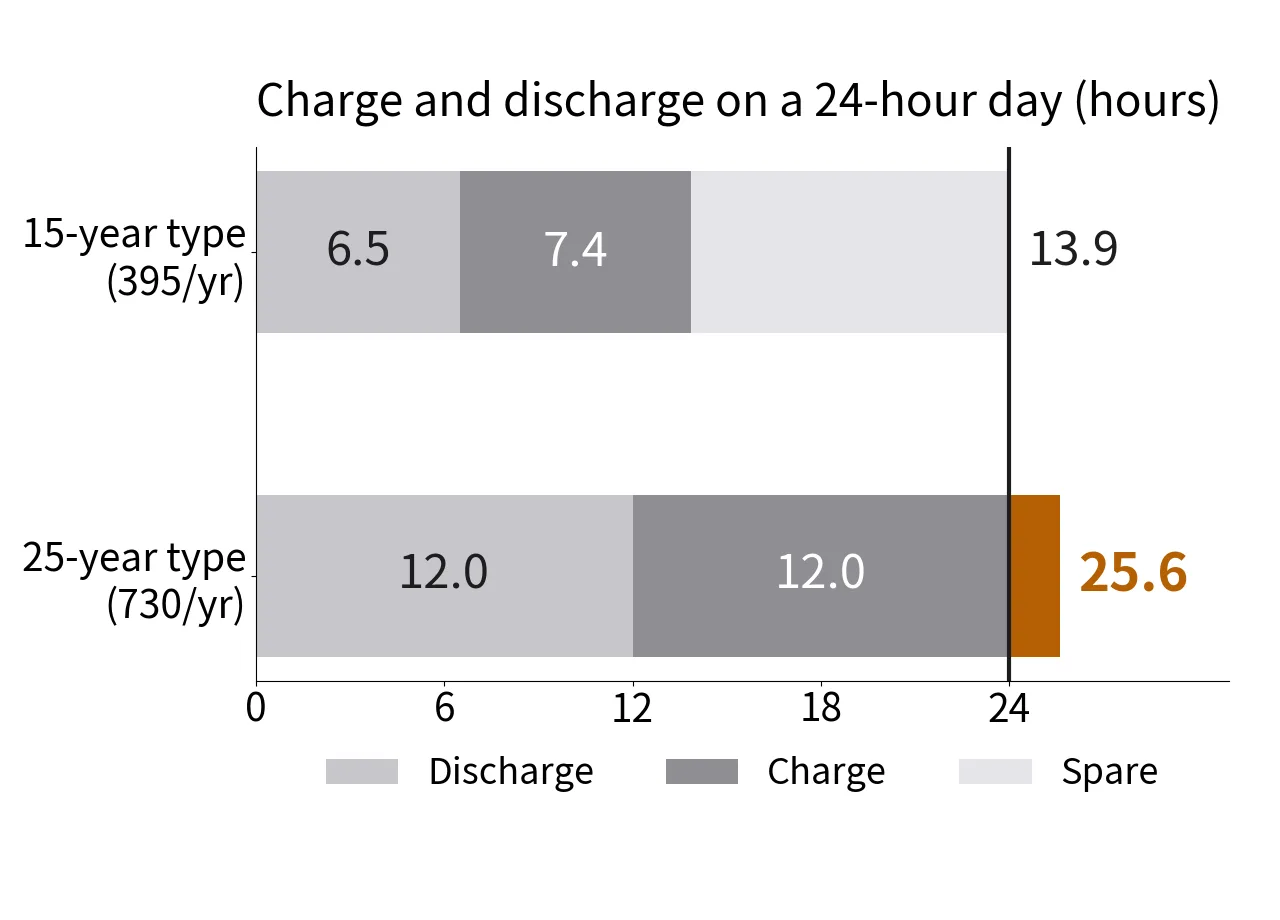
This chart lines up a day for the 15-year and 25-year types. At 395 cycles a year, about 1.08 a day, the 15-year type spends 13.9 hours charging and discharging and keeps 10.1 spare. By the same formula it uses 57.8 % of the day. A 25-year type needs 25.6 hours, so its bar crosses the 24-hour line by 1.6 hours.
Neofab’s calculation note
Takt time = available operating time ÷ demand = 86,400 ÷ 2 = 43,200 s
Discharge = 480 MWh ÷ 80 MW × 3,600 = 21,600 s
Charge (round-trip efficiency 0.88) = 21,600 ÷ 0.88 = 24,545 s
One full charge and discharge = 21,600 + 24,545 = 46,145 s
Two a day = 92,291 s → 106.8 % of 86,400 s
Most cycles per day = 86,400 ÷ 46,145 = 1.872 → 683 a year (short of 730)
Average depth limit per cycle = 43,200 ÷ 46,145 = 93.6 %
With charging power raised to 1.5 times discharge (120 MW): charge 16,364 s, two cycles 75,927 s (87.9 %)
Assumptions: a cycle means a full charge and discharge, charging power equals the 80 MW discharge power, round-trip efficiency is 0.88, and the system runs 24 hours a day without rest. I could not find in the public reports whether cycles are counted this way.
Two conclusions follow. To reach 730 a year, the average depth of a cycle has to stay at or below 93.6 %. To count full cycles, charging power has to exceed discharge power. A 1.5 times charging rate brings the day down to 87.9 %, but it calls for a 120 MW PCS. Battery line workload stays the same while PCS line workload grows by 50 %.
Until the cycle definition is published, I would not read 730 as a battery-life requirement alone. That same 730 drags PCS capacity in, depending on depth and charging power. My evidence is the two results, 106.8 % and 87.9 %.
The retention tier decides the cell volume
My second calculation starts from the score sheet. If required capacity must still be met at term end and no cells can be added, the initial installation has to be at least the required capacity divided by the remaining fraction. At 90 % that is 1.111 times, and at 75 % it is 1.333 times. That formula is my assumption. I found no sentence in the public reports telling bidders to size it this way.
Using each tier’s lower bound as the remaining fraction and applying it to the mainland’s 6.6 GWh, the cells to install come to 7.333 GWh in the 90 % tier, 7.765 GWh at 85 to 90 %, 8.250 GWh at 80 to 85 %, and 8.800 GWh at 75 to 80 %. A chart sets them next to the scores.
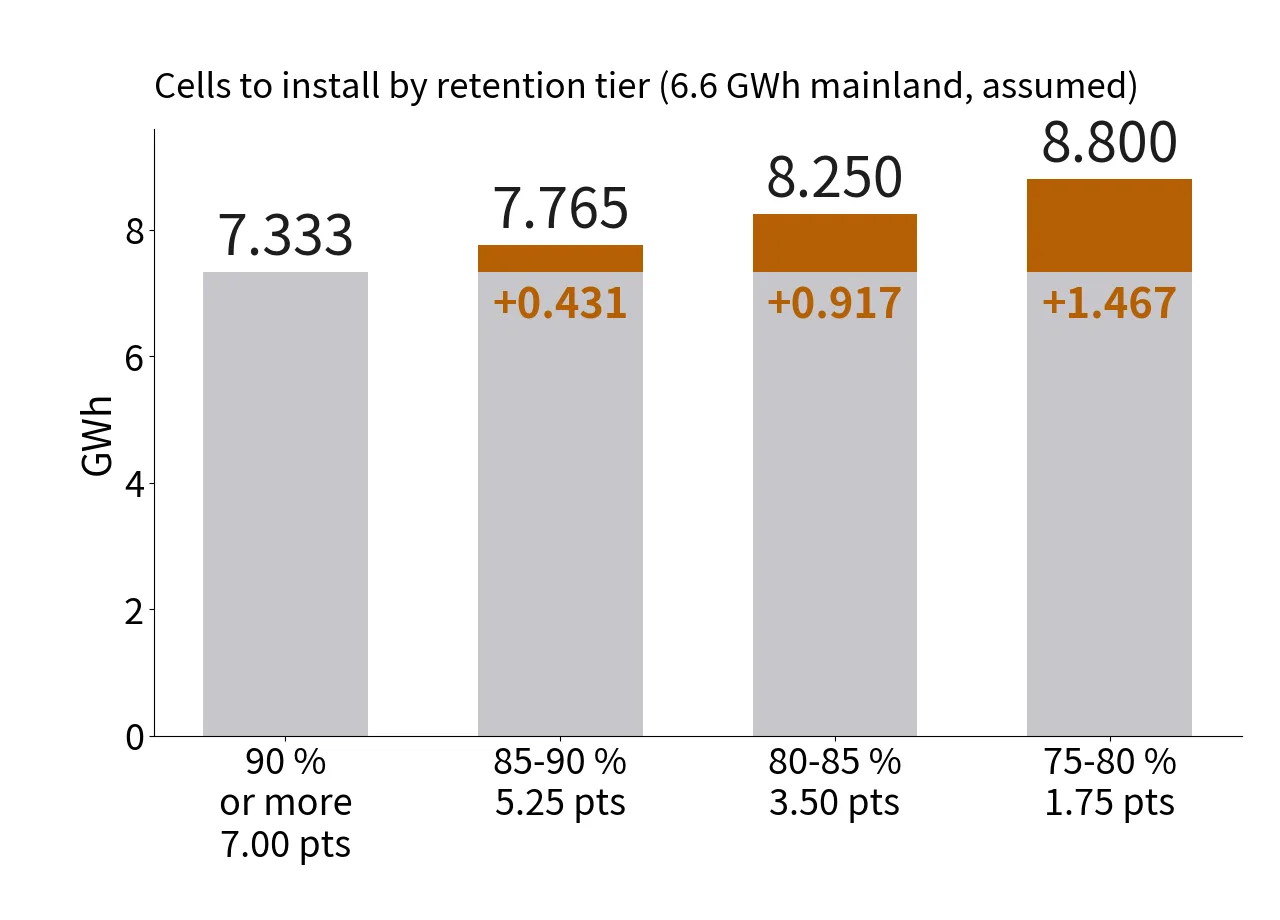
Comparing 90 % with 75 % gives a 1.467 GWh difference in installed cells and a 5.25-point difference in score. Each step down costs the same 1.75 points. Extra cells per step grow, at 0.431, 0.485, and 0.550 GWh. Per point, that is 0.246, 0.277, and 0.314 GWh. Lower tiers take more cells to give up the same number of points.
From a factory’s side, 1.467 GWh is 53.5 days of output from a line that ships 10 GWh a year (assumed). Building the 6.6 GWh itself takes that line 241 days. At the 90 % tier that is 268 days, and at the 75 % tier 321 days. One tier choice moves almost two months of a line’s work.
From the other side, the 25-year type carries a harder task. Aiming at 90 % remaining at term end spends 10 percentage points over 18,250 cycles, so the allowed fade is 0.000548 points per cycle. A 15-year type spends the same 10 points over 5,925 cycles, which is 0.001688 points per cycle. To land in the same tier, a 25-year cell must fade 3.08 times more slowly per cycle. This is a simple calculation with no calendar ageing and a constant fade rate, so real conditions are tighter.
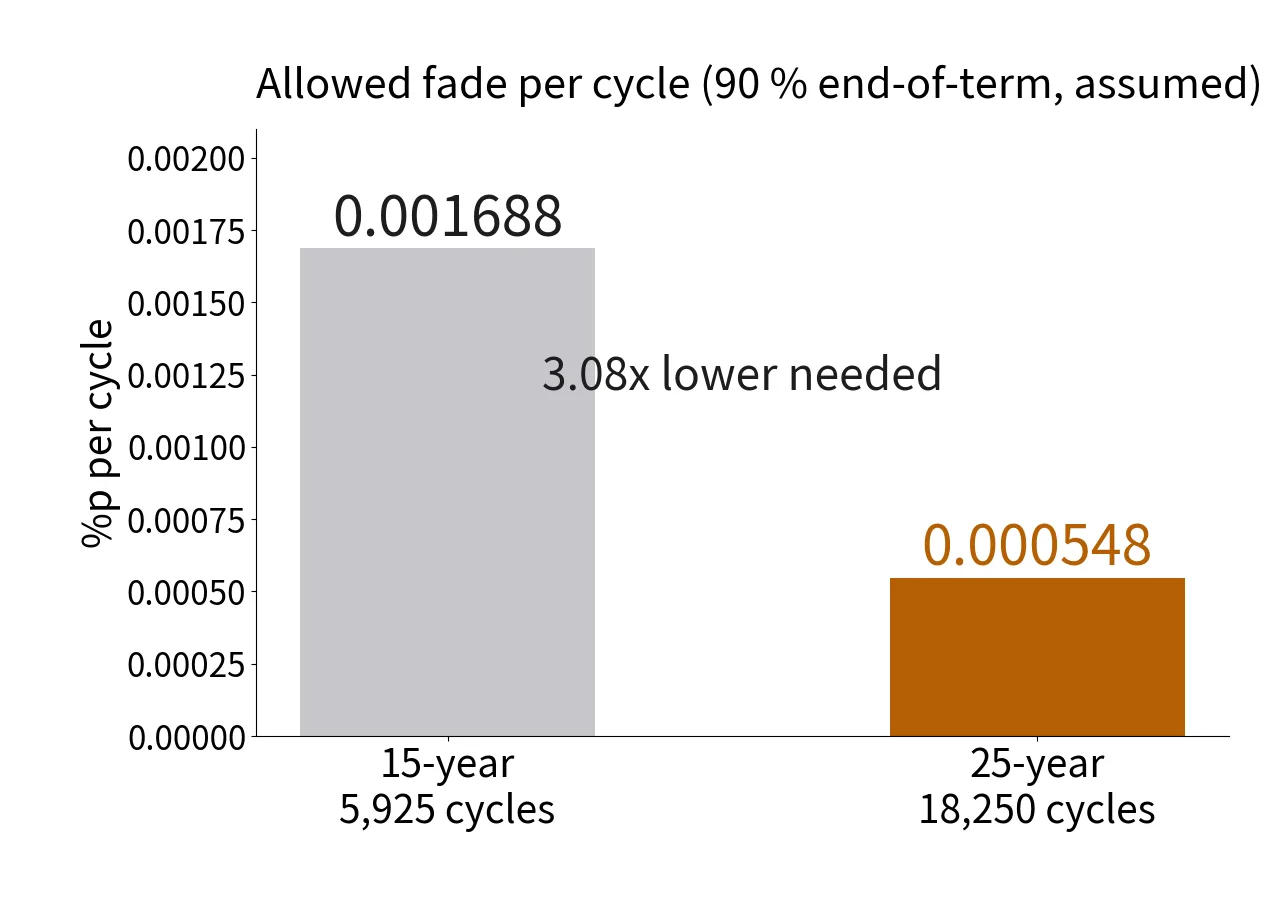
That 3.08 gap between the bars equals the ratio of cycle counts, 18,250 ÷ 5,925. With the same remaining fraction, the fade budget shrinks in proportion to the number of cycles. Global Economic quotes an industry source who says that, for a maker, cell-to-cell variation and thermal management across thousands of cells decide 25 years more than any single cell does[2]. A smaller fade budget raises the weight of that variation.
The bidder and the builder are different companies
That the bidder sits outside the battery maker shakes the calculation in another direction[1]. Power producers negotiate supply terms with several battery makers and sometimes change supplier just before bidding. A maker may then not know how many GWh its own line will build until winners are named in November. A 1.467 GWh gap between tiers gets locked in before award, when the producer files the proposal.
Domestic production is checked beyond the paperwork as well. Each supplier’s production region must be stated in the bid, the exchange says, and the certificate of origin10 is checked again during contract performance[3]. That means a record of which line each cell came from has to survive after shipment. That same 6.6 GWh becomes 7.33 to 8.80 GWh depending on the tier, so the number of cells to record grows by the same ratio.
I judge the retention tier in this auction to be a decision about cell volume before it is a scoring tactic. My evidence is that mid-term top-ups are blocked and that the installed gap between the 90 % and 75 % tiers reaches 1.467 GWh (assumed). This judgment holds only if the sizing formula matches the real rules.
A few limits are worth stating. Timetable figures rest on one 80 MW Jeju system, and the mainland’s 15-year type uses 57.8 % of the day by the same formula, so it has room. Sizing is a simple formula based on tier lower bounds. It leaves out cell layout, auxiliary power, and temperature derating. A round-trip efficiency of 0.88 also varies by system. Raising it to 0.95 still leaves the day at 102.6 %, so the overrun stays.
My opening question is still open. If cycles are counted as full ones, the Jeju 25-year type must do in 46,145 s what a 43,200 s takt time allows. If the tender notice or briefing materials around the October 6 opening spell out the cycle definition, that sentence is the first thing I will look for. One number decides it, and that is whether the depth behind the 730 cycles is above 93.6 %.
Frequently asked questions
If the 730 cycles are not full cycles, is this calculation wrong?
Conditions change. Schedules fit if the average depth of a cycle is 93.6 % or lower. At an average depth of 80 %, two cycles a day take 73,833 s, or 85.5 % of 86,400 s. A shallower cycle also means the 480 MWh system delivers less energy per cycle, and the public reports do not say how that relates to contract volume.
Does a cell have to survive 18,000 cycles by itself for a 25-year life?
An industry source in the report says a single-cell count does not settle it[2]. Some cells are rated for more than 10,000 cycles, but a system of thousands of cells adds cell-to-cell variation, thermal management, and ageing over time. That 3.08 figure counts cycles only, so it is a starting point.
What each reader can do
These numbers serve different readers in different ways.
| Reader | What to take away | What to try now |
|---|---|---|
| Job seeker | Takt time = available operating time / customer demand quantity also works on an asset’s operating schedule (43,200 s) | Find the contract term and yearly cycle count in a company’s ESS project material and lay them on an 86,400 s day |
| General reader | A promise of “twice a day” is tied to system size and charging time | When the tender notice appears, look for the sentence that says how a cycle is counted and copy it down |
| Reader following the market | The retention tier links to 7.33 to 8.80 GWh of cells on the mainland’s 6.6 GWh | Record each supplier’s awarded MW from the November result, converted to six-hour storage |
This article is for information only and is not investment advice. See our Disclaimer.
Glossary
- Energy storage system (ESS) — Equipment that stores electricity in batteries and releases it when needed. Here it means large battery storage connected to the grid. ↩
- Central contract market — A Korean scheme in which a public body pools ESS volume, invites bids, and signs long-term contracts with the winners. Here it means the ESS auction run by the power exchange. ↩
- GW and GWh (gigawatt, gigawatt-hour) — GW measures power at a given moment, and GWh measures the energy that power delivers over time. Running 1 GW for 3,600 s delivers 1 GWh. ↩
- Charge and discharge cycle — One round trip of filling and emptying a battery. A cycle can be counted as a full fill and empty, or as partial use added up to a full one. ↩
- Power producer (generation business operator) — A business that makes or stores electricity and supplies it to the power market. Here it is the party that builds, runs, and bids with an ESS. ↩
- Remaining capacity (state of health) — The share of a new battery’s original capacity that is still left. It falls as time and cycles accumulate. ↩
- Power conversion system (PCS) — The device that converts between the battery’s direct current and the grid’s alternating current. It sets the power limit for both charging and discharging. ↩
- Takt time — How often a line must finish one unit to keep up with customer demand. Takt time = available operating time / customer demand quantity. More: how to calculate takt time ↩
- Round-trip efficiency — The share of the energy put in during charging that comes back out in discharge. At 0.88, putting in 100 gives back 88. ↩
- Certificate of origin — A document that proves in which country and region goods were made. Here it confirms where batteries and key materials were produced. ↩
Sources and notes
- Electronic Times (etnews), “1.18GW 규모 ‘3차 ESS 수주전’ 본격화…28일부터 사업자 등록” (The 1.18 GW third ESS auction begins, registration from the 28th), 2026-09-28. https://www.etnews.com/20260928000202
- Global Economic (g-enews), “ESS 계약기간 15년서 25년으로 늘어나…K배터리 3사 ‘수명 경쟁’ 붙는다” (ESS contract term grows from 15 to 25 years), 2026-09-24. Cited for the Jeju 25-year cycle counts, warranty-life scores, and second-round awards. https://www.g-enews.com/article/Industry/2026/09/2026092310523795993084322ec9_1
- Electronic Times (etnews), “ESS 시장 3라운드…국내 생산·안전성은 기본, 계통 기여도 부각” (ESS round three), 2026-09-30. Cited for the power exchange’s briefing. https://www.etnews.com/20260930000442
- Assumed values: a cycle is a full charge and discharge, charging power equals the 80 MW discharge power (the raised case is marked in the text), round-trip efficiency is 0.88, the system runs 24 hours a day, and a year has 365 days. Installed cells equal required capacity ÷ remaining fraction, using each tier’s lower bound. The 10 GWh a year line is an assumption used to express the gap in days.
- The fade budget is 10 percentage points for a 90 % end-of-term target divided by total cycles, assuming fade is constant per cycle and leaving out calendar ageing. The 15-year type uses 395 cycles a year and the 25-year type 730. The first and second round volumes are reported at about 540 MW with small differences between articles, and the text uses etnews’s 540 MW.


You May Also Like
Embedding an AI Vision Inspection Gate in the Line: Redefining OEE and Takt-Time Design Variables
Designing the Merge Point in a 10 GWh Pack-Container Integration Line: Synchronizing Two Upstream Lines and Sizing AGV Fleet from the Powertrac × Sunka Lead Order