SK On’s Dual-Site ESS Production Bases — Where Fixed Contracts and Variable Bidding Split Takt Time Design
Abstract
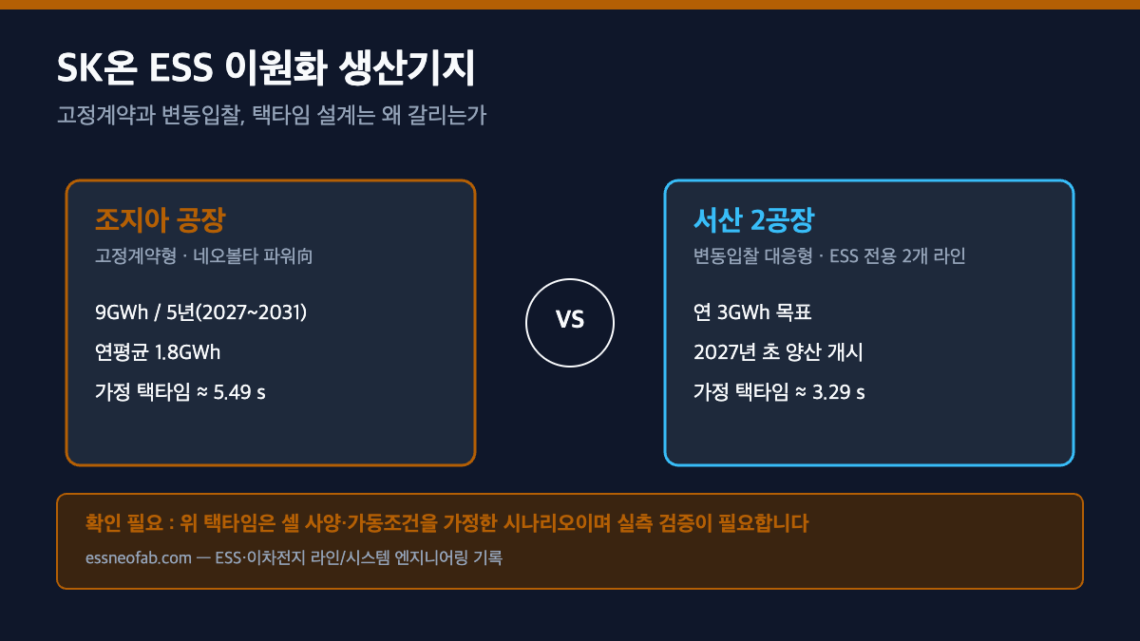
As of the second half of 2026, SK On is simultaneously pursuing two capacity-allocation efforts that look similar on the surface but differ sharply in character: a long-term fixed-contract ESS supply obligation from its Georgia, USA plant (9 GWh over 2027-2031 to NeoVolta Power), and a variable-bid-responsive capacity build at its domestic Seosan Plant 2, where 2 of 4 production lines are being converted to dedicated ESS-LFP pouch-cell lines. Both sites represent “ESS expansion” on paper, but the takt time (Takt Time) character each demands is different.
Using publicly disclosed contract and conversion volumes, this article constructs an assumed scenario showing quantitatively that the fixed-contract site is better served by an availability-maximizing, fixed takt time design, while the variable-bid site is better served by a design built around takt time slack and buffer. However, because many variables, such as cell specifications and operating conditions, remain undisclosed, all figures below are assumed scenarios requiring field verification.
1. SK On’s Two Faces – Same ESS, Different Capacity-Allocation Logic
To state the conclusion first: SK On’s ESS business expansion is not one strategy but two capacity-allocation problems of different character. The Georgia, USA plant must fulfill a fixed-volume contract to supply a total of 9 GWh to NeoVolta Power over the five years 2027-2031, while the domestic Seosan Plant 2 must convert 2 of its 4 production lines into dedicated ESS LFP pouch-cell lines to meet 3 GWh/year of annual capacity against domestic bid demand.
The Situation is this: SK On is a late entrant in the ESS business relative to LG Energy Solution and Samsung SDI, and has set a global ESS order target of roughly 20 GWh this year. The Complication is that this 20 GWh is being filled simultaneously from two demand sources of entirely different character (overseas fixed contract vs. domestic variable bidding). The Question naturally follows: should the same line design philosophy be applied to both sites, or should the takt time design itself be split according to demand character? This article’s Answer is the latter.
2. Fixed Contract vs. Variable Bidding – An Assumed Takt Time Back-Calculation Scenario
The actual cell specifications (rated capacity, voltage) and the Seosan line’s operating conditions (operating days, shift system) are not publicly disclosed. Accordingly, the calculations below apply industry-standard values as an assumed scenario, intended only to show the direction of the relative comparison in the conclusion; actual line design values may differ.
Assumptions: LFP pouch cell rated capacity 130 Ah, rated voltage 3.2 V, giving energy per cell of 0.416 kWh. 300 operating days/year, 22 h/day across 2 shifts (excluding non-operating time such as maintenance), giving annual operating time of 6,600 h (23,760,000 s).
| Site | Annual target volume | Required cell count (assumed) | Required takt time (assumed) |
|---|---|---|---|
| Georgia plant (fixed contract, assuming even distribution of 9 GWh/5 yr to NeoVolta Power) | 1.8 GWh/year | approx. 4,326,923 cells | approx. 5.49 s/cell |
| Seosan Plant 2 (variable-bid response, 2 dedicated ESS lines) | 3.0 GWh/year | approx. 7,211,538 cells | approx. 3.29 s/cell |
Under the assumed scenario, the takt time required at the Seosan line (approx. 3.29 s) is roughly 40% tighter than at the Georgia line (approx. 5.49 s). This gap stems not from absolute volume but from differences in throughput per operating hour, and it should also be considered that Seosan’s “3 GWh” is a capital-investment target capacity, not a confirmed order volume.
3. Why the Design Philosophy Must Diverge – Line Balancing for Fixed vs. Responsive Types
OEE (Overall Equipment Effectiveness) = Availability x Performance x Quality, and Takt Time = Available Operating Time / Customer Required Quantity. These are distinct from Cycle Time or FPY (Final Pass Yield) and are not used interchangeably.
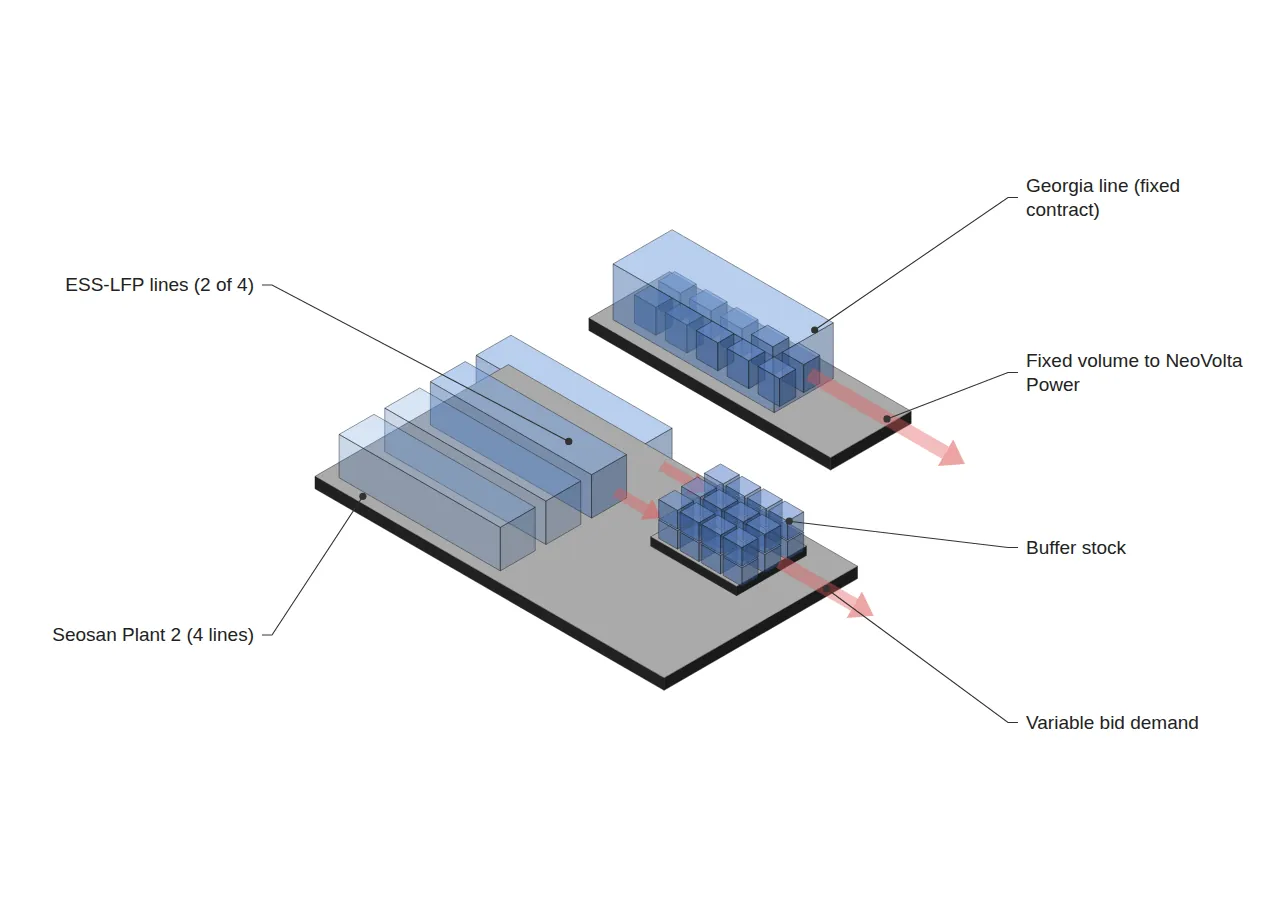
A line like the Georgia plant, with a confirmed 5-year fixed volume, has relatively little need to absorb demand variation. In this case, fixing the takt time and concentrating resources on maximizing Availability is rational from an OEE standpoint – minimizing planned downtime and changeover time to raise the operating rate delivers more cost-effectiveness than securing flexibility.
By contrast, a site like the Seosan line, where actual volume can change every quarter depending on domestic bid-award results, is safer designed with takt time slack and buffer stock together, rather than fixing takt time at its theoretical minimum. If the bid-award volume falls short of the target, the line becomes idle; if it exceeds the target, overtime or additional shifts are required to respond, and without slack to absorb this variation, the Availability component of OEE actually deteriorates.
Worth reviewing from this perspective are a patent on a flexible manufacturing system designed to respond to multi-variety, variable specifications (WO2024185998A1, “Flexible manufacturing device for battery pack and flexible manufacturing system for battery pack”) and a patent addressing dynamic capacity reallocation according to shipment plans (CN103353954A, “Dynamic capacity allocation system and method”). Neither patent has been confirmed to have a direct connection to SK On’s line conversion in this case; both are cited purely as general prior art supporting the concept of “fixed vs. responsive capacity design.” As a structural reference for the LFP pouch cell itself, KR20220090428A, which addresses a degassing channel structure, is also relevant.
4. Trend Snapshot
During the same period, adjacent ESS/edge-AI areas also saw developments worth noting for interface design.
- AIPro FireFocus+ – a multimodal fire-detection technology that integrates video and sensor data into a single dashboard to monitor fire anomaly signs across ESS, server rooms, and electrical rooms, unveiled at the 2026 Korea Safety Industry Expo (Sept. 2-4, BEXCO, Busan). By consolidating interfaces among BOS (Balance of System) components into a single control screen, it can be read as a response case to the “wiring, cooling, BMS, and other BOS interactions” emphasized in the 2026 edition of NFPA 855.
- Cognex Korea’s two new edge-AI vision products – high-speed manufacturing-floor inspection automation solutions unveiled at Industrial AX Korea 2026. The direction of completing judgment at the edge stands in contrast to the gateway-aggregation architecture discussed previously, and there is room for an in-depth comparison in a future installment.
5. Conclusion and Implications
SK On’s Georgia-Seosan dual-site structure gives a system-level implication that the takt time and line-balancing design philosophy must be split not by “overseas vs. domestic” but by “fixed contract vs. variable bidding.” Even for the same ESS-LFP pouch cell, when demand character differs, the method for raising OEE (availability-focused vs. buffer-focused) must also differ.
This operates at a different level from an earlier piece, Where Does OEE Break Down in an EV Line’s Conversion to ESS (2026-08-19, #184). That piece addressed where OEE loss occurs within a single plant’s internal EV-to-ESS conversion process, while this article addresses how the takt time design itself should diverge, by contract character, between two production bases already confirmed as dedicated to ESS – a different level of analysis and subject.
However, all takt time figures above are assumed scenarios and should be used only as directional reference until actual cell specifications and operating conditions are confirmed. The Seosan line is scheduled to begin mass production in early 2027, and given that industry-standard early ramp-up figures (initial yield in the 40% range, OEE below 70%) typically apply, it is also likely, and requires further verification, that actual cycle times during early ramp-up will run longer than the theoretical takt time.
FAQ
Q. Does the fact that the Seosan line’s required takt time is shorter than the Georgia line’s mean the Seosan line carries a heavier burden?
A. No. A shorter takt time only means a higher required throughput per hour – it does not indicate the line’s difficulty or total risk. In fact, the core point of this article is not the total burden but the difference in “volume certainty”: Georgia can optimize its design around a 5-year volume fixed by contract, whereas Seosan’s target capacity (3 GWh) is an investment target rather than a confirmed order, so a separate slack design is needed to respond to volume variation during actual operation.
Field Application Notes
| Check item | How to execute | Verification needed |
|---|---|---|
| Classify demand character by site | First determine whether the line in question is fixed-contract or variable-bid type, and check whether the same takt time design standard is being applied to both types | Verification needed against internal contract/order data |
| Size buffer-stock slack | For variable-bid lines, scenario-test whether the Availability component of OEE does not sharply decline even when awarded volume varies +/- some % from target | Verification needed against actual variation history data |
| Reset early-ramp-up OEE targets | For newly converted lines, pre-set a separate ramp-up KPI (e.g., an allowed band below 70%) on the premise that initial yield/operating rate will be lower than theoretical takt time | Verification needed against internal ramp-up plan documents |
| Review integrated BOS interface monitoring | Check whether fire-detection, cooling, BMS, and other BOS signals are split into a separate dashboard from the line control system (in response to the 2026 edition of NFPA 855) | Verification needed against current control architecture |


You May Also Like
Pylontech’s 588 Ah and 601 Ah LFP Cells Enter Mass Production — Why Energy-Weighted Availability Stays the Same When the Cell Count Halves
LFP High-Compaction-Density Conversion and the Calendering Interface: How Nip Pressure and Line Speed Affect Takt Time