Converting EV Lines to ESS: What the H1 Utilization Gap Reveals About Line-Conversion Speed
Abstract: In H1 2026, utilization rates at the three major domestic battery makers’ plants diverged based on how quickly each converted its lines to ESS use amid weak EV demand. LG Energy Solution and Samsung SDI sharply raised utilization through faster conversion and by securing new demand outlets (ESS, BBU), while SK On’s utilization actually declined due to delayed conversion. This is not a matter of individual equipment performance, but of the speed of line-level decision-making. This article compares the three companies’ utilization changes from a line-reconfiguration perspective.
1. What Happened
U.S. EV demand is weak. The three battery makers all faced the same market environment. So why did their utilization rates move so differently? The answer lies in how quickly each converted its lines to ESS use.
LG Energy Solution converted its EV battery lines in the U.S., Canada, and Poland to ESS use, raising its average utilization from 47.6% last year to 57.8% in H1 this year. Samsung SDI, boosted by demand for BBUs (battery backup units) for AI data centers and a recovery in the power-tool market, sharply improved its small-battery average utilization from 50% to 73%. SK On, by contrast, saw its H1 average utilization fall year-over-year to 36.4%, as entry into major non-EV demand outlets had not yet materialized in earnest.
2. The Systemic Meaning of Line Conversion
Utilization is adjacent to the Availability factor of OEE (= Availability × Performance × Quality), but it is not the same metric — even if a line is running, if it is not producing the target product (ESS use), the utilization figure alone makes it hard to judge actual revenue contribution. However, this case is not a matter of “turning the line on and off” but of “which product fills the line,” so conversion itself acted as a direct cause of the utilization recovery.
3. Three-Company Comparison
| Category | Utilization last year | Utilization H1 this year | Driver of change |
|---|---|---|---|
| LG Energy Solution | 47.6% | 57.8% | ESS conversion of U.S./Canada/Poland lines |
| Samsung SDI (small-format) | 50% | 73% | AI-data-center BBU demand and power-tool market recovery |
| SK On | Declined y/y | 36.4% | Delayed entry into new demand outlets |
What this table shows: a utilization gap of 20 percentage points or more is not a difference in equipment performance, but a difference in how quickly each company decided “what to make.”
4. Why Did Only SK On Decline?
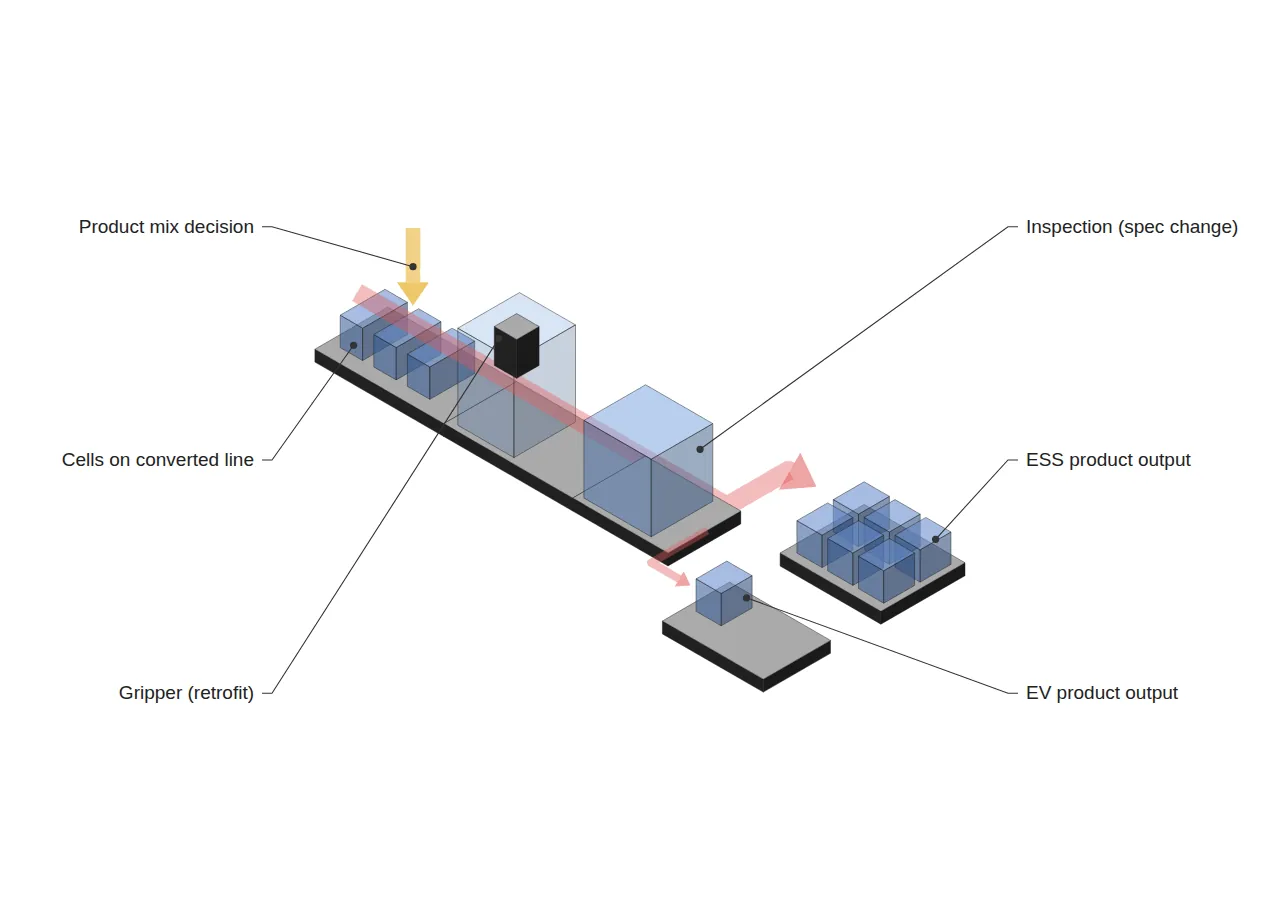
SK On plans to respond in H2 by converting lines at its Georgia plant in the U.S. and its Seosan No. 2 plant in Korea to ESS use. In other words, this is interpreted not as SK On abandoning conversion altogether, but as conversion coming late. That said, this interpretation has a limit — based on publicly available information alone, it is difficult to distinguish whether the delay in conversion is a decision-making issue or a matter of the time required for equipment retrofitting (such as gripper and inspection-specification changes).
5. Outlook for H2
The three battery makers expect utilization to improve in H2, supported by expanding EV supply in Europe and continued ESS growth. Whether SK On’s Georgia and Seosan No. 2 conversions actually complete on schedule is the next checkpoint for judging whether the gap will narrow.
FAQ
Q. Does low utilization always mean a loss?
A. Not necessarily. There can be planned low-utilization periods, such as during new-product line setup. However, this SK On case is reported to be different in nature — a result of “unsecured demand outlets” rather than a “planned adjustment.”
Q. Can an ESS conversion be reversed?
A. If the cell specification itself differs between EV and ESS use, reversing the conversion without a line retrofit is difficult. The extent of the conversion (the scope of gripper and inspection-specification changes) cannot be confirmed from publicly available information alone (undisclosed).
Field Application Notes
If a line conversion is under review, set the retrofit start date by working backward from the planned conversion-completion date — as the SK On case shows, the lag between “recognizing the need” and “completing the conversion” shows up directly as a utilization gap.
Related Reading
- Converting EV Lines to ESS: Where Does OEE Break Down?
- LG Energy Solution’s ESS Rear-Base Positioning — What Changes in Line Management
- The Equipment Maker’s Line-Ownership Shift — OEE and Takt-Time Design During the ESS-LFP New-Line Mass-Production Ramp-Up


You May Also Like
EU Battery Carbon Footprint Methodology Still Pending: How Line Energy Metering Resolution and Allocation Choice Shift Per-Cell Values
After Korea’s Battery History Management System: IDs Continue, Operating History Breaks — History Continuity of ESS Reuse Racks