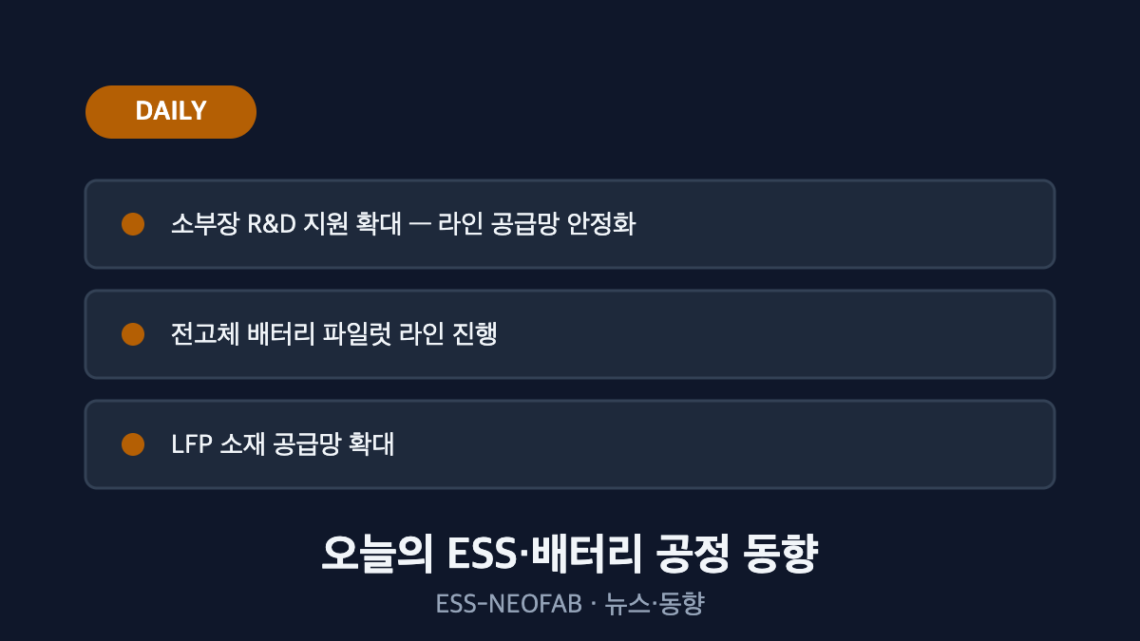
Today’s ESS/Battery Process Trends — Expanded Support for Materials/Parts/Equipment Lines, Solid-State/LFP Pilot Lines Launch (2026.08.07)
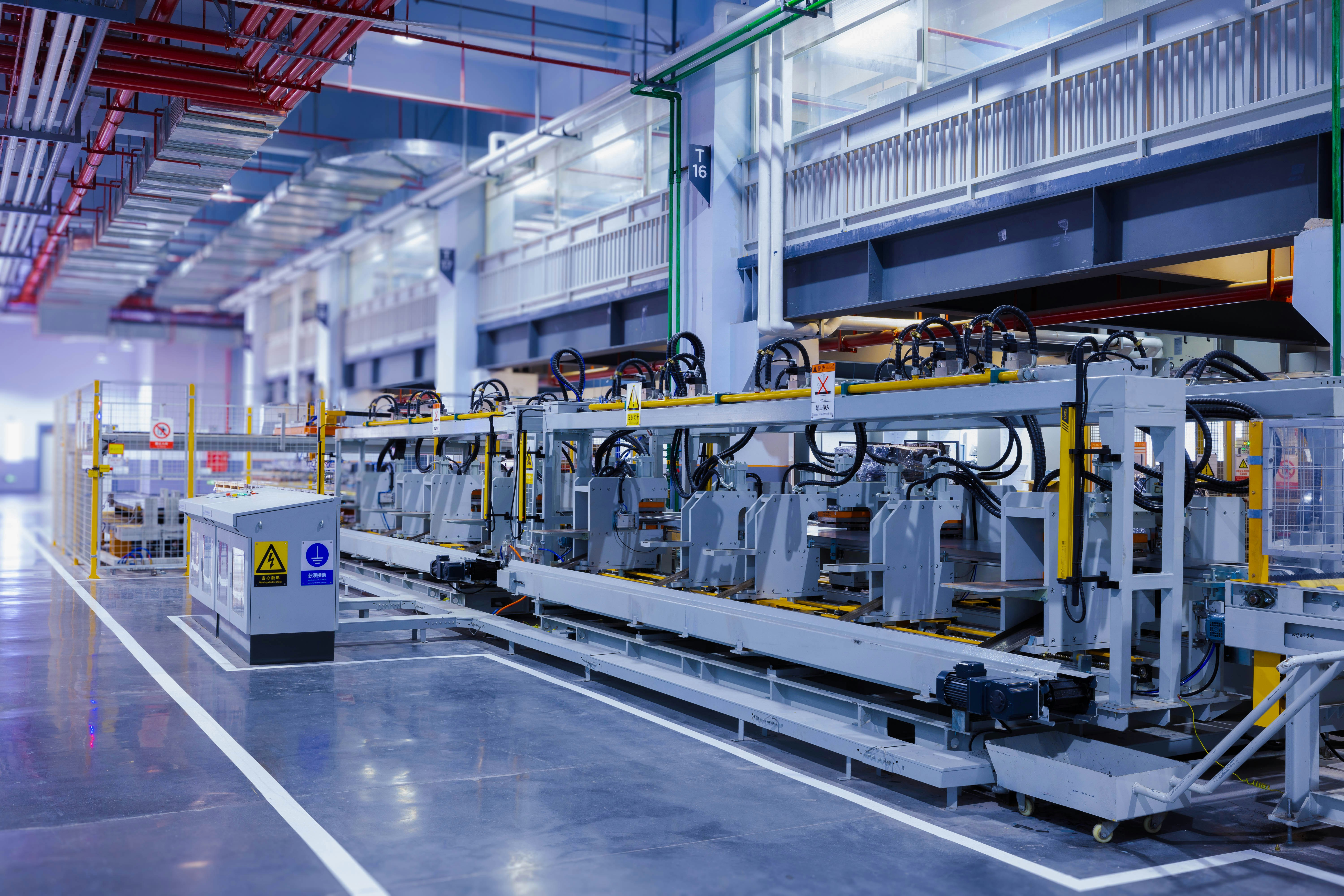
Photo by Homa Appliances on Unsplash
This is a line/systems-perspective summary of industry trends for August 7, 2026. Today three axes stand out: expanded R&D support for materials/parts/equipment companies, progress on solid-state battery pilot lines, and expansion of the LFP material supply chain.
1. Materials/Parts/Equipment R&D Support — Stabilizing the Line Supply Chain
The Ministry of Trade, Industry and Energy has newly approved five materials/parts/equipment cooperation models and selected five companies as “Super Eul” enterprises. A total of KRW 91 billion in R&D funding will be invested over five years; Ecopro BM will develop sulfide-based solid electrolyte for solid-state batteries, and Hanwha Ocean will develop core fuel-cell equipment for submarines. From the perspective of companies preparing to introduce new lines, this can be seen as a trend of improving stability in the domestic materials/parts supply chain.
2. Solid-State Battery Pilot Lines — Entering the Verification Stage
Samsung SDI is targeting mass production in the second half of 2027 based on a pilot line at its Suwon research institute, while SK On is building a continuous solid-state battery manufacturing pilot line at its Daejeon research institute, with plant verification and trial operation planned for the fourth quarter. Both companies are working with Solid Power to improve solid-electrolyte performance. Process data accumulated at the pilot-line stage is expected to become the baseline for future mass-production line design.
3. LFP Material Supply Chain Expansion — Line Conversion Cases
POSCO Future M has converted part of its high-nickel cathode-material line at its Pohang plant to LFP production, and L&F will begin full-scale LFP supply for the North American ESS market from the end of the third quarter. Lotte Energy Materials has also secured an annual LFP cathode-material production capacity of 1,000 tons and is undergoing qualification review with 10 global customers. Notably, the number of cases of flexible conversion from existing high-nickel lines is increasing.
4. ESS Infrastructure — Expanding Regional-Scale Deployment
The Yeonggwang BESS project (total project cost KRW 179.8 billion, maximum discharge capacity 80MW, storage capacity 480MWh) has been selected as the 10th Regional Revitalization Investment Fund project. As a large-scale system for storing and supplying surplus renewable-energy power, it offers a useful scale reference for ESS system design.
| Category | Key Content | Line/System Implication |
|---|---|---|
| Materials/Parts/Equipment Support | 5 companies, KRW 91 billion R&D | Stabilizing domestic materials/parts supply |
| Solid-State Battery | Pilot lines under verification (Samsung SDI, SK On) | Accumulating design data for mass-production lines |
| LFP Materials | Expanding high-nickel to LFP line conversion | Growing demand for flexible production-line design |
| ESS Infrastructure | Yeonggwang 480MWh BESS | Reference for large-scale ESS system design |
FAQ
Q. What does line conversion (high-nickel → LFP) mean from an equipment standpoint?
A. It is often not simply a matter of switching materials on the same line — process parameters such as calcination and mixing conditions frequently need to be re-validated, which is increasing demand for flexible production-line design.
Field Application Notes
Since news of solid-state battery pilot lines is still at a pre-mass-production-verification stage, it is safer to set a conservative timeline for reflecting this in line investment plans.
Sources: EBN Industry News, DHNews, TheGuru, ETNews, ChosunBiz, Dailian, Newspim (Aug 6–7, 2026)
Related Reading — From EV to ESS Use: What Ultium Cells and Cosmos Lab Show About Converting a Line’s Purpose · Samsung SDI Turns Its GM Joint-Venture Plant Into an ESS Hub · “Capturing the U.S. ESS Market” — K-Battery Supply Chain’s Wave of Localization: What’s Going Where

You May Also Like
Doubling the Renewable-Energy Budget and Underground-Parking EV Fire-Detection AI — Two Signals the 2027 Budget Sends to the ESS Line
Hanwha Energy Sells Two Large Italian BESS Projects to Sweden’s OX2 — Evidence of European Development Capability